
Michael R. Gordon
Author of Cobra II: The Inside Story of the Invasion and Occupation of Iraq
About the Author
Image credit: courtesy of the author
Works by Michael R. Gordon
Tagged
Common Knowledge
- Birthdate
- 1951
- Gender
- male
- Education
- Colgate University (B.A.)
Columbia University (M.A.|Philosophy)
Columbia University Graduate School of Journalism (M.S.) - Occupations
- journalist
- Organizations
- The New York Times
Institute for the Study of War (Senior Fellow) - Awards and honors
- George Polk Award
- Nationality
- USA
- Associated Place (for map)
- USA
Members
Reviews
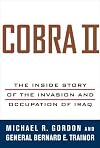
This is a detailed and thorough account of the military aspects of the 2003 Iraq invasion. It spans from just after September 2001, going through the steps of building the operational plans for the invasion, to the summer of 2003 not long after the end of "major military operations" after the collapse of the Iraqi regime.
Today, like most people, I consider the invasion a disastrous mistake since the official reasons why the U.S. invaded Iraq were ultimately found wrong: there were no weapons show more of mass destruction in Iraq, and the Saddam regime did not partake in the September 2001 terrorist attacks with al Qaeda.
But what this book does very well explain is how much the actual plan of invasion, which did enabled a lightning quick military victory over the Iraqi regime, turned out to be also the source of the failure of the occupation and pacifying of Iraq post-invasion.
There are 2 key elements explaining this failure: the new doctrine pushed by Secretary of Defense Donald Rumsfeld which held the view that the development of new battlefield technology rendered large armies obsolete and overly costly; and the almost obsessive fear of getting sucked into "nation building" after invasion. When looked independently of each other, making full use of technology and preventing the lengthy and uncertain undertaking of nation-building are reasonable propositions. But in the context of a Middle east invasion and in a country like Iraq, they are delusional.
This is because the doctrine of a small invasion force equipped with force-multiplying technology can make you win a war, but it will not make you win the peace. Technology is no replacement for a large security footprint to manage most societies where the government has collapsed after military defeat. This is especially true in Iraq, which is culturally, religiously and ethnically very diverse, and prone to internecine conflicts.
As a consequence, the US forces were not in a position to successfully stabilize Iraq post-conflict and help Iraqi society build a democratic, multi-ethnic and multi-religious state. It is no accident that things turn out that way, they are the direct consequence of misguided and delusional policy forcefully implemented, and compounded by serious judgment errors (the drastic deBaathization, which released on the streets frustrated and humiliated soldiers and officers, being the most egregious error). The Bush administration did not want to have a large force in Iraq, and it did not want to do "nation building" as it smacked of Bill Clinton's policy in the Balkans. The consequence of this was ultimately a nation wasted, plunged into civil conflict, and a breeding ground of future terrorist groups such as ISIS. show less
Today, like most people, I consider the invasion a disastrous mistake since the official reasons why the U.S. invaded Iraq were ultimately found wrong: there were no weapons show more of mass destruction in Iraq, and the Saddam regime did not partake in the September 2001 terrorist attacks with al Qaeda.
But what this book does very well explain is how much the actual plan of invasion, which did enabled a lightning quick military victory over the Iraqi regime, turned out to be also the source of the failure of the occupation and pacifying of Iraq post-invasion.
There are 2 key elements explaining this failure: the new doctrine pushed by Secretary of Defense Donald Rumsfeld which held the view that the development of new battlefield technology rendered large armies obsolete and overly costly; and the almost obsessive fear of getting sucked into "nation building" after invasion. When looked independently of each other, making full use of technology and preventing the lengthy and uncertain undertaking of nation-building are reasonable propositions. But in the context of a Middle east invasion and in a country like Iraq, they are delusional.
This is because the doctrine of a small invasion force equipped with force-multiplying technology can make you win a war, but it will not make you win the peace. Technology is no replacement for a large security footprint to manage most societies where the government has collapsed after military defeat. This is especially true in Iraq, which is culturally, religiously and ethnically very diverse, and prone to internecine conflicts.
As a consequence, the US forces were not in a position to successfully stabilize Iraq post-conflict and help Iraqi society build a democratic, multi-ethnic and multi-religious state. It is no accident that things turn out that way, they are the direct consequence of misguided and delusional policy forcefully implemented, and compounded by serious judgment errors (the drastic deBaathization, which released on the streets frustrated and humiliated soldiers and officers, being the most egregious error). The Bush administration did not want to have a large force in Iraq, and it did not want to do "nation building" as it smacked of Bill Clinton's policy in the Balkans. The consequence of this was ultimately a nation wasted, plunged into civil conflict, and a breeding ground of future terrorist groups such as ISIS. show less
We Weep; those of us who supported the decision to invade Iraq and those of us who did not.
The authors present the pageant of blunders that is the Iraq War. This is a disheartening account of the decisions and events that has led us to where we are today. Whether you supported the initial decision to invade or not, the questions before all of us today, are what do we do now, and what must be done to resolve the Iraq dilemma. To address these decisions we must have some understanding of what show more happened. Mr. Gordon and General Trainor have compiled a detailed and rigorous account of the miscalculations, misconceptions, misjudgments, misunderstandings and misstatements by both civilian and military leaders. Though the authors have gone to extraordinary lengths to be dispassionate and unbiased, they have named names and shown no favoritism in recounting disastrous decisions and their resultant consequences. Their account will fill you with sadness and rage. Perhaps that is where we need to begin to extricate ourselves from this nightmare. I highly recommend this book. show less
The authors present the pageant of blunders that is the Iraq War. This is a disheartening account of the decisions and events that has led us to where we are today. Whether you supported the initial decision to invade or not, the questions before all of us today, are what do we do now, and what must be done to resolve the Iraq dilemma. To address these decisions we must have some understanding of what show more happened. Mr. Gordon and General Trainor have compiled a detailed and rigorous account of the miscalculations, misconceptions, misjudgments, misunderstandings and misstatements by both civilian and military leaders. Though the authors have gone to extraordinary lengths to be dispassionate and unbiased, they have named names and shown no favoritism in recounting disastrous decisions and their resultant consequences. Their account will fill you with sadness and rage. Perhaps that is where we need to begin to extricate ourselves from this nightmare. I highly recommend this book. show less
As I did not want to spend much money on this book, I come late to the party with a withdrawn library copy. Even in 2010, this book remains surprisingly readable - under two conditions. First, the book assumes familiarity with the structure, arms and command of all US forces. It never explains the difference between a RCT (regimental combat team) and a BCT (brigade combat team). The lack of an Order of Battle is inexcusable and hampers the reading process (as do the sub-par maps). Secondly, show more the authors also assume familiarity with the political personnel on both sides.
The chronological account is well told, although it suffers from the inclusion of two much sideshows. The authors offer vignettes of all service branches (except the Navy) which distracts from the main events. The fighting is well described and vivid. I wish more Iraqi voices could have been inserted into this US centric account.
The false pretense and the press collaboration in the build-up to the war (of which at least one author was heavily involved in) do not feature in this campaign account. It only shows that the political opposition prevented a desired early attack, which given the general state of unpreparedness might have resulted in a fiasco from the start. In contrast to other, harsher accounts, Tommy Franks is presented as a simple (favorite film; The nutty professor) but devoted servant of his political masters. Strategic thoughts were not wanted, so he concentrated on the run to Baghdad which was immensely facilitated by the stupidity of Saddam Hussein, a dictator way past his prime. If Saddam had systematically destroyed the Euphrates bridges, US logistics might have been overwhelmed by the resource hunger of its own forces.
The stupidity was evenly matched by the Americans. The consistently incompetent CIA. the hunt for non-existent WMD coupled with the failure to protect these suspected sites and ammo dumps, choppers attacking directly into a prepared position, ... The command structure of the Americans was top-heavy. The tip of the spear consisted of but two infantry divisions which carried out most of the fighting, arriving thoroughly exhausted in Baghdad only to be pressured into guard duty. The systematic break-down of the public order by the "thunder runs" and the subsequent and deliberate failure to provide order remains a professional disgrace. The Iraq War created a new category of war crime: Not issuing orders and not stopping the buck.
The Americans were lucky that they were only facing the shell of a real army. Then again, the war was based on cracking a shell with its two division prong. Not much thought was given to Phase IV and any mention of it vigorously stamped out. The White House wanted a cheap, quick and easy war and any clashes with reality were avoided at all cost. The war (first acronym: OIL) turned out to be a complete success for the oil industry as well as the military-industrial complex. The suffering it caused for a country, the soldiers' families as well as the rest of the world are unfortunately not part of the equation. show less
The chronological account is well told, although it suffers from the inclusion of two much sideshows. The authors offer vignettes of all service branches (except the Navy) which distracts from the main events. The fighting is well described and vivid. I wish more Iraqi voices could have been inserted into this US centric account.
The false pretense and the press collaboration in the build-up to the war (of which at least one author was heavily involved in) do not feature in this campaign account. It only shows that the political opposition prevented a desired early attack, which given the general state of unpreparedness might have resulted in a fiasco from the start. In contrast to other, harsher accounts, Tommy Franks is presented as a simple (favorite film; The nutty professor) but devoted servant of his political masters. Strategic thoughts were not wanted, so he concentrated on the run to Baghdad which was immensely facilitated by the stupidity of Saddam Hussein, a dictator way past his prime. If Saddam had systematically destroyed the Euphrates bridges, US logistics might have been overwhelmed by the resource hunger of its own forces.
The stupidity was evenly matched by the Americans. The consistently incompetent CIA. the hunt for non-existent WMD coupled with the failure to protect these suspected sites and ammo dumps, choppers attacking directly into a prepared position, ... The command structure of the Americans was top-heavy. The tip of the spear consisted of but two infantry divisions which carried out most of the fighting, arriving thoroughly exhausted in Baghdad only to be pressured into guard duty. The systematic break-down of the public order by the "thunder runs" and the subsequent and deliberate failure to provide order remains a professional disgrace. The Iraq War created a new category of war crime: Not issuing orders and not stopping the buck.
The Americans were lucky that they were only facing the shell of a real army. Then again, the war was based on cracking a shell with its two division prong. Not much thought was given to Phase IV and any mention of it vigorously stamped out. The White House wanted a cheap, quick and easy war and any clashes with reality were avoided at all cost. The war (first acronym: OIL) turned out to be a complete success for the oil industry as well as the military-industrial complex. The suffering it caused for a country, the soldiers' families as well as the rest of the world are unfortunately not part of the equation. show less
The core of this book is the contest between Rumsfeld trying to organize this campaign as though it were a "just in time" industrial process, how the professional soldiers tried to follow sound military art in response, and what happened when the contending visions played out in practice. What is most breathtaking is the total blindness of the major players in regards to the fragile nature of Saddam's state and Iraqi society, even while dreaming of provoking a quick collapse. It might also show more be noted that George W. Bush and Dick Cheney are like black holes in this book, in that light goes in but does not reflect back, so don't expect to learn a great deal about the proverbial "echelons beyond reality." If I have any particular gripes about this book it's that the maps could have been better and that an order of battle would have been most helpful. show less
Lists
Awards


You May Also Like


Associated Authors
Statistics
- Works
- 6
- Members
- 1,305
- Popularity
- #19,662
- Rating
- 3.9
- Reviews
- 15
- ISBNs
- 27
- Languages
- 1