
Andrew Bacevich
Author of The Limits of Power: The End of American Exceptionalism (American Empire Project)
About the Author
Andrew Bacevich was born in Normal Illinois. He was a graduate of West Point in 1969 and served in the U.S. Army during the Vietnam War. He later held posts in Germany and the Persian Gulf up until his retirement from service in the early 1990's. He has a PhD in American Diplomatic History from show more Princeton University and has taught at West Point and Johns Hopkins University before joining the faculty at Boston University in 1998 and becoming Professor of International Relations. He has been a critic of the U.S. occupation of Iraq calling the conflict a catastrophic failure. He wrote several books including American Empire: The Realities and Consequences of U.S. Diplomacy and Washington Rules. (Bowker Author Biography) show less
Image credit: Kalman Zabarsky
Works by Andrew Bacevich
The Limits of Power: The End of American Exceptionalism (American Empire Project) (2008) 835 copies, 25 reviews
Washington Rules: America's Path to Permanent War (American Empire Project) (2010) 409 copies, 4 reviews
Breach of Trust: How Americans Failed Their Soldiers and Their Country (2013) 136 copies, 14 reviews
Paths of Dissent: Soldiers Speak Out Against America's Misguided Wars (2022) — Editor — 48 copies, 12 reviews
On Shedding an Obsolete Past: Bidding Farewell to the American Century (Dispatch Book Series) (2022) 29 copies
Diplomat in Khaki: Major General Frank Ross McCoy and American Foreign Policy, 1898-1949 (1989) 12 copies
American Military Policy in Small Wars: The Case of El Salvador : Special Report, 1988 (Special Report (Institute for Foreign Policy Analysis)) (1988) 6 copies
Supporting Peace: America's Role in an Israel-Syria Peace Agreement : Report of a Washington Institute Study Group (1994) 2 copies
World War IV 1 copy
Associated Works
War No More: Three Centuries of American Antiwar and Peace Writing (2016) — Contributor — 110 copies, 2 reviews
Empire As A Way of Life: An Essay on the Causes and Character of America's Present Predicament Along with a Few Thoughts about an Alternative (1980) — Introduction — 78 copies
Iraq and the Lessons of Vietnam: Or, How Not to Learn from the Past (2007) — Contributor — 61 copies
Tagged
Common Knowledge
- Canonical name
- Bacevich, Andrew
- Legal name
- Bacevich, Andrew John, Sr.
- Birthdate
- 1947-07-05
- Gender
- male
- Education
- United States Military Academy (1969)
Princeton University (PhD|American Diplomatic History) - Occupations
- soldier
professor - Organizations
- United States Army
Boston University (Professor International Relations) - Nationality
- USA
- Birthplace
- Normal, Illinois, USA
- Associated Place (for map)
- Illinois, USA
Members
Reviews
After the Apocalypse: America's Role in a World Transformed (American Empire Project) by Andrew Bacevich
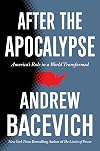
I can't remember the last time I read a work on contemporary policy that was really non-partisan, and it's almost jarring to encounter. Bacevich takes down the founding myths of consensus American self-conception and foreign-policy assumptions to focus on real outcomes, and along the way, he shows where US leaders of both major parties have followed the dogma to unwise decisions. This isn't conventional realism, but perhaps realityism, which is aware that our conventional thinking tends to show more ignore by default the main issues we must address.
The apocalypse of the title is 2020, which somewhere missed the memo that it was supposed to have only four horsemen. As a shock to the system, it creates an opportunity to reconsider our assumptions, especially that the US can continue with its 1947 superpower vision indefinitely. The book ends with an extended conclusion in the form of policy recommendations that will be a hard sell in Washington. Sadly, we're more likely to see these dismissed than debated, but it's a helpful exercise to show those of us not in office that there are alternatives.
In his introduction, Bacevich writes that the book is not so much for his contemporaries as for later generations, but there's no reason to let the current generation of leaders off the hook like that. This book is full of points worth pondering for those who rise to the pulpit and preach to the choir from the book of common mythology. It's time to reconsider our assumptions, and this quick read has some excellent suggestions about where to start. show less
The apocalypse of the title is 2020, which somewhere missed the memo that it was supposed to have only four horsemen. As a shock to the system, it creates an opportunity to reconsider our assumptions, especially that the US can continue with its 1947 superpower vision indefinitely. The book ends with an extended conclusion in the form of policy recommendations that will be a hard sell in Washington. Sadly, we're more likely to see these dismissed than debated, but it's a helpful exercise to show those of us not in office that there are alternatives.
In his introduction, Bacevich writes that the book is not so much for his contemporaries as for later generations, but there's no reason to let the current generation of leaders off the hook like that. This book is full of points worth pondering for those who rise to the pulpit and preach to the choir from the book of common mythology. It's time to reconsider our assumptions, and this quick read has some excellent suggestions about where to start. show less
 This review was written for LibraryThing Early Reviewers.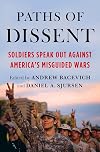
Paths of Dissent: Soldiers Speak out Against America’s Misguided Wars is a collection of 15 personal narratives edited by Andrew Bacevich. In these narratives the authors seek to encapsulate the events and struggles that led them to become military “dissenters.” Well written sometimes jarring, these memoirs in miniature are compelling stories, but together they form a comprehensive and cohesive case against the wars in Afghanistan and Iraq – indeed against all wars of choice.
The show more authors come from varied socio-economic backgrounds, educational levels, and military experiences. The readers engage with a self-described “grunt” like Buddhika Jayahama who noted that “There are moments in life when the smart thing to do and the right thing to do don’t necessarily align.” (14) He realized this as he felt compelled to do his part to participate in the wars and struggled with his personal responsibilities to his wife and child. But readers also meet Kevin Tillman, a veteran of the wars in Iraq and Afghanistan, who was the brother of the late Pat Tillman, the NFL player who joined after 9/11. Kevin’s experiences lead him to note, with exquisite accuracy, that “This nation has been living off the virtue of the greatest generation most of a century in order to systematically pillage the planet. It’s an insult to everything that generation fought for in the first place.” (230)
Bacevich, whose own son was killed by an IED in Iraq, explained that “Genuine military dissent is patriotic. It expresses a determination to right wrongs, especially policies that victimize US troops without yielding any discernible benefit to the nation. Military dissenters are not self-seeking. Their commitment is to a cause larger than themselves.” (7). Their willingness to cut against the grain of American society and call the military and the American government to account for its failures and wrongdoing infuse their narratives with a certain weightiness and seriousness that we would do well to heed.
Paths of Dissent is a powerful read. However, it does lack a diversity of voices. Only one woman contributed to this book, Joy Damiani. Her story is important, but it is disappointing that more female voices and experiences were not used. Bacevich also included a narrative by Jonathan Hutto, Sr. titled, “A Sailor’s Story.” Hutto explains, in detail, the racism and prejudice he experienced at the hands of his commanding officer and fellow sailors – and the apparent lack of concern of his immediate chain of command. However, while his story is about dissent, it is not about dissent against the wars in Iraq and Afghanistan, per se, and it seems as if the inclusion of Hutto’s story is a clumsy way to make the book more racially diverse. I do not want to imply that Hutto’s experiences are unimportant or that the need to examine the Navy’s response to the abject racism in its ranks should not be discussed. But in the context of Bacevich’s stated purpose, it seems disjointed and out of place. Hutto’s narrative deserves to be read and seen – and perhaps more books dealing with the current culture of racism and white supremacy in the armed forces should address those very issues.
Ultimately Bacevich’s book is an important addition to the growing literature on military dissent and opposition to American wars of choice by serving military personnel. It is an easy, but important read. And all of these men and women deserve to be heard. show less
The show more authors come from varied socio-economic backgrounds, educational levels, and military experiences. The readers engage with a self-described “grunt” like Buddhika Jayahama who noted that “There are moments in life when the smart thing to do and the right thing to do don’t necessarily align.” (14) He realized this as he felt compelled to do his part to participate in the wars and struggled with his personal responsibilities to his wife and child. But readers also meet Kevin Tillman, a veteran of the wars in Iraq and Afghanistan, who was the brother of the late Pat Tillman, the NFL player who joined after 9/11. Kevin’s experiences lead him to note, with exquisite accuracy, that “This nation has been living off the virtue of the greatest generation most of a century in order to systematically pillage the planet. It’s an insult to everything that generation fought for in the first place.” (230)
Bacevich, whose own son was killed by an IED in Iraq, explained that “Genuine military dissent is patriotic. It expresses a determination to right wrongs, especially policies that victimize US troops without yielding any discernible benefit to the nation. Military dissenters are not self-seeking. Their commitment is to a cause larger than themselves.” (7). Their willingness to cut against the grain of American society and call the military and the American government to account for its failures and wrongdoing infuse their narratives with a certain weightiness and seriousness that we would do well to heed.
Paths of Dissent is a powerful read. However, it does lack a diversity of voices. Only one woman contributed to this book, Joy Damiani. Her story is important, but it is disappointing that more female voices and experiences were not used. Bacevich also included a narrative by Jonathan Hutto, Sr. titled, “A Sailor’s Story.” Hutto explains, in detail, the racism and prejudice he experienced at the hands of his commanding officer and fellow sailors – and the apparent lack of concern of his immediate chain of command. However, while his story is about dissent, it is not about dissent against the wars in Iraq and Afghanistan, per se, and it seems as if the inclusion of Hutto’s story is a clumsy way to make the book more racially diverse. I do not want to imply that Hutto’s experiences are unimportant or that the need to examine the Navy’s response to the abject racism in its ranks should not be discussed. But in the context of Bacevich’s stated purpose, it seems disjointed and out of place. Hutto’s narrative deserves to be read and seen – and perhaps more books dealing with the current culture of racism and white supremacy in the armed forces should address those very issues.
Ultimately Bacevich’s book is an important addition to the growing literature on military dissent and opposition to American wars of choice by serving military personnel. It is an easy, but important read. And all of these men and women deserve to be heard. show less
This review was written for LibraryThing Early Reviewers.The title PATHS OF DISSENT bought to mind a classic anti-war film (and the book, by Humphrey Cobb), PATHS OF GLORY, and, as was the case with that film, there's precious little glory to be found in this collection of a dozen-plus essays by various disillusioned veterans of the Afghanistan and Iraq wars of the past couple of decades. I had read Anthony Bacevich's BREACH OF TRUST and Daniel Sjursen's GHOST RIDERS OF BAGHDAD a few years back, so I was familiar with the work and backgrounds of show more the co-editors. But I only recognized the name of one contributor, Roy Scranton, who was co-editor of another fine collection of military essays, FIRE AND FORGET, and, later, WAR PORN, a novel. The other names were all new to me. But every piece here is good in its own way.
The first essay, Erik Edstrom's "As American as It Gets," details his indoctrination as a West Point cadet though his deployment as a young platoon leader to Afghanistan, where he came to feel "the moral injury of realizing that the War on Terror - the thing I had spent years of my life preparing for - was illegal, immoral, self-perpetuating, and counterproductive."
Then there is Jason Dempsey's "The Accountability Avoidance Two-Step" -
"... that both generals and politicians find advantageous. Political leaders can appear strong by putting the military in charge of even the most inappropriate missions, like nation-building ... And ambitious military leaders can then play the role of soldier-statesmen, basking in public adoration, but with no responsibility for the outcome of their efforts. After all, if a plan does not work out, they were 'just following orders,' and the ultimate fault must lie with elected politicians. Ultimately, no one ends up being held accountable."
In Kevin Tillman's tale of how he left his minor league baseball career to enter the military after 9/11, along with his NFL star brother, Pat, who ended up being killed by friendly fire in Afghanistan, and how the Bush administration lied about it -
"... with a manufactured story about him dying by enemy fire. For maximum effect, they awarded him a Silver Star, one of the highest military honors."
Or Gian Gentile's "What I Learned in Baghdad," about the civil war set off in occupied Iraq, with his horrific memories of a "woman weeping ... holding her dead baby in her arms while her husband lay dead on the street nearby. Her baby had been shot in the head by the same Sunni fighters who killed her husband ..."
Or Gil Barndollar, on the long-lasting effects of war and his acknowledgement, in "My Good War," that "Most veterans I know well have lost more friends and comrades to suicide than they did to the enemy."
Books like PATHS OF DISSENT should be required reading for all members of Congress, which will never happen, of course. These essays leave me feeling angy, frustrated, horrified and, mostly, sad. War sucks, but it appears it will always be a part of the human experience. Those who are ignorant of history are indeed, it seems, doomed to repeat it. A pity so many ignoramuses keep getting elected to the halls of power.
How do I end this? A very good collection of thought-provoking essays about the folly and tragedy of our recent "forever wars." Very highly recommended.
- Tim Bazzett, author of the memoir, BOOKLOVER show less
The first essay, Erik Edstrom's "As American as It Gets," details his indoctrination as a West Point cadet though his deployment as a young platoon leader to Afghanistan, where he came to feel "the moral injury of realizing that the War on Terror - the thing I had spent years of my life preparing for - was illegal, immoral, self-perpetuating, and counterproductive."
Then there is Jason Dempsey's "The Accountability Avoidance Two-Step" -
"... that both generals and politicians find advantageous. Political leaders can appear strong by putting the military in charge of even the most inappropriate missions, like nation-building ... And ambitious military leaders can then play the role of soldier-statesmen, basking in public adoration, but with no responsibility for the outcome of their efforts. After all, if a plan does not work out, they were 'just following orders,' and the ultimate fault must lie with elected politicians. Ultimately, no one ends up being held accountable."
In Kevin Tillman's tale of how he left his minor league baseball career to enter the military after 9/11, along with his NFL star brother, Pat, who ended up being killed by friendly fire in Afghanistan, and how the Bush administration lied about it -
"... with a manufactured story about him dying by enemy fire. For maximum effect, they awarded him a Silver Star, one of the highest military honors."
Or Gian Gentile's "What I Learned in Baghdad," about the civil war set off in occupied Iraq, with his horrific memories of a "woman weeping ... holding her dead baby in her arms while her husband lay dead on the street nearby. Her baby had been shot in the head by the same Sunni fighters who killed her husband ..."
Or Gil Barndollar, on the long-lasting effects of war and his acknowledgement, in "My Good War," that "Most veterans I know well have lost more friends and comrades to suicide than they did to the enemy."
Books like PATHS OF DISSENT should be required reading for all members of Congress, which will never happen, of course. These essays leave me feeling angy, frustrated, horrified and, mostly, sad. War sucks, but it appears it will always be a part of the human experience. Those who are ignorant of history are indeed, it seems, doomed to repeat it. A pity so many ignoramuses keep getting elected to the halls of power.
How do I end this? A very good collection of thought-provoking essays about the folly and tragedy of our recent "forever wars." Very highly recommended.
- Tim Bazzett, author of the memoir, BOOKLOVER show less
This review was written for LibraryThing Early Reviewers.Bacevich marks 2020 as the year of the American apocalypse. The year 2020 saw the convergence of political, economic, social, and environmental disruptions brought about by the Trump presidency, the pandemic, racial tensions, and environmental catastrophes. The book’s focus is on American foreign policy since World War I, a policy dominated by the myth of American Exceptionalism. Bacevich highlights the costs to the nation and its citizens of this false premise. There is enough in show more Bacevich’s analysis and recommendations to anger individuals wherever they fall on the political spectrum. Bacevich demands that Americans face the facts of our history and current circumstances and reimagine our role in the world. He argues that the first role of government is to ensure the safety and wellbeing of its citizens. American foreign policy has put American world hegemony ahead of the true security of Americans. What threatens American security today are racial divisions, environmental degradation, and economic instability. The bulk of the book points out the errors of American foreign policy. Bacevich ends with his recommendations for American priorities. This is a book to be read by all who are concerned about America’s future at home and on the world stage. The arguments Bacevich puts forth may evoke discomfort but are worthy of careful consideration. show less
This review was written for LibraryThing Early Reviewers.Lists
Awards


You May Also Like


Associated Authors
Statistics
- Works
- 32
- Also by
- 5
- Members
- 3,000
- Popularity
- #8,503
- Rating
- 4.0
- Reviews
- 99
- ISBNs
- 81
- Languages
- 2
- Favorited
- 4
