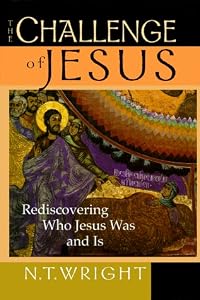
The Challenge of Jesus: Rediscovering Who Jesus Was and Is
by N. T. Wright
On This Page
Description
Today a renewed and vigorous scholarly quest for the historical Jesus is underway. In the midst of well publicized and controversial books on Jesus, N. T. Wright's lectures and writings have been widely recognized for providing a fresh, provocative and historically credible portrait. The Challenge of Jesus poses a double-edged challenge: to grow in our understanding of the historical Jesus within the Palestinian world of the first century, and to follow Jesus more faithfully into the show more postmodern world of the twenty-first century. show lessTags
Recommendations



Member Reviews
I didn't think Wright offered anything new and fresh in this book. Learning more about the historicity of Jesus and understanding Him within the context of 1st century Judaism is certainly not a new concept. Hermeneutics has applied this method to all aspects of Scripture for many years. Wright claims we now have more resources at our disposal than ever before to help us better understand who Jesus is. But, with the discovery of the Dead Sea Scrolls (which Wright often alludes to) we have had these "new resources" for over 50 years. The Dead Sea Scrolls have only verified and confirmed what we already know about a messiah, Judaism, and Jewish culture.
Wright suggests that Jesus' proclamation about the kingdom of God was not about a show more future heavenly abode where believers will eternally dwell, but a charge for 1st century Jews to enter into a new covenant and fulfill the Abrahamic promise that Israel will become a great nation. This is certainly one aspect of the kingdom of God, but there are several more components as well. Confining Jesus only to the context of 1st century Judaism is I believe a grave mistake. Jesus' messages transcends all ages and time and should never be limited to the hearers of 1st century Palestine. Proper hermeneutics certainly allows for this to some extent, but should not be solely limited to it. If the message is applicable to our time and culture, then we must certainly apply it to our lives today. And, the kingdom of God is a kingdom that exists on earth today with the presence of the church and the Holy Spirit, and will someday be fully consummated upon Christ's return when He establishes His kingdom on earth.
I heard great things about N.T. Wright and I've always enjoyed many of his articles and podcasts online. I agree in most part with his theology. But overall, I wasn't that impressed with what was my first N.T. Wright book. I didn't find anything new and fresh, but found it to be full of presuppositions and speculations. Nothing scholarly nor life-changing. Wright certainly had some interesting perspectives and good insight, but nothing profound. However, I haven't given up on Wright and look forward to reading some of his other works. show less
Wright suggests that Jesus' proclamation about the kingdom of God was not about a show more future heavenly abode where believers will eternally dwell, but a charge for 1st century Jews to enter into a new covenant and fulfill the Abrahamic promise that Israel will become a great nation. This is certainly one aspect of the kingdom of God, but there are several more components as well. Confining Jesus only to the context of 1st century Judaism is I believe a grave mistake. Jesus' messages transcends all ages and time and should never be limited to the hearers of 1st century Palestine. Proper hermeneutics certainly allows for this to some extent, but should not be solely limited to it. If the message is applicable to our time and culture, then we must certainly apply it to our lives today. And, the kingdom of God is a kingdom that exists on earth today with the presence of the church and the Holy Spirit, and will someday be fully consummated upon Christ's return when He establishes His kingdom on earth.
I heard great things about N.T. Wright and I've always enjoyed many of his articles and podcasts online. I agree in most part with his theology. But overall, I wasn't that impressed with what was my first N.T. Wright book. I didn't find anything new and fresh, but found it to be full of presuppositions and speculations. Nothing scholarly nor life-changing. Wright certainly had some interesting perspectives and good insight, but nothing profound. However, I haven't given up on Wright and look forward to reading some of his other works. show less
Listen to some and Wright is a demon. Listen to others and he's the savior of Christianity, at least academically. I find him somewhere in between. I've read the first three chapters and I certainly don't agree with everything, but his historical research really brings Jesus teaching about the Kingdom of God to life. Unfortunately, his new spin on what it means to be justified comes throught, and I can't endorse that at all. He recast justification to mean inclusion in the covenant community rather than a legal declaration of righteousness before God. This seems to undermine the historic Reformational teaching on justification. That being said, I'm really enjoying the other 85% of this book...
An insightful look into the quest for the historical Jesus, modernity, and postmodernism. This work is more of a summary and synthesis of many of his previous works; for those seeking thorough discussions of his main points, he has included references to those works. I found this particularly enlightening for finding my way in a post-COVID world with an evangelical church that has largely strayed into less-than-spiritual desires.
Highly recommended for those going through deconstruction/reformation of their Christian faith, those interested in a harmonized view of Jesus through academic study and theology, or those seeking to place Jesus into his first-century Jewish context.
Highly recommended for those going through deconstruction/reformation of their Christian faith, those interested in a harmonized view of Jesus through academic study and theology, or those seeking to place Jesus into his first-century Jewish context.
Blew my mind AND frustrated me. The which took hold of me and wont leave me go is the idea of the Kingdom of God as an alternative to other "kingdoms" in the world and the fact that Jesus' preaching is often polemic against these kingdoms in favour of the KOG. The last two chapters should be essential reading for all christians interested in following God in the postmodern world. Wright understand the message of the KOG as the metanarrative to bring hope to a world burnt out from all metanarratives.
That said wrights claim that we have failed (or at least done poorly) to read Jesus in a proper historical setting is on the surface a good idea but it seems to me that frequently his exegesis of passages to support this idea is stretching show more the passages in question to places they were never meant to go.
Wrights theme is that Jesus enacts the end of the exile for the Jews. He takes the punishment they deserve for their failure to be the covenant community and lives as they should have. Wright claims that this understanding of the gospels free us from imposing an "ethical" understanding of his teaching. THere is much here i can vibe with but sometimes i have as much time for him as i do a fresh batch of haemorrhoids. show less
That said wrights claim that we have failed (or at least done poorly) to read Jesus in a proper historical setting is on the surface a good idea but it seems to me that frequently his exegesis of passages to support this idea is stretching show more the passages in question to places they were never meant to go.
Wrights theme is that Jesus enacts the end of the exile for the Jews. He takes the punishment they deserve for their failure to be the covenant community and lives as they should have. Wright claims that this understanding of the gospels free us from imposing an "ethical" understanding of his teaching. THere is much here i can vibe with but sometimes i have as much time for him as i do a fresh batch of haemorrhoids. show less
While readers who are new to "Historical Jesus" studies might find the first chapter (which summarizes the so-called First, Second and Third Quests) to be a bit off-putting, this is an excellent work that engages honestly with historical criticism of the Gospel traditions and both encourages and challenges "traditional" Christian conceptions.
A shorter discussion of Wright regarding his understanding of Jesus in His first century context and how believers today can reflect that image in a postmodern world.
While much of the discussion about the historical quest and the analysis of Jesus' life is covered in the Christian Origins and the Question of God series (with many quotations, especially from Jesus and the Victory of God), here Wright goes beyond just discussing how it is that Jesus can be properly understood in His first century context and goes on to provide those who believe in Him today a way to begin to communicate the message of Jesus to our own age.
Chapter 7 at least, if not also chapter 8, should be required reading for all believers. Wright does quite well there show more at showing the challenges of the Enlightenment and postmodernity and viable means by which the ethic of the Kingdom can be communicated in such an environment.
Many great thoughts here; very much worth consideration. show less
While much of the discussion about the historical quest and the analysis of Jesus' life is covered in the Christian Origins and the Question of God series (with many quotations, especially from Jesus and the Victory of God), here Wright goes beyond just discussing how it is that Jesus can be properly understood in His first century context and goes on to provide those who believe in Him today a way to begin to communicate the message of Jesus to our own age.
Chapter 7 at least, if not also chapter 8, should be required reading for all believers. Wright does quite well there show more at showing the challenges of the Enlightenment and postmodernity and viable means by which the ethic of the Kingdom can be communicated in such an environment.
Many great thoughts here; very much worth consideration. show less
Great read. Really helps demonstrate how Jesus fulfilled prophecy. Also good at putting events like the cleansing of the temple and the Last Supper in historical and scriptural context.
Members
- Recently Added By
Talk Discussions
Past Discussions
What book would you give to an atheist? in Christianity (December 2022)
Author Information

295+ Works 56,046 Members
N. T. Wright serves as Senior Research Fellow at Wycliffe Hall, Oxford University, as well professor emeritus of New Testament and Early Christianity at the School of Divinity at the University of St. Andrews. He is the award-winning author of many books, including Broken Signposts, Paul: A Biography, Surprised by Hope, and many more.
Some Editions
Common Knowledge
- Original publication date
- 1999
- People/Characters
- Jesus Christ
Classifications
Statistics
- Members
- 1,654
- Popularity
- 13,480
- Reviews
- 10
- Rating
- (4.22)
- Languages
- English, Portuguese, Spanish, Swedish
- Media
- Paper, Audiobook, Ebook
- ISBNs
- 14
- ASINs
- 6