
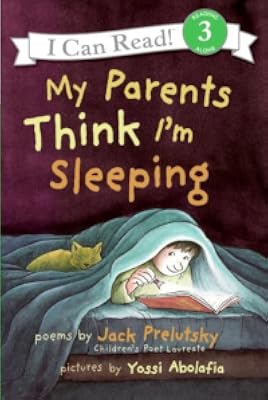
My Parents Think I'm Sleeping
by Jack Prelutsky
On This Page
Description
A collection of humorous poems about bedtime.Tags
Recommendations

Member Reviews
As I read this book I noticed how all the poems were connected with the story. The book is about a boy who lets his mind run wild and thinks of monsters, the cloud, cake, colors, streams, and many more. The illustrations bring the text to live and as I read it the images were in my head. I enjoyed the chocolate cake poem the most! I recommend this as a read aloud for third, fourth, and fifth graders. Most can relate to staying awake after being told to go to bed.
This book is good for elementary aged kids. It shows kids to be creative and adventure out of their comfort zone. The character in the book finds that he is having trouble sleeping. Instead of just laying in bed dwelling over the fact that he can't sleep, he decides to be creative and find things to do while he can't sleep. He reads a book with a flashlight under the covers, finds himself a piece of cake from the kitchen, and listens to the rain fall outside his window. Although the little boy can't sleep unfortunately, he finds many ways to entertain himself and use his time wisely.
Being a night owl who always laid in bed wide awake after bedtime, I can relate to the poems in this book. They are cute and creative, and it is nice to see some poetry that relates to real life situations. I think most children can relate to being scared at night at one point or another by shadows on the walls and the possibility of seeing a monster. Luckily, they can also relate to wanting a midnight snack and having a quiet time to let their imagination wander. The color tones in the pictures reminded me of Where the Wild Things Are. Coincidentally, that book is also about a boy who's vivid imagination gets away from him at night...interesting! Overall, a cute book and a good introduction to poetry for young readers.
This book of poems by Jack Prelutsky is all about that magical time of night when we go to sleep. The fourteen poems about falling asleep, dreaming, the quiet of night, and monsters under the bed are great for children who are just beginning to read longer, more challenging books on their own.
Prelutsky's poetry is exactly what can be expected of a Children's Poet Laureate. It is rhythmic and rambunctious, silly and sophisticated. The words "ogres," "orchestra," and "poltergeist" are pretty representative of Prelutsky's range of vocabulary.
Coupled with Prelutsky's poetry, Yossi Abolafia's illustrations help the reader think about the poems in more complex ways. So, in "Chocolate Cake," a poem about going downstairs to eat dessert while show more the family is sleeping, we get an illustration that shows a child tiptoeing into the kitchen where his father is already finishing the last slice of cake. In "I'm Awake! I'm Awake!" Prelutsky writes about a boy who is fidgeting to get to sleep and just can't until the very end where he says "I cannot fall asleep" while Abolafia draws a boy who is obviously slumbering. Illustrations such as these add depth to this book of poems that an unillustrated book of poems would not have otherwise.
In any case, this is a great book for children to read on their own, preferably at night! show less
Prelutsky's poetry is exactly what can be expected of a Children's Poet Laureate. It is rhythmic and rambunctious, silly and sophisticated. The words "ogres," "orchestra," and "poltergeist" are pretty representative of Prelutsky's range of vocabulary.
Coupled with Prelutsky's poetry, Yossi Abolafia's illustrations help the reader think about the poems in more complex ways. So, in "Chocolate Cake," a poem about going downstairs to eat dessert while show more the family is sleeping, we get an illustration that shows a child tiptoeing into the kitchen where his father is already finishing the last slice of cake. In "I'm Awake! I'm Awake!" Prelutsky writes about a boy who is fidgeting to get to sleep and just can't until the very end where he says "I cannot fall asleep" while Abolafia draws a boy who is obviously slumbering. Illustrations such as these add depth to this book of poems that an unillustrated book of poems would not have otherwise.
In any case, this is a great book for children to read on their own, preferably at night! show less
I liked this book for many reasons. The language used in this book was patterned and engaging. Figurative language was used multiple times throughout the book. An example of this figurative language occurred on page 23, "Who paints away the garden when the sky's a sea of ink?". This enhances the book because it helps the reader create mental pictures. The illustrations in this book are very well done. They fit with the written text and portray what the character is doing. They enhance the story because they bring a visual element that adds more dimension to the short text. For children's books, this is useful for children who have trouble reading because they can use picture cues if they need extra assistance reading any words. The big show more idea I took away from this story is how children can use their imagination to the fullest extent to have fun, even if they are by themselves at bed time. show less
These poems are all themed around bedtime and the questions children think up right before bedtime. Adults may not realize how very real some of these poems and their ideas are to children. Most are silly, and there are illustrations that go along with each poem that give the reader a more vivid picture of the things that are happening. There are 14 short poems in all and I really enjoyed “What Happened to the Colors” and “Chocolate Cake”. All of these poems are from a child's point of view, which makes them silly, and humorous, young children will enjoy reading these.
I really love poetry and I saw these at my son's book fair and picked them up. There are a few poems in this collection that could be a little scary for young show more readers especially at nighttime with the talk about monsters and things in the dark. Overall there were several I enjoyed reading and I like that there were pictures to finish painting the picture for you especially in “Chocolate Cake”. Reading the poem, you would have never guessed that when the little boy gets up to eat the piece of cake that he will find his dad already eating the last piece!
You could incorporate these poems in the classroom anytime of the day to give your students a taste of silly poetry. You could also incorporate “What Happens to the Colors” into a science lesson when you are discussing the way the Earth has a day and nighttime and the changes that they see in our environment during both. I would even like to read some of these poems aloud to the students and purposely not show them the illustrations and have them draw a picture of what they “see.” show less
I really love poetry and I saw these at my son's book fair and picked them up. There are a few poems in this collection that could be a little scary for young show more readers especially at nighttime with the talk about monsters and things in the dark. Overall there were several I enjoyed reading and I like that there were pictures to finish painting the picture for you especially in “Chocolate Cake”. Reading the poem, you would have never guessed that when the little boy gets up to eat the piece of cake that he will find his dad already eating the last piece!
You could incorporate these poems in the classroom anytime of the day to give your students a taste of silly poetry. You could also incorporate “What Happens to the Colors” into a science lesson when you are discussing the way the Earth has a day and nighttime and the changes that they see in our environment during both. I would even like to read some of these poems aloud to the students and purposely not show them the illustrations and have them draw a picture of what they “see.” show less
Summary
This is a poetry book that almost takes a reader on a journey of a young boy in his room after bedtime. There are several different poems throughout the book and each one tells of different things the boy is doing in his room while he should be asleep. It tells about the noises the boy hears and the shadows he sees. It turns those shadows and noises into almost scary images for the reader to see. The author writes about how the boy can’t sleep and the chocolate cake he knows is waiting in the kitchen. The poems end when the boy finally falls asleep.
Personal Reaction
I liked how each poem in this book was a continuation of the story being told from the boy’s perspective. I did thing the book has a sort of Halloween feel to it show more because of the poems that talked about the shadows turning into monsters. This would be a great book for students in third through sixth grade and is also very relatable to children who often don’t go to sleep after their parents have put them to bed.
Classroom Extensions
1. This could be read to students around Halloween for a fun lesson and then students could draw a picture representing their favorite poem in the book.
2. Students could write their own poem about what they might do after their parent’s thing they are sleeping. show less
This is a poetry book that almost takes a reader on a journey of a young boy in his room after bedtime. There are several different poems throughout the book and each one tells of different things the boy is doing in his room while he should be asleep. It tells about the noises the boy hears and the shadows he sees. It turns those shadows and noises into almost scary images for the reader to see. The author writes about how the boy can’t sleep and the chocolate cake he knows is waiting in the kitchen. The poems end when the boy finally falls asleep.
Personal Reaction
I liked how each poem in this book was a continuation of the story being told from the boy’s perspective. I did thing the book has a sort of Halloween feel to it show more because of the poems that talked about the shadows turning into monsters. This would be a great book for students in third through sixth grade and is also very relatable to children who often don’t go to sleep after their parents have put them to bed.
Classroom Extensions
1. This could be read to students around Halloween for a fun lesson and then students could draw a picture representing their favorite poem in the book.
2. Students could write their own poem about what they might do after their parent’s thing they are sleeping. show less
Members
- Recently Added By
Author Information

117+ Works 33,602 Members
Jack Prelutsky, born on September 8, 1940 in Brooklyn, New York, is primarily known as a poet for children but he is also a gifted musician, actor, photographer, sculptor and potter. Prelutsky studied at Hunter College for two years. He proposed to his future wife, Carolynn, on the day they met; she accepted the next day. While growing up in show more Brooklyn, Prelutsky studied voice at The High School of Music and Art in New York and first planned to be an opera singer. However, he decided he did not have the drive to sing opera, and he became a folk singer. Later he tried his hand at drawing. For fun, he wrote some short poems and made some drawings, which became his first publication. He has since published numerous books of illustrated poetry and also provided illustrations for books by other writers, including many in translation. Prelutsky never condescends to his young readers. He deals in verse with many imaginative creatures, but he also writes about people and problems such bullies, school, and fear of the dark. He is aware of the sound of his words and likes to perform his poetry to the accompaniment of the guitar. He visits schools and libraries to perform his work. Jack Prelutsky is the recipient of numerous awards. In 1977 The Children's Book Council honored him for Nightmares: Poems to Trouble Your Sleep. His other award-winners are The Mean Old Mean Hyena, The Headless Horseman Rides Tonight, and The New Kid on the Block. In 2006, the Poetry Foundation named Prelutsky the inaugural winner of the Children's Poet Laureate award. His book Behold the Bold Umbrellaphant and Other Poems (illustrated by Carin Berger) won the 2007 Scandiuzzi Children's Book Award of the Washington State Book Awards in the Picture Book category. (Bowker Author Biography) show less
All Editions
Awards and Honors
Awards
Series
Belongs to Publisher Series
I Can Read! (Level 3)
Common Knowledge
- Canonical title
- My Parents Think I'm Sleeping
- Original publication date
- 1985
Classifications
Statistics
- Members
- 1,113
- Popularity
- 22,727
- Reviews
- 21
- Rating
- (3.70)
- Languages
- Czech, English
- Media
- Paper
- ISBNs
- 15
- UPCs
- 1
- ASINs
- 5