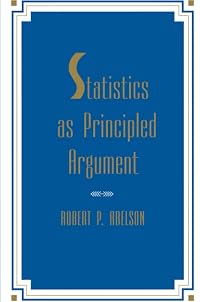
Statistics As Principled Argument
by Robert P. Abelson
On This Page
Description
The author delves into the too-often-dismissed problems of interpreting quantitative data and then presenting them in the context of a coherent story about one's research ... The focus of the book is that the purpose of statistics is to organize a useful argument from quantitative evidence, using a form of principled rhetoric. Five criteria, described by the acronym MAGIC (magnitude, articulation, generality, interestingness, and credibility) are proposed as crucial features of a persuasive, show more principled argument. Particular statistical methods are discussed, with minimum use of formulas and heavy data sets. The ideas throughout the book revolve around elementary probability theory, t tests, and simple issues of research design. It is therefore assumed that the reader has already had some access to elementary statistics. Many examples are included to explain the connection of statistics to substantive claims about real phenomena. show lessTags
Recommendations





Member Recommendations
Member Reviews
So you understand how to manipulate data and can make fancy charts. Great. Those statistics are still just numbers on a page -- that most people skim -- unless you can turn them into useful arguments. Abelson uses the acronym MAGIC (Magnitude, Articulation, Generality, Interesting, Credibility) to describe the five components of a persuasive statistical argument. I especially like that he uses examples to illustrate his points.
While this book is light on formulas and math, you still need a basic understanding of statistics to get the most out of it. This book is probably most often used by grad students in the social sciences, but every journalist, salesperson, politician, and activist should own a copy, too.
While this book is light on formulas and math, you still need a basic understanding of statistics to get the most out of it. This book is probably most often used by grad students in the social sciences, but every journalist, salesperson, politician, and activist should own a copy, too.
This book wasn't quite what I thought it would be. The title led me to expect an analysis of statistical methodology in comparison to other forms of "principled argument", but it's really just a how-to-do-good-research guide. The examples are heavily tilted towards the author's own speciality, social psychology. It seems like a good supplement to theoretical textbooks for researchers who write papers containing statistical data.
"It will be of true interest and lasting value to beginning graduate students and seasoned researchers alike."
I shoulda read the blurb more carefully. I am neither of those audiences. And I've been reading about the use and abuse of statistics in more recent science books, so ok.
Nov. 2021
I shoulda read the blurb more carefully. I am neither of those audiences. And I've been reading about the use and abuse of statistics in more recent science books, so ok.
Nov. 2021
Really great book on statistics - not really for use as a main textbook, but as additional reading to help students understand the concepts and philosophy behind the tests they're using. This was one of the books in my grad school stats 2 class, and I'm really glad to have read it. People in my program love to quote this book; I hear "chance is lumpy" on a weekly basis :D
A must read book for anyone who does or reads research in the social sciences, psychology, education, or similar fields. With almost no math or formulas, Abelson does not teach methods, he teaches thinking.
Was strongly recommended by a friend: http://bps-occupational-digest.blogspot.com/2012/03/be-all-you-can-be-how-milita...
Was strongly recommended by a friend: http://bps-occupational-digest.blogspot.com/2012/03/be-all-you-can-be-how-milita...
Members
- Recently Added By
Author Information
10 Works 242 Members
Classifications
- Genres
- Nonfiction, Science & Nature, General Nonfiction
- DDC/MDS
- 001.422 — Computer science, information & general works Computer science, knowledge & systems Knowledge and learning in general Research; Evaluation research, works discussing what research is Research methods Statistical methods
- LCC
- QA276 .A22 — Science Mathematics Mathematics Probabilities. Mathematical statistics
- BISAC
Statistics
- Members
- 140
- Popularity
- 234,684
- Reviews
- 7
- Rating
- (4.50)
- Languages
- English
- Media
- Paper, Ebook
- ISBNs
- 7