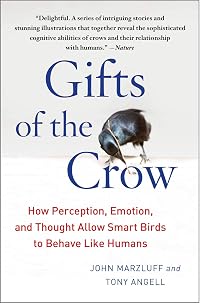
Gifts of the Crow: How Perception, Emotion, and Thought Allow Smart Birds to Behave Like Humans
by John Marzluff, Tony Angell
On This Page
Description
Offers insight into crows' ability to make tools and respond to environmental challenges, explaining how they engage in human-like behaviors, from giving gifts and seeking revenge to playing and experiencing dreams.Tags
Recommendations






Member Reviews
It reads far more like an academic paper than it does a book. Because of that, it's not particularly well-written nonfiction, as it often isn't very engaging. Additionally, the title would be better written as one that mentions neurology or the brain, as a huge portion of the book focuses on the corvid's brain structure, function, etc. compared to our own. To be honest, even though it's only an 8-hour book, I found it to feel much longer than that. Yet, there were many chunks during which I found myself tuning out. Sometimes I didn't even bother to re-read (re-listen to) it after realizing.
I did enjoy the more story-like pieces that told about individual crows and their interactions with humans. I also enjoyed the wide range of show more information they gave about corvid behavior.
I don't typically factor audiobook performance into the overall star rating of a book, but I would give Danny Campbell's performance the same as the book: 3.5/5. He wasn't particularly engaging, but it's honestly hard to tell whether that could just be chalked up to the writing of the book. show less
I did enjoy the more story-like pieces that told about individual crows and their interactions with humans. I also enjoyed the wide range of show more information they gave about corvid behavior.
I don't typically factor audiobook performance into the overall star rating of a book, but I would give Danny Campbell's performance the same as the book: 3.5/5. He wasn't particularly engaging, but it's honestly hard to tell whether that could just be chalked up to the writing of the book. show less
I was slightly disappointing in this one, mainly because I didn't love the narrator. (He pronounced some words oddly. He says expeeeriment, for example.) But there are some great anecdotes, and a lot of in-depth science, too.
If I ever listen to anything else by this author I will borrow it instead of buying it via Audible.
If I ever listen to anything else by this author I will borrow it instead of buying it via Audible.
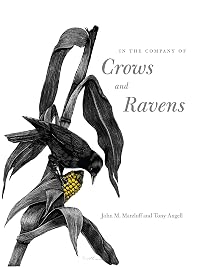
Not just an updated [b:In the Company of Crows and Ravens|593177|In the Company of Crows and Ravens|John M. Marzluff|https://images.gr-assets.com/books/1408427303s/593177.jpg|579910]; read both if you're as fascinated as I am. Otoh, if you want to choose one, choose this, as it is newer and incorporates new knowledge and studies.
This has less on cultural co-evolution, and fewer pictures. It also has more skepticism and less mysticism. And more anatomy & hard science (which I admit I read lightly), including appendices. If you want to read a sample before bringing it home from store or library, I recommend the chapter "Awareness" as the most exciting.
I really like the title of this. Gifts, as in talents, as in what the birds can show more accomplish. Gifts, as in benefits to us from knowing them, including, for example, friendships and a heightened understanding of our place in the world, and also as in tangible gifts like beads and nuts.
"Worldwide, cats are implicated in the extinction of thirty0three species of birds. An invasive species when let outdoors, cats are estimated to kill nearly 500 million birds each in year in the United States alone, as well as many native small mammals, amphibians, and reptiles."
"Consciousness appears to depend on an integrated forebrain, and especially on its reciprocal connection to the thalamus. The connected loops of neurons that originate in the brain stem, pass through the thalamus, and course up to the forebrain before checking in again with the thalamus or commanding muscles are an important neural basis of consciousness. Animals with loops between the thalamus and forebrain have expectations--in other words, they are able to consciously think. Birds and mammals have these loops. Reptile's loops are minimal. Loops are unknown in amphibians."
"Unlike in mammals, hair cells in a bird's ear damaged by loud sound or toxins regenerate. Old birds don't need hearing aids." (While considering this, also consider that some birds live lifetimes comparable to those of apes; crows and raven are juvenile for several years and may live several decades even in the wild.)
"Golfers near Leavenworth, Washington, were upset when a crow stole a bagged sandwich from their cart. When a crow returned with the now-empty bag and replaced it in the cart two holes later, they were dumbfounded. Similarly, in Barclay Sound kayakers were upset when ravens stole a fresh pie, and were really angered when the pair returned with the pan the next day and dropped it on the boatmen." (Note: *the next day*!)
"Fun is not an abstract concept....We--humans, corvids, lab rats, and probably all vertebrates--build better brains through play."
Weapon use between a pair of Stellar's Jays and a crow at a feeder: "The jay swooped at the crow... but the crow held its ground.... After the second swoop, the jay flew into a nearby mountain mahogany bush and twisted off a four-inch-long pointed stick. With the sharp end facing forward, the jay held the stick in its beak and lunged toward the crow. The joust barely missed the crow, who lunged back at the jay, causing the weapon to fall onto the feeder. The crow recovered the stick and, as the jay had done, gripped the dull end, aimed the sharp end toward the jay, and lunged. That was was effective. The jays flew off, and crow followed in hot pursuit, stick in beak."
Unfortunately there is no 'for further reading' and the index is not helpful, as I happened to want to check on three different things and none were listed. Still, I highly recommend the book to all with the slightest interest. show less
This has less on cultural co-evolution, and fewer pictures. It also has more skepticism and less mysticism. And more anatomy & hard science (which I admit I read lightly), including appendices. If you want to read a sample before bringing it home from store or library, I recommend the chapter "Awareness" as the most exciting.
I really like the title of this. Gifts, as in talents, as in what the birds can show more accomplish. Gifts, as in benefits to us from knowing them, including, for example, friendships and a heightened understanding of our place in the world, and also as in tangible gifts like beads and nuts.
"Worldwide, cats are implicated in the extinction of thirty0three species of birds. An invasive species when let outdoors, cats are estimated to kill nearly 500 million birds each in year in the United States alone, as well as many native small mammals, amphibians, and reptiles."
"Consciousness appears to depend on an integrated forebrain, and especially on its reciprocal connection to the thalamus. The connected loops of neurons that originate in the brain stem, pass through the thalamus, and course up to the forebrain before checking in again with the thalamus or commanding muscles are an important neural basis of consciousness. Animals with loops between the thalamus and forebrain have expectations--in other words, they are able to consciously think. Birds and mammals have these loops. Reptile's loops are minimal. Loops are unknown in amphibians."
"Unlike in mammals, hair cells in a bird's ear damaged by loud sound or toxins regenerate. Old birds don't need hearing aids." (While considering this, also consider that some birds live lifetimes comparable to those of apes; crows and raven are juvenile for several years and may live several decades even in the wild.)
"Golfers near Leavenworth, Washington, were upset when a crow stole a bagged sandwich from their cart. When a crow returned with the now-empty bag and replaced it in the cart two holes later, they were dumbfounded. Similarly, in Barclay Sound kayakers were upset when ravens stole a fresh pie, and were really angered when the pair returned with the pan the next day and dropped it on the boatmen." (Note: *the next day*!)
"Fun is not an abstract concept....We--humans, corvids, lab rats, and probably all vertebrates--build better brains through play."
Weapon use between a pair of Stellar's Jays and a crow at a feeder: "The jay swooped at the crow... but the crow held its ground.... After the second swoop, the jay flew into a nearby mountain mahogany bush and twisted off a four-inch-long pointed stick. With the sharp end facing forward, the jay held the stick in its beak and lunged toward the crow. The joust barely missed the crow, who lunged back at the jay, causing the weapon to fall onto the feeder. The crow recovered the stick and, as the jay had done, gripped the dull end, aimed the sharp end toward the jay, and lunged. That was was effective. The jays flew off, and crow followed in hot pursuit, stick in beak."
Unfortunately there is no 'for further reading' and the index is not helpful, as I happened to want to check on three different things and none were listed. Still, I highly recommend the book to all with the slightest interest. show less
Oddly enough I'm in the perfect position to "eat crow" as the saying goes. I saw a number of reviews that suggested this book was uneven, that there was too much science, as one person put it, and I smugly laughed it off. I read a lot of science and I'm rarely put off by complexities.
Yeah this time? Not so much. The critics were spot on and I'm sorry I doubted them. The book is uneven with hunks of information about the neurobiology of crows and other corvids, none of which seems to be particularly well integrated into the narrative. It was so scattered that I only got through four chapters before I bailed.
The thing is that the folks who said this wasn't good scientific writing were spot on. It's by turns inaccessible and lightly show more anecdotal, but solid behavioral information that might have tied those two opposite modes of inquiry together seemed to be lacking.
I was wrong to dismiss the naysayers, and I admit it.
Apropos of the audiobook quality, it's good as is the narrator. It's the material that's rather dull and disappointing. show less
Yeah this time? Not so much. The critics were spot on and I'm sorry I doubted them. The book is uneven with hunks of information about the neurobiology of crows and other corvids, none of which seems to be particularly well integrated into the narrative. It was so scattered that I only got through four chapters before I bailed.
The thing is that the folks who said this wasn't good scientific writing were spot on. It's by turns inaccessible and lightly show more anecdotal, but solid behavioral information that might have tied those two opposite modes of inquiry together seemed to be lacking.
I was wrong to dismiss the naysayers, and I admit it.
Apropos of the audiobook quality, it's good as is the narrator. It's the material that's rather dull and disappointing. show less
An absolute must-read for anyone who enjoys birds. Marzluff does a great job of telling very entertaining stories of corvid behavior while also explaining the anatomy, physiology, and biochemistry behind the behavior. I've always loved crows and known they were smart, but some of the behavior detailed in this book blew me away. I need a crow friend. Immediately.
This was rather disappointing. A fair number of anecdotes, none of them surprising if you've read news articles about crows. Very little description of the science of studying crow intelligence. Bernd Heinrich's "Mind of the Raven" is vastly superior, being basically a series of experiments (although often inconclusive ones). This has only a couple descriptions of experiments, and they were mostly not particularly novel or interesting. For example, they describe showing crows different images, then anesthetizing them and putting them through a PET scanner. Then they over-interpret the results. Basically, it goes from "we have no idea how crows do this, but it must be somewhere in their brain" to "we have no idea how crows do this, but show more it might be related to these [large and vaguely defined] areas of the brain." So what? The book is also overwritten, and I personally would have preferred photographs to the sketches.
One interesting experiment they do is to capture ravens while wearing a mask, and then for the next five years continue to wear the mask, or give it to undergrads to wear, around campus. The ravens passed the identity of the "bad guy" down and kept harassing him, in fact in larger and larger groups, and even when the mask was worn upside-down.
> Not only was the crows' hatred of the caveman persistent, it was getting worse with time. In the five years since we trapped on campus, the number of birds scolding the caveman on a typical walk has increased threefold. And the vast majority of those who berate the Neanderthal were never even touched by him show less
One interesting experiment they do is to capture ravens while wearing a mask, and then for the next five years continue to wear the mask, or give it to undergrads to wear, around campus. The ravens passed the identity of the "bad guy" down and kept harassing him, in fact in larger and larger groups, and even when the mask was worn upside-down.
> Not only was the crows' hatred of the caveman persistent, it was getting worse with time. In the five years since we trapped on campus, the number of birds scolding the caveman on a typical walk has increased threefold. And the vast majority of those who berate the Neanderthal were never even touched by him show less
Oddly enough I'm in the perfect position to "eat crow" as the saying goes. I saw a number of reviews that suggested this book was uneven, that there was too much science, as one person put it, and I smugly laughed it off. I read a lot of science and I'm rarely put off by complexities.
Yeah this time? Not so much. The critics were spot on and I'm sorry I doubted them. The book is uneven with hunks of information about the neurobiology of crows and other corvids, none of which seems to be particularly well integrated into the narrative. It was so scattered that I only got through four chapters before I bailed.
The thing is that the folks who said this wasn't good scientific writing were spot on. It's by turns inaccessible and lightly show more anecdotal, but solid behavioral information that might have tied those two opposite modes of inquiry together seemed to be lacking.
I was wrong to dismiss the naysayers, and I admit it.
Apropos of the audiobook quality, it's good as is the narrator. It's the material that's rather dull and disappointing. show less
Yeah this time? Not so much. The critics were spot on and I'm sorry I doubted them. The book is uneven with hunks of information about the neurobiology of crows and other corvids, none of which seems to be particularly well integrated into the narrative. It was so scattered that I only got through four chapters before I bailed.
The thing is that the folks who said this wasn't good scientific writing were spot on. It's by turns inaccessible and lightly show more anecdotal, but solid behavioral information that might have tied those two opposite modes of inquiry together seemed to be lacking.
I was wrong to dismiss the naysayers, and I admit it.
Apropos of the audiobook quality, it's good as is the narrator. It's the material that's rather dull and disappointing. show less
Members
- Recently Added By
Lists

Books Read in 2016
4,666 works; 199 members
Author Information
10+ Works 1,156 Members

11+ Works 690 Members
Tony Angell is the author or illustrator of numerous books in the fields of art and natural history.
Some Editions
Awards and Honors
Distinctions
Common Knowledge
- Canonical title
- Gifts of the Crow: How Perception, Emotion, and Thought Allow Smart Birds to Behave Like Humans
- Original title
- Gifts of the Crow: How Perception, Emotion, and Thought Allow Smart Birds to Behave Like Humans
- Original publication date
- 2012
- Dedication
- To crows, so often maligned,
and
the people whom they engage, so often ignored - First words
- A blue-black crow perches regally on the cornice of a stone building on the University of Washington campus, where he is often found. (Preface)
Betty, a New Caledonian crow, peers briefly into a tall, clear vertical tube at the small basket of food inside of it and pecks quickly at the plastic to test if she can break through it. - Last words
- (Click to show. Warning: May contain spoilers.)In so doing, they will continue to stir our souls and expand our minds.
- Publisher's editor
- Meredith, Leslie
- Blurbers
- Heinrich, Bernd; Pepperberg, Irene M.; O'Brien, Stacey; Montgomery, Sy; Bekoff, Marc; Ehrlich, Paul R. (show all 7); Gilbert, Suzie
- Original language
- English US
Classifications
Statistics
- Members
- 457
- Popularity
- 67,244
- Reviews
- 16
- Rating
- (3.69)
- Languages
- English
- Media
- Paper, Audiobook, Ebook
- ISBNs
- 8
- ASINs
- 2