
Michele Raffin
Author of The Birds of Pandemonium: Life Among the Exotic & the Endangered
About the Author
Works by Michele Raffin
Tagged
Common Knowledge
- Gender
- female
Members
Reviews
Since I read this in an ARC I was not able to see the pictures of the various birds...Missed that...
I have an Yellow Naped Amazon named Jujubee, who has her own brand of personality.
The first thing that happened when I read The birds of Pandemonium was to start to feel guilty of what I am not doing for my bird..... Jujubee is a loud girl and shouts 'Bye bye see you later" to mail men and delivery people, me when I leave. To anyone who will listen....I used to take her to work with me at the show more Humane Society, so she makes the Animal Control back up noise. And calls the kittens.....Here kitty kitty kitty!Meow meow.....On and on....
So reading a book that directs peoples reality to the nature of living with birds and experiencing their Cause and effect minds is a great thing....
The author's writing is clean and concise making for an easy read...... show less
I have an Yellow Naped Amazon named Jujubee, who has her own brand of personality.
The first thing that happened when I read The birds of Pandemonium was to start to feel guilty of what I am not doing for my bird..... Jujubee is a loud girl and shouts 'Bye bye see you later" to mail men and delivery people, me when I leave. To anyone who will listen....I used to take her to work with me at the show more Humane Society, so she makes the Animal Control back up noise. And calls the kittens.....Here kitty kitty kitty!Meow meow.....On and on....
So reading a book that directs peoples reality to the nature of living with birds and experiencing their Cause and effect minds is a great thing....
The author's writing is clean and concise making for an easy read...... show less

Raffin tells the story of Pandemonium Aviaries, a non-profit bird sanctuary with a conservation mission that started with an impulse rescue of a highway-stranded pigeon, and evolved into a hobby aviary grown too big to maintain privately. The message isn't delivered from a soap box until the end, though: each chapter tells a little bit about a specific species, or the breeding cottage industry, or conservation (whether habitat or zoo-based) after introducing the reader to one or two of show more Raffin's birds. These avian biographies are the core of the book, and we come to know individual birds by name and personality. Seemingly this narrative arc mirrors Raffin's own story, shaped through the experience of saving or caring for specific birds and adapting better ways to serve them.
Raffin's key insight is that avian conservation efforts are hampered by the lack of cooperation among breeders, shown to be innately competitive to the point of secrecy; and equally the lack of collaboration between commercial breeders and scientists, whether from zoos or veterinarian hospitals. Pandemonium develops its ARC mission (Avian Recovery for Conservation), aiming to bridge this gap.
//
According to BirdLife International there are 9,934 existing bird species in the world. [43]
Wild Bird Conservation Act of 1992 (US legislation) outlawed importing wild birds, and had immediate effects: number of imports dropped from 1 MM in 1992 to 3K in 1993 (with estimates that 3 birds die for every living bird, in addition to habitat destruction linked to import efforts). But the breeding stock of bird species also affected, as breeders focused on viable breeding pairs and species, focusing on fewer species. [75-6]
Amigo illustrated a common situation: rehoming, in which birds outlast their owners or their owner's ability / willingness to keep the bird. Parrots have long lifespans. The "Why?" / "Why not?" game Amigo played with his new owners, who didn't know the spiel apparently developed with Amigo's first owners, only stumbling on the proper response by accident: when given the response "Why not?", Amigo would pause and then reply, "I don't know."
Epilogue summarizes her TEDx talk: metaphor of Noah's ark, and outline of the ARC mission statement.
"Our birds have taught me how to meet their needs. Since they are such powerful educators, their stories are the heart of this book. Some of their journeys to our backyard can break your heart; their spirit and their revelations amaze and cheer me daily. In sharing their oddyseys -- and yes, their wisdom -- I hope to gently pull the rug from beneath what you think you know about these feathered familiars. I intend to convince you that "birdbrain!" is the finest of compliments." [15] show less
Raffin's key insight is that avian conservation efforts are hampered by the lack of cooperation among breeders, shown to be innately competitive to the point of secrecy; and equally the lack of collaboration between commercial breeders and scientists, whether from zoos or veterinarian hospitals. Pandemonium develops its ARC mission (Avian Recovery for Conservation), aiming to bridge this gap.
//
According to BirdLife International there are 9,934 existing bird species in the world. [43]
Wild Bird Conservation Act of 1992 (US legislation) outlawed importing wild birds, and had immediate effects: number of imports dropped from 1 MM in 1992 to 3K in 1993 (with estimates that 3 birds die for every living bird, in addition to habitat destruction linked to import efforts). But the breeding stock of bird species also affected, as breeders focused on viable breeding pairs and species, focusing on fewer species. [75-6]
Amigo illustrated a common situation: rehoming, in which birds outlast their owners or their owner's ability / willingness to keep the bird. Parrots have long lifespans. The "Why?" / "Why not?" game Amigo played with his new owners, who didn't know the spiel apparently developed with Amigo's first owners, only stumbling on the proper response by accident: when given the response "Why not?", Amigo would pause and then reply, "I don't know."
Epilogue summarizes her TEDx talk: metaphor of Noah's ark, and outline of the ARC mission statement.
"Our birds have taught me how to meet their needs. Since they are such powerful educators, their stories are the heart of this book. Some of their journeys to our backyard can break your heart; their spirit and their revelations amaze and cheer me daily. In sharing their oddyseys -- and yes, their wisdom -- I hope to gently pull the rug from beneath what you think you know about these feathered familiars. I intend to convince you that "birdbrain!" is the finest of compliments." [15] show less

The author's love affair with birds begins with a dove she is unable to save, and it grows to include rescue birds of numerous species. Then, in a decision that is both energizing and heartbreaking, Raffin becomes a breeding conservationist that focuses on ex-situ conservation of endangered species. These conservation breeding efforts are centered around six endangered species endemic to New Guinea or the Philippines, such as the Mindanao bleeding-heart. Their natural habitats are being show more decimated by palm oil plantations.
The Birds of Pandemonium is not a pull-no-punches conservation plea. Raffin, who is friends with private breeders and relies on their expertise and support, is unable or unwilling to critique the greed that motivates much of the for-profit breeding industry. She touches at numerous points on the unwillingness of breeders to share their information. One suspects their secrecy is motivated by dollar signs not "snobbery [or] stubbornness" (198).
The birds who reside at Michele Raffin's Pandemonium Aviaries are colorful characters. Raffin's life with her bird friends is zany and her cheeky prose style in The Birds of Pandemonium: Life Among the Exotic and Endangered reflects this. show less
The Birds of Pandemonium is not a pull-no-punches conservation plea. Raffin, who is friends with private breeders and relies on their expertise and support, is unable or unwilling to critique the greed that motivates much of the for-profit breeding industry. She touches at numerous points on the unwillingness of breeders to share their information. One suspects their secrecy is motivated by dollar signs not "snobbery [or] stubbornness" (198).
The birds who reside at Michele Raffin's Pandemonium Aviaries are colorful characters. Raffin's life with her bird friends is zany and her cheeky prose style in The Birds of Pandemonium: Life Among the Exotic and Endangered reflects this. show less
 This review was written for LibraryThing Early Reviewers.
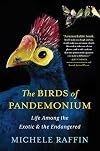
I requested this Early Reviewers book, like most of the ones I end up receiving, just because it sounded moderately interesting. I'm not at all a "bird person," though I'm fond of occasional backyard bird observation. The teaser description was interesting enough, and the bird on the cover was striking, which was enough to merit a request.
When I received the book in the mail two days ago, I'll admit to being a touch disappointed. There were other books in the month's offers that I'd have show more preferred, but I planned to put it nearer the top of the TBR shelf and hope to get to it before the non-review counted against me.
Then I noticed there were pictures. So I looked at them. And read a couple pages. And brought the book to read during my lunch break at work. And wished my lunch break was a little longer. And decided to finish it as soon as I got home. And did so. And then looked at the pictures some more. And then wondered if it would be cruel to adopt a bird into a house with five cats . . . (Alas, "yes" is almost certainly the answer.)
While this little narrative isn't much of a review, it is a strong recommendation on my part. Raffin does an excellent job of showing how a soft spot for an injured dove turned into a lifelong mission/obsession, and her profiles of some standout birds are both touching and humorous. For those whose preference in life companions has been most mammalian, she gives plenty of evidence that birds are capable of companionship and love. For those who tend towards conservationism, she gives good reasons to consider human/avian interaction and the rapid disappearance of species. No doubt those who disapprove of pets and all forms of animal captivity wouldn't approve, but otherwise, there's much to enjoy in this book.
That's not to say it's strictly a "message book," by the way. I don't tend to enjoy memoirs written solely to advance the author's pet project, and at first I was a little afraid Raffin would harp on whatever her "angle" was. While she does go into the reasons and methodology of the type of conservation and breeding programs she supports, it's much more the stories of (as the title suggests) the birds she's cared for and loved. Which is as it should be. show less
When I received the book in the mail two days ago, I'll admit to being a touch disappointed. There were other books in the month's offers that I'd have show more preferred, but I planned to put it nearer the top of the TBR shelf and hope to get to it before the non-review counted against me.
Then I noticed there were pictures. So I looked at them. And read a couple pages. And brought the book to read during my lunch break at work. And wished my lunch break was a little longer. And decided to finish it as soon as I got home. And did so. And then looked at the pictures some more. And then wondered if it would be cruel to adopt a bird into a house with five cats . . . (Alas, "yes" is almost certainly the answer.)
While this little narrative isn't much of a review, it is a strong recommendation on my part. Raffin does an excellent job of showing how a soft spot for an injured dove turned into a lifelong mission/obsession, and her profiles of some standout birds are both touching and humorous. For those whose preference in life companions has been most mammalian, she gives plenty of evidence that birds are capable of companionship and love. For those who tend towards conservationism, she gives good reasons to consider human/avian interaction and the rapid disappearance of species. No doubt those who disapprove of pets and all forms of animal captivity wouldn't approve, but otherwise, there's much to enjoy in this book.
That's not to say it's strictly a "message book," by the way. I don't tend to enjoy memoirs written solely to advance the author's pet project, and at first I was a little afraid Raffin would harp on whatever her "angle" was. While she does go into the reasons and methodology of the type of conservation and breeding programs she supports, it's much more the stories of (as the title suggests) the birds she's cared for and loved. Which is as it should be. show less
This review was written for LibraryThing Early Reviewers.Lists
You May Also Like


Statistics
- Works
- 1
- Members
- 200
- Popularity
- #110,007
- Rating
- 4.1
- Reviews
- 32
- ISBNs
- 5
