
John M. Marzluff
Author of In the Company of Crows and Ravens
About the Author
Works by John M. Marzluff
Gifts of the Crow: How Perception, Emotion, and Thought Allow Smart Birds to Behave Like Humans (2012) 456 copies, 16 reviews
Welcome to Subirdia: Sharing Our Neighborhoods with Wrens, Robins, Woodpeckers, and Other Wildlife (2014) 92 copies, 2 reviews
Urban Ecology: An International Perspective on the Interaction Between Humans and Nature (2008) 10 copies
Associated Works
Tagged
Common Knowledge
- Canonical name
- Marzluff, John M.
- Gender
- male
- Education
- Northern Arizona University
University of Vermont - Occupations
- professor
ornithologist - Organizations
- American Ornithologists' Union
University of Washington - Awards and honors
- A. Brazier Howell award
H.R. Painton award - Agent
- Trena Keating
- Short biography
- Joh Marzluff is Professor of Wildlife Science in the School of Environmental and Forest Sciences at the University of Washington. His research has been the focus of articles in The New York Times, National Geographic, Audobon, Boy's Life, The Seattle Times and National Wildlife. PBS's Nature featured his raven research in its 2001 production "Ravens" and featured his crow research in 2010 with the documentary film "A Murder of Crows". John has been a guest on NPR's Diane Rehm show, The Jay Thomas Show, and Morning Edition (www.npr.org/crows)
John has won writing awards and speaking award, including the A. Brazier Howell, Board of Directors, and H.R. Painton awards from the Cooper Ornithological Society. He is a fellow of the American Ornithologists' Union. He speaks regularly at professional conference across the country, including to the American Ornithologists' Union, and the Cooper Ornithological Society, as well as keynotes birding festivals, informs local birding and civic clubs, and addresses special events such as the Ketchikan Museum Lecture, the Egan Lecture, the Beaty Museum Biodiversity Lecture, and the Athens Speaker Series.
His graduate (Northern Arizona University, studying with Professor Russell Balda) and initial postdoctoral (University of Vermont with Professor Bernd Heinrich) research focused on the social behavior and ecology of jays and ravens. He has authored more than one hundred scientific papers on various aspects of bird behavior and wildlife management in addition to the books he has written. [from Gifts of the Crow (2012)] - Nationality
- USA
- Associated Place (for map)
- USA
Members
Reviews
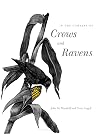
In the Company of Crows and Ravens was a surprisingly good read. Tony Angell's illustrations highlight John Marzluff's narration of the co evolution of corvids and humans. Marzluff says, "Their conspicuousness, curiosity, sociality, insightful behavior, and powerful voices have captured our imaginations more significantly than other species." There are fascinating facts about corvids, such as his theory that corvids use a language to communicate with each other and that you can teach a crow show more to talk, though in talking with humans it's just learned repetition, not actual communication. I didn't know, but my daughter says you can teach any bird repetitious talk. He mentions that crows can gather in flocks up to 2 million. Add those numbers to the fact that crows sometimes attack people, and you come up with a far greater appreciation Hitchcock's movie The Birds. Marzluff shows how carnivorous ravens were numerous when humans were hunters, but as we became planters, the numbers of omnivorous crows increased. He even has an interesting theory that the increasing numbers of corvids encouraged wolves to work in larger communities to protect their kills and humans to increase community size to protect their food supplies. He suggests that increasing numbers of corvids might have been a reason for humans to domesticate wolves. Crows and ravens feasting on dead bodies were a help to humans because they helped to keep the environment clean, but in doing so they became associated with death, and that association made humans suspicious and fearful of the birds. Throughout the book you see the love and fear corvids and humans have for each other. He cites a great poem by Doug Anderson:
"Crows
Hunch in the trees
to gossip
about God and his inexorable
experimenting,
about deer guts and fish so stupid
you could sell them air
and how out in the deserts
there's a dog called coyote
with their mind
but no wings.
Crow with Iroquois hair.
Crow with a wisecrack
for everybody.
Crow with his beak
thrust through a bun,
the paper still clinging.
Crow in a midnight blue suit
standing in front of a judge:
Your honor, I didn't
kill him,
just ate him
and I wasn't impressed." show less
"Crows
Hunch in the trees
to gossip
about God and his inexorable
experimenting,
about deer guts and fish so stupid
you could sell them air
and how out in the deserts
there's a dog called coyote
with their mind
but no wings.
Crow with Iroquois hair.
Crow with a wisecrack
for everybody.
Crow with his beak
thrust through a bun,
the paper still clinging.
Crow in a midnight blue suit
standing in front of a judge:
Your honor, I didn't
kill him,
just ate him
and I wasn't impressed." show less
Gifts of the Crow: How Perception, Emotion, and Thought Allow Smart Birds to Behave Like Humans by John Marzluff
It reads far more like an academic paper than it does a book. Because of that, it's not particularly well-written nonfiction, as it often isn't very engaging. Additionally, the title would be better written as one that mentions neurology or the brain, as a huge portion of the book focuses on the corvid's brain structure, function, etc. compared to our own. To be honest, even though it's only an 8-hour book, I found it to feel much longer than that. Yet, there were many chunks during which I show more found myself tuning out. Sometimes I didn't even bother to re-read (re-listen to) it after realizing.
I did enjoy the more story-like pieces that told about individual crows and their interactions with humans. I also enjoyed the wide range of information they gave about corvid behavior.
I don't typically factor audiobook performance into the overall star rating of a book, but I would give Danny Campbell's performance the same as the book: 3.5/5. He wasn't particularly engaging, but it's honestly hard to tell whether that could just be chalked up to the writing of the book. show less
I did enjoy the more story-like pieces that told about individual crows and their interactions with humans. I also enjoyed the wide range of information they gave about corvid behavior.
I don't typically factor audiobook performance into the overall star rating of a book, but I would give Danny Campbell's performance the same as the book: 3.5/5. He wasn't particularly engaging, but it's honestly hard to tell whether that could just be chalked up to the writing of the book. show less
Gifts of the Crow: How Perception, Emotion, and Thought Allow Smart Birds to Behave Like Humans by John Marzluff

I was slightly disappointing in this one, mainly because I didn't love the narrator. (He pronounced some words oddly. He says expeeeriment, for example.) But there are some great anecdotes, and a lot of in-depth science, too.
If I ever listen to anything else by this author I will borrow it instead of buying it via Audible.
If I ever listen to anything else by this author I will borrow it instead of buying it via Audible.
Gifts of the Crow: How Perception, Emotion, and Thought Allow Smart Birds to Behave Like Humans by John Marzluff
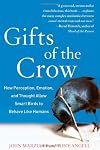
Not just an updated [b:In the Company of Crows and Ravens|593177|In the Company of Crows and Ravens|John M. Marzluff|https://images.gr-assets.com/books/1408427303s/593177.jpg|579910]; read both if you're as fascinated as I am. Otoh, if you want to choose one, choose this, as it is newer and incorporates new knowledge and studies.
This has less on cultural co-evolution, and fewer pictures. It also has more skepticism and less mysticism. And more anatomy & hard science (which I admit I read show more lightly), including appendices. If you want to read a sample before bringing it home from store or library, I recommend the chapter "Awareness" as the most exciting.
I really like the title of this. Gifts, as in talents, as in what the birds can accomplish. Gifts, as in benefits to us from knowing them, including, for example, friendships and a heightened understanding of our place in the world, and also as in tangible gifts like beads and nuts.
"Worldwide, cats are implicated in the extinction of thirty0three species of birds. An invasive species when let outdoors, cats are estimated to kill nearly 500 million birds each in year in the United States alone, as well as many native small mammals, amphibians, and reptiles."
"Consciousness appears to depend on an integrated forebrain, and especially on its reciprocal connection to the thalamus. The connected loops of neurons that originate in the brain stem, pass through the thalamus, and course up to the forebrain before checking in again with the thalamus or commanding muscles are an important neural basis of consciousness. Animals with loops between the thalamus and forebrain have expectations--in other words, they are able to consciously think. Birds and mammals have these loops. Reptile's loops are minimal. Loops are unknown in amphibians."
"Unlike in mammals, hair cells in a bird's ear damaged by loud sound or toxins regenerate. Old birds don't need hearing aids." (While considering this, also consider that some birds live lifetimes comparable to those of apes; crows and raven are juvenile for several years and may live several decades even in the wild.)
"Golfers near Leavenworth, Washington, were upset when a crow stole a bagged sandwich from their cart. When a crow returned with the now-empty bag and replaced it in the cart two holes later, they were dumbfounded. Similarly, in Barclay Sound kayakers were upset when ravens stole a fresh pie, and were really angered when the pair returned with the pan the next day and dropped it on the boatmen." (Note: *the next day*!)
"Fun is not an abstract concept....We--humans, corvids, lab rats, and probably all vertebrates--build better brains through play."
Weapon use between a pair of Stellar's Jays and a crow at a feeder: "The jay swooped at the crow... but the crow held its ground.... After the second swoop, the jay flew into a nearby mountain mahogany bush and twisted off a four-inch-long pointed stick. With the sharp end facing forward, the jay held the stick in its beak and lunged toward the crow. The joust barely missed the crow, who lunged back at the jay, causing the weapon to fall onto the feeder. The crow recovered the stick and, as the jay had done, gripped the dull end, aimed the sharp end toward the jay, and lunged. That was was effective. The jays flew off, and crow followed in hot pursuit, stick in beak."
Unfortunately there is no 'for further reading' and the index is not helpful, as I happened to want to check on three different things and none were listed. Still, I highly recommend the book to all with the slightest interest. show less
This has less on cultural co-evolution, and fewer pictures. It also has more skepticism and less mysticism. And more anatomy & hard science (which I admit I read show more lightly), including appendices. If you want to read a sample before bringing it home from store or library, I recommend the chapter "Awareness" as the most exciting.
I really like the title of this. Gifts, as in talents, as in what the birds can accomplish. Gifts, as in benefits to us from knowing them, including, for example, friendships and a heightened understanding of our place in the world, and also as in tangible gifts like beads and nuts.
"Worldwide, cats are implicated in the extinction of thirty0three species of birds. An invasive species when let outdoors, cats are estimated to kill nearly 500 million birds each in year in the United States alone, as well as many native small mammals, amphibians, and reptiles."
"Consciousness appears to depend on an integrated forebrain, and especially on its reciprocal connection to the thalamus. The connected loops of neurons that originate in the brain stem, pass through the thalamus, and course up to the forebrain before checking in again with the thalamus or commanding muscles are an important neural basis of consciousness. Animals with loops between the thalamus and forebrain have expectations--in other words, they are able to consciously think. Birds and mammals have these loops. Reptile's loops are minimal. Loops are unknown in amphibians."
"Unlike in mammals, hair cells in a bird's ear damaged by loud sound or toxins regenerate. Old birds don't need hearing aids." (While considering this, also consider that some birds live lifetimes comparable to those of apes; crows and raven are juvenile for several years and may live several decades even in the wild.)
"Golfers near Leavenworth, Washington, were upset when a crow stole a bagged sandwich from their cart. When a crow returned with the now-empty bag and replaced it in the cart two holes later, they were dumbfounded. Similarly, in Barclay Sound kayakers were upset when ravens stole a fresh pie, and were really angered when the pair returned with the pan the next day and dropped it on the boatmen." (Note: *the next day*!)
"Fun is not an abstract concept....We--humans, corvids, lab rats, and probably all vertebrates--build better brains through play."
Weapon use between a pair of Stellar's Jays and a crow at a feeder: "The jay swooped at the crow... but the crow held its ground.... After the second swoop, the jay flew into a nearby mountain mahogany bush and twisted off a four-inch-long pointed stick. With the sharp end facing forward, the jay held the stick in its beak and lunged toward the crow. The joust barely missed the crow, who lunged back at the jay, causing the weapon to fall onto the feeder. The crow recovered the stick and, as the jay had done, gripped the dull end, aimed the sharp end toward the jay, and lunged. That was was effective. The jays flew off, and crow followed in hot pursuit, stick in beak."
Unfortunately there is no 'for further reading' and the index is not helpful, as I happened to want to check on three different things and none were listed. Still, I highly recommend the book to all with the slightest interest. show less
Lists
Awards


You May Also Like


Associated Authors
Statistics
- Works
- 10
- Also by
- 1
- Members
- 1,154
- Popularity
- #22,275
- Rating
- 3.8
- Reviews
- 36
- ISBNs
- 32