

Tim Birkhead
Author of Bird Sense: What It's Like to Be a Bird
About the Author
Tim Birkhead teaches animal behaviour and the history of science at the University of Sheffield. He is a Fellow of the Royal Society of London and the author of several books including The Wisdom of Birds, The Cambridge Encyclopaedia of Ornithology, which won the McColvin Medal, and The Red Canary, show more which won the Consul Cremer Prize. He lives in Sheffield, England. Katrina Van Grouw, illustrator, is a full-time artist and writer, and the creator of The Unfeathered Bird. show less
Image credit: photo by Miriam Birkhead
Works by Tim Birkhead
A Brand New Bird: How Two Amateur Scientists Created The First Genetically Engineered Animal (2003) 60 copies
Virtuoso by Nature: The Scientific Worlds of Francis Willughby Frs (1635-1672) (Emergence of Natural History) (2016) 6 copies
Segredos do Mundo Animal 3 copies
Com és això de ser un ocell? 1 copy
Tagged
Common Knowledge
- Canonical name
- Birkhead, Tim
- Birthdate
- 1950-02-20
- Gender
- male
- Education
- University of Newcastle (BS, Biology)
University of Oxford (PhD, Ornithology)
University of Newcastle (DSc) - Occupations
- professor (zoology)
- Organizations
- University of Sheffield
Royal Society - Agent
- Felicity Bryan Associates Literary Agency
- Short biography
- [from The Wonderful Mr. Willughby]
Tim Birkhead FRS is Professor of Zoology at the University of Sheffield, where he teaches animal behaviour and history of science. Among his other books are Promiscuity; Great Auk Islands; The Cambridge Encyclopedia of Birds, which won the McColvin Medal; The Red Canary, which won the Consul Cremer Prize; The Wisdom of Birds, which was the British Birds/British Trust for Ornithology Best Bird Book of the Year 2009; Bird Sense, which was the Guardian and Independent's Natural History Book of the Year; and The Most Perfect Thing, winner of the Zoological Society of London's Communicating Zoology Award for 2016. He lives in Sheffield. - Nationality
- UK
- Places of residence
- Sheffield, Yorkshire, England, UK
- Associated Place (for map)
- England, UK
Members
Reviews
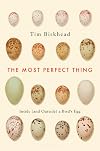
Rating: 4.5* of five
The Publisher Says: Renowned ornithologist Tim Birkhead opens this gripping story as a female guillemot chick hatches, already carrying her full quota of tiny eggs within her undeveloped ovary. As she grows into adulthood, only a few of her eggs mature, are released into the oviduct, and are fertilized by sperm stored from copulation that took place days or weeks earlier. Within a matter of hours, the fragile yolk is surrounded by albumen and the whole is gradually show more encased within a turquoise jewel of a shell. Soon afterward the fully formed egg is expelled onto a bare rocky ledge, where it will be incubated for four weeks before another chick emerges and the life cycle begins again.
The Most Perfect Thing is about how eggs in general are made, fertilized, developed, and hatched. The eggs of most birds spend just 24 hours in the oviduct; however, that journey takes 48 hours in cuckoos, which surreptitiously lay their eggs in the nests of other birds. From the earliest times, the study of birds' ovaries and ova (eggs) played a vital role in the quest to unravel the mysteries of fertilization and embryo development in humans. Birkhead uses birds' eggs as wondrous portals into natural history, enlivened by the stories of naturalists and scientists, including Birkhead and his students, whose discoveries have advanced current scientific knowledge of reproduction.
My Review: I thought "guillemot" was a Dr. Seuss name before I read this book. Author Birkhead disabused me of this with his praises sung for the aesthetics of their shells:
I mean pretty enough, but this guy's obsessed....
He is not overselling the burden of his refrain. This is a fascinating look at what these dinosaur revenants do in the reproductive world (I got a new insult out of the read: I told one person I detest that she was an altricial birth to a precocial species) and what that has revealed to scientists in applicability to all others.
People's love of the beauty of eggs has led to some dark consequences. Egg collectors hunted their favorites to actual or functional extinction, inspiring the UK to pass pretty draconian laws against private ownership of the things...in 1954! Even *I* wasn't born then, and Rachel Carson's Silent Spring was still a love-offering in progress!
What you need to know most is: was it fun to read? I'll say yes, because I really like science and am not afraid of the dictionary. If you're not a science nut, maybe it won't delight you; maybe you'll have to look stuff up; and maybe that won't agree with you.
It agreed with me. show less
The Publisher Says: Renowned ornithologist Tim Birkhead opens this gripping story as a female guillemot chick hatches, already carrying her full quota of tiny eggs within her undeveloped ovary. As she grows into adulthood, only a few of her eggs mature, are released into the oviduct, and are fertilized by sperm stored from copulation that took place days or weeks earlier. Within a matter of hours, the fragile yolk is surrounded by albumen and the whole is gradually show more encased within a turquoise jewel of a shell. Soon afterward the fully formed egg is expelled onto a bare rocky ledge, where it will be incubated for four weeks before another chick emerges and the life cycle begins again.
The Most Perfect Thing is about how eggs in general are made, fertilized, developed, and hatched. The eggs of most birds spend just 24 hours in the oviduct; however, that journey takes 48 hours in cuckoos, which surreptitiously lay their eggs in the nests of other birds. From the earliest times, the study of birds' ovaries and ova (eggs) played a vital role in the quest to unravel the mysteries of fertilization and embryo development in humans. Birkhead uses birds' eggs as wondrous portals into natural history, enlivened by the stories of naturalists and scientists, including Birkhead and his students, whose discoveries have advanced current scientific knowledge of reproduction.
My Review: I thought "guillemot" was a Dr. Seuss name before I read this book. Author Birkhead disabused me of this with his praises sung for the aesthetics of their shells:
I mean pretty enough, but this guy's obsessed....
And eggs are perfect in so many different ways. They have to be, for birds lay and incubate in such incredible diversity of habitats and situations, from the poles to the tropics; in wet, dry, clean and microbe-infested conditions; in nests and without nests; warmed by body heat and without body heat. The shape, colour and size of eggs as well as the composition of their yolk and albumen all constitute the most extraordinary set of adaptations. The fact that birds' eggs also provided biologists with their first insights into human reproduction makes their story even more momentous.
He is not overselling the burden of his refrain. This is a fascinating look at what these dinosaur revenants do in the reproductive world (I got a new insult out of the read: I told one person I detest that she was an altricial birth to a precocial species) and what that has revealed to scientists in applicability to all others.
People's love of the beauty of eggs has led to some dark consequences. Egg collectors hunted their favorites to actual or functional extinction, inspiring the UK to pass pretty draconian laws against private ownership of the things...in 1954! Even *I* wasn't born then, and Rachel Carson's Silent Spring was still a love-offering in progress!
What you need to know most is: was it fun to read? I'll say yes, because I really like science and am not afraid of the dictionary. If you're not a science nut, maybe it won't delight you; maybe you'll have to look stuff up; and maybe that won't agree with you.
It agreed with me. show less
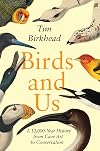
What a delightful read! This bird nerd was enchanted from the opening chapter describing a visit to a shallow cave in Spain, the walls adorned with hundreds of birds - silhouettes in ochre and yellow skillful enough to be identified as to species, from 8000 years ago. Birkhead starts there, and takes us on a varied and wide-ranging trip through millennia, continents (largely Eurocentric, but with attention to areas of the New World and northern Africa), the arts, and the studies of a number show more of bird-obsessed people, to illustrate how birds and people have affected each other. He is an expert and genial host, weaving his own passion and experiences with birds (the man cheerfully admits he loves the smell of seabird shit - his words) in with tales of Darwin, medieval falconry and cookery, princely Egyptian hunting, resplendent South American costume, egg collectors, artists, ornithologists, and conservationists. He is attentive to ethical issues - the effects of the Europeans on indigenous people, Faroese whale hunting, wholesale bird killing for the sake of study skins, and human disruption of habitat and climate change. As a young student, he almost went to art school, and his appreciation for the artistic aspect of birds as subjects is lovely, though I was disappointed that he didn't mention my all-time favorite bird artist: the brilliant Edward Lear... yes, that Edward Lear of the owl and the pussycat and "There once was a man with a beard...," whose paintings of parrots take your breath away. (see The Natural History of Edward Lear) I was also pleased to find a kindred soul who openly admires Pre-Raphaelite paintings.
A wonderful read - highly recommended. And boy, would I love to go birding with him.
EDITED TO ADD: Because I liked this book so much, I googled up Birkhead's email and sent him an effusive fan message. This morning I got a lovely, warm reply, thanking me and answering several of my questions and comments. I love when that happens! I'm adding a star just for that. show less
A wonderful read - highly recommended. And boy, would I love to go birding with him.
EDITED TO ADD: Because I liked this book so much, I googled up Birkhead's email and sent him an effusive fan message. This morning I got a lovely, warm reply, thanking me and answering several of my questions and comments. I love when that happens! I'm adding a star just for that. show less
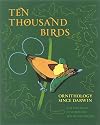
This fascinating and beautiful book is a must for anyone with a serious interest in birds, ornithology and evolutionary theory.
Topics covered include: the debates surrounding the evolutionary origins of birds; the speciation process; classification; migration; breeding behaviour; sexual selection; learned and instinctive behaviour; population studies; and conservation.
But the book does not just feature the birds and the science. It also tells the story of the human personalities involved in show more the development of ornithology since Darwin.
For example, there is Ernst Mayr, who was both a field ornithologist and also one of the most important evolutionary theorists of the twentieth century. Mayr was still writing books on evolution when he was in his nineties, and his ideas were particularly important in explaining speciation: the process through which a new species branches off from an already existing one.
Mayr wrote that “... birds are a marvellous stepping-stone in three directions: towards evolution, towards systematics, and towards biogeography.”
Then there are Peter and Rosemary Grant, who carried out a long-term study of the finches on the Galapagos Islands, a study which (like Mayr’s theoretical approach) revealed much about the speciation process through which the finches have diversified.
I’ll just mention one more of the many interesting characters from the book, and that is Rachel Carson. Carson’s book “Silent Spring” (1962) played a crucial role in bringing to public attention the damage being done by DDT and other pesticides. For her pains, she was subjected to vicious attacks by the agrochemical industry and its hired intellectual thugs.
This book is not cheap, but it is well worth the money. I strongly recommend it. show less
Topics covered include: the debates surrounding the evolutionary origins of birds; the speciation process; classification; migration; breeding behaviour; sexual selection; learned and instinctive behaviour; population studies; and conservation.
But the book does not just feature the birds and the science. It also tells the story of the human personalities involved in show more the development of ornithology since Darwin.
For example, there is Ernst Mayr, who was both a field ornithologist and also one of the most important evolutionary theorists of the twentieth century. Mayr was still writing books on evolution when he was in his nineties, and his ideas were particularly important in explaining speciation: the process through which a new species branches off from an already existing one.
Mayr wrote that “... birds are a marvellous stepping-stone in three directions: towards evolution, towards systematics, and towards biogeography.”
Then there are Peter and Rosemary Grant, who carried out a long-term study of the finches on the Galapagos Islands, a study which (like Mayr’s theoretical approach) revealed much about the speciation process through which the finches have diversified.
I’ll just mention one more of the many interesting characters from the book, and that is Rachel Carson. Carson’s book “Silent Spring” (1962) played a crucial role in bringing to public attention the damage being done by DDT and other pesticides. For her pains, she was subjected to vicious attacks by the agrochemical industry and its hired intellectual thugs.
This book is not cheap, but it is well worth the money. I strongly recommend it. show less

Nicely organized and easy-to-read book on sexual selection and multiple mating in females. It was very useful to my research, but it would probably be interesting, informative, and understandable for the non-scientist reader as well. It also provided many instances of me shouting things across the room like "Ohmygod, did you know that male pigs produce a liter of ejaculate each time?!?"
Lists
Awards


You May Also Like


Associated Authors
Statistics
- Works
- 37
- Members
- 1,207
- Popularity
- #21,276
- Rating
- 3.8
- Reviews
- 33
- ISBNs
- 87
- Languages
- 8
