
About the Author
Thor Hanson is a conservation biologist, Guggenheim fellow, and author of award-winning books including Feathers, The Impenetrable Forest, and The Triumph of Seeds. He lives with his wife and son on an island in Washington State.
Works by Thor Hanson
The Triumph of Seeds: How Grains, Nuts, Kernels, Pulses, and Pips Conquered the Plant Kingdom and Shaped Human History (2015) 467 copies, 18 reviews
Hurricane Lizards and Plastic Squid: The Fraught and Fascinating Biology of Climate Change (2021) 174 copies, 10 reviews
Tagged
Common Knowledge
- Birthdate
- ca. 1980
- Gender
- male
- Occupations
- conservation biologist
- Nationality
- USA
- Birthplace
- USA
- Associated Place (for map)
- USA
Members
Reviews

I found this book totally by accident. Browsing the fiction shelves at a Friends of the Library sale I was caught by its spine. The cover, so beautiful and bold, drew me in. When I discovered it wasn’t a novel, but a natural history of feathers I could barely get it in my bag fast enough. Thanks to whoever shelved it wrong!
While not a birder per se, I do have an appreciation for birds, flight and the marvels they are. So many different behaviors, environments and body styles - there are show more few things in nature as broadly diverse as birds. Then there are the feathers. I have a small collection of them in my home. Yes, I know this is a Federal Offense, but I can’t help it and have been known to hide a beautiful specimen on my way out on a hike so I can pick it up on the way back and have less chance of damaging it while I walk and prevent anyone else from snagging it. I also pick them up in the yard, on the road when walking to the mailbox and almost anywhere I find them. From a great blue heron primary to the pointy tail feather of a northern flicker and the contour feathers of turkeys - they are universally appealing. I even bought a field guide to feather identification so I could tell a broad wing hawk feather from a great horned owl feather. They are little wonders of nature and this book dives into the latest (well for 2011) theories and advances into how they evolved.
Here are some of the things I learned -
* Developing feathers, called pinfeathers have a blood supply. I’d always thought they were like claws or hair - like those things, they don't bleed and are largely made of keratin, but no - pinfeathers do bleed. The blood supply is connected until the feather is mature then it disconnects at the base of the follicle. When it’s time to replace it, the new pin feather ejects the worn-out feather. Astounding.
* Many birds scavenge feathers of other birds to line their nests - I always thought it was only their own feathers that filled that role. Nope.
* Some birds expose their legs and increase blood flow to them as a cooling strategy.
* Grebes eat feathers, their own or a duck feather floating by, in order to line their stomachs to protect against the bones of the fish they eat. They feed them to the chicks for the same purpose.
* Quill toothpicks were quite the industry and very popular into the 20th century.
* The US Supreme court distributes 20 (or more, it isn’t clear) quill pens every day on the counsel tables. No one uses them except as souvenirs.
* Old and New World vultures are not related to each other and evolved the bald head strategy independently. It is a direct result of eating carrion - blood and tissue stick to feathers and makes them useless and impossible to clean. No feathers, no problem!
Written in an engaging and enthusiastic style, the book was continually interesting and entertaining. It begins with feathered dinosaur finds and scientists working on the evolution of feathers and flight and how, or how not, those might intersect. Then on to feathers in fashion and other human uses like pens and the functions of feathers aside from flight. There are chapters devoted to colors and breeding displays. If you are into birds or evolutionary biology this book is well worth adding to your library. show less
While not a birder per se, I do have an appreciation for birds, flight and the marvels they are. So many different behaviors, environments and body styles - there are show more few things in nature as broadly diverse as birds. Then there are the feathers. I have a small collection of them in my home. Yes, I know this is a Federal Offense, but I can’t help it and have been known to hide a beautiful specimen on my way out on a hike so I can pick it up on the way back and have less chance of damaging it while I walk and prevent anyone else from snagging it. I also pick them up in the yard, on the road when walking to the mailbox and almost anywhere I find them. From a great blue heron primary to the pointy tail feather of a northern flicker and the contour feathers of turkeys - they are universally appealing. I even bought a field guide to feather identification so I could tell a broad wing hawk feather from a great horned owl feather. They are little wonders of nature and this book dives into the latest (well for 2011) theories and advances into how they evolved.
Here are some of the things I learned -
* Developing feathers, called pinfeathers have a blood supply. I’d always thought they were like claws or hair - like those things, they don't bleed and are largely made of keratin, but no - pinfeathers do bleed. The blood supply is connected until the feather is mature then it disconnects at the base of the follicle. When it’s time to replace it, the new pin feather ejects the worn-out feather. Astounding.
* Many birds scavenge feathers of other birds to line their nests - I always thought it was only their own feathers that filled that role. Nope.
* Some birds expose their legs and increase blood flow to them as a cooling strategy.
* Grebes eat feathers, their own or a duck feather floating by, in order to line their stomachs to protect against the bones of the fish they eat. They feed them to the chicks for the same purpose.
* Quill toothpicks were quite the industry and very popular into the 20th century.
* The US Supreme court distributes 20 (or more, it isn’t clear) quill pens every day on the counsel tables. No one uses them except as souvenirs.
* Old and New World vultures are not related to each other and evolved the bald head strategy independently. It is a direct result of eating carrion - blood and tissue stick to feathers and makes them useless and impossible to clean. No feathers, no problem!
Written in an engaging and enthusiastic style, the book was continually interesting and entertaining. It begins with feathered dinosaur finds and scientists working on the evolution of feathers and flight and how, or how not, those might intersect. Then on to feathers in fashion and other human uses like pens and the functions of feathers aside from flight. There are chapters devoted to colors and breeding displays. If you are into birds or evolutionary biology this book is well worth adding to your library. show less

Natural history books are probably the fastest growing segment of my reading life. After serendipitously discovering Hanson’s book about feathers last year I had a look at his other books. This was perfect because I love all manner of bees and I’m even becoming more tolerant of (read - not running away from screaming) wasps. Before reading this book I was toying with the idea of setting up an “artificial” habitat for native pollinators. Now I’ve decided to do it.
This book focuses show more on species other than honey bees although they do figure into a chapter or two. Hanson says there are copious better sources of information on that species. Instead this book talks about wild bees and their role in, and influence on, nature and agriculture. It’s written quite well and full of personal anecdotes about his field work and writing process.
A few things I learned from this book -
Bees have two pairs of wings (that part I knew) that can hook together (that part I didn’t). They use this function to adjust lift during flight. Wow. There’s a lot more about exactly how bees, and especially flight-maligned bumblebees, actually fly. From incredible muscle energy application to create 200+ strokes per second to that wings don’t move up and down, but laterally in a scooping motion, it’s an eye opening reveal. (p 46-7)
And no wonder they’ve had to evolve such elaborate flight mechanisms. The specialized hairs on bees can, depending on species, hold more than 25% of the bee’s bodyweight. That’s like an average sized person carrying a 50 pound backpack around all day. (p 83)
Not all bees have stingers. Only true hive/colonial bees can sting. Solitary bees, which make up the majority of the population, don’t have them. So cute little mason, sweat, digger, leaf-cutter, wool-carder and alkali bees pose no threat. Not that honey or bumble bees really do either. I’ve found both species quite blase about my nearness to them and only once did I get in trouble by being too nosy at a bumble bee nest in my yard. I can’t remember if I got stung or not, but I did get chased! (p 108)
Mice and rats will eat bumble bee larvae and honey stores are are often the cause of nest failure in early spring before there are enough workers to defend the nest. Not sure if this carries to chipmunks or voles, but it might. Darn rodents! (p 155)
Two things kept this from being a perfect book. That the illustrations and photos are not in color. Understandable though and I can’t knock keeping the price down. The second thing are the endnotes. They’re not indicated in the text at all and so even if you did want to read them in the narrative flow, it’s almost impossible. I found them informative and would prefer to have had them as page notes so I could read them immediately when referred to. show less
This book focuses show more on species other than honey bees although they do figure into a chapter or two. Hanson says there are copious better sources of information on that species. Instead this book talks about wild bees and their role in, and influence on, nature and agriculture. It’s written quite well and full of personal anecdotes about his field work and writing process.
A few things I learned from this book -
Bees have two pairs of wings (that part I knew) that can hook together (that part I didn’t). They use this function to adjust lift during flight. Wow. There’s a lot more about exactly how bees, and especially flight-maligned bumblebees, actually fly. From incredible muscle energy application to create 200+ strokes per second to that wings don’t move up and down, but laterally in a scooping motion, it’s an eye opening reveal. (p 46-7)
And no wonder they’ve had to evolve such elaborate flight mechanisms. The specialized hairs on bees can, depending on species, hold more than 25% of the bee’s bodyweight. That’s like an average sized person carrying a 50 pound backpack around all day. (p 83)
Not all bees have stingers. Only true hive/colonial bees can sting. Solitary bees, which make up the majority of the population, don’t have them. So cute little mason, sweat, digger, leaf-cutter, wool-carder and alkali bees pose no threat. Not that honey or bumble bees really do either. I’ve found both species quite blase about my nearness to them and only once did I get in trouble by being too nosy at a bumble bee nest in my yard. I can’t remember if I got stung or not, but I did get chased! (p 108)
Mice and rats will eat bumble bee larvae and honey stores are are often the cause of nest failure in early spring before there are enough workers to defend the nest. Not sure if this carries to chipmunks or voles, but it might. Darn rodents! (p 155)
Two things kept this from being a perfect book. That the illustrations and photos are not in color. Understandable though and I can’t knock keeping the price down. The second thing are the endnotes. They’re not indicated in the text at all and so even if you did want to read them in the narrative flow, it’s almost impossible. I found them informative and would prefer to have had them as page notes so I could read them immediately when referred to. show less
The Triumph of Seeds: How Grains, Nuts, Kernels, Pulses & Pips Conquered the Plant Kingdom and Shaped Human History by Thor Hanson

This was exactly what I wanted to listen to while weeding and planting this Spring. Oddly enough there was a lot more about caffeine than I was expecting, including some intriguing details on how different (maybe not better) coffee can taste if one is brave enough to try some one-of-a-kind brews. There was some great info on seed storage facilities, and on the work of Gregor Mendel, who was not recognized for his genius during his lifetime. And there is humor, which I greatly appreciate.
I show more have quite a bit more respect for the contents of my seed packets now! I will soon be looking for Thor Hanson's latest book. show less
I show more have quite a bit more respect for the contents of my seed packets now! I will soon be looking for Thor Hanson's latest book. show less
Hurricane Lizards and Plastic Squid: The Fraught and Fascinating Biology of Climate Change by Thor Hanson
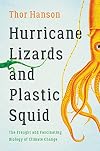
Hurricane Lizards and Plastic Squid by Thor Hanson is enjoyable and accessible science writing that will appeal to a large demographic. “When complex ideas are attached to a narrative, they immediately become more relatable,” Hanson writes in his introduction. And he does a marvelous job of telling stories of climate change’s impact on species whose ecosystems are changing, the species changing, or dying, in response. And as Hanson takes us across the world, the book is an ecological show more travelogue.
We humans have known climate change has been happening, yet continued to believe it was ‘coming.’ Changing our lives and cultures hasn’t happened. And now, plants and animals across the globe are showing us that the change is already here. They are modifying their behaviors, even if we haven’t.
We are seeing before our eyes rapid changes in climate and shifting ecosystems. What can we learn from species adapting to these changes?
Hanson visits Waldon Pond, a major source of harvested ice in Thoreau’s time, while he found ice barely 2″ thick in February. He tells stories of the “greatest redistribution of species since the last ice age,” as Gretta Pecl stated. Some plants and animals “roll with the punches.” That gives some hope.
The book is illustrated with photographs. The ‘hurricane lizards,’ for instance, are shown during a wind test to see how they coped with gale force winds. Those with the largest toe pads could cling better. Those lizards survived the hurricanes.
The book is as enjoyable to read as it is informative. show less
We humans have known climate change has been happening, yet continued to believe it was ‘coming.’ Changing our lives and cultures hasn’t happened. And now, plants and animals across the globe are showing us that the change is already here. They are modifying their behaviors, even if we haven’t.
We are seeing before our eyes rapid changes in climate and shifting ecosystems. What can we learn from species adapting to these changes?
Hanson visits Waldon Pond, a major source of harvested ice in Thoreau’s time, while he found ice barely 2″ thick in February. He tells stories of the “greatest redistribution of species since the last ice age,” as Gretta Pecl stated. Some plants and animals “roll with the punches.” That gives some hope.
The book is illustrated with photographs. The ‘hurricane lizards,’ for instance, are shown during a wind test to see how they coped with gale force winds. Those with the largest toe pads could cling better. Those lizards survived the hurricanes.
The book is as enjoyable to read as it is informative. show less
Lists
Awards


You May Also Like


Associated Authors
Statistics
- Works
- 11
- Members
- 1,435
- Popularity
- #17,925
- Rating
- 4.0
- Reviews
- 62
- ISBNs
- 53
- Languages
- 7
- Favorited
- 1