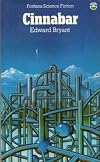
Cinnabar
by Edward Bryant
On This Page
Description
In the city at the center of time, paradox is just another urban renewal project.All time and all possibilities converge in the city of Cinnabar. to experience its magic you must:Seek entrances both near and far... Cross uncountable parsecs and millennia... Look beyond the mirror... Try that odd freeway exit you've never taken... Follow the yellow brick road... Turn left at the north star and go straight on till morning...Or... use this book as your map. Here are some of your traveling show more companions:Tourmaline Hayes, beautiful Network sex star, the compleat tourist.Obregon, the completely nonspecialized scientist and inventor of a time machine.Leah Sand, melancholy media artist.Jade Blue, the computer-created cat-mother.Cougar Lou Landis, once a pudgy adolescent, now the last hero.Sidhe, the great white shark that voyaged 350 million years.Harry Vincent Blake, a 20th century student who fell down the rabbit hole.Terminex, the ultimate, though only intermittently sane, computer.These and many more will accompany you on a phantasmagorical expedition through a city where the choice of alternatives, be they biological, social, or technological, is infinite.Among the Dead, Bryant's first book, was grim in tone; though at the core there were as many affirmative as negative visions. Still the book's predominant portraits were painted in shades of gray to black. Bryant was exorcising his nightmares.Cinnabar, on the other hand, is written in splashes of brighter-than-life color, supplied from the palette of Bryant's better dreams. It is the author's hope that at some point in the reading of this book, you'll wish you were in Cinnabar rather than where you are now.Because of Ed's financial needs, almost all the profits from this book go directly to Ed. Donations to help with Ed's medical and other financial needs are also most appreciated via www.FriendsOfEd.org. Thank you!Critical Acclaim for Edward Bryant and Among the Dead"Not since Harlan Ellison has there been so energetic an author; when you read Bryant, you are in good hands."-Theodore Sturgeon, New York Times"These are contemporary horror stories with monsters more frightening than old-fashioned ghosts and vampires."-Kirkus Reviews."Compelling and totally unnerving."-Chicago Tribune"Brilliant, mythopoeic science fiction stories of events leading to the Apocalypse."-E. Nelson Hayes, Boston Patriot Ledger"...a finely crafted example of justifiable paranoia in black and white; poetic, surrealistic, cynically humorous, and all too believable."-Jim Anderson, Colorado Daily"Bryant is a major talent."-Richard Lupoff, Algol."...his first book is very good indeed. Bryant writes both black humor and weird tales with a flair."-Olga Curtis, Denver Post"...the work of a very gifted author and the most impressive science-fiction collection by a new writer in many years."-Kirby McCauley, Minneapolis Sunday Tribune show lessTags
Recommendations









Member Reviews
This book is isn't a novel; it's a collection of short stories with a common setting and overlapping sets of characters. This kind of thing isn't done that much anymore (unless by Alexander McCall Smith) but was not so terribly unusual in the SF genre back when magazines were still at least on equal terms with paperback books. In this case the common setting is Cinnabar, the City at the Centre of Time, which is not a Utopia, but stands alongside some other Cities of the fantastical literary genres as a place that many real people would like to go to, at least for a visit. (Moorcock's Tanelorn and M. John Harrison's Viriconium are two such kindred Urbs.) Indeed in one story, an adolescent male is forcibly, though accidentally, dragged show more from the 1960s to Cinnabar, which may be the only human community left in its time. This simple device allows Bryant to contrast the culture he was writing in with the culture he was writing about very effectively. What is Cinnabar like, then?
When I first read the book I was a teen (like the visitor to Cinnabar) and I was greatly impressed by the book. Twenty or so years later I remembered liking it greatly for its atmosphere and for one story in particular...Sharking Down. I didn't remember much detail about the city, just an over-all notion of other-worldly, dream-like strangeness. Re-reading it I find that this is because the place is not described in great detail and it is placed between the sea and the desert, between two empty worlds. One's imagination is allowed to work on it as new locales and oddities and strange characters are introduced, never filling the place, indeed leaving it still largely empty and unexplored. There is so much room for more stories that seem never to have appeared. I forgot just how much sex there is in Cinnabar - seems like they hardly have time for anything else! Sometimes it's a distraction but over-all it is a big aspect of what Bryant was writing about - 30 or so years after its publication we aren't really much closer to the exceedingly permissive attitudes he gives his characters and it seems to me that one reason amongst many is that the problem of disease has got worse rather than better.
One thing I did not forget is Sharking Down. Because I love it. It is the penultimate story of the collection and spends much of its time on matters extraneous to the central plot, setting things up for the final story - I'd forgotten all that - but I'd remembered accurately the main thrust and plot of the story, which is about sharks. Not just any old sharks, either, but two Carcharodon Megalodon - apparently the largest sharks to have swum the oceans of Earth, 20m long as full grown adults. One of these has been ressurected through genetic means, the other is a synthetic reconstruction - and the latter was specifically built to fight the former. What happens I shall not say and why it happens - well, see if you can figure it out from the cryptic clues given in the earlier part of the story.
I've told people the story of Sharking Down repeatedly, cutting it to its bare essentials, so that it has taken on a sort of oral tradition in my mind and in some ways that version is better than Bryant's - but only outside the context of the book. Within it, Bryant rules. Why do I love this essentially simple story? Because it is about sharks, and I love sharks, as did Bryant. And if you're going to have a fantastical story about sharks, why bother with Great Whites or Tigers? Why not go for the Ultimate Shark, instead? Hence Megalodon. It's a great story - but perhaps if you don't admire a-moral predators as much as I do you won't think so.
Over all this re-reading of Cinnabar was enjoyable but many of the SF ideas presented which seemed radical to me twenty years ago are rather old hat now - the book survives mainly on its atmosphere, characters and pair of really big fish...
****************************************************************************************************
On reading for a third time, I notice that the two stand-out stories are those I give some details of above: the one where Cinnabar receives a visitor from 1963 and Sharking Down. There are many subtleties in the latter that I am not sure I had noticed previously. For instance, the name of the genetically resurrected shark has been carefully chosen by the author to have multiple symbolic meanings in relation to the rest of the story and the title also has multiple interpretations.
I should try to dig up more by Bryant; there is another short story collection, at least. show less
When I first read the book I was a teen (like the visitor to Cinnabar) and I was greatly impressed by the book. Twenty or so years later I remembered liking it greatly for its atmosphere and for one story in particular...Sharking Down. I didn't remember much detail about the city, just an over-all notion of other-worldly, dream-like strangeness. Re-reading it I find that this is because the place is not described in great detail and it is placed between the sea and the desert, between two empty worlds. One's imagination is allowed to work on it as new locales and oddities and strange characters are introduced, never filling the place, indeed leaving it still largely empty and unexplored. There is so much room for more stories that seem never to have appeared. I forgot just how much sex there is in Cinnabar - seems like they hardly have time for anything else! Sometimes it's a distraction but over-all it is a big aspect of what Bryant was writing about - 30 or so years after its publication we aren't really much closer to the exceedingly permissive attitudes he gives his characters and it seems to me that one reason amongst many is that the problem of disease has got worse rather than better.
One thing I did not forget is Sharking Down. Because I love it. It is the penultimate story of the collection and spends much of its time on matters extraneous to the central plot, setting things up for the final story - I'd forgotten all that - but I'd remembered accurately the main thrust and plot of the story, which is about sharks. Not just any old sharks, either, but two Carcharodon Megalodon - apparently the largest sharks to have swum the oceans of Earth, 20m long as full grown adults. One of these has been ressurected through genetic means, the other is a synthetic reconstruction - and the latter was specifically built to fight the former. What happens I shall not say and why it happens - well, see if you can figure it out from the cryptic clues given in the earlier part of the story.
I've told people the story of Sharking Down repeatedly, cutting it to its bare essentials, so that it has taken on a sort of oral tradition in my mind and in some ways that version is better than Bryant's - but only outside the context of the book. Within it, Bryant rules. Why do I love this essentially simple story? Because it is about sharks, and I love sharks, as did Bryant. And if you're going to have a fantastical story about sharks, why bother with Great Whites or Tigers? Why not go for the Ultimate Shark, instead? Hence Megalodon. It's a great story - but perhaps if you don't admire a-moral predators as much as I do you won't think so.
Over all this re-reading of Cinnabar was enjoyable but many of the SF ideas presented which seemed radical to me twenty years ago are rather old hat now - the book survives mainly on its atmosphere, characters and pair of really big fish...
****************************************************************************************************
On reading for a third time, I notice that the two stand-out stories are those I give some details of above: the one where Cinnabar receives a visitor from 1963 and Sharking Down. There are many subtleties in the latter that I am not sure I had noticed previously. For instance, the name of the genetically resurrected shark has been carefully chosen by the author to have multiple symbolic meanings in relation to the rest of the story and the title also has multiple interpretations.
I should try to dig up more by Bryant; there is another short story collection, at least. show less
Rather 1970s short stories set in a now-familiar type of locale: city of the future inhabited by a few rich dilettantes engaged in advanced science, futuristic entertainment, and parties, their lives prolonged indefinitely by biotechnology, with some simulacra and semi-artificial persons for variety, a few mostly-offstage Luddites who throw stones and think babies should grow in their mothers' bodies, and a near-omniscient central computer. Throw in a radiating time-distortion based at the city centre, a time traveller from 1963 (22nd November, now who'd have thought it?), and some sex, sharks, and necrophilia and you've more or less got it. The overtones are mainly Heinlein and Ray Bradbury.
MB 1-iii-2013
MB 1-iii-2013
Ratings
Members
- Recently Added By
Author Information

74+ Works 916 Members
Some Editions
Awards and Honors
Awards
Series
Belongs to Publisher Series
Work Relationships
Contains
Common Knowledge
- Canonical title
- Cinnabar
- Original title
- Cinnabar
- Original publication date
- 1976-08
- Epigraph
- "Perhaps the most powerfully symbolic natural substance of all, that has a profound meaning, is cinnabar. This is a rosy-purple crystalline stone, sulphide of mercury. Ground up, it is the red pigment used in painting. But... (show all) in Taoist symbolism and magic it represents the nuclear energy of joined yang in yin, which is to be fired in the internal crucible by alchemical yoga, to generate the yogi's immortality -- just as mercury is produced from the rock by calcining it, when the sulphur releases a shining metallic fluid."
Philip Rawson and Lazlo Legeza (from Tao) - Dedication
- This one is for the members of the Denver and Colorado Springs SF Writers' Workshops; but it is especially for Doris Beetem the Elder, first honorary citizen of Cinnabar.
- First words
- The Road to Cinnabar It wove through the warp of the desert; a dusty trail looping around wind-eroded buttes, over dry stream beds, among clumps of gray scrub brush.
- Last words
- (Click to show. Warning: May contain spoilers.)Dying Cinnabar waits.
- Publisher's editor*
- Alpers, Hans Joachim
- Original language*
- Englisch
*Some information comes from Common Knowledge in other languages. Click "Edit" for more information.
Classifications
Statistics
- Members
- 230
- Popularity
- 141,484
- Reviews
- 2
- Rating
- (3.31)
- Languages
- English, German, Japanese, Spanish
- Media
- Paper, Ebook
- ISBNs
- 8
- ASINs
- 7