On This Page
Description
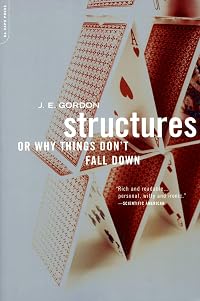
In a book that Business Insider noted as one of the "14 Books that inspired Elon Musk," J. E. Gordon strips engineering of its confusing technical terms, communicating its founding principles in accessible, witty prose. For anyone who has ever wondered why suspension bridges don't collapse under eight lanes of traffic, how dams hold back-or give way under-thousands of gallons of water, or what principles guide the design of a skyscraper or a kangaroo, this book will ease your anxiety and show more answer your questions. J. E. Gordon strips engineering of its confusing technical terms, communicating its founding principles in accessible, witty prose. show lessTags
Recommendations













Member Reviews
Finally finished this after an abortive start a few years ago (the original ebook produced chapters in a totally random order). It's an interesting and fairly accessible look at how structures and materials work. My basic scientific background definitely helped, but the book is full of diagrams and examples - and it helpfully emphasises that the equations can be skipped.
That being said, it was originally published in 1978, the author flourished in the 1940s, and that does show up both in the examples used and in the odd, dated way he talks about women in a few places (nothing pervy, not complaining women can't be engineers or anything - just odd). Presumably it's been updated somewhat for the 1991 edition, but that's still 30 years of show more social progress. There's probably a better equivalent out there nowadays. show less
That being said, it was originally published in 1978, the author flourished in the 1940s, and that does show up both in the examples used and in the odd, dated way he talks about women in a few places (nothing pervy, not complaining women can't be engineers or anything - just odd). Presumably it's been updated somewhat for the 1991 edition, but that's still 30 years of show more social progress. There's probably a better equivalent out there nowadays. show less
Structures, or Why Things Don't Fall Down
J.E. Gordon
May 22, 2013
A Folio reprint of a 1978 book on engineering, mostly engineering materials. The author seems to be an engineer possibly summing up his career, with a direct and opinionated voice. He explains technical details artfully, describing Young's modulus of elasticity, mathematics of cantilevers, and the desirable properties of wood. The volume has excellent, but too few photographs, and good stories of structures that were unexpectedly good and spectacularly bad.
J.E. Gordon
May 22, 2013
A Folio reprint of a 1978 book on engineering, mostly engineering materials. The author seems to be an engineer possibly summing up his career, with a direct and opinionated voice. He explains technical details artfully, describing Young's modulus of elasticity, mathematics of cantilevers, and the desirable properties of wood. The volume has excellent, but too few photographs, and good stories of structures that were unexpectedly good and spectacularly bad.
: A book that simplifies the basics of engineering and I still found it tough reading. I enjoyed the examples he gives, but the general concepts in dry form were hard to comprehend. It still is worth reading in only that it makes you think of the way things are made; natural and man-made.
Very interesting book, I learned a lot. Gordon's prose is readable. He is also opinionated and throws in just the right number of anecdotes. I read this book while also watching the "Great Courses" class, "Understanding the World's Greatest Structures," by Stephen Ressler, and think those lectures covered a lot of the same material but with more compelling examples, buildings and bridges.
Стигнах някъде до 20% и се отказах - книгата страхотно описва историята, практиката и математиката на инженерните достижения, свързани с качествата на сгради и съоръжения, но в мен няма грам инженерна и математическа жилка така че се отказах със съжаление.
Interesting. Easy to understand. Somewhat old fashioned writing style.
Definitely read this book if you're planning on building things; memorize it if you're planning on building things in public.
Members
- Recently Added By
Lists

Best Science Books for Non-Scientists
113 works; 57 members

Recommend the 20 best books you've read in the last five years
2,168 works; 607 members

Mechanical Engineering
10 works; 1 member
Author Information
4 Works 1,569 Members
Some Editions
Series

Common Knowledge
- Original title
- Structures: Or Why Things Don't Fall Down
- Original publication date
- 1978
- Quotations
- What we find difficult about mathematics is the formal, symbolic presentation of the subject by pedagogues with a taste for dogma, sadism and incomprehensible squiggles.
Classifications
- Genres
- Science & Nature, Nonfiction, Art & Design, General Nonfiction, Technology
- DDC/MDS
- 624.1 — Applied science & technology Engineering Bridges & Tunnels Structural Engineering
- LCC
- TA645 .G65 — Technology Engineering Civil engineering (General). Engineering (General). Civil engineering (General) Structural engineering (General)
- BISAC
Statistics
- Members
- 1,020
- Popularity
- 25,558
- Reviews
- 9
- Rating
- (3.89)
- Languages
- 6 — Dutch, English, Estonian, French, Italian, Spanish
- Media
- Paper, Ebook
- ISBNs
- 16
- ASINs
- 5
