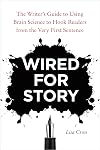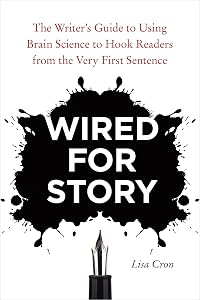
Wired for Story: The Writer's Guide to Using Brain Science to Hook Readers from the Very First Sentence
by Lisa Cron
On This Page
Description
"This guide reveals how writers can take advantage of the brain's hard-wired responses to story to captivate their readers' minds through each plot element"--Provided by publisher.Tags
Recommendations

Member Reviews
Wow! This is the book I have spent years searching for. This is the first book I have read that explains the process of storytelling. Lisa Cron has cracked the storytelling code and reveals its secrets.
Our brains actually are wired for story. Stories help us identify and remember what is most important, connect events, experiment safely, anticipate consequences, teach, play, and learn. A good story draws us in so completely that we become lost in the story and unable to know why it works. As a result we quickly dismiss a boring or disorganized story, yet the explicit understanding of how to go about crafting a good story remains elusive.
So many disappointing books on storytelling describe stories without providing the instructional show more insight needed to understand what makes them tick. It’s like trying to learn algebra by pouring over an endless collection of calculations, without even knowing which ones are correct and which ones are not. This book closes that gap—it actually clearly identifies and teaches the mechanisms of great storytelling.
In each of a dozen enlightening and well-written chapters the author presents a finding from cognitive science, translates it into practical advice for storytelling, expands on those ideas, helps us understand what works and why, provides clear examples, corrects some myths, and ends with a practical check list.
This book was a joy to read, and light bulbs were lighting up on every page. This book may just unveil the secret to crossing the chasm that separates tedious writing from good storytelling. show less
Our brains actually are wired for story. Stories help us identify and remember what is most important, connect events, experiment safely, anticipate consequences, teach, play, and learn. A good story draws us in so completely that we become lost in the story and unable to know why it works. As a result we quickly dismiss a boring or disorganized story, yet the explicit understanding of how to go about crafting a good story remains elusive.
So many disappointing books on storytelling describe stories without providing the instructional show more insight needed to understand what makes them tick. It’s like trying to learn algebra by pouring over an endless collection of calculations, without even knowing which ones are correct and which ones are not. This book closes that gap—it actually clearly identifies and teaches the mechanisms of great storytelling.
In each of a dozen enlightening and well-written chapters the author presents a finding from cognitive science, translates it into practical advice for storytelling, expands on those ideas, helps us understand what works and why, provides clear examples, corrects some myths, and ends with a practical check list.
This book was a joy to read, and light bulbs were lighting up on every page. This book may just unveil the secret to crossing the chasm that separates tedious writing from good storytelling. show less
Every writer should read this book. It has great insight into how the brain and the written word interface and the avenue is via story. Fantastic learning tool for writers of all ability levels.
I was turned on to Wired for Story through an interview Chuck Wendig did with Lisa Cron in July 2012 for his blog Terribleminds. She gave us her views on developing story. Lisa has a very fresh take on the importance of STORY and how it relates to the human brain. She is a producer for Showtime and Court TV, a writer, and also teaches a writing course at UCLA, but spent the last ten years researching the connection between neuroscience and how the brain relates to stories. It’s quite fascinating and illuminating, allowing us to learn techniques show more that will make our story click with the reader. They can’t help themselves, the brain is hard wired for receiving stories and if we can strike the right chord it will resonate within the readers mind.
On Lisa's blog she touched on why books that get panned by critiques can still sell at amazing rates. It answers the question as to why books like 50 Shades of Gray can sell millions of books. I remember picking up The Hunger Games, because my wife and daughter love it, and reading the first couple of pages and saying to myself, the prose just aren’t all that, but next thing I knew I was 100 pages in and couldn’t put it down. Stephanie Myers' Twilight books have been criticized for not having elaborate prose also, but the one thing all of these books have in common is they tell a great story and in a way that touches those chords in the mind.
Wired for Story is broken down into twelve chapters with a cognitive hook and a writer's shortcut she calls the story secret for each chapter. She gives us concrete examples for each section of the book and breaks down what the writer is doing.
The concept is amazing -- we are designed to think in story form. It allows us to use a form of mental telepathy with the story teller, that when done right is an experience almost as visceral as the real thing. It allows us to learn by using the experience of the story instead of having to live through something to learn it the hard way. It has certainly saved lives. The takeaway for Lisa is that we need to hook the reader from the very first sentence. She opens up her book with some fascinating facts about how the brain filters the 11 million bits of information that are bombarding us every second. Wham, she has me right away. Learning through story has been saving mankind since the stone age.
Next, she explain in very clear terms what story actually is:
"What happens" is the plot.
"Someone" is the protagonist.
The "Goal" is what's known as the story question.
And "how he or she changes" is what the story itself is actually about.
As counterintuitive as it may sound, a story is not about the plot or even what happens in it. Stories are about how we, rather than the world around us, change.
She continues with ways to hook the reader. Tidbits like "nothing focuses the mind like surprise" and "we are looking for a reason to care" and "we need to meet the protagonist as soon as possible" cut right through the b. s. and give us concrete clues. She describes the reasons we need to be clear in our writing so that the reader can anticipate what might happen next. That is what will keep them turning the page.
She also has an interesting take on writing style. She claims that "learning to 'write well' is not synonymous with learning to write a story. And of the two, writing well is secondary." This probably won't go down well with literary fiction fans, but for genre writers the message is clear -- tell us an interesting story.
She describes the relationship of theme with plot and how tone is just as important has what you are saying. The key to the whole thing lies with emotion. It determines the meaning of everything. If we aren't feeling we aren't conscious, and we certainly aren't reading the book if it's not reaching us on an emotional level.
She breaks down the use of POV for conveying feelings and thoughts. She is not a fan of head hopping, because it is so jarring if done poorly.
She describes the essence of why showing is so much more effective than telling.
Cause and effect has its own chapter and it clearly delineates why each scene should ask "What is at stake here?" Everything needs to be connected together so that it can make sense. She also discusses how to stay focused on the cause and effect and still keep things unpredictable.
She closes the book with a chapter on revision and how to do it right, adding in the layers that take a book to the next level. This book is so chock full of useful advice, and I've only touched on a few things here. It should be mandatory reading for every beginning level writing course. She opened my eyes to thinking about writing in a completely different way. The tools are the same, but it's all in the focus. I can't say enough positive things about this brilliant book. show less
I was turned on to Wired for Story through an interview Chuck Wendig did with Lisa Cron in July 2012 for his blog Terribleminds. She gave us her views on developing story. Lisa has a very fresh take on the importance of STORY and how it relates to the human brain. She is a producer for Showtime and Court TV, a writer, and also teaches a writing course at UCLA, but spent the last ten years researching the connection between neuroscience and how the brain relates to stories. It’s quite fascinating and illuminating, allowing us to learn techniques show more that will make our story click with the reader. They can’t help themselves, the brain is hard wired for receiving stories and if we can strike the right chord it will resonate within the readers mind.
On Lisa's blog she touched on why books that get panned by critiques can still sell at amazing rates. It answers the question as to why books like 50 Shades of Gray can sell millions of books. I remember picking up The Hunger Games, because my wife and daughter love it, and reading the first couple of pages and saying to myself, the prose just aren’t all that, but next thing I knew I was 100 pages in and couldn’t put it down. Stephanie Myers' Twilight books have been criticized for not having elaborate prose also, but the one thing all of these books have in common is they tell a great story and in a way that touches those chords in the mind.
Wired for Story is broken down into twelve chapters with a cognitive hook and a writer's shortcut she calls the story secret for each chapter. She gives us concrete examples for each section of the book and breaks down what the writer is doing.
The concept is amazing -- we are designed to think in story form. It allows us to use a form of mental telepathy with the story teller, that when done right is an experience almost as visceral as the real thing. It allows us to learn by using the experience of the story instead of having to live through something to learn it the hard way. It has certainly saved lives. The takeaway for Lisa is that we need to hook the reader from the very first sentence. She opens up her book with some fascinating facts about how the brain filters the 11 million bits of information that are bombarding us every second. Wham, she has me right away. Learning through story has been saving mankind since the stone age.
Next, she explain in very clear terms what story actually is:
"What happens" is the plot.
"Someone" is the protagonist.
The "Goal" is what's known as the story question.
And "how he or she changes" is what the story itself is actually about.
As counterintuitive as it may sound, a story is not about the plot or even what happens in it. Stories are about how we, rather than the world around us, change.
She continues with ways to hook the reader. Tidbits like "nothing focuses the mind like surprise" and "we are looking for a reason to care" and "we need to meet the protagonist as soon as possible" cut right through the b. s. and give us concrete clues. She describes the reasons we need to be clear in our writing so that the reader can anticipate what might happen next. That is what will keep them turning the page.
She also has an interesting take on writing style. She claims that "learning to 'write well' is not synonymous with learning to write a story. And of the two, writing well is secondary." This probably won't go down well with literary fiction fans, but for genre writers the message is clear -- tell us an interesting story.
She describes the relationship of theme with plot and how tone is just as important has what you are saying. The key to the whole thing lies with emotion. It determines the meaning of everything. If we aren't feeling we aren't conscious, and we certainly aren't reading the book if it's not reaching us on an emotional level.
She breaks down the use of POV for conveying feelings and thoughts. She is not a fan of head hopping, because it is so jarring if done poorly.
She describes the essence of why showing is so much more effective than telling.
Cause and effect has its own chapter and it clearly delineates why each scene should ask "What is at stake here?" Everything needs to be connected together so that it can make sense. She also discusses how to stay focused on the cause and effect and still keep things unpredictable.
She closes the book with a chapter on revision and how to do it right, adding in the layers that take a book to the next level. This book is so chock full of useful advice, and I've only touched on a few things here. It should be mandatory reading for every beginning level writing course. She opened my eyes to thinking about writing in a completely different way. The tools are the same, but it's all in the focus. I can't say enough positive things about this brilliant book. show less
This is better than a craft book. It made me change how I think about story - how I plan a book. I'm a pantser, so all the 'rule' books don't work for me. This one did.
I planned a story while I read this, taking notes as I went. I can't tell you how much better the story is going to be for it!
I have tons of craft books. This is in my top 5!
I planned a story while I read this, taking notes as I went. I can't tell you how much better the story is going to be for it!
I have tons of craft books. This is in my top 5!
This book is mainly writing instruction, and it covers the same ground as many other books out there. The author's unique approach was to add some basics of brain science that are relevant to reading and writing fiction. That part is certainly interesting and worth a read if it intrigues you. But if it doesn't, and you're familiar with basic writing advice, you may not get much from this book.
5 stars, with a reservation. You can't say that science tells us what a good story is. Instead examples are cherry picked from neuroscience, psychology and Jonah Lehrer to make points. But they are good points. They're sometimes points that are very similar to Ben Bova's guide on writing scifi, but they're points well made. I'll need to re-read it, but I think it could help immensely with storytelling.
Lisa Cron wrote Wired for Story to assist authors on how people think as they read a story. It's the science behind what makes the reader continue to read.
I've always heard show not tell---but Cron goes deeper to show not just the facial expressions and posture of the person, but the 'why's, the reason why they are sad,... This showing takes storytelling to a deeper level and brings the reader along with the author.
A very well presented and helpful guide to the reasons behind how authors should write.
I've always heard show not tell---but Cron goes deeper to show not just the facial expressions and posture of the person, but the 'why's, the reason why they are sad,... This showing takes storytelling to a deeper level and brings the reader along with the author.
A very well presented and helpful guide to the reasons behind how authors should write.
Compelled by the title, I chose the book to read. It started off on an interesting note, but soon I realised it is specifically for the fiction writers, and not for copywriters in general. So, didn't find much to my benefits.
Members
- Recently Added By
Lists

GraceCollection TBR/To Buy List
106 works; 1 member
Author Information

3+ Works 1,312 Members
Lisa Cron has worked as a literary agent, TV producer, and story consultant for Warner Brothers and the William Morris Agency, She teaches in the UCLA Extension Writers' Program and is on the faculty of the School of Visual Arts MFA in Visual Narrative program. The author of Wired for Story, Cron splits her time between Santa Monica and New York show more City. show less
Classifications
Statistics
- Members
- 609
- Popularity
- 47,965
- Reviews
- 11
- Rating
- (4.15)
- Languages
- Chinese, English
- Media
- Paper, Audiobook, Ebook
- ISBNs
- 7
- ASINs
- 3