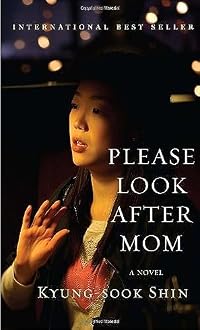
Please Look After Mom
by Kyung-Sook Shin
On This Page
Description
Follows the efforts of a family to find the mother who went missing from Seoul Station and their sobering realizations when they recall memories that suggest she may not have been happy.Tags
Recommendations











Member Reviews
I didn’t expect to enjoy this as much as I did; usually family dramas don’t interest me. But something about the sparse prose, the effective use of second person narration, and the clarity of its themes turned this simple, subdued story into a special experience. It’s reflective, quiet, tender, and thoughtful, illuminating the web of connections that form our lives and the people—mothers, spouses, siblings—who are so entrenched in our day-to-day routines that we stop thinking of them as separate from ourselves, with their own desires and dreams. The main takeaway from Please Look After Mom is that it’s imperative we draw aside the veil of mundaneness and really tell these people we love them and respect them, and try to show more understand them, before a sudden loss highlights their absence by the jagged edges it leaves behind.
”Before she went missing, you spent your days without thinking about your wife. When you did think about her, it was to ask her to do something, or to blame her or ignore her. Habit can be a frightening thing.”
____________________
Global Challenge: South Korea show less
”Before she went missing, you spent your days without thinking about your wife. When you did think about her, it was to ask her to do something, or to blame her or ignore her. Habit can be a frightening thing.”
____________________
Global Challenge: South Korea show less
I really liked this, and I seem to have a very different understanding of it than any other reviews I have read. Here is what it was about to me very briefly stated: Each chapter is written from a child or spouse’s point of view; and everyone knew a different version of the mom that was shaped by their own needs and expectations of her rather than who she actually was as a stand-alone person. Final chapter is written from the mom’s perspective: she, essentially, is saying “bye” to everyone. Her “disappearance" illustrated how women disappear when they become moms. Epilogue was her daughter --now with her own family-- realizing she didn’t know her mom as she realizes SHE is becoming unknown and disappearing, too.
This is a zinger of a novel. (And why, why, why, I ask, am I reading this novel at this time? So mysterious.) No one is looking after Mom and, after a while, Mom just wanders off. Her family doesn't even realize she is missing until she has been lost for some time.
And where does she go? No one knows for sure, but her family sees her, or what they think is her, everywhere.
Told alternately from the point-of-view of the various family members, this is a powerful story. I think I would love it even if I wasn't trying harder than I've ever tried in my life to Look After Mom myself.
And where does she go? No one knows for sure, but her family sees her, or what they think is her, everywhere.
Told alternately from the point-of-view of the various family members, this is a powerful story. I think I would love it even if I wasn't trying harder than I've ever tried in my life to Look After Mom myself.
Kyung-sook Shin is a prolific and extremely popular South Korean author. Please Look After Mom was her first novel to be translated into English, and was the first novel by a South Korean and a woman to win the Man Asian Literary Prize. For these reasons, I was looking forward to reading the book, but I had a hard time getting into it. Fortunately I persevered, as I ended up enjoying it quite a bit.
The novel opens with a family trying to create a missing persons flyer for their mother/wife. In the process they realize that none of them truly knew her. In the months that follow, memories surface, relationships are reflected upon, and a myriad of feelings emerge. Although the book is narrated in the second person, each chapter is told show more from the perspective of a different person: the daughters, the oldest son, and the father. There is even a chapter by the mother, and it is only at this point that we learn the woman's name. As each perspective is layered atop the previous ones, the character of the woman they called Mom is developed further.
My initial difficultly in connecting with the book stems in large part from the second person narration. At first I had trouble tracking who "you" was, and it sounded forced to my inner ear. But as I became more engaged, I ceased to notice it as much, and when I finished, I realized why the author chose to use this technique. By inundated the reader with "you", the distinction between reader and character is less clear, and it's impossible not to reflect on one's own family relationships.
The life of the woman at the center of the story is a difficult one. Poor, illiterate, and ignored, she nonetheless sacrifices to ensure that her children succeed in life. Although in her children's eyes, her absence and their guilt combine to beatify her, even going so far as to invoke images of the Pieta, Park So-nyo is a multi-faceted character with some interesting secrets and dimensions.
Please Look After Mom can be read as a universal story of mother-child relationships, or as a South Korean one, with particular emphasis on the tension between the responsibility to care for one's parents and the desire to live independently, and the importance of birth order and gender in sibling relationships. After reading a short biography of the author, I wonder if there are autobiographical elements as well. Like the oldest daughter in the book, Kyung-sook Shin was born into a large family in a rural village but moved as a teenager to Seoul to live with her elder brother and became a successful author. show less
The novel opens with a family trying to create a missing persons flyer for their mother/wife. In the process they realize that none of them truly knew her. In the months that follow, memories surface, relationships are reflected upon, and a myriad of feelings emerge. Although the book is narrated in the second person, each chapter is told show more from the perspective of a different person: the daughters, the oldest son, and the father. There is even a chapter by the mother, and it is only at this point that we learn the woman's name. As each perspective is layered atop the previous ones, the character of the woman they called Mom is developed further.
My initial difficultly in connecting with the book stems in large part from the second person narration. At first I had trouble tracking who "you" was, and it sounded forced to my inner ear. But as I became more engaged, I ceased to notice it as much, and when I finished, I realized why the author chose to use this technique. By inundated the reader with "you", the distinction between reader and character is less clear, and it's impossible not to reflect on one's own family relationships.
The life of the woman at the center of the story is a difficult one. Poor, illiterate, and ignored, she nonetheless sacrifices to ensure that her children succeed in life. Although in her children's eyes, her absence and their guilt combine to beatify her, even going so far as to invoke images of the Pieta, Park So-nyo is a multi-faceted character with some interesting secrets and dimensions.
Please Look After Mom can be read as a universal story of mother-child relationships, or as a South Korean one, with particular emphasis on the tension between the responsibility to care for one's parents and the desire to live independently, and the importance of birth order and gender in sibling relationships. After reading a short biography of the author, I wonder if there are autobiographical elements as well. Like the oldest daughter in the book, Kyung-sook Shin was born into a large family in a rural village but moved as a teenager to Seoul to live with her elder brother and became a successful author. show less
One woman. That woman disappeared, bit by bit, having forgotten the joy of being born and her childhood and dreams, marrying before her first period and having five children and raising them. . . . The woman whose life was marred with sacrifice until the day she went missing.
An elderly woman becomes separated from her husband in a busy city as they prepare to board a train. The family join forces to look for her. I enjoyed my glimpses of Korean culture, from the days of the Korean War, when whole families slept together in one room to stay warm, to contemporary times with the searchers using cell phones. On this backdrop, the thoughts and regrets of her husband and children form the core of the story.
Memories infuse them and leave the show more pain of regret.
Her husband: The thing your wife said to you most frequently, ever since you met her when you were twenty, was to walk more slowly. How could you have not gone slower, when your wife asked you to slow down your entire lives? You'd stopped and waited for her, but you'd never walked next to her, conversing with her, as she wanted – not even once. Since your wife has gone missing, your heart feels as if it will explode every time you think about your fast gait.
Eldest daughter: Since you heard about Mom's disappearance, you haven't been able to focus on a single thought, besieged by long-forgotten memories unexpectedly popping up. And the regret that always trailed each memory. . . ”Did you like being in the kitchen? Did you like to cook?” Mom's eyes held yours for a moment. “I don't like or dislike the kitchen. I cooked because I had to. I had to stay in the kitchen so you could all eat and go to school. How could you only do what you like? There are things you have to do whether you like it or not.” Mom's expression asked, What kind of question is that? And then she murmured, “If you only do what you like, who's going to do what you don't like?”
Youngest daughter: If I can't live like Mom, how could she have wanted to live like that? Why did this thought never occur to me when she was with us? Even though I'm her daughter, I had no idea, so how alone must she have felt with other people? How unfair is it that all she did was sacrifice everything for us, and she wasn't understood by anyone?
Both sad to read and thought-provoking, this was a very special book. As quoted in the epigraph: O love, so long as you can love. - Franz Liszt show less
An elderly woman becomes separated from her husband in a busy city as they prepare to board a train. The family join forces to look for her. I enjoyed my glimpses of Korean culture, from the days of the Korean War, when whole families slept together in one room to stay warm, to contemporary times with the searchers using cell phones. On this backdrop, the thoughts and regrets of her husband and children form the core of the story.
Memories infuse them and leave the show more pain of regret.
Her husband: The thing your wife said to you most frequently, ever since you met her when you were twenty, was to walk more slowly. How could you have not gone slower, when your wife asked you to slow down your entire lives? You'd stopped and waited for her, but you'd never walked next to her, conversing with her, as she wanted – not even once. Since your wife has gone missing, your heart feels as if it will explode every time you think about your fast gait.
Eldest daughter: Since you heard about Mom's disappearance, you haven't been able to focus on a single thought, besieged by long-forgotten memories unexpectedly popping up. And the regret that always trailed each memory. . . ”Did you like being in the kitchen? Did you like to cook?” Mom's eyes held yours for a moment. “I don't like or dislike the kitchen. I cooked because I had to. I had to stay in the kitchen so you could all eat and go to school. How could you only do what you like? There are things you have to do whether you like it or not.” Mom's expression asked, What kind of question is that? And then she murmured, “If you only do what you like, who's going to do what you don't like?”
Youngest daughter: If I can't live like Mom, how could she have wanted to live like that? Why did this thought never occur to me when she was with us? Even though I'm her daughter, I had no idea, so how alone must she have felt with other people? How unfair is it that all she did was sacrifice everything for us, and she wasn't understood by anyone?
Both sad to read and thought-provoking, this was a very special book. As quoted in the epigraph: O love, so long as you can love. - Franz Liszt show less
Fascinating book, way outside my usual areas of reading.
Tells the story of a family and their responses when their mother/wife goes missing. The story is skilfully told in the voices of different family members, gradually revealing the dynamics of family relationships. There is much regret in reviewing their past interactions with the missing family member. What seemed normal/acceptable then, often seems heartless and cruel in the new circumstances. One of the strengths of the book is that such regrets are universal.
The book is set in the economic surge in Korea from the end of the Korean War in the 1950s through to the current time. From illiteracy and fear of not having enough food, to fear of not having enough time in the bustle of show more the modern world. Many of the relationship stresses are related to the changes in life and lifestyle that flowed from the economic boom. show less
Tells the story of a family and their responses when their mother/wife goes missing. The story is skilfully told in the voices of different family members, gradually revealing the dynamics of family relationships. There is much regret in reviewing their past interactions with the missing family member. What seemed normal/acceptable then, often seems heartless and cruel in the new circumstances. One of the strengths of the book is that such regrets are universal.
The book is set in the economic surge in Korea from the end of the Korean War in the 1950s through to the current time. From illiteracy and fear of not having enough food, to fear of not having enough time in the bustle of show more the modern world. Many of the relationship stresses are related to the changes in life and lifestyle that flowed from the economic boom. show less
Welp I loved this book. It had everything I like all jammed into one crazy quilt of a novel. There's lots of Korean details here and interesting food scenes. There's pathos and a bit of soap opera and history and life standing still in the Korean countryside and that exhausted sadness that inhabits seemingly all Korean books and in the middle of this there's the moment when you realize you're face to face with your own relationships and family and it's quite a shock. It's like the biggest ever reminder to pay attention as people change under the sameness of day to day life and you don't always see. Extremely readable.
Members
- Recently Added By
Published Reviews
ThingScore 50
In an odd way this brilliant book reminds me of Natsume Sōseki's 夏目漱石 (1867–1916) novel Kokoro こころ (1914). Natsume laments how much the Japanese lost in their mad rush to modernize during the Meiji period (1868–1912). Ms. Shin asks the same questions of Koreans a century later.
added by sgump
Penitence is, after all, this book’s whole point. Characters’ eyes begin watering, pooling with tears, brimming over, etc., as each one has the chance to realize that Mom was a treasure. (Bonus sobbing cue: Nobody knew that Mom was secretly working at an orphanage in her spare time.) Mom’s children start to see how wrong it was to abandon ancestral traditions for their busy, newfangled, show more heartless, stressed-out city lives. show less
added by Nickelini
An enormous publishing success in South Korea, this simple portrait of a family shocked into acknowledging the strength and heroic self-sacrifice of the woman at its center is both universal and socially specific.
added by Shortride
Lists

Recommend the 20 best books you've read in the last five years
2,167 works; 606 members

Top Five Books of 2014
1,064 works; 398 members
Top Five Books of 2016
795 works; 229 members

the mother of all novels (parenting theme)
15 works; 4 members

Books Read in 2017
4,248 works; 129 members

Recommendations for Ezra
12 works; 1 member

Mothers and Daughters
114 works; 11 members
Author Information

16+ Works 2,572 Members
Some Editions
Awards and Honors
Distinctions
Common Knowledge
- Canonical title*
- Waar is onze moeder
- Original title
- 엄마를 부탁해
- Original publication date
- 2008
- People/Characters
- Park So-nyo; Hyong-chol; Chi-hon
- Important places
- Seoul, South Korea
- Important events
- Korean War
- Epigraph
- O love, so long as you can love. - Franz Liszt
- First words
- It's been one week since Mom went missing.
- Quotations
- Since you heard about Mom's disappearance, you haven't been able to focus on a single thought, besieged by long-forgotten memories unexpectedly popping up. And the regret that always trailed each memory.
”Did you like being in the kitchen? Did you like to cook?” Mom's eyes held yours for a moment. “I don't like or dislike the kitchen. I cooked because I had to. I had to stay in the kitchen so you could all eat and g... (show all)o to school. How could you only do what you like? There are things you have to do whether you like it or not.” Mom's expression asked, What kind of question is that? And then she murmured, “If you only do what you like, who's going to do what you don't like?”
The thing your wife said to you most frequently, ever since you met her when you were twenty, was to walk more slowly. How could you have not gone slower, when your wife asked you to slow down your entire lives? You'd stopp... (show all)ed and waited for her, but you'd never walked next to her, conversing with her, as she wanted – not even once. Since your wife has gone missing, your heart feels as if it will explode every time you think about your fast gait.
If I can't live like Mom, how could she have wanted to live like that? Why did this thought never occur to me when she was with us? Even though I'm her daughter, I had no idea, so how alone must she have felt with other peo... (show all)ple? How unfair is it that all she did was sacrifice everything for us, and she wasn't understood by anyone?
One woman. That woman disappeared, bit by bit, having forgotten the joy of being born and her childhood and dreams, marrying before her first period and having five children and raising them. The woman who, at least when it ... (show all)came to her children, wasn't surprised or thrown off by anything. The woman whose life was marred with sacrifice until the day she went missing. - Last words
- (Click to show. Warning: May contain spoilers.)"Please, please look after Mom."
- Blurbers
- Brooks, Geraldine; Shteyngart, Gary; Danticat, Edwidge; Verghese, Abraham; Lee, Janice Y. K.
- Original language
- Korean
*Some information comes from Common Knowledge in other languages. Click "Edit" for more information.
Classifications
- Genres
- General Fiction, Fiction and Literature
- DDC/MDS
- 895.7 — Literature & rhetoric Literatures of other languages Literatures of East and Southeast Asia Korean
- LCC
- PL992.73 .K94 .O4613 — Language and Literature Languages and literatures of Eastern Asia, Africa, Oceania Languages of Eastern Asia, Africa, Oceania Korean language and literature Korean literature Individual authors and works
- BISAC
Statistics
- Members
- 1,723
- Popularity
- 12,758
- Reviews
- 112
- Rating
- (3.75)
- Languages
- 20 — Danish, Dutch, English, Finnish, French, German, Hebrew, Hindi, Hungarian, Indonesian, Italian, Korean, Norwegian (Bokmål), Polish, Slovenian, Spanish, Swedish, Turkish, Portuguese (Portugal), Chinese, traditional
- Media
- Paper, Audiobook, Ebook
- ISBNs
- 56
- ASINs
- 17