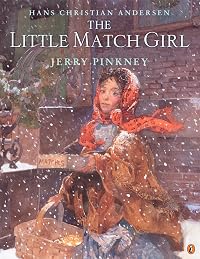
The Little Match Girl [Jerry Pinkney]
by Hans Christian Andersen
On This Page
Description
The wares of the poor little match girl illuminate her cold world, bringing some beauty to her brief, tragic life.Tags
Recommendations












Member Reviews
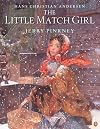
The Little Match Girl, illustrated by Jerry Pinkney.
The Little Match Girl - Andersen's tragic tale of a poor young match-seller who freezes to death one New Year's Eve - is transplanted from Denmark to the United States in Jerry Pinkney's lovely retelling. Set in an American city, sometime in the early twentieth century, the narrative follows its young heroine as she dodges carriages and automobiles, threading her way through a busy market, and trying to sell her matches and paper flowers. Eventually, defeated by the cold and indifferent world around her, and unable to return home for fear of a beating, she retreats to a sheltered corner, where she begins to light her matches, in an effort to keep warm...
Although I tend to be wary of show more folk and fairy-tale adaptations which divorce a tale from its own cultural context, every once in a while I happen across a book which manages to be both innovative and respectful. This is most certainly the case with Jerry Pinkney's The Little Match Girl, which highlights the universality of Andersen's tale, without doing any violence to its narrative. I liked that this match girl lived in a tenement, that her ethnic identity was ambiguous, and that the time-period was (somewhat) more modern. I also appreciated Pinkney's pencil, gouache and watercolor illustrations, which felt a little "rougher" than Rachel Isadora's or Anastassija Archipowa's, but had an expressive and emotive quality all their own. The scene where the little match girl remembers combing her grandmother's hair is particularly moving. A little different, but not too different, this version is a splendid addition to any Andersen lover's collection! show less
The Little Match Girl - Andersen's tragic tale of a poor young match-seller who freezes to death one New Year's Eve - is transplanted from Denmark to the United States in Jerry Pinkney's lovely retelling. Set in an American city, sometime in the early twentieth century, the narrative follows its young heroine as she dodges carriages and automobiles, threading her way through a busy market, and trying to sell her matches and paper flowers. Eventually, defeated by the cold and indifferent world around her, and unable to return home for fear of a beating, she retreats to a sheltered corner, where she begins to light her matches, in an effort to keep warm...
Although I tend to be wary of show more folk and fairy-tale adaptations which divorce a tale from its own cultural context, every once in a while I happen across a book which manages to be both innovative and respectful. This is most certainly the case with Jerry Pinkney's The Little Match Girl, which highlights the universality of Andersen's tale, without doing any violence to its narrative. I liked that this match girl lived in a tenement, that her ethnic identity was ambiguous, and that the time-period was (somewhat) more modern. I also appreciated Pinkney's pencil, gouache and watercolor illustrations, which felt a little "rougher" than Rachel Isadora's or Anastassija Archipowa's, but had an expressive and emotive quality all their own. The scene where the little match girl remembers combing her grandmother's hair is particularly moving. A little different, but not too different, this version is a splendid addition to any Andersen lover's collection! show less
A sad tale of a little girl living in poverty with an abusive father, at the hands of this highly talented illustrator, the story comes to life.
On New Years eve when all is bleak, frozen and bitter cold, a lonely, the tiny, hungry girl walks the busy streets as horses clamor, and cars race, all in a hurry to get home to family, food and warmth.
Alas, the match girl is not successful in selling one match, or one paper flower. Losing her hand me down shoes that were way too big, her feet and hands are frozen.
Sitting in a corner, she strikes matches, as one after the other bring forth a wonderful image.
In the end, the last match shows the face of her wonderful grandmother who has come to take her to heaven where she will be warm, have food show more and be surrounded by love. show less
On New Years eve when all is bleak, frozen and bitter cold, a lonely, the tiny, hungry girl walks the busy streets as horses clamor, and cars race, all in a hurry to get home to family, food and warmth.
Alas, the match girl is not successful in selling one match, or one paper flower. Losing her hand me down shoes that were way too big, her feet and hands are frozen.
Sitting in a corner, she strikes matches, as one after the other bring forth a wonderful image.
In the end, the last match shows the face of her wonderful grandmother who has come to take her to heaven where she will be warm, have food show more and be surrounded by love. show less
The Little Match Girl is about a young girl that is sent out to sell flowers and matches to help make some money for her family. Its a freezing day out in New York, she doesn't manage to sell anything, and she wants to go home, but she knows if she doesn't come back with any money she will get in trouble. She decides to stay outside that night and uses the matches to keep her warm. When she lights the matches, she sees these fantastic things she wants in the light. She sees a table full of food, a heater to keep her warm and her grandmother. She lights all the matches so she can spend more time with her grandmother in the light. In the morning it turns out that the little girl froze to death. She is in the light with her grandmother. show more This book was kind of depressing, but it's good for children to see that things like this happen. The illustrations were beautiful. It was full of detail, and I liked how the words are separated from the drawings by having them in a small box while the picture covered the whole page. show less
A young girl forced to work on New Year's Eve sells matches to make a bit of money for her family. Dreadfully cold, lonely, and unable to make any sales, she slumps into a corner on the street and lights a match to warm herself. Unable face the cold again, she lights another match and then another, each one comforting her with visions of warmth and love.
This is a profoundly sad story, best for grade 2 and older. It's wonderful for showing inference. There are several versions, but I like Pinkney's watercolor illustrations the best.
This is a profoundly sad story, best for grade 2 and older. It's wonderful for showing inference. There are several versions, but I like Pinkney's watercolor illustrations the best.
This book could be used for ELL they could relate especially if they come from 3rd world countries. A Danish girl of Andersen's tale into a child plucked straight from America's melting pot, shedding new light on the invisibility of the poor among the prosperous-a circumstance as familiar in Andersen's day as it is in our own. Ages 4-10 yrs old
Jerry Pinkney really does a great job with the pictures in this book. The faces that he has painted on the people in town really portray their emotions. When the little girl keeps lighting the matches, she was supposed to sell, to keep warm the imaginary things that she sees like the stove, feast, and Christmas tree, etc. use very rich coloring to portray glory. The color of the paintings remind us of good places where there is no pain, suffering, hunger or poverty stricken children like what this little girl is experiencing on New Year's Eve.
This story is about a little girl whose family is very poor and they are trying to survive the winter. Her father sends her out in the streets to sell flowers and matches. No one buys anything from her all day, and she is freezing in the cold. She decides to take a break and sit down. She lights a match and sees wonderful images, such as a feast, a Christmas tree and her grandmother. She ends up dying and joining her grandmother. This book might be too dark for younger age, so I would read it to upper elementary aged children.
Members
- Recently Added By
Lists

Children's picture books with kids of color
129 works; 15 members
Author Information

3,956+ Works 54,133 Members
Hans Christian Andersen, one of the best known figures in literature, is best know for combining traditional folk tales with his own great imagination to produce fairy tales known to most children today. The Danish writer was born in the slums of Odense. Although he was raised in poverty, he eventually attended Copenhagen University. Although show more Andersen wrote poems, plays and books, he is best known for his Fairy Tales and Other Stories, written between 1835 and 1872. This work includes such famous tales as The Emperor's New Clothes, Little Ugly Duckling, The Tinderbox, Little Claus and Big Claus, Princess and the Pea, The Snow Queen, The Little Mermaid, The Nightingale, The Story of a Mother and The Swineherd. Andersen's greatest work is still influential today, helping mold some of the works of writers ranging from Charles Dickens to Oscar Wilde and inspiring many of the works of Disney and other motion pictures. Andersen, who traveled greatly during his life, died in his home in Rolighed on August 4, 1875. (Bowker Author Biography) show less
All Editions
Awards and Honors
Notable Lists
Common Knowledge
- Canonical title
- The Little Match Girl [Jerry Pinkney]
Classifications
Statistics
- Members
- 245
- Popularity
- 132,953
- Reviews
- 16
- Rating
- (3.95)
- Languages
- Chinese, English
- Media
- Paper, Audiobook
- ISBNs
- 10
- ASINs
- 5