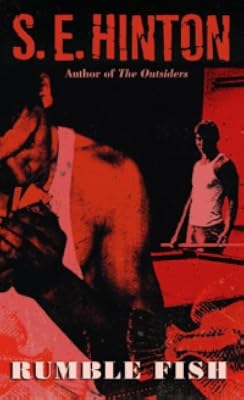
Rumble Fish
by S. E. Hinton
On This Page
Description
A junior high school boy idolizes his older brother, the coolest, toughest guy in the neighborhood, and wants to be just like him.Tags
Recommendations







Member Reviews
I read this after hearing it praised by Markus Zusak as one of his favorite books. I’d read The Outsiders years ago, but I actually loved this one more. It’s a short and simple story told from the point of view of an angry and frustrated man who is remembering something that happened long ago. His idealistic view of his brother and his desire to be as tough as he thinks he should be is heartbreaking. I could see echoes of this in Zusak’s early books about the Wolfe brothers.
Acho que gostei mais do The Outsiders em termos da literatura da Hinton, embora em termos do cinema do Coppola goste mais de Rumble Fish.
O livro da Hinton segue a mesma pegada Young Adult com grande ênfase na masculinidade tóxica rockabilly daqueles idos, nunca deixando de ser poético. Hinton tem grande sensibilidade quanto ao mundo da masculinidade juvenil.
O livro da Hinton segue a mesma pegada Young Adult com grande ênfase na masculinidade tóxica rockabilly daqueles idos, nunca deixando de ser poético. Hinton tem grande sensibilidade quanto ao mundo da masculinidade juvenil.
Since teaching The Outsiders a few years ago I've been working my way through the remainder of S. E. Hinton's works in her YA shared universe. Rumble Fish is the third of those, though in this case I'm not sure what its connections to the others actually are! I found this less effective than either Outsiders or That Was Then, This Is Now; it certainly has some strong scenes, particularly when Rusty-James and his friend go for a night on the town, and the imagery of the ending is captivating, but this one never quite clicked for me and I'm not sure I could tell you why exactly. Too repetitive? Just as TWTTIN did a similar thing to the previous book but sadder, so does Rumble Fish, going for an even more depressing ending. Yet, show more I don't know that that's explanation enough; plenty of authors circle around similar themes repeatedly and manage to make them compelling nonetheless. I think perhaps what hold the book back is Rusty-James's lack of self-knowledge; I don't think he ever really gets himself, which is different from Ponyboy or Byron. This certainly happens to real people (quite frequently!) but it does mean it's harder to immerse yourself in the narrative, I think. show less
Motherless, with a drunken father, and a brother who is always on the run, Rusty James' future looks pretty bleak. For now, however, he is the king of the hill. His brother built up a reputation as the toughest, baddest, and most indifferent fellow to ever walk his streets. With few role models to look up to, Rusty James does everything in his power to emulate Motorcycle Boy.
Despite being able to take a knife to the side, drink like there is no tomorrow, and get with any girl he wants, Rusty James just cannot be his brother. His brother is in a league of his own. He is apathetic to the world. He sees in black and white and hears nothing. After a series of tragic events culminating in Motorcycle Boy's unnecessary death, Rusty James' show more wish finally comes true. He has become Motorcycle Boy. When all is said and done, though, and the scar tissue has formed, Rusty James is unhappy. Yes, he has become his brother. But in doing so, he has become a ghost. show less
Despite being able to take a knife to the side, drink like there is no tomorrow, and get with any girl he wants, Rusty James just cannot be his brother. His brother is in a league of his own. He is apathetic to the world. He sees in black and white and hears nothing. After a series of tragic events culminating in Motorcycle Boy's unnecessary death, Rusty James' show more wish finally comes true. He has become Motorcycle Boy. When all is said and done, though, and the scar tissue has formed, Rusty James is unhappy. Yes, he has become his brother. But in doing so, he has become a ghost. show less
It is hard to image writing such a powerful story as Rumble Fish with relatively few words, yet S.E. Hinton’s book from the sixties about teenager brothers who are disconnected from healthy human emotion and behavior is told very simply and sparingly. That is part of the book’s appeal—and of course lends an authenticity to the protagonist’s voice. There is so much depth in this story in which Rusty-James, a street-fighter who enjoys his status as the toughest kid in the neighborhood, battles personal demons—primary among them is a fear of being alone. He idolizes a distant and disconnected older brother, the Motorcycle Boy, but doesn’t trust him and senses that he can’t depend on him. Hinton has a way of getting into her show more characters’ psyches and then expressing their feelings in very believable way. In a sequence leading up to an important plot development, Rusty-James, the Motorcycle Boy and a friend, Steven, cross the river to go to the city. Rusty-James comes alive amidst the sights and sounds of the city at night, declaring, “…you could feel energy coming off things, even buildings.” In that passage, I got the feeling that his senses were usually deadened and that he felt comforted by the garish, artificial environment.
Rusty-James is fourteen, but seems older because of the drinking and street fighting he engages in. The Motorcycle Boy is seventeen, but he is described as looking more like in his 20s. The book can be read in middle school, but would also be a great pick for all types of high school students, who might bring more mature insights to classroom discussions. They also might be able to better understand the bleakness and alienation of the characters. Rumble Fish delivers a rich, nuanced story that provides an opportunity for rich literary analyses—for reluctant readers, English language learners, and the enthusiastic readers alike. Target audience is grades 7-10. show less
Rusty-James is fourteen, but seems older because of the drinking and street fighting he engages in. The Motorcycle Boy is seventeen, but he is described as looking more like in his 20s. The book can be read in middle school, but would also be a great pick for all types of high school students, who might bring more mature insights to classroom discussions. They also might be able to better understand the bleakness and alienation of the characters. Rumble Fish delivers a rich, nuanced story that provides an opportunity for rich literary analyses—for reluctant readers, English language learners, and the enthusiastic readers alike. Target audience is grades 7-10. show less
I really loved this book. It's a classic S.E. Hinton novel. Her stories are touching, moving, and bring out your inner emotions to make you feel inspired. Her books make me want to reach out and help another, struggling with some kind of burden. As you read "Rumblefish", you will begin to notice that our world isn't as perfect as it seems, and you can't help but shed a small tear.
"Rumblefish" is about a 14 year old small town boy named Rusty-James. Everyone sees him as the toughest kid in town, for he's always wanting to pick fights and act cool. He smokes, drinks, and cheats people out of there moneyl. He's basically the town's very own delinquent. When he's not out stealing from convenience stores or jumping some poor kid off the show more street, he's either at his girlfriend, Patty's, house, or at home, waiting for his drunk of a father to return from the bar. He doesn't have a mother (she ran away when he was very young), and he doesn't exactly have the potential to lead out a good life. As you get deeper into the book, you'll realize that Rusty's biggest set back is his older, tough cooler brother. No one knows his real name, so they all call him "The Motorcycle Boy." He tells Rusty stories of when there used to be gangs in the good old days, how everyone belonged to one and there were the "Greasers" and the "Socs". Rusty tries so hard to be like his older brother that he, in turn, loses sight of who he really is.
One of the most admirable things about Hinton's novel, "Rumblefish", was that it had real character and reality to it. It was blunt and to the point, which is perfect. It shows how real life was back in the 60's or 70's, and it just makes you think of how much our world has changed since then. Think about; today you don't just jump everyone you see, and there are far more laws and policies about bullying now than back then. Back then, if you got called "gay" or "fat", there just weren't the same disciplinary actions as there are today against that type of harassment. it gives you a real view of now vs. then (which is ironic because an other one of Hinton's great novels is "That was Then, This is Now")
I rated this book a 4/5 because, all though it was an exemplary novel, it had a few kinks in it, so I deducted a point. One of these so called "kinks" was that i thought she could have described the characters a tad bit more. instead of getting a true, cinema-like picture buzzing through my head, i got kind of a blurred vision, with a blank background. when there was a lot of action going on, it started to get confusing. i really think it would of helped if Hinton spent a little more time and gave the characters morecomplex personalities that created a real image inside my head.
Another thing that is really notable about "Rumblefish" is that Hinton left the ending kind of open. In my opinion, this is wonderful! It had just the right amount of closure to end well, but she left you with a job. When you finish the book, you think to yourself "What happens next?" But its that kind of question you can answer yourself, even though the author never stated anything indubitable or sure about it. That is the real magic of this book. You read the whole thing and then, YOU, the reader gets to decide what happens to Rusty. But really, it all depends on your perspective and what you see Rusty as. show less
"Rumblefish" is about a 14 year old small town boy named Rusty-James. Everyone sees him as the toughest kid in town, for he's always wanting to pick fights and act cool. He smokes, drinks, and cheats people out of there moneyl. He's basically the town's very own delinquent. When he's not out stealing from convenience stores or jumping some poor kid off the show more street, he's either at his girlfriend, Patty's, house, or at home, waiting for his drunk of a father to return from the bar. He doesn't have a mother (she ran away when he was very young), and he doesn't exactly have the potential to lead out a good life. As you get deeper into the book, you'll realize that Rusty's biggest set back is his older, tough cooler brother. No one knows his real name, so they all call him "The Motorcycle Boy." He tells Rusty stories of when there used to be gangs in the good old days, how everyone belonged to one and there were the "Greasers" and the "Socs". Rusty tries so hard to be like his older brother that he, in turn, loses sight of who he really is.
One of the most admirable things about Hinton's novel, "Rumblefish", was that it had real character and reality to it. It was blunt and to the point, which is perfect. It shows how real life was back in the 60's or 70's, and it just makes you think of how much our world has changed since then. Think about; today you don't just jump everyone you see, and there are far more laws and policies about bullying now than back then. Back then, if you got called "gay" or "fat", there just weren't the same disciplinary actions as there are today against that type of harassment. it gives you a real view of now vs. then (which is ironic because an other one of Hinton's great novels is "That was Then, This is Now")
I rated this book a 4/5 because, all though it was an exemplary novel, it had a few kinks in it, so I deducted a point. One of these so called "kinks" was that i thought she could have described the characters a tad bit more. instead of getting a true, cinema-like picture buzzing through my head, i got kind of a blurred vision, with a blank background. when there was a lot of action going on, it started to get confusing. i really think it would of helped if Hinton spent a little more time and gave the characters morecomplex personalities that created a real image inside my head.
Another thing that is really notable about "Rumblefish" is that Hinton left the ending kind of open. In my opinion, this is wonderful! It had just the right amount of closure to end well, but she left you with a job. When you finish the book, you think to yourself "What happens next?" But its that kind of question you can answer yourself, even though the author never stated anything indubitable or sure about it. That is the real magic of this book. You read the whole thing and then, YOU, the reader gets to decide what happens to Rusty. But really, it all depends on your perspective and what you see Rusty as. show less
The edition that I read has a nice little preface from the author, from 2013. Referencing mythology, which really is the best way to read this very short book. Thinking about the reality that inspired it is disturbing.
"It's a bit of a burden to be Robin Hood, Jesse James, and the Pied Piper. I'd just as soon stay a neighborhood novelty, if it's all the same to you."
"It's a bit of a burden to be Robin Hood, Jesse James, and the Pied Piper. I'd just as soon stay a neighborhood novelty, if it's all the same to you."
Members
- Recently Added By
Lists

Novels that you shouldn't waste your time on
94 works; 52 members

Used books to buy next
565 works; 1 member

Dysfunctional Families
133 works; 7 members

Gen X Library
245 works; 4 members
Author Information

25+ Works 35,208 Members
S. E. Hinton was born in Tulsa, Oklahoma and attended the University of Tulsa. Her first novel, The Outsiders, was published in 1967 and changed publishing for young adults by portraying a grittier, more realistic view of the lives of teenagers. It was made into a movie in 1983. Her other young adult works include Rumble Fish, Tex, Taming the Star show more Runner, and That Was Then, This is Now. Her children's books include The Puppy Sister and Big David, Little David. She has won numerous awards including the Margaret Alexander Edwards Award, the Media and Methods Maxi Award, and the Land of the Enchantment Award. (Bowker Author Biography) show less
Some Editions
Awards and Honors
Series
Belongs to Publisher Series
Alfaguara juvenil (219)
Work Relationships
Is contained in
Has the adaptation
Has as a student's study guide
Has as a teacher's guide
Common Knowledge
- Canonical title
- Rumble Fish
- Original title
- Rumble Fish
- Original publication date
- 1975
- People/Characters
- Rusty-James; Motorcycle Boy; Patty; Steve
- Related movies
- Rumble Fish (1983 | IMDb)
- First words
- I ran into Steve a couple of days ago.
- Last words
- (Click to show. Warning: May contain spoilers.)I figured if I didn't see him, I'd start forgetting again. But it's been taking me longer than I thought it would.
Classifications
- Genres
- Teen, Fiction and Literature, Young Adult
- DDC/MDS
- 813.54 — Literature & rhetoric American literature in English American fiction in English 1900-1999 1945-1999
- LCC
- PZ7 .H5976 .R — Language and Literature Fiction and juvenile belles lettres Fiction and juvenile belles lettres Juvenile belles lettres
- BISAC
Statistics
- Members
- 2,265
- Popularity
- 8,879
- Reviews
- 54
- Rating
- (3.71)
- Languages
- 10 — Catalan, English, Finnish, French, German, Italian, Norwegian (Bokmål), Portuguese, Spanish, Swedish
- Media
- Paper, Audiobook, Ebook
- ISBNs
- 71
- UPCs
- 2
- ASINs
- 18