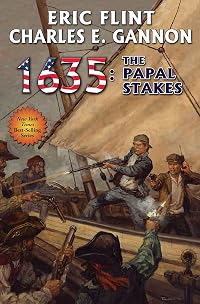
1635: The Papal Stakes
by Eric Flint, Charles E. Gannon (Author)
Assiti Shards (13), Ring of Fire reading order / per Eric Flint (18)
On This Page
Description
Held hostage by a papal usurper, 1635 uptimer Frank Stone and his pregnant downtime wife, Giovanna, become targets in a rescue effort by Harry Lefferts and his infamous Wrecking Crew at the same time the true pope is targeted for assassination.Tags
Recommendations










Member Reviews
1635: THE PAPAL STAKES by Eric Flint & Charles E. Gannon --
This is the third of four novels of Eric Flint's 1632 series' Southern European storyline, following 1634: THE GALILEO AFFAIR and 1635: THE CANON LAW. While much continues from the earlier novels, it is not, imho, essential to have read these first, for the authors aptly catches the reader up-to-date, and each novel has its own unique conflict.
The Southern Europe storyline is, for the most part, distinct from the "Main" storyline begun with the original novel "1632." Cardinal, now "Pope", Borja has usurped the papacy and the Vatican from the true Pope, Pope Urban VIII who has fled Rome with the United States of Europe Ambassador Sharon Nichols, her husband, and others, pursued show more by Borja’s assassins.
There is plenty of action (especially of the direct face-to-face type where tension is high amid the slash of swords and the volleys of firearms and artillery both on land and sea) and also political intrigues and betrayals, but what makes this Southern European storyline uniquely interesting -- at least to me -- are the ecclesiastical debates before Pope Urban performed in formal conclave fashion despite the participants being on the run and in hiding. Nothing less than the future of the Roman Catholic Church of the 17th-century is to be decided in light of the "Ring of Fire" transition of the 21st-century town of Grantville, West Virginia to the past -- with all its future knowledge, ideals and religious and ethical beliefs that conflict with those of the 17th-century.
(1) Was the time displacement of Grantville and its citizens an act of Satan or not?
(2) Are the decrees of the future ecumenical councils and future Popes, particularly those of Pope John Paul and Vatican II that, among other things, recognized religious freedom, and, in Nostra Aetate, "reveres the work of God in all the major faith traditions" (including Judaism and Islam) applicable to the Church and Christians of the 17th-century.
The debates regarding the meaning of the Ring of Fire and the Vatican II decrees for the Church’s future are, for this student of Judaism, nearly Talmudic in their formal, respectful discourse. The skill with which Flint and Gannon relate these "battles" of words and reasoning are intense and enthralling. These theological-philosophical discussions are relevant not only to the characters and the world of the story but also to the reader and our world today. That they are conducted under the threat of pursuit and murder, as the climactic action-filled battle at the novel's end engagingly depicts, elevates the import and infinite value of the discussions.
While the book started a bit slow, perhaps, by the end of the work, I was in awe in how Eric and Chuck brought all these elements of high stakes physical and theological-philosophical conflicts together. Well done. show less
This is the third of four novels of Eric Flint's 1632 series' Southern European storyline, following 1634: THE GALILEO AFFAIR and 1635: THE CANON LAW. While much continues from the earlier novels, it is not, imho, essential to have read these first, for the authors aptly catches the reader up-to-date, and each novel has its own unique conflict.
The Southern Europe storyline is, for the most part, distinct from the "Main" storyline begun with the original novel "1632." Cardinal, now "Pope", Borja has usurped the papacy and the Vatican from the true Pope, Pope Urban VIII who has fled Rome with the United States of Europe Ambassador Sharon Nichols, her husband, and others, pursued show more by Borja’s assassins.
There is plenty of action (especially of the direct face-to-face type where tension is high amid the slash of swords and the volleys of firearms and artillery both on land and sea) and also political intrigues and betrayals, but what makes this Southern European storyline uniquely interesting -- at least to me -- are the ecclesiastical debates before Pope Urban performed in formal conclave fashion despite the participants being on the run and in hiding. Nothing less than the future of the Roman Catholic Church of the 17th-century is to be decided in light of the "Ring of Fire" transition of the 21st-century town of Grantville, West Virginia to the past -- with all its future knowledge, ideals and religious and ethical beliefs that conflict with those of the 17th-century.
(1) Was the time displacement of Grantville and its citizens an act of Satan or not?
(2) Are the decrees of the future ecumenical councils and future Popes, particularly those of Pope John Paul and Vatican II that, among other things, recognized religious freedom, and, in Nostra Aetate, "reveres the work of God in all the major faith traditions" (including Judaism and Islam) applicable to the Church and Christians of the 17th-century.
The debates regarding the meaning of the Ring of Fire and the Vatican II decrees for the Church’s future are, for this student of Judaism, nearly Talmudic in their formal, respectful discourse. The skill with which Flint and Gannon relate these "battles" of words and reasoning are intense and enthralling. These theological-philosophical discussions are relevant not only to the characters and the world of the story but also to the reader and our world today. That they are conducted under the threat of pursuit and murder, as the climactic action-filled battle at the novel's end engagingly depicts, elevates the import and infinite value of the discussions.
While the book started a bit slow, perhaps, by the end of the work, I was in awe in how Eric and Chuck brought all these elements of high stakes physical and theological-philosophical conflicts together. Well done. show less
Excellent book in an outstanding series. The insertion of Vatican 2 theological revelation into Urban VIII's papacy was a master stroke. They use quite coherent logic to mesh current RC thinking into the issues of the 17th century church. It will redefine foes and friends on a sustaining basis and should generate some very interesting plots and story lines.
Continuation of the 1632 series about a West Virginia mining town plunked into the midst of the Thirty Years' War. Here we have papal politics and Habsburg intrigue at full bore. This is very well done, as usual, with not too much infodumping and some pretty decent incluing. I'm waiting to see the novel that will tell us just how Oliver was freed from the Tower.
This picks up a few days after Cannon Law. The Pope is fleeing and the young Stone family is hostages with the Borjas (Borgias).
This is around the 15th book in the series and there has only been a few years. At this story tempo we will never get further than 1640 which would be a pity because this world building is fascinating. The story telling isn't great and the characters are two dimensional but the history lesson makes it worth it. Though I wonder how confusing it would be to read this if you studied history at the same time. Would you vecome unsure what was fiction and what (probably) happened for real?
I'm giving the book 3 stars but it is not strong 3 stars. The end is better than the beginning.
There doesn't seem to be a show more followup yet to this story arc. Maybe there will never be one. show less
This is around the 15th book in the series and there has only been a few years. At this story tempo we will never get further than 1640 which would be a pity because this world building is fascinating. The story telling isn't great and the characters are two dimensional but the history lesson makes it worth it. Though I wonder how confusing it would be to read this if you studied history at the same time. Would you vecome unsure what was fiction and what (probably) happened for real?
I'm giving the book 3 stars but it is not strong 3 stars. The end is better than the beginning.
There doesn't seem to be a show more followup yet to this story arc. Maybe there will never be one. show less
Borja has usurped the papacy and taken Frank and Giovanna Stone hostage. Henry Lefferts and the Wrecking Crew are on their way, but a rescue might be harder than they think. And Urban is being protected by USE forces, although he is uncertain of the religious wisdom of actually taking refuge in the USE.
Fairly typical of the series, but overall one of the weaker entries.
Fairly typical of the series, but overall one of the weaker entries.
I love the 1632 series, but this is disappointing. As in most, I learned a lot about combat and the topic in question, in this case Roman Catholic law and politics. Many books in the series can be read out of order, and in some cases can even be used as stand alone books. Unfortunately, if you are not very familiar with the series this book is quite opaque. Even having read the other books in the series I was often confused. Having re-read the book, noting where the voice and place changed, I got more interested. I think my problem was the fact that locale and personna changed mid-chapter, with little or no indication. Having noted these myself, in pencil, at each change, I expect I will enjoy it better next time. I also noted places show more where information from books not yet published is assumed by the characters. The penciled in stage notes helped, so on the third reading it went well. That shows my dedication to the series, not the vast readability of the book. show less
[1635: The Papal Stakes] by [[Erice Flint]] and [[Charles Gannon]] Another installment in Eric Flint's increasingly complicated alternate history universe which started with 1632. In that year, a small town from West Virginia was transported in time from 2000. The shock of having a 21st century town in the middle of Europe during the 30 years war is still rippling through the world. The Borgia pope has ousted Pope Urban, but he is not dead, but is being protected by the United States of Europe. Borgia has kidnapped the son and pregnant daughter-in-law of a promininent USE industrialist and is seeking diplomatic leverage. The USE attempts to rescue them and also preserve Pope Urban's life constitute the two major plot lines of this show more novel.
If you enjoyed 1632 or any of the other novels in this series or if you enjoy alternate history, I highly recommend this book. show less
If you enjoyed 1632 or any of the other novels in this series or if you enjoy alternate history, I highly recommend this book. show less
Members
- Recently Added By
Author Information

207+ Works 28,953 Members
Eric Flint was born in southern California in 1947. He received a bachelor's degree from UCLA in 1968 and did some work toward a Ph.D. in history, with a specialization in history of southern Africa in the 18th and early 19th centuries, also at UCLA. After leaving the doctoral program over political issues, he supported himself from that time show more until age 50 as a laborer, machinist and labor organizer. In 1993, his short story entitled Entropy and the Strangler won first place in the Winter 1992 Writers of the Future contest. His first novel, Mother of Demons, was published in 1997 and was picked by the Science Fiction Chronicle as a best novel of the year. He became a full-time writer in 1999. He writes science fiction and fantasy works including The Philosophical Strangler and the Belisarius series. (Bowker Author Biography) show less

Charles E. Gannon is associate professor of English at St. Bonaventure University
Some Editions
Series


Common Knowledge
- Canonical title
- 1635: The Papal Stakes
- Original publication date
- 2012-10
- Important places
- Italy
- Epigraph
- The line of the horizon, thin and fine
- First words
- Odo, the young German operating the radio, shook his head.
- Last words
- (Click to show. Warning: May contain spoilers.)Ed Piazza did not share this thought, but instead, joined them in sipping the whiskey in slience, asold freinds often do when they reflect on the uncertainty and peril of coming days.
Classifications
Statistics
- Members
- 209
- Popularity
- 156,304
- Reviews
- 10
- Rating
- (3.99)
- Languages
- English
- Media
- Paper, Audiobook, Ebook
- ISBNs
- 7
- ASINs
- 4