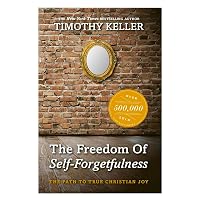
The Freedom of Self Forgetfulness: The Path to True Christian Joy
by Timothy Keller
On This Page
Description
What are the marks of a supernaturally changed heart? This is one of the questions the Apostle Paul addresses as he writes to the church in Corinth. He's not after some superficial outward tinkering, but instead a deep rooted, life altering change that takes place on the inside. In an age where pleasing people, puffing up your ego and building your résumé are seen as the methods to 'make it', the Apostle Paul calls us to find true rest in blessed self forgetfulness.In this short and show more punchy book, best selling author Timothy Keller, shows that gospel humility means we can stop connecting every experience, every conversation with ourselves and can thus be free from self condemnation. A truly gospel humble person is not a self-hating person or a self-loving person, but a self-forgetful person.
This freedom can be yours...
. show less
Tags
Recommendations





















Member Reviews
Timothy Keller, shows that gospel humility means we can stop connecting every experience, every conversation with ourselves and can thus be free from self condemnation. A truly gospel humble person is not a self-hating person or a self-loving person, but a self-forgetful person.
Short, sermon based booklet on 1 Corinthians 3:21–4:7. Keller defines the nature of the human ego and how it is empty, painful, busy, and fragile. I would take only a small exception with this description of it being empty. It is compared to the riches of having it full of Christ, but we are always trying to put small, insignificant things there in hopes of filling it up. And what we put in it is comparisons to others.
He deals with the fallacy of low-self esteem. I wish this had been a little clearer. Low self-esteem is really pride that can't seem to locate an inferior object.
Next Keller describes what the transformed view of self is: not caring what others or even self thinks of self. This, then, is accomplished by realizing that show more in the grand court of opinion, God has already judged. Judgment is not based on performance. The verdict was rendered on the cross before we performed anything. And that is why we can think of ourselves less—and thus everyone else, in love, more. Like Jesus!
A short, helpful look at why we get caught up in the rat race, are often never satisfied for long, and feel buyers remorse about so many things in life. show less
He deals with the fallacy of low-self esteem. I wish this had been a little clearer. Low self-esteem is really pride that can't seem to locate an inferior object.
Next Keller describes what the transformed view of self is: not caring what others or even self thinks of self. This, then, is accomplished by realizing that show more in the grand court of opinion, God has already judged. Judgment is not based on performance. The verdict was rendered on the cross before we performed anything. And that is why we can think of ourselves less—and thus everyone else, in love, more. Like Jesus!
A short, helpful look at why we get caught up in the rat race, are often never satisfied for long, and feel buyers remorse about so many things in life. show less
This is a lifetime book, one that you'll come back to time and time again.
Keller argues over and over that humility is attainable when we take our sights off ourselves- both from our shortcomings and our successes- and begin focusing on other people.
The writing style is very simple and repetitive, but I believe that's the point. Keller wants us to see that "humility" or self-forgetfulness is that easy. Our ego wants to complicate it, to find all sorts of hoops to jump and accomplishments to say, "well, that was a workout, but I've finally mastered humility! Aren't I great!" But that would defeat the purpose wouldn't it?
Instead, the book is so darn simple, you find yourself asking over and over, "can that really be it? Is it really that show more simple? It can't be! But why don't I get it yet?" It's a topic that requires regular review, regular re-reading to change your preexisting assumptions on what humility is. show less
Keller argues over and over that humility is attainable when we take our sights off ourselves- both from our shortcomings and our successes- and begin focusing on other people.
The writing style is very simple and repetitive, but I believe that's the point. Keller wants us to see that "humility" or self-forgetfulness is that easy. Our ego wants to complicate it, to find all sorts of hoops to jump and accomplishments to say, "well, that was a workout, but I've finally mastered humility! Aren't I great!" But that would defeat the purpose wouldn't it?
Instead, the book is so darn simple, you find yourself asking over and over, "can that really be it? Is it really that show more simple? It can't be! But why don't I get it yet?" It's a topic that requires regular review, regular re-reading to change your preexisting assumptions on what humility is. show less
Every book that I have read by Keller has been deeply meaningful. This one is no exception...I think that makes 5 in a row over the last 2 years or so. During this same time, I have read several other authors who have also had great impact in my life, Nancy Pearcey, Greg Koukl, Ray Comfort, Abdu Murray, Nabeel Qureshi, Rick Warren, but Keller stands out somehow...maybe he just speaks to my way of thinking. Always thoughtful, always well reasoned, always insightful. I had already posted this to another review:
Keller has a knack for presenting the truths of Christianity. I have yet to find a book of his where I even have any small quibbles, of either substance or style! This short book was probably a sermon that he tightened up for a show more reading audience. Self-esteem is now a highly sought quality, highly praised, and seen as a solution to so many ills of modern life. Keller shows that this is misguided and the there is a better way. Let me quote: "His conscience may be clear -- but he knows that even if he does have a clear conscience, that does not necessarily mean he is innocent. Hitler might have had a clear conscience, but it does not mean he was innocent.
What would Paul say to those who tell him to set his own standards? He would say it is a trap. A trap he will not fall into. You see, it is a trap to say that we should not worry about everyone else's standards, just set our own. That's not an answer. Boosting our self-esteem by living up to our own standards or someone else's sounds like a great solution. But it does not deliver. It cannot deliver. I cannot live up to my parents' standards -- and that makes me feel terrible. I cannot live up to society's standards -- and that makes me feel terrible. I cannot live up to other societies' standards --that makes me feel terrible. Perhaps the solution is to set my own standards? but I cannot keep them either -- and that make me feel terrible, unless I set incredibly low standards. Are low standards a solution? Not at all. That makes me feel terrible because I realize I am the type of person who has low standards. Trying to boost our self-esteem by trying to live up to our own standards or someone else's is a trap. It is not an answer."
As bleak as this is, no question about it, Keller does find good news, a new direction that brings hope and a better way. His website is www.10ofthose.com and this book is less than 50 pages. You may find his book at other retailers at deeper discounts too...but I am really tempted to buy more copies in bulk to give away.
I cannot leave you without a little hint of the solution Keller presents: instead of a performance driven life, he suggests a forgiveness inspired life. Once you recognize who you are, you can find forgiveness (because we all fall short of the best) and in that forgiveness, find something (someone, actually) who gives you the chance to be transformed. show less
Keller has a knack for presenting the truths of Christianity. I have yet to find a book of his where I even have any small quibbles, of either substance or style! This short book was probably a sermon that he tightened up for a show more reading audience. Self-esteem is now a highly sought quality, highly praised, and seen as a solution to so many ills of modern life. Keller shows that this is misguided and the there is a better way. Let me quote: "His conscience may be clear -- but he knows that even if he does have a clear conscience, that does not necessarily mean he is innocent. Hitler might have had a clear conscience, but it does not mean he was innocent.
What would Paul say to those who tell him to set his own standards? He would say it is a trap. A trap he will not fall into. You see, it is a trap to say that we should not worry about everyone else's standards, just set our own. That's not an answer. Boosting our self-esteem by living up to our own standards or someone else's sounds like a great solution. But it does not deliver. It cannot deliver. I cannot live up to my parents' standards -- and that makes me feel terrible. I cannot live up to society's standards -- and that makes me feel terrible. I cannot live up to other societies' standards --that makes me feel terrible. Perhaps the solution is to set my own standards? but I cannot keep them either -- and that make me feel terrible, unless I set incredibly low standards. Are low standards a solution? Not at all. That makes me feel terrible because I realize I am the type of person who has low standards. Trying to boost our self-esteem by trying to live up to our own standards or someone else's is a trap. It is not an answer."
As bleak as this is, no question about it, Keller does find good news, a new direction that brings hope and a better way. His website is www.10ofthose.com and this book is less than 50 pages. You may find his book at other retailers at deeper discounts too...but I am really tempted to buy more copies in bulk to give away.
I cannot leave you without a little hint of the solution Keller presents: instead of a performance driven life, he suggests a forgiveness inspired life. Once you recognize who you are, you can find forgiveness (because we all fall short of the best) and in that forgiveness, find something (someone, actually) who gives you the chance to be transformed. show less
This book is short and profoundly challenging. The simplicity of the message will rattle around in the tombs of our soiled memories.
Tim Keller looks at our condition in this inflated/deflated world. The world is flat and black and white; while we perform in our shadowed reality. There is only one way to the truth and the light. We find ourselves off the beaten track and lost. Until, we are picked up for hitch-hiking.
We are then brought to a trial room with only the smiling mob and the Court Jester. Every day we wake to a trial, much like the trial of the main character in Franz Kafka's The Trial.
We find that all the jurors are pointing at us and laughing at our hopeless condition, because we still think we can save ourselves. We think that there is a away for us to justify our actions. We cower at our reflected image and our ballooned ego lets out a gasp and we find ourselves thinner than Jack Sprat.
Where is your heart (insert your name here)? is the first question the Supreme Court Jester asks.
We say in response, "I played the game! I played by the rules! How can you accuse me of being a loser on my own?"
The Jester replies, "Who do you want to be son, than be that person."
We wake up and the trial resumes.
Keller shows us how to break out of this fun house mirror and self delusion through the reliance of Christ. This book must be read by anyone who struggles with depression or anxiety in the modern world. show less
Tim Keller looks at our condition in this inflated/deflated world. The world is flat and black and white; while we perform in our shadowed reality. There is only one way to the truth and the light. We find ourselves off the beaten track and lost. Until, we are picked up for hitch-hiking.
We are then brought to a trial room with only the smiling mob and the Court Jester. Every day we wake to a trial, much like the trial of the main character in Franz Kafka's The Trial.
We find that all the jurors are pointing at us and laughing at our hopeless condition, because we still think we can save ourselves. We
Where is your heart (insert your name here)? is the first question the Supreme Court Jester asks.
We say in response, "I played the game! I played by the rules! How can you accuse me of being a loser on my own?"
The Jester replies, "Who do you want to be son, than be that person."
We wake up and the trial resumes.
Keller shows us how to break out of this fun house mirror and self delusion through the reliance of Christ. This book must be read by anyone who struggles with depression or anxiety in the modern world. show less
A Christian Case For A Phenomenon Many Realize As They Mature. In this short text - right around 40 pages or so - Christian theologian Timothy Keller makes a Biblical case for getting onself to the point of both self acceptance and no longer caring what anyone thinks of you. He spins this through his own worldview and builds his case based primarily on a text from 1 Corinthians - and both cites it within its context and doesn't directly appeal to any other texts to "prove" his points, thus earning a rare 5* rating from me for a Christian nonfiction book. Solid within its frame, as noted here there are other methods for achieving the very same state Keller claims is only possible for Christians, which hurts his case objectively but which show more is understandable within the author's own mindset. Very much recommended. show less
This is a brief and handy (if not too terribly exhaustive) exegesis of a short section in 1 Corinthians. Keller suggests that Paul's words are so counter to our current understanding of ego that they are "off the map" for us, urging us into a transformed way of thinking about humility. I like his thoughts; I could probably stand to read this book at least monthly.
Unfortunately, the poor editing and loose, slightly repetitive writing style were distracting to me. It seemed almost like it had been transcribed from a lecture or sermon, then no one had gone back and punctuated it correctly before publication.
Still, I recommend it. It only takes about 15 or 20 minutes to read.
Unfortunately, the poor editing and loose, slightly repetitive writing style were distracting to me. It seemed almost like it had been transcribed from a lecture or sermon, then no one had gone back and punctuated it correctly before publication.
Still, I recommend it. It only takes about 15 or 20 minutes to read.
Members
- Recently Added By
Lists

Blake’s Recommended Commentaries
69 works; 1 member
Author Information

378+ Works 43,925 Members
Timothy J. Keller was born in 1950. He received a B.A. from Bucknell University in 1972, a M.Div. from Gordon-Conwell Theological Seminary in 1975, and a D.Min. from Westminster Theological Seminary in 1981. He was ordained by the Presbyterian Church in America and served as a pastor in Virginia for nine years. He is founding pastor of Redeemer show more Presbyterian Church in New York City, New York. He has written several books including Grace Changes Everything, Generous Justice: How God's Grace Makes Us Just, and The Reason for God: Belief in an Age of Skepticism, which won awards from World Magazine and Christianity Today. His title, Preaching: Communicating Faith in a Skeptical Age, made the New York Times Best Seller List in 2015. Hidden Christmas: The Surprising Truth Behind the Birth of Christ was published in October 2016. (Bowker Author Biography) show less
Common Knowledge
- Original publication date
- 2012
Classifications
- Genres
- Religion & Spirituality, Nonfiction, General Nonfiction
- DDC/MDS
- 248.4 — Religion Christian practice & observance Christian experience, practice, life Christian Living
- LCC
- BV4647 .H8 .K44 — Philosophy, Psychology and Religion Practical Theology Practical Theology Practical religion. The Christian life Moral theology Virtues
- BISAC
Statistics
- Members
- 1,820
- Popularity
- 11,983
- Reviews
- 21
- Rating
- (4.28)
- Languages
- 6 — Danish, Dutch, English, German, Portuguese, Spanish
- Media
- Paper, Audiobook, Ebook
- ISBNs
- 10
- ASINs
- 8