On This Page
Description
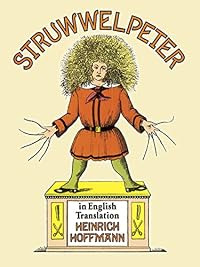
Presents a collection of German cautionary tales, featuring such characters as Shock-Headed Peter, Cruel Frederick, Little Suck-a-Thumb, and the Inky Boys. Includes a brief biography of the author.Tags
Recommendations





















Member Recommendations

Member Reviews
"Such fun I do not understand."
Me, I do understand. I understand naughty children who don't listen to their wise parents, in spite of many numerous warnings:
Don't lean back in your chair at the table.
Pay attention to where you are walking.
Don't play with guns.
Stop bullying other children just because they have a different skin tone.
...ad nauseum.
Written in 1845, Struwwelpeter still had the sting, the tragic results, and the bloody horrors that were once part and parcel in old tales written for children. It no doubt would be banned today by the usual group of public ignoramuses as too violent for society's tender little brats who often grow up to be beasts.
(Thank you to Dorothy Haynes who mentioned a little girl reading and being show more frightened by this very book in one of her short stories in Thou Shalt Not Suffer a Witch)
Wicked old thing that I am, I loved it. show less
Me, I do understand. I understand naughty children who don't listen to their wise parents, in spite of many numerous warnings:
Don't lean back in your chair at the table.
Pay attention to where you are walking.
Don't play with guns.
Stop bullying other children just because they have a different skin tone.
...ad nauseum.
Written in 1845, Struwwelpeter still had the sting, the tragic results, and the bloody horrors that were once part and parcel in old tales written for children. It no doubt would be banned today by the usual group of public ignoramuses as too violent for society's tender little brats who often grow up to be beasts.
(Thank you to Dorothy Haynes who mentioned a little girl reading and being show more frightened by this very book in one of her short stories in Thou Shalt Not Suffer a Witch)
Wicked old thing that I am, I loved it. show less
"The English Struwwelpeter or Pretty Stories and Funny Pictures", October 8, 2014
This review is from: Struwwelpeter in English Translation (Dover Children's Classics) (Paperback)
I was brought up on Struwwelpeter - a series of hilarious 'morality rhymes' for children from 1840s Germany. Who could forget 'Fidgety Phil' pulling the tablecloth and all its contents onto his head? ("Table oh so bare, and ah! Poor Papa and poor Mama Look quite cross, and wonder how They shall make their dinner now.") Or chubby Augustus who wouldn't eat his soup and met a sticky end ("He's like a little bit of thread, and on the fifth day - he was dead!")
More grotesque is the Long Red Legged Scissorman who cuts off Conrad's thumbs when he sucks them ("Mama had show more scarcely turned her back, the thumb was in, Alas! Alack!")
But 21st century readers may have more sympathy with the hare who runs off with the hunter's gun and turns it on him; the boys who mock a black child and are dipped in a huge bottle of ink by 'Great Agrippa', and the dog who bites Cruel Frederick, then eats his dinner.
24 utterly unforgettable pages. I would certainly disagree with reviewers who think it's too bloodthirsty for children (I adored it - I got my book aged around 8), and have just bought a copy for my granddaughter. show less
This review is from: Struwwelpeter in English Translation (Dover Children's Classics) (Paperback)
I was brought up on Struwwelpeter - a series of hilarious 'morality rhymes' for children from 1840s Germany. Who could forget 'Fidgety Phil' pulling the tablecloth and all its contents onto his head? ("Table oh so bare, and ah! Poor Papa and poor Mama Look quite cross, and wonder how They shall make their dinner now.") Or chubby Augustus who wouldn't eat his soup and met a sticky end ("He's like a little bit of thread, and on the fifth day - he was dead!")
More grotesque is the Long Red Legged Scissorman who cuts off Conrad's thumbs when he sucks them ("Mama had show more scarcely turned her back, the thumb was in, Alas! Alack!")
But 21st century readers may have more sympathy with the hare who runs off with the hunter's gun and turns it on him; the boys who mock a black child and are dipped in a huge bottle of ink by 'Great Agrippa', and the dog who bites Cruel Frederick, then eats his dinner.
24 utterly unforgettable pages. I would certainly disagree with reviewers who think it's too bloodthirsty for children (I adored it - I got my book aged around 8), and have just bought a copy for my granddaughter. show less
“Der Struwwelpeter” is Heinrich Hoffman's classic collection of moral fables for children. The message of the lavishly illustrated book is that children who are disobedient or display antisocial behavior will suffer a hideous fate. Children like Harriet (who plays with matches), Little Suck-a-Thumb, Fidgety Philip, and the Inky Boys ignore the sound advice of their elders and are swiftly punished or destroyed by their own behavior or by supernatural forces. It is an example of a code of behavior very different from modern books for kids which encourage boldness, curiosity, and individualism, and in which mistakes are forgiven and seen as a way to learn and grow. In “Der Struwwelpeter,” children are meant to learn to conform show more through fear and threat of injury or death.
I think this book could rpvoke some interesting discussions in middle school and up about societal norms and expectations and the methods we use to teach kids to abide by them. It's also extremely chuckle-inducing and fun to read in as serious a voice as one can maintain. show less
I think this book could rpvoke some interesting discussions in middle school and up about societal norms and expectations and the methods we use to teach kids to abide by them. It's also extremely chuckle-inducing and fun to read in as serious a voice as one can maintain. show less
This book is the antidote to Disney. It is the opposite of all those nasty, sugar-sweet versions of Cinderella, the Little Mermaid and worst of all Winnie-the-Pooh. Worst because Eeyore was, in the original, A.A. Milne version, a sarcastic, depressive real loner of a donkey, not a sweet-natured stuffed toy.
Struwwelpeter is all about children getting punished in the nastiest possible ways for their awful misdeeds. I loved this book when I was a kid. I also loved Disney, but I grew out of that, except for Bambi. Have to love Bambi.
My two personal favourites of the stories are firstly, Conrad, aka Little Suck-a-Thumb who was told that if he didn't stop plugging his mouth with his thumb he would get it cut off. And when he didn't and his show more mother was out, the nasty Scissorman came and snip snap, both thumbs gone!
Secondly is Augustus, my personal favourite, who starved himself to death rather than drink the nasty soup he was served for lunch. I had some sympathy there as more than once I had to sit at the lunch table, even missing school in the afternoon, because I wouldn't drink up the nasty chicken soup.I know that being Jewish chicken soup is supposed to be in my dna, but it just isn't and I hate the stuff, loathe it Or another time, wouldn't eat the liver casserole, cold with congealed floating grease, or lamb chops glistening with fat...
These sort of stories were much more satisfying to me as a child being delightfully shivery.
But there was something else. Children have a very highly developed sense of justice. They are forever saying, "it's not fair" about some perceived injustice. Stories like these where naughty children get their comeuppance appeal to kids, they see the fitness of a punishment, rather than the forgiveness and sugary reward and happily-ever-after od Disney that never actually comes their way when they've been very naughty little boys and girls.
You can read all the stories and see the original hand-coloured woodblock prints on the Gutenberg site. show less
Struwwelpeter is all about children getting punished in the nastiest possible ways for their awful misdeeds. I loved this book when I was a kid. I also loved Disney, but I grew out of that, except for Bambi. Have to love Bambi.
My two personal favourites of the stories are firstly, Conrad, aka Little Suck-a-Thumb who was told that if he didn't stop plugging his mouth with his thumb he would get it cut off. And when he didn't and his show more mother was out, the nasty Scissorman came and snip snap, both thumbs gone!
Secondly is Augustus, my personal favourite, who starved himself to death rather than drink the nasty soup he was served for lunch. I had some sympathy there as more than once I had to sit at the lunch table, even missing school in the afternoon, because I wouldn't drink up the nasty chicken soup.
These sort of stories were much more satisfying to me as a child being delightfully shivery.
But there was something else. Children have a very highly developed sense of justice. They are forever saying, "it's not fair" about some perceived injustice. Stories like these where naughty children get their comeuppance appeal to kids, they see the fitness of a punishment, rather than the forgiveness and sugary reward and happily-ever-after od Disney that never actually comes their way when they've been very naughty little boys and girls.
You can read all the stories and see the original hand-coloured woodblock prints on the Gutenberg site. show less
It's hard not to burst into xenophobic raptures when contemplating this bizarre little book. I mean, where else could a children's book of such an austere and humourless moral tone have originated than nineteenth century Germany? Have you heard the story of Harriet who played with matches? She BURNS TO DEATH! What should happen to naughty Conrad who sucks his thumbs when his mother isn't looking? The Long Legged Scissor Man leaps out of a door and CUTS HIS THUMBS OFF WITH A HUGE PAIR OF SHEARS, OF COURSE! And what of Augustus, who wouldn't eat his soup? HE STARVES TO DEATH! Naturally!
The only thing more ghastly than reading this to your lovely child as she or he is tucked up in bed is reading it in the original German: fear not if you show more don't understand German; in fact it's even better that way: far more scary!
And all illustrated in the most grotesque fashion, sure to surprise, delight and permanently derange even the most pleasantly disposed child.
Well, it never did me any harm... show less
The only thing more ghastly than reading this to your lovely child as she or he is tucked up in bed is reading it in the original German: fear not if you show more don't understand German; in fact it's even better that way: far more scary!
And all illustrated in the most grotesque fashion, sure to surprise, delight and permanently derange even the most pleasantly disposed child.
Well, it never did me any harm... show less
Struwwelpeter escrito pelo psiquiatra germânico Heinrich Hoffmann é um dos livros infantis mais influentes da literatura alemã do século XIX, você encontra inúmeras referências dele na cultura popular do século XX, das quais a mais óbvia deve ser a obra do Edward Gorey.
Apesar de parecer um livro de horror para crianças, a intenção de Hoffmann não era ser didático e nem moralista, era simplesmente divertir as crianças de 3 a 6 anos, no caso, seus próprios filhos.
No Brasil esse livro recebeu o nome de João Felpudo e foi publicado pela Iluminuras.
Apesar de parecer um livro de horror para crianças, a intenção de Hoffmann não era ser didático e nem moralista, era simplesmente divertir as crianças de 3 a 6 anos, no caso, seus próprios filhos.
No Brasil esse livro recebeu o nome de João Felpudo e foi publicado pela Iluminuras.
Der Struwwelpeter might seem a bit alien and off-putting to the modern English-speaking reader. I'm not familiar with the abridged English version, so I don't know how much was snipped (SNIP! THE THUMBS!). I did grow up with the original and a healthy suspicion of tailors, even though I can't say that I knew any. This peculiarly German alienness should not detract from the quality of the book as such.
Some of the stories ought to be looked at in the context of the times. Der Struwwelpeter predates modern medicine, hygiene, and emergency services. Cleanliness may not necessarily have been next to godliness but it did improve your children's chance of seeing their next birthday. Playing with candles was potentially more deadly by a factor show more of a bazillion when the horse-drawn fire pump took half an hour to get to the blaze.
The rest of the stories are definitely more gratuitous in their cruelty. Granted, even in 1845 no one starved to death without soup in five days but entertainment was more gory in general, as is evident in the collections of the Brothers Grim(m). At least the German middle classes, who were the target audience of the book, were mostly cured of the scatological excesses of mediaeval and Renaissance humour by the 1840s. This book was billed as funny and indeed it was a tool that consciously intended to mock nonconformity and lack of discipline. As another reviewer pointed out, these were turbulent times for the European bourgeoisie. Keeping children in line was of utmost importance lest they find themselves broke and embarrassing their parents by writing radical manifesta by candlelight. And this book would make even children old enough to know the difference between a scary story and a real threat stop and think.
Despite its dated and unfamiliar imagery, der Struwwelpeter is quite capable of frightening the bejeezus out of your four-year-old and I would not feed it to mine. As an article of wordcraft it is powerful in its pictorial display and effective in its message. Today the book is paedagogically suspect, to put it mildly, but still makes a top-notch cultural curiosum. show less
Some of the stories ought to be looked at in the context of the times. Der Struwwelpeter predates modern medicine, hygiene, and emergency services. Cleanliness may not necessarily have been next to godliness but it did improve your children's chance of seeing their next birthday. Playing with candles was potentially more deadly by a factor show more of a bazillion when the horse-drawn fire pump took half an hour to get to the blaze.
The rest of the stories are definitely more gratuitous in their cruelty. Granted, even in 1845 no one starved to death without soup in five days but entertainment was more gory in general, as is evident in the collections of the Brothers Grim(m). At least the German middle classes, who were the target audience of the book, were mostly cured of the scatological excesses of mediaeval and Renaissance humour by the 1840s. This book was billed as funny and indeed it was a tool that consciously intended to mock nonconformity and lack of discipline. As another reviewer pointed out, these were turbulent times for the European bourgeoisie. Keeping children in line was of utmost importance lest they find themselves broke and embarrassing their parents by writing radical manifesta by candlelight. And this book would make even children old enough to know the difference between a scary story and a real threat stop and think.
Despite its dated and unfamiliar imagery, der Struwwelpeter is quite capable of frightening the bejeezus out of your four-year-old and I would not feed it to mine. As an article of wordcraft it is powerful in its pictorial display and effective in its message. Today the book is paedagogically suspect, to put it mildly, but still makes a top-notch cultural curiosum. show less
Members
- Recently Added By
Lists

1001 Children's Books You Must Read Before You Grow Up
774 works; 100 members

19th Century
190 works; 16 members

German Literature
518 works; 55 members

Before Austen Comes Aesop
318 works; 9 members

Books Read in 2015
3,299 works; 126 members
Author Information

Some Editions
Awards and Honors
Series

Belongs to Publisher Series
Work Relationships
Is contained in
Contains
Has the adaptation
Is parodied in
Common Knowledge
- Canonical title
- Struwwelpeter
- Original title
- Der Struwwelpeter: Lustige Geschichten und drollige Bilder für Kinder von 3 bis 6 Jahren
- Alternate titles
- Der Struwwelpeter
- Original publication date
- 1845
- People/Characters
- Struwwelpeter; Wicked Frederick; Harriet and the Matches; Inky Boys; Wild Huntsman; Thumb-Sucker (show all 11); Soup-Kaspar; Fidgety Philip; Johnny Look-in-the-Air; Flying Robert; Scissorman
- Important places
- Germany
- Important events
- Christmas
- Dedication
- TO THE CHILDREN.
When the children have been good,
That is, be it understood,
Good at meal-times, good at play,
Good all night and good all day,--
They shall have the pretty things
Merry Christmas always bri... (show all)ngs.
Naughty, romping girls and boys
Tear their clothes and make a noise,
Spoil their pinafores and frocks,
And deserve no Christmas-box.
Such as these shall never look
At this pretty Picture-Book. - First words
- Just look at him! there he stands,
With his nasty hair and hands. - Last words
- (Click to show. Warning: May contain spoilers.)The same sloppy boy, though, I'll stay;
I won't get dolled up any more! - Original language
- German
Classifications
Statistics
- Members
- 1,493
- Popularity
- 15,476
- Reviews
- 40
- Rating
- (3.88)
- Languages
- 18 — Chinese, Danish, Dutch, English, Esperanto, Estonian, Finnish, French, German, Hebrew, Italian, Latin, Multiple languages, Low German, Occitan (post-1500), Portuguese, Spanish, Yiddish
- Media
- Paper, Audiobook, Ebook
- ISBNs
- 190
- UPCs
- 1
- ASINs
- 59