
The Gulag Archipelago, 1918-1956: Parts III-IV
by Aleksandr Solzhenitsyn
The Gulag Archipelago (Volume 2, Parts III-IV)
On This Page
Description
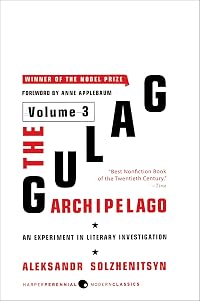
Volume 2 of the Nobel Prize-winner's towering masterpiece: the story of Solzhenitsyn's entrance into the Soviet prison camps, where he would remain for nearly a decade. Features a new foreword by Anne Applebaum.Tags
Recommendations





































Member Reviews
Volume II of 'The Gulag Archipelago' is much longer than the first volume, and in this volume, Aleksandr Solzhenitsyn continues his exploration of the Soviet forced labour system.
In the first volume, the author explored the historical and bureaucratic development of the Gulag, including the state's arbitrary system of arrests.
In the second volume, the author focused on personal accounts, in addition to providing a detailed description of the system's development. The description of the system's development is fascinating and disturbing, clearly showing how a state can gradually build a system of repression.
While giving voice to some of the prisoners, Aleksandr Solzhenitsyn also explores several themes – moral choices under show more oppression, survival and adaptation, the nature of evil, memory, testimony, and spiritual resilience.
In Volume II, the author's perspective became considerably more nuanced, philosophical, and less judgmental, focusing on people's narratives and seeming to have listened to their stories.
The stories and the narrative center on the general theme of how people act under duress and explore how some were brave, and others were not. He studied how guards and prisoners were sometimes complicit with one another.
The book is heavy, so if you expect a narrative that shines the warm light of hope and optimism, then you will walk away disappointed. A casual reader may also be tempted to dismiss the text, telling themselves that the events took place in the Soviet Republic many years ago and are therefore irrelevant to us in our modern times or in our countries. This potential dismissal will be a mistake: the events he described in his book could – and probably do - take place in our countries and in our times. We live in a world where autocracy is on the rise. The themes Aleksandr Solzhenitsyn describes are relevant today, and the spare, terse writing style makes the book more frightening than any melodramatic writing could. show less
In the first volume, the author explored the historical and bureaucratic development of the Gulag, including the state's arbitrary system of arrests.
In the second volume, the author focused on personal accounts, in addition to providing a detailed description of the system's development. The description of the system's development is fascinating and disturbing, clearly showing how a state can gradually build a system of repression.
While giving voice to some of the prisoners, Aleksandr Solzhenitsyn also explores several themes – moral choices under show more oppression, survival and adaptation, the nature of evil, memory, testimony, and spiritual resilience.
In Volume II, the author's perspective became considerably more nuanced, philosophical, and less judgmental, focusing on people's narratives and seeming to have listened to their stories.
The stories and the narrative center on the general theme of how people act under duress and explore how some were brave, and others were not. He studied how guards and prisoners were sometimes complicit with one another.
The book is heavy, so if you expect a narrative that shines the warm light of hope and optimism, then you will walk away disappointed. A casual reader may also be tempted to dismiss the text, telling themselves that the events took place in the Soviet Republic many years ago and are therefore irrelevant to us in our modern times or in our countries. This potential dismissal will be a mistake: the events he described in his book could – and probably do - take place in our countries and in our times. We live in a world where autocracy is on the rise. The themes Aleksandr Solzhenitsyn describes are relevant today, and the spare, terse writing style makes the book more frightening than any melodramatic writing could. show less
Under the Czars Russia produced many great writers, but under the Soviets there was only one, Alexander Solzhenitsyn. His Gulag Archipelago is a masterpiece, it is literature and a record of one of the most monstrous times in history. The Soviet Union, like Nazi Germany and Japan during the Second World War was a slave empire. Together they were the three slave empires of the Twentieth Century. Solzhenitsyn looks at the life of the Corrective Labour Camps, known as GULAG. And like a chain of islands, known as an archipelago, these camps spread right across the Soviet Union. Hence the title of "The Gulag Archipelago".
He starts off here in his second volume with the birth of the camps right at the start of the Russian Revolution. Then the show more first camp on Solovetsky, the building of the White Sea Canal and the spread of the camps throughout the Soviet Union. How the camps provided both free labour to build the Socialist economy, and that they also destroyed "through labour" those opposed in word, deed or thought to the Soviet Government. What does destroyed through labour mean? It means these people were worked to death. They were murdered as surely as if they had been shot, which the Soviet Government did as well.
He includes chapters on those loyal Communists sent to the Gulags, on how Gulag influenced the entire society, on the Zeks as the prisoners were known, on women, on the Guards, on the 58's (the political prisoners), on the Thiefs. It is hard to think of anything that has been left out. Throughout there are personal stories, things that he experienced and saw, things that others experienced. He includes stories on both those who survived and those who died. His research is impressive and his knowledge is extensive and he admits when he doesn't know something. How impressive is his research? This was the first real study of the Gulags and 40 years after it was published it is still one of the best. It just covers so many bases.
No book is perfect and it must be admitted that most people who start this book will not finish it, it is a heavy book in every sense of the word. This volume is volume 2 for a start, further it's nearly 700 pages long, thats a lot of reading. It is also about the death and destruction of millions of lives. To quote George Orwell out of context, most people do not want to read 700 pages of " If you want a picture of the future, imagine a boot stamping on a human face—forever". When it was written the Soviet Union existed, it no longer does. What I found interesting is how many things I found that were still current in the world. show less
He starts off here in his second volume with the birth of the camps right at the start of the Russian Revolution. Then the show more first camp on Solovetsky, the building of the White Sea Canal and the spread of the camps throughout the Soviet Union. How the camps provided both free labour to build the Socialist economy, and that they also destroyed "through labour" those opposed in word, deed or thought to the Soviet Government. What does destroyed through labour mean? It means these people were worked to death. They were murdered as surely as if they had been shot, which the Soviet Government did as well.
He includes chapters on those loyal Communists sent to the Gulags, on how Gulag influenced the entire society, on the Zeks as the prisoners were known, on women, on the Guards, on the 58's (the political prisoners), on the Thiefs. It is hard to think of anything that has been left out. Throughout there are personal stories, things that he experienced and saw, things that others experienced. He includes stories on both those who survived and those who died. His research is impressive and his knowledge is extensive and he admits when he doesn't know something. How impressive is his research? This was the first real study of the Gulags and 40 years after it was published it is still one of the best. It just covers so many bases.
No book is perfect and it must be admitted that most people who start this book will not finish it, it is a heavy book in every sense of the word. This volume is volume 2 for a start, further it's nearly 700 pages long, thats a lot of reading. It is also about the death and destruction of millions of lives. To quote George Orwell out of context, most people do not want to read 700 pages of " If you want a picture of the future, imagine a boot stamping on a human face—forever". When it was written the Soviet Union existed, it no longer does. What I found interesting is how many things I found that were still current in the world. show less
Truly worthwhile. A historical record and analysis and a personal story all running in parallel. Provides surprising insights into workings of governments, psychology, human motivations and of course the mind harrowing horrors of Russian 20th century history, showing how a whole society can collapse in on itself.
This is the stunning continuation of Solzhenitsyn's "experiement in Literary history" about the Stalinist Gulag (prison camps). In the first volume, Solzhenitsyn took us into the lives of the "zeks" (prisoners) starting with the arrest. In this volume he takes us deep into the heart of the camps, and it is a broken heart. Ironically though, it is in this demonic atmosphere that Solzhenitsyn finds his spiritual grounding, which he recounts in this volume.
If you made it through the first volume, you owe it to yourself to keep going, for their is as much value here as you found in Part I.
If you made it through the first volume, you owe it to yourself to keep going, for their is as much value here as you found in Part I.
This review is written with a GPL 4.0 license and the rights contained therein shall supersede all TOS by any and all websites in regards to copying and sharing without proper authorization and permissions. Crossposted at WordPress, Blogspot, & Librarything by Bookstooge’s Exalted Permission
Title: Gulag Archipelago, Vol 2
Series: Gulag Archipelago
Author: Alexander Solzhenitsyn
Rating: 4 of 5 Stars
Genre: Non-fiction
Pages: 648
Words: 276.5K
Synopsis:
Containing Parts III & IV of Solzhenitsyn’s book, The Gulag Archipelago.
From Wikipedia.com
Structurally, the text comprises seven sections divided (in most printed editions) into three volumes: parts 1–2, parts 3–4, and parts 5–7. At one level, the Gulag Archipelago traces the history of show more the system of forced labor camps that existed in the Soviet Union from 1918 to 1956. Solzhenitsyn begins with V. I. Lenin’s original decrees which were made shortly after the October Revolution; they established the legal and practical framework for a series of camps where political prisoners and ordinary criminals would be sentenced to forced labor. The book then describes and discusses the waves of purges and the assembling of show trials in the context of the development of the greater Gulag system; Solzhenitsyn gives particular attention to its purposive legal and bureaucratic development.
The narrative ends in 1956 at the time of Nikita Khrushchev’s Secret Speech (“On the Personality Cult and its Consequences”). Khrushchev gave the speech at the 20th Congress of the Communist Party of the Soviet Union, denouncing Stalin’s personality cult, his autocratic power, and the surveillance that pervaded the Stalin era. Although Khrushchev’s speech was not published in the Soviet Union for a long time, it was a break with the most atrocious practices of the Gulag system.
Despite the efforts by Solzhenitsyn and others to confront the legacy of the Gulag, the realities of the camps remained a taboo subject until the 1980s. Solzhenitsyn was also aware that although many practices had been stopped, the basic structure of the system had survived and it could be revived and expanded by future leaders. While Khrushchev, the Communist Party, and the Soviet Union’s supporters in the West viewed the Gulag as a deviation of Stalin, Solzhenitsyn and many among the opposition tended to view it as a systemic fault of Soviet political culture – an inevitable outcome of the Bolshevik political project.
Parallel to this historical and legal narrative, Solzhenitsyn follows the typical course of a zek (a slang term for an inmate), derived from the widely used abbreviation “z/k” for “zakliuchennyi” (prisoner) through the Gulag, starting with arrest, show trial, and initial internment; transport to the “archipelago”; the treatment of prisoners and their general living conditions; slave labor gangs and the technical prison camp system; camp rebellions and strikes (see Kengir uprising); the practice of internal exile following the completion of the original prison sentence; and the ultimate (but not guaranteed) release of the prisoner. Along the way, Solzhenitsyn’s examination details the trivial and commonplace events of an average prisoner’s life, as well as specific and noteworthy events during the history of the Gulag system, including revolts and uprisings.
Solzhenitsyn also states:
Macbeth’s self-justifications were feeble – and his conscience devoured him. Yes, even Iago was a little lamb, too. The imagination and spiritual strength of Shakespeare’s evildoers stopped short at a dozen corpses. Because they had no ideology. Ideology – that is what gives evildoing its long-sought justification and gives the evildoer the necessary steadfastness and determination. That is the social theory which helps to make his acts seem good instead of bad in his own and others’ eyes…. That was how the agents of the Inquisition fortified their wills: by invoking Christianity; the conquerors of foreign lands, by extolling the grandeur of their Motherland; the colonizers, by civilization; the Nazis, by race; and the Jacobins (early and late), by equality, brotherhood, and the happiness of future generations… Without evildoers there would have been no Archipelago.
— The Gulag Archipelago, Chapter 4, p. 173
There had been works about the Soviet prison/camp system before, and its existence had been known to the Western public since the 1930s. However, never before had the general reading public been brought face to face with the horrors of the Gulag in this way. The controversy surrounding this text, in particular, was largely due to the way Solzhenitsyn definitively and painstakingly laid the theoretical, legal, and practical origins of the Gulag system at Lenin’s feet, not Stalin’s. According to Solzhenitsyn’s testimony, Stalin merely amplified a concentration camp system that was already in place. This is significant, as many Western intellectuals viewed the Soviet concentration camp system as a “Stalinist aberration”
My Thoughts:
Where Volume 1 seemed mainly to be about the process of how the (fictional) legalities came into being that led to arrests and about the arrests and early detainment, this volume was all about the camps and the various kinds of people in the Gulag. The first 65% dealt exclusively with the camps, what went on in them, how the prisoners existed, how they lived (and died) what uses the camps were put too.
This was grueling. I started this particular volume back in August of last year and am just now finishing it up. So 5 months?
I wish I had profound things to write here but I don't. Solzhenitsyn simply chronicles what has gone on and shows how some of it happened (people turning a blind eye, people letting it happen because it was happening to someone else, people letting it happen because they were afraid of it happening to them, people letting it happen because it was happening to a group they didn't like) and the absolutely horrific costs of the camps. Make no mistake, the Gulags were death camps as sure as the Nazi camps were.
Solzhenitsyn also lets his own personality and biases show through quite a bit when he talks about the various kinds of people in the last part of the book. Any time a “thief” is mentioned (ie, a non-political offender for some actual crime), he really goes off against them. He makes no bones about how he survived his time (becoming an informer in the camps) and describes the very few kind of people who would refuse that (Christians being the main group).
Besides the weighty content, what also slowed me down was the references to things or people that I simply had no idea about or anyway to put them into context. Many times whole passages held almost no meaning for me because I didn't know the people being talked about or the brand of Russian humor went winging its way over my head. Solzhenitsyn did have a dry, sarcastic kind of humor and I appreciated what I could understand. Whenever he talked about the language and how particular words grew out of the Gulag, he lost me there too.
I won't go into the politics beyond to say that what we are seeing now in terms of our media organizations in lockstep with the current administration will be very familiar to anyone who has read this.
I am going to be taking an extended break before attempting Volume 3. I've got a bunch of other non-fiction books that have been just sitting on my kindle so it's time to pay them some attention. And I can't face another volume like this for awhile, it's just too much.
★★★★☆ show less
Title: Gulag Archipelago, Vol 2
Series: Gulag Archipelago
Author: Alexander Solzhenitsyn
Rating: 4 of 5 Stars
Genre: Non-fiction
Pages: 648
Words: 276.5K
Synopsis:
Containing Parts III & IV of Solzhenitsyn’s book, The Gulag Archipelago.
From Wikipedia.com
Structurally, the text comprises seven sections divided (in most printed editions) into three volumes: parts 1–2, parts 3–4, and parts 5–7. At one level, the Gulag Archipelago traces the history of show more the system of forced labor camps that existed in the Soviet Union from 1918 to 1956. Solzhenitsyn begins with V. I. Lenin’s original decrees which were made shortly after the October Revolution; they established the legal and practical framework for a series of camps where political prisoners and ordinary criminals would be sentenced to forced labor. The book then describes and discusses the waves of purges and the assembling of show trials in the context of the development of the greater Gulag system; Solzhenitsyn gives particular attention to its purposive legal and bureaucratic development.
The narrative ends in 1956 at the time of Nikita Khrushchev’s Secret Speech (“On the Personality Cult and its Consequences”). Khrushchev gave the speech at the 20th Congress of the Communist Party of the Soviet Union, denouncing Stalin’s personality cult, his autocratic power, and the surveillance that pervaded the Stalin era. Although Khrushchev’s speech was not published in the Soviet Union for a long time, it was a break with the most atrocious practices of the Gulag system.
Despite the efforts by Solzhenitsyn and others to confront the legacy of the Gulag, the realities of the camps remained a taboo subject until the 1980s. Solzhenitsyn was also aware that although many practices had been stopped, the basic structure of the system had survived and it could be revived and expanded by future leaders. While Khrushchev, the Communist Party, and the Soviet Union’s supporters in the West viewed the Gulag as a deviation of Stalin, Solzhenitsyn and many among the opposition tended to view it as a systemic fault of Soviet political culture – an inevitable outcome of the Bolshevik political project.
Parallel to this historical and legal narrative, Solzhenitsyn follows the typical course of a zek (a slang term for an inmate), derived from the widely used abbreviation “z/k” for “zakliuchennyi” (prisoner) through the Gulag, starting with arrest, show trial, and initial internment; transport to the “archipelago”; the treatment of prisoners and their general living conditions; slave labor gangs and the technical prison camp system; camp rebellions and strikes (see Kengir uprising); the practice of internal exile following the completion of the original prison sentence; and the ultimate (but not guaranteed) release of the prisoner. Along the way, Solzhenitsyn’s examination details the trivial and commonplace events of an average prisoner’s life, as well as specific and noteworthy events during the history of the Gulag system, including revolts and uprisings.
Solzhenitsyn also states:
Macbeth’s self-justifications were feeble – and his conscience devoured him. Yes, even Iago was a little lamb, too. The imagination and spiritual strength of Shakespeare’s evildoers stopped short at a dozen corpses. Because they had no ideology. Ideology – that is what gives evildoing its long-sought justification and gives the evildoer the necessary steadfastness and determination. That is the social theory which helps to make his acts seem good instead of bad in his own and others’ eyes…. That was how the agents of the Inquisition fortified their wills: by invoking Christianity; the conquerors of foreign lands, by extolling the grandeur of their Motherland; the colonizers, by civilization; the Nazis, by race; and the Jacobins (early and late), by equality, brotherhood, and the happiness of future generations… Without evildoers there would have been no Archipelago.
— The Gulag Archipelago, Chapter 4, p. 173
There had been works about the Soviet prison/camp system before, and its existence had been known to the Western public since the 1930s. However, never before had the general reading public been brought face to face with the horrors of the Gulag in this way. The controversy surrounding this text, in particular, was largely due to the way Solzhenitsyn definitively and painstakingly laid the theoretical, legal, and practical origins of the Gulag system at Lenin’s feet, not Stalin’s. According to Solzhenitsyn’s testimony, Stalin merely amplified a concentration camp system that was already in place. This is significant, as many Western intellectuals viewed the Soviet concentration camp system as a “Stalinist aberration”
My Thoughts:
Where Volume 1 seemed mainly to be about the process of how the (fictional) legalities came into being that led to arrests and about the arrests and early detainment, this volume was all about the camps and the various kinds of people in the Gulag. The first 65% dealt exclusively with the camps, what went on in them, how the prisoners existed, how they lived (and died) what uses the camps were put too.
This was grueling. I started this particular volume back in August of last year and am just now finishing it up. So 5 months?
I wish I had profound things to write here but I don't. Solzhenitsyn simply chronicles what has gone on and shows how some of it happened (people turning a blind eye, people letting it happen because it was happening to someone else, people letting it happen because they were afraid of it happening to them, people letting it happen because it was happening to a group they didn't like) and the absolutely horrific costs of the camps. Make no mistake, the Gulags were death camps as sure as the Nazi camps were.
Solzhenitsyn also lets his own personality and biases show through quite a bit when he talks about the various kinds of people in the last part of the book. Any time a “thief” is mentioned (ie, a non-political offender for some actual crime), he really goes off against them. He makes no bones about how he survived his time (becoming an informer in the camps) and describes the very few kind of people who would refuse that (Christians being the main group).
Besides the weighty content, what also slowed me down was the references to things or people that I simply had no idea about or anyway to put them into context. Many times whole passages held almost no meaning for me because I didn't know the people being talked about or the brand of Russian humor went winging its way over my head. Solzhenitsyn did have a dry, sarcastic kind of humor and I appreciated what I could understand. Whenever he talked about the language and how particular words grew out of the Gulag, he lost me there too.
I won't go into the politics beyond to say that what we are seeing now in terms of our media organizations in lockstep with the current administration will be very familiar to anyone who has read this.
I am going to be taking an extended break before attempting Volume 3. I've got a bunch of other non-fiction books that have been just sitting on my kindle so it's time to pay them some attention. And I can't face another volume like this for awhile, it's just too much.
★★★★☆ show less
incredible. especially book 4
“Een mens is geen steen, en zelfs dié wordt nog wel gebroken” (278).
Members
- Recently Added By
Lists

Russian Literature
184 works; 35 members

Books Read in 2023
5,638 works; 147 members

imperialism, war & genocide
11 works; 1 member

The Well-Educated Mind, Susan Wise Bauer, 2016
179 works; 3 members

Personal 2024 reads
5 works; 1 member

Personal 2025 reads
18 works; 1 member
Author Information

217+ Works 44,439 Members
Aleksandr Solzhenitsyn was born on December 11, 1918 in Kislovodsk in the northern Caucusus Mountains. He received a degree in physics and math from Rostov University in 1941. He served in the Russian army during World War II but was arrested in 1945 for writing a letter criticizing Stalin. He spent the next decade in prisons and labor camps and, show more later, exile, before being allowed to return to central Russia, where he worked as a high school science teacher. His first novel, One Day in the Life of Ivan Denisovich, was published in 1962. In 1970, he was awarded the Nobel Prize for Literature. In 1974, he was arrested for treason and exiled following the publication of The Gulag Archipelago. He moved to Switzerland and later the U. S. where he continued to write fiction and history. When the Soviet Union collapsed, he returned to his homeland. His other works include The First Circle and The Cancer Ward. He died due to a heart ailment on August 3, 2008 at the age of 89. (Bowker Author Biography) show less
Some Editions
Awards and Honors
Distinctions
Series

Belongs to Publisher Series
Work Relationships
Is contained in
Common Knowledge
- Canonical title
- The Gulag Archipelago, 1918-1956: An Experiment in Literary Investigation (Volume Two, Parts III-IV) (Volume Two, Parts III-IV); The Gulag Archipelago, 1918-1956: Parts III-IV
- Original title
- Arkhipelag GULag, 1918-1956
- Alternate titles*
- De Goelag Archipel 1918-1956 : proeve van een artistieke studie. Boek 2/3
- Original publication date
- 1974 (Russian) (Russian); 1975 (English: Thomas P. Whitney) (English: Thomas P. Whitney)
- Important places
- USSR (Soviet Union)
- Epigraph
- Part III
"Only those can understand us who ate from the same bowl with us."
Quotation from a letter of a Hutzul girl, a former zek
Vierter Teil
Siehe, ich sage euch ein Geheimnis: Wir werden nicht alle sterben, aber wir werden alle verwandelt werden.
(Brief an die Korinther, 15,51) - First words
- Rosy-fingered Eos, so often mentioned in Homer and called Aurora by the Romans, caressed, too, with those fingers the first early morning of the Archipelago.
- Last words*
- (Click to show. Warning: May contain spoilers.)Wenn ich jetzt, zu Beginn des Jahres 1967, dieses Buch abbreche [Fußnote: Nein, ich brach es nicht ab, beendete es ein Jahr später], so tue ich es in dem Bewußtsein, daß es mir nicht mehr beschieden sein wird, zum Thema "Archipel" zurückzukehren.
Es genügt wohl auch. Es hat uns zwanzig Jahre beschäftigt.
(Deutsche Übersetzung von Anna Peturnig und Ernst Walter) - Original language
- Russian
- Disambiguation notice
- Aleksandr Solzhenistyn's The Gulag Archipelago has been published in a number of formats, and is catalogued in a variety of ways. The complete work consists of seven parts, often divided into three volumes as follow: V... (show all)olume One, consisting of Part I ("The Prison Industry") and Part II ("Perpetual Motion"); Volume Two, consisting of Part III ("The Destructive-Labor Camps") and Part IV ("The Soul and Barbed Wire"); and Volume III, consisting of Part V ("Katorga"), Part VI ("Exile") and Part VII ("Stalin Is No More").
THIS LT WORK IS INTENDED ONLY FOR VOLUME TWO, PARTS III-IV.
Please do not combine other copies having materially different content (e.g., Parts I-II, Parts V-VII, the complete work, an omnibus [such as Parts I-VI], any individual Part, or the abridged version). Thank you.
*Some information comes from Common Knowledge in other languages. Click "Edit" for more information.
Classifications
- Genres
- Nonfiction, History, Biography & Memoir
- DDC/MDS
- 365.450947 — Society, government, & culture Social problems and social services Punishment Institutions for specific classes of inmates Institutions for political prisoners and related groups of people
- LCC
- HV9713 .S6413 — Social sciences Social pathology. Social and public welfare. Criminology Social pathology. Social and public welfare. Criminal justice administration Penology. Prisons. Corrections By region or country
- BISAC
Statistics
- Members
- 1,950
- Popularity
- 10,903
- Reviews
- 13
- Rating
- (4.23)
- Languages
- 18 — Czech, Danish, Dutch, English, Estonian, Finnish, French, German, Hungarian, Italian, Japanese, Norwegian (Bokmål), Polish, Romanian, Russian, Serbian, Spanish, Swedish
- Media
- Paper, Audiobook, Ebook
- ISBNs
- 48
- ASINs
- 36