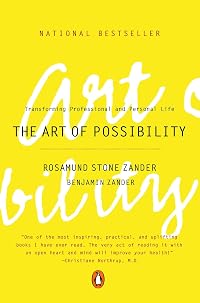
The Art of Possibility: Transforming Professional and Personal Life
by Rosamund Stone Zander, Benjamin Zander
On This Page
Description
Presenting twelve breakthrough practices for bringing creativity into all human endeavors, The Art of Possibility is the dynamic product of an extraordinary partnership. The Art of Possibility combines Benjamin Zander's experience as conductor of the Boston Philharmonic and his talent as a teacher and communicator with psychotherapist Rosamund Stone Zander's genius for designing innovative paradigms for personal and professional fulfillment. The authors' harmoniously interwoven perspectives show more provide a deep sense of the powerful role that the notion of possibility can play in every aspect of life. Through uplifting stories, parables, and personal anecdotes, the Zanders invite us to become passionate communicators, leaders, and performers whose lives radiate possibility into the world. show lessTags
Recommendations

Member Reviews
Honestly, if the only takeaway that I wind up with from this book is the action of throwing my hands up in the air and saying "how fascinating!" when I make a mistake, I feel like that was worth the listening time. Of course there are lots of cool ideas in here, and I love the way this book challenges the dominant paradigm of constant competition and scarcity. I really enjoyed hearing how about the world of classical music as well, and having concrete examples of some of the concepts.
The best book I have read in forever. Beyond self-help and hackneyed relational tips and tricks, this book outlines a blueprint for how to live in the world -- with yourself, with others, at home, at work, in every way humans live -- by revising your world view. Eminently practical and satisfyingly woo-woo at the same time.
After two chapters I was in full skim-and-dash mode. I was disappointed, depressed, and wanting to do nothing more than throw it all away as a waste of time. But I am not like that. Even if I fear I have taken the first steps of a meaningless journey through empty platitudes and mindless ideas, I will complete that journey. Once I start a book, I will (except for a very, very, few exceptions) finish it. That doesn't mean I have to pay close attention. Skimming means I am reading. But I will get through it.
This book proves why it is so important to keep plodding through. Had I not done so, I would have missed a lot.
A few years ago I saw Benjamin Zander speak and I was very impressed. Recently I had cause to revisit some of the principles show more he talked about, looking up his TED talk as well as some other videos of his presentations. (Check the TED talk out; it will not disappoint.) It was enough to make me take the leap and buy the book. I knew I was running the risk of this being another feel-good, we-are-the-world, kumbaya tome. But, based on what I had seen of his work, I took that chance.
And, as you saw, the first set of pages lead me to believe my fears were well founded.
And then I got into Chapter 3 – "Giving an A" – and I found myself deeply wrapped within the ideas and concepts that were being spun. Yes, the concept is simple. Rather than judging people – making them earn your respect – start with the idea that they have already received an "A" and see what happens.
Now, if I were you and I were just reading this out of context, I know I would respond in much the same way I did to the early parts of the book. "Yeah, nice story, tell me something I can use." But in the context of the book – in the context of the stories – there is something in this simple idea that resounds within me.
Here's a quote from the chapter. "...I actively train my students that when they make a mistake, they are to lift their arms in the air, smile, and say, 'How fascinating!'" Here's another. "A cynic, after all, is a passionate person who does not want to be disappointed again." Just two dog-eared pages from the many that eventually populated this little book.
What I found within were not so much motivational things for me (although readers will find those if that is what they need); rather I found ideas and concepts that have more to do with leadership and motivating others, about new ways to approach old problems, and ideas that have practical applications in life, the universe, and everything.
Don't get me wrong. There were down times. I still stumbled across chapters that left me just as cold as those first two, situations where autopilot kicked in and I was reading just trying to get to something I cared about. But when I did arrive at those destinations I was floored by the impact of what was being said.
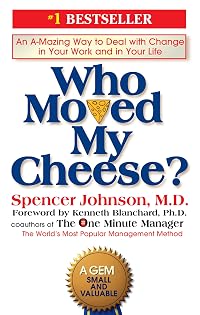
I think the point of all of this is that your mileage may differ. And that is as it should be for this type of book. I never got Who Moved My Cheese, but exec after exec seemed to think it was the greatest thing since cheese without holes. And so you may read this and wonder what I am going on about. Or you may read it and say that chapters one and two were the greatest words ever written and what the bleep did I see in chapter three. Or your reactions may be all over the board.
All I can say is that I will be stealing – I'm sorry, make that borrowing – many of the ideas and concepts as I train others about leadership and self-direction. And I think that, if you give it a chance, you will find things that will make a difference for you, also. show less
This book proves why it is so important to keep plodding through. Had I not done so, I would have missed a lot.
A few years ago I saw Benjamin Zander speak and I was very impressed. Recently I had cause to revisit some of the principles show more he talked about, looking up his TED talk as well as some other videos of his presentations. (Check the TED talk out; it will not disappoint.) It was enough to make me take the leap and buy the book. I knew I was running the risk of this being another feel-good, we-are-the-world, kumbaya tome. But, based on what I had seen of his work, I took that chance.
And, as you saw, the first set of pages lead me to believe my fears were well founded.
And then I got into Chapter 3 – "Giving an A" – and I found myself deeply wrapped within the ideas and concepts that were being spun. Yes, the concept is simple. Rather than judging people – making them earn your respect – start with the idea that they have already received an "A" and see what happens.
Now, if I were you and I were just reading this out of context, I know I would respond in much the same way I did to the early parts of the book. "Yeah, nice story, tell me something I can use." But in the context of the book – in the context of the stories – there is something in this simple idea that resounds within me.
Here's a quote from the chapter. "...I actively train my students that when they make a mistake, they are to lift their arms in the air, smile, and say, 'How fascinating!'" Here's another. "A cynic, after all, is a passionate person who does not want to be disappointed again." Just two dog-eared pages from the many that eventually populated this little book.
What I found within were not so much motivational things for me (although readers will find those if that is what they need); rather I found ideas and concepts that have more to do with leadership and motivating others, about new ways to approach old problems, and ideas that have practical applications in life, the universe, and everything.
Don't get me wrong. There were down times. I still stumbled across chapters that left me just as cold as those first two, situations where autopilot kicked in and I was reading just trying to get to something I cared about. But when I did arrive at those destinations I was floored by the impact of what was being said.
I think the point of all of this is that your mileage may differ. And that is as it should be for this type of book. I never got Who Moved My Cheese, but exec after exec seemed to think it was the greatest thing since cheese without holes. And so you may read this and wonder what I am going on about. Or you may read it and say that chapters one and two were the greatest words ever written and what the bleep did I see in chapter three. Or your reactions may be all over the board.
All I can say is that I will be stealing – I'm sorry, make that borrowing – many of the ideas and concepts as I train others about leadership and self-direction. And I think that, if you give it a chance, you will find things that will make a difference for you, also. show less
What I most appreciate about this book is that the twelve valuable practices are novel. It's hard to come up with an orthogonal approach in this space. It's the authors' combined background in a creative field and a counseling field that give them a different base of experiences to draw from compared to the typical experiences we see in this genre, yet alone from Harvard Business School Press. The reader will gain a new lens for viewing their world, and with plenty of interesting and moving stories to make the points set.
"The history of transformational phenomena - the Internet, for example, or paradigm shifts in science, or the spread of a new religion - suggests that transformation happens less by arguing cogently for something new than by generating active, ongoing practices that shift a culture's experience of the basis for reality."
This is an excellent observation. The contents would have made an interesting article, if written by someone else. Numerous times I wanted to punch Ben in the face.
This is an excellent observation. The contents would have made an interesting article, if written by someone else. Numerous times I wanted to punch Ben in the face.
Ben Zander's TED presentation was great, so I decide to buy his book, but the book wasn't as impressive as I expected. it was slow and boring and not practical.
"This inspirational book is a synthesis of Rosamund Stone Zander's knowledge of cutting-edge psychology and Benjamin Zander's experiences as the conductor of the Boston Philharmonic Orchestra." The Zanders propose and illustrate a type of cognitive-psychological-reboot to one's thinking and approach to life. It's an antidote to our frantic, consumerist, competitive, sensationalist culture. Their enthusiasm, energy, and humor are quite contagious. We need more of this. A lot more.
Members
- Recently Added By
Lists

Wisdom
31 works; 5 members

Creating Possibilities
10 works; 1 member

Teacher Leadership
10 works; 1 member

ORCID Book list
27 works; 1 member

TED 2013 Summer Reading List
190 works; 13 members

Books for Educators
164 works; 6 members
Author Information

3 Works 1,888 Members
7 Works 1,839 Members
Series
Belongs to Publisher Series
Common Knowledge
- Canonical title*
- L'arte del possibile. Diventare gli artefici del proprio successo.
- Original publication date
- 2000
*Some information comes from Common Knowledge in other languages. Click "Edit" for more information.
Classifications
Statistics
- Members
- 1,833
- Popularity
- 11,845
- Reviews
- 33
- Rating
- (3.91)
- Languages
- 9 — Dutch, English, French, German, Greek, Italian, Russian, Spanish, Portuguese (Portugal)
- Media
- Paper, Audiobook, Ebook
- ISBNs
- 18
- ASINs
- 15
