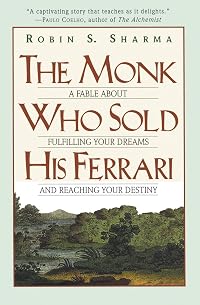
The Monk Who Sold His Ferrari: A Fable About Fulfilling Your Dreams & Reaching Your Destiny
by Robin Sharma
On This Page
Description
Includes a bonus excerpt of Robin Sharma's upcoming The Secret Letters of the Monk Who Sold His Ferrari. With more than four million copies sold in fifty-one languages, The Monk Who Sold His Ferrari launched a bestselling series and continues to help people from every walk of life live with far greater success, happiness and meaning in these times of dramatic uncertainty. The Monk Who Sold His Ferrari celebrates the story of Julian Mantle, a successful but misguided lawyer whose physical and show more emotional collapse propels him to confront his life. The result is an engaging odyssey on how to release your potential and live with passion, purpose and peace. A brilliant blend of timeless wisdom and cutting-edge success principles, The Monk Who Sold His Ferrari is now, more than ever, a guide for the times, as countless Canadians dedicate themselves to living a life where family, work and personal fulfillment are achieved in harmonious balance. show lessTags
Recommendations




Member Reviews
I read this book for a challenge. One of the worst things I have ever read.
A badly written, ultra-orientalist regurgitation of common sense, factual inaccuracies and downright dangerous declarations.
1. Most of the points of "wisdom" in this book are everyday commonsense points repackages for credulous readers.
2. The Eastern Mysticism bit is so overblown - everything is 5000 years old, everything is mystic - its utter rubbish. India is not the land of wise sages dispensing ageless wisdom - sure we have our share of philosophers, but so does most cultures. This entire "bunch of ageless people living on the top of the mountains" is a very old, very overblown myth.
3. Some things are hilariously inaccurate - no sandalwood does not grow on show more top of the Himalayas, and no vegetarianism is not "how nature intended things to be" All those carnivores are supernatural or something?
4. Some things are downright dangerous
a. be totally fearless. No. Fear can be healthy. It often functions as a survival mechanism.
b. Sunbathe in the Indian Sun. No. If you don't have a lot of melanin, that's how you get cancer. Even if you do, and you try this at anytime except winter you will die of a neat combination of sunstroke and dehydration.
c. Do not think negative thoughts, don't even allow them to enter your mind. No. That's how you become narrow minded. Rather consider the negative, find out whats causing it, examine it in detail, find out how to deal with it. See? I can write self help book too!
5. Weirdly enough in this entire lecture this book never talks about how this magical monks get things to eat. Do they practice agriculture? Hunter gatherers? Not really stated. As a fantasy reader such shoddy worldbuilding offends me.
6. Also among so much advice, there is nothing about sex or relationships except the standard "spend time with your loved ones" line. Seems to be a pretty glaring omission in a book about life.
So in conclusion, this book does not deserve the status of a book. show less
A badly written, ultra-orientalist regurgitation of common sense, factual inaccuracies and downright dangerous declarations.
1. Most of the points of "wisdom" in this book are everyday commonsense points repackages for credulous readers.
2. The Eastern Mysticism bit is so overblown - everything is 5000 years old, everything is mystic - its utter rubbish. India is not the land of wise sages dispensing ageless wisdom - sure we have our share of philosophers, but so does most cultures. This entire "bunch of ageless people living on the top of the mountains" is a very old, very overblown myth.
3. Some things are hilariously inaccurate - no sandalwood does not grow on show more top of the Himalayas, and no vegetarianism is not "how nature intended things to be" All those carnivores are supernatural or something?
4. Some things are downright dangerous
a. be totally fearless. No. Fear can be healthy. It often functions as a survival mechanism.
b. Sunbathe in the Indian Sun. No. If you don't have a lot of melanin, that's how you get cancer. Even if you do, and you try this at anytime except winter you will die of a neat combination of sunstroke and dehydration.
c. Do not think negative thoughts, don't even allow them to enter your mind. No. That's how you become narrow minded. Rather consider the negative, find out whats causing it, examine it in detail, find out how to deal with it. See? I can write self help book too!
5. Weirdly enough in this entire lecture this book never talks about how this magical monks get things to eat. Do they practice agriculture? Hunter gatherers? Not really stated. As a fantasy reader such shoddy worldbuilding offends me.
6. Also among so much advice, there is nothing about sex or relationships except the standard "spend time with your loved ones" line. Seems to be a pretty glaring omission in a book about life.
So in conclusion, this book does not deserve the status of a book. show less
The monk who sold his Ferrari, is a misleading title. The man who sold his Ferrari and became a monk, would have been more accurate. The idea of a monk driving a Ferrari is somewhat thought provoking and made me smile. The book itself was a merger between fiction and instruction on techniques to perfect your life experience. From a fiction point of view, it too often told rather than showed. It’s an easy to read book (I read it in an afternoon) and the structure works well making it easy to remember what went before, or where to look for a particular part.
However, I don’t feel helped. I don’t feel like my life has been enlightened. I feel like I’ve been told to get up earlier in the morning and meditate. I could have told me show more that before. Somehow, I couldn’t believe in these monks doing their one handed press-ups at 4am every morning. I felt sorry for them. What sort of enlightenment requires being in the same village forever? How did the monks know about the real world if they didn’t experience it? show less
However, I don’t feel helped. I don’t feel like my life has been enlightened. I feel like I’ve been told to get up earlier in the morning and meditate. I could have told me show more that before. Somehow, I couldn’t believe in these monks doing their one handed press-ups at 4am every morning. I felt sorry for them. What sort of enlightenment requires being in the same village forever? How did the monks know about the real world if they didn’t experience it? show less
I liked this for its parable and simplicity. It is a bit formula driven but it did force me to have a look at his website. For all the good and bad Robin is a realist that practices what he preaches. The best thing about his work are the lists. I love lists and they inspire me (sorry but I also have a stationary fetish) 24 Things to do before you die, that type of thing. Things like "Be the most generous person in every room you’re in" "Be the most ethical person you know" sage advice for anyone in any stage of life. You won't find God reading Sharman but you will live at peace with yourself and the world. Personally I'd rather find God but each to his own.
Short on story and long on instruction, but an easy, rewarding readIn "The Monk Who Sold His Ferrari," Robin S. Sharma clothes sound advice for spiritual and personal growth in a thin mantle of fiction that delivers much instruction but minimal entertainment. However, Sharma’s fictional approach makes for an easy read and good retention of his key principles.Spiritual/metaphysical content: The narrator spends one revelation-filled night with Julian Mantle learning the fundamentals of spiritual growth. Julian imparts everything he has learned from his time with the Sivana monks, cramming a lifetime of wisdom into their short time together. Sharma structures the lessons into seven chapters based on a short fable full of symbols. Each show more symbol represents a key idea from the Seven Basic Principles for Enlightened Living. Each chapter ends with an action page that summarizes the symbol, what you need to remember, and techniques to try, such as the Ten Rituals for Radiant Living.My take: Sharma calls his book a “fable” in the subtitle, but it is both more and less than that. The fable part takes place in the opening chapters of the book, in which we discover that the hard-driven attorney has moved to India, become a monk, and after three years has returned to pass on his wisdom to his protégé. That’s the extent of the story, and character development fares little better. As a work of fiction, the book leaves much to be desired.However, as a collection of easy-to-digest life strategies and pearls of wisdom, the book is quite satisfying. Sharma has organized the book around a short fable about a garden full of symbols (a fable within a fable), which makes it easy to understand and follow his 30-day plan to enlightened living. The give-and-take of dialog between Julian Mantle and his student rescues the story from the tedium of an instructional guide. If your primary goal as a reader is to quickly absorb the core of Sharma’s life improvement teaching, then this book is a great place to start.For more reviews of new age novels, see Fiction For A New Age. show less
I read two books for my Black Belt Test: Mindfulness in Plain English, by Bhante Gunaratana and The Monk Who Sold His Ferrari, a Fable About Fulfilling Your Dreams and Reaching Your Destiny by Robin S. Sharma. I will be reviewing the latter book.
This book tells the tale of Julian Mantle, a lawyer whose life was unfulfilled and out of balance. He suffers a heart attack, a wake-up call, and abandons his life in search of meaning. He travels far and ultimately winds up studying with the Great Sages of Sivana. After learning many lessons, he returns to the United States to share his newfound wisdom with his former legal associate, John. The practical lessons within this jewel of a book teach us to:
• “Develop Joyful Thoughts
• Follow show more Our Life’s Mission and Calling
• Cultivate Self-Discipline and Act Courageously
• Value Time As Our Most Important Commodity
• Nourish Our Relationships, and
• Live Fully, One Day At A Time.”
Although the writing can be somewhat forced at times, the pearls of wisdom far outweigh any stylistic flaws. The structure of the book is an all-night conversation between Julian and John. Julian relates a story, which goes something like this:
You are sitting in a magnificent, lush, green garden. It is tranquil and silent. In the midst of this beauty you notice a tall towering lighthouse. From a door at the base, out stumbles a nine-foot-tall nine-hundred-pound Japanese sumo wrestler. He is clothed in pink wire cable. He finds a shiny gold stopwatch, but slips on it and falls, knocked unconscious. When he awakens, he is greeted by the fragrance of roses. He goes to the bushes and then sees a long winding path covered by millions of diamonds. Something tells him to take this path.
Each of these elements in the story represents a lesson to be learned. For example, the lush garden represents the mind. Just as we would yank out any weeds growing in our garden, so we must guard against them in our mind. The weeds of the mind are negative thoughts. They stand in the way of our true potential and happiness. The lighthouse represents your purpose in life. It must be tall and bright for you to see it, for you cannot hit a target you cannot see. The sumo wrestler represents self-mastery or Kaizen and the wire he wears stands for self-discipline. The clock he trips upon reminds us not to waste time, for it is precious. The roses remind us to selflessly serve others and the diamonds on the path symbolize the jewel of living in the present.
At the end of each lesson, Sharma has included a summary page sharing the symbol, the virtue learned, the wisdom behind it, the techniques to use and a quotable quote. For me, the first lesson about the garden was particularly significant and provided immediate confirmation that the lessons within this book are important and true. I had been having difficulty remembering the sequence of some of the Taeguk forms and I realized while reading this book that I had a negative voice in my head telling me that I couldn’t learn them. Within a day of silencing this nasty voice and replacing it with the positive twin “could,” I was able to master my forms. There were immediate benefits and lessons from each of the symbols, but obviously they are lessons that must be learned and practiced continually in order to see changes in my life. In fact, the book states that any desired change must be practiced for 21 consecutive days before the new thought/attitude/behavior will stick.
While reading this book, I dog-eared many pages and highlighted lots of passages. I am quite sure I will be reread this book many times. Below I have shared just a few of my favorite words of wisdom from The Monk Who Sold His Ferrari. (I could go on for pages!)
• Never regret your past. Rather, embrace it as the teacher that it is. *
• There are no mistakes in life, only lessons.
• Begin to live out the glory of your imagination, not your memory.
• The price of greatness is responsibility over each of your thoughts. –Churchill
• Stillness is the stepping stone to connecting with the universal source of intelligence that throbs through every living thing.
• Everything is created twice, first in the mind and then in reality.
• Imagination is more important than knowledge. –Einstein
• The only limits on your life are those you set yourself. –Yogi Raman
• Failure is not having the courage to try.
And most interestingly:
• The Chinese character for “crisis” is comprised of two sub-characters: one that spells “danger” and another that spells “opportunity”…the ancient Chinese knew that there is a bright side to the darkest circumstances—if you have the courage to look for it.
Obviously, I highly recommend this book! It will bless your life.
* If no author is listed, the quote is attributed to Julian. show less
This book tells the tale of Julian Mantle, a lawyer whose life was unfulfilled and out of balance. He suffers a heart attack, a wake-up call, and abandons his life in search of meaning. He travels far and ultimately winds up studying with the Great Sages of Sivana. After learning many lessons, he returns to the United States to share his newfound wisdom with his former legal associate, John. The practical lessons within this jewel of a book teach us to:
• “Develop Joyful Thoughts
• Follow show more Our Life’s Mission and Calling
• Cultivate Self-Discipline and Act Courageously
• Value Time As Our Most Important Commodity
• Nourish Our Relationships, and
• Live Fully, One Day At A Time.”
Although the writing can be somewhat forced at times, the pearls of wisdom far outweigh any stylistic flaws. The structure of the book is an all-night conversation between Julian and John. Julian relates a story, which goes something like this:
You are sitting in a magnificent, lush, green garden. It is tranquil and silent. In the midst of this beauty you notice a tall towering lighthouse. From a door at the base, out stumbles a nine-foot-tall nine-hundred-pound Japanese sumo wrestler. He is clothed in pink wire cable. He finds a shiny gold stopwatch, but slips on it and falls, knocked unconscious. When he awakens, he is greeted by the fragrance of roses. He goes to the bushes and then sees a long winding path covered by millions of diamonds. Something tells him to take this path.
Each of these elements in the story represents a lesson to be learned. For example, the lush garden represents the mind. Just as we would yank out any weeds growing in our garden, so we must guard against them in our mind. The weeds of the mind are negative thoughts. They stand in the way of our true potential and happiness. The lighthouse represents your purpose in life. It must be tall and bright for you to see it, for you cannot hit a target you cannot see. The sumo wrestler represents self-mastery or Kaizen and the wire he wears stands for self-discipline. The clock he trips upon reminds us not to waste time, for it is precious. The roses remind us to selflessly serve others and the diamonds on the path symbolize the jewel of living in the present.
At the end of each lesson, Sharma has included a summary page sharing the symbol, the virtue learned, the wisdom behind it, the techniques to use and a quotable quote. For me, the first lesson about the garden was particularly significant and provided immediate confirmation that the lessons within this book are important and true. I had been having difficulty remembering the sequence of some of the Taeguk forms and I realized while reading this book that I had a negative voice in my head telling me that I couldn’t learn them. Within a day of silencing this nasty voice and replacing it with the positive twin “could,” I was able to master my forms. There were immediate benefits and lessons from each of the symbols, but obviously they are lessons that must be learned and practiced continually in order to see changes in my life. In fact, the book states that any desired change must be practiced for 21 consecutive days before the new thought/attitude/behavior will stick.
While reading this book, I dog-eared many pages and highlighted lots of passages. I am quite sure I will be reread this book many times. Below I have shared just a few of my favorite words of wisdom from The Monk Who Sold His Ferrari. (I could go on for pages!)
• Never regret your past. Rather, embrace it as the teacher that it is. *
• There are no mistakes in life, only lessons.
• Begin to live out the glory of your imagination, not your memory.
• The price of greatness is responsibility over each of your thoughts. –Churchill
• Stillness is the stepping stone to connecting with the universal source of intelligence that throbs through every living thing.
• Everything is created twice, first in the mind and then in reality.
• Imagination is more important than knowledge. –Einstein
• The only limits on your life are those you set yourself. –Yogi Raman
• Failure is not having the courage to try.
And most interestingly:
• The Chinese character for “crisis” is comprised of two sub-characters: one that spells “danger” and another that spells “opportunity”…the ancient Chinese knew that there is a bright side to the darkest circumstances—if you have the courage to look for it.
Obviously, I highly recommend this book! It will bless your life.
* If no author is listed, the quote is attributed to Julian. show less
I truly like the Bhagavad Gita style of writing. A narrative where a master is revealing the truth of living a full life to an eager student. I suspect that he is attempting to distill the wisdom of the Ancient Indian Religious texts by placing them in contemporary settings.
For some reason I thought I had read this and fancied reading it again. After a short period I realised 2 things. First, I hadn't read this before and must have mistaken the title for something else similar. Secondly, I thought it was a true story but it quickly dawned on me that it was a tale told as a parable. The basic premise is that the high flying boss of a law firm has a heart attack and decides to leave the company immediately. No one hears from him for several years and when he comes back he is unrecognisable both physically (he looks 30 years younger) and spiritually. He promises to reveal all the secrets of the world to our narrator over the course of a long conversation.
I gave up after 100 pages as I thought it was total show more rubbish. I could see what the underlying message was but it is handled in such a clunky way I was too grating to get through. At times it felt like I was reading a book designed for 5 year olds because the questions were so telegraphed. Apparently this tale is losely based on Sharma's own spritual journey and he would have been far better served writing about that in a factual way instead of trying to turn it into a fable. show less
I gave up after 100 pages as I thought it was total show more rubbish. I could see what the underlying message was but it is handled in such a clunky way I was too grating to get through. At times it felt like I was reading a book designed for 5 year olds because the questions were so telegraphed. Apparently this tale is losely based on Sharma's own spritual journey and he would have been far better served writing about that in a factual way instead of trying to turn it into a fable. show less
Members
- Recently Added By
Lists

Books Read in 2016
4,666 works; 199 members

Books Read in 2020
4,379 works; 124 members

Best Self Help Books
87 works; 18 members

Plan to Read Books
75 works; 1 member
Author Information

99 Works 7,011 Members
Robin Sharma is a globally respected humanitarian who, for over a quarter of a century, has been devoted to helping human beings realize their native gifts. One of the top leadership and personal mastery experts in the world, he works with clients such as MASA, Nike, Microsoft, Unilever, GE, FedEx, HP, Starbucks, Yale University, Oracle, PwC, IBM show more Watson and the Young Presidents' Organization. His #1 international bestsellers, such as The 5am Club, The Greatness Guide, Who Will Cry When You Die? and The Everyday Hero Manifesto, have sold millions of copies in over 92 languages and dialects, making him one of the most widely read authors alive. show less
Awards and Honors
Distinctions
Notable Lists
Work Relationships
Common Knowledge
- Canonical title*
- Il monaco che vendette la sua Ferrari
- Original title
- The Monk Who Sold His Ferrari: A Fable About Fulfilling Your Dreams & Reaching Your Destiny
- Alternate titles*
- Il monaco che vendette la sua Ferrari: Una favola
- Original publication date
- 1997
*Some information comes from Common Knowledge in other languages. Click "Edit" for more information.
Classifications
Statistics
- Members
- 3,002
- Popularity
- 5,941
- Reviews
- 55
- Rating
- (3.35)
- Languages
- 24 — Catalan, Chinese, Czech, Danish, Dutch, English, Estonian, Finnish, French, German, Greek, Gujarati, Hebrew, Hindi, Hungarian, Italian, Lithuanian, Marathi, Norwegian (Bokmål), Spanish, Swedish, Tamil, Turkish, Portuguese (Portugal)
- Media
- Paper, Audiobook, Ebook
- ISBNs
- 128
- UPCs
- 1
- ASINs
- 25