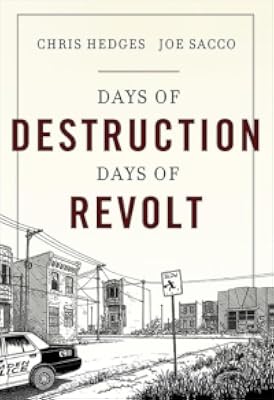
Days of Destruction, Days of Revolt
by Chris Hedges, Joe Sacco
On This Page
Description
"Camden, New Jersey, with a population of 70,390, is per capita the poorest city in the nation. It is also the most dangerous. The city's real unemployment - hard to estimate, since many residents have been severed from the formal economy for generations - is probably 30 to 40 percent. The median household income is $24,600. There is a 70 percent high school dropout rate, with only 13 percent of students managing to pass the state's proficiency exams in math. The city is planning $28 million show more in draconian budget cuts, with officials talking about cutting 25 percent from every department, including layoffs of nearly half the police force. The proposed slashing of the public library budget by almost two-thirds has left the viability of the library system in doubt. There are perhaps a hundred open-air drug markets, most run by gangs like the Bloods, the Latin Kings, and MS-13. Camden is awash in guns, easily purchased across the river in Pennsylvania, where gun laws are lax.Camden, like America, was once an industrial giant. It employed some 36,000 workers in its shipyards during World War II and built some of the nation's largest warships. It was the home to major industries, from RCA Victor to Campbell's Soup. It was a destination for immigrants and upwardly mobile lower middle class families. Camden now resembles a penal colony.In Days of Destruction, Days of Revolt, Pulitzer Prize winning journalist Chris Hedges and American Book Award winning cartoonist Joe Sacco show how places like Camden, a poster child of postindustrial decay, stand as a warning of what huge pockets of the United States will turn into if we cement in place a permanent underclass. In addition to Camden, Hedges and Sacco report from the coal fields of West Virginia, Pine Ridge Reservation in South Dakota and undocumented farm worker colonies in California. With unemployment and underemployment combined at far over ten percent, as Congress proposes to slash Medicare and Medicaid, Food Stamps, Pell Grants, Social Security, and other social services, Hedges and Sacco warn of a bleak near future-where cities and states fall easily into bankruptcy, neofeudalism reigns, and the nation's working and middle classes are decimated. A shocking report from the frontlines of poverty in America, Days of Destruction, Days of Revolt is a clarion call for reform"-- "In the vein of Let Us Now Praise Famous Men, Pulitzer Prize winner and bestselling author Chris Hedges and American Book Award winning cartoonist Joe Sacco bring us a searing on-the-ground report on the crisis gripping underclass America and crime-ridden poverty enclaves--in prisons, urban slums, and rural communities--metastasizing around the nation"-- show lessTags
Recommendations

Member Reviews
Hedges and Sacco examine colonialism in the United States by actively investigating communities of Native Americans both on and off reservations, poverty stricken neighborhoods (reservations) in Camden, New Jersey, mining areas in West Virginia, and current day slavery in Immokalee, Florida (which Senator Bernie Sanders calls the bottom in the race to the bottom). Each separate section on these places and topics include history and facts of colonial takeover laid out very clearly and logically. The authors have managed to make institutional racism and discrimination, something that many people struggle with understanding or believing, very clear. That is quite a feat.
Each section is also illustrated with personal stories of local show more individuals, families or groups with detailed stories of their struggles. This makes this one of those educational books that read so well you can't put it down. Although I DID put it down between sections that were so self-contained I could get the complete idea, theory and real stories in one sitting and then let the information percolate for awhile before I went on to the next section. The authors draw clear connections to illustrate how and why people make some of the choices that look destructive from the outside, such as why we take our rage out on each other, burning our own communities, etc.
I am American so it is especially eye-opening to see these terms such as colonialism applied to myself as a colonized person. No matter how much I read, learn, study and come to understand and believe these ideas, I am still sometimes surprised to hear this language applied to the U.S. It is so much easier to think in terms of the other while I am, e.g., reading about Palestine and -you know - OTHERS!
This book is hard hitting and depressing, but does not leave the reader there. The closing section is about the Occupy movement, its history, founders, possibilities for the future and to NOT coin a phrase, "Being the change". This history of Occupy has not received a lot of media attention so many think it was simply very spontaneous and unorganized, although before the physical occupation began, well trained teams were already in place to provide legal services, security at the park, medical services and food as well as the famous library and educational team. These are people who know revolution, how it has worked historically, and are full of creative ideas such as my personal favorite movement, Strike Debt. The media kept saying Occupiers were simply a bunch of homeless addicts going nowhere and accomplishing nothing. And yes of course there were plenty of homeless and addicts. The beautiful difference is how they were included and cared for rather than ostracized. The media kept asking all the wrong questions of Occupy - who are your leaders and what are your demands. You'll also develop an understanding of those issues before you finish the book. AND.....you will finish it quickly - it is a fast and easy read and still covers all of this! Amazing accomplishment! Five stars and highly recommended.
P.S. If you can't tell, I really, really loved this book! show less
Each section is also illustrated with personal stories of local show more individuals, families or groups with detailed stories of their struggles. This makes this one of those educational books that read so well you can't put it down. Although I DID put it down between sections that were so self-contained I could get the complete idea, theory and real stories in one sitting and then let the information percolate for awhile before I went on to the next section. The authors draw clear connections to illustrate how and why people make some of the choices that look destructive from the outside, such as why we take our rage out on each other, burning our own communities, etc.
I am American so it is especially eye-opening to see these terms such as colonialism applied to myself as a colonized person. No matter how much I read, learn, study and come to understand and believe these ideas, I am still sometimes surprised to hear this language applied to the U.S. It is so much easier to think in terms of the other while I am, e.g., reading about Palestine and -you know - OTHERS!
This book is hard hitting and depressing, but does not leave the reader there. The closing section is about the Occupy movement, its history, founders, possibilities for the future and to NOT coin a phrase, "Being the change". This history of Occupy has not received a lot of media attention so many think it was simply very spontaneous and unorganized, although before the physical occupation began, well trained teams were already in place to provide legal services, security at the park, medical services and food as well as the famous library and educational team. These are people who know revolution, how it has worked historically, and are full of creative ideas such as my personal favorite movement, Strike Debt. The media kept saying Occupiers were simply a bunch of homeless addicts going nowhere and accomplishing nothing. And yes of course there were plenty of homeless and addicts. The beautiful difference is how they were included and cared for rather than ostracized. The media kept asking all the wrong questions of Occupy - who are your leaders and what are your demands. You'll also develop an understanding of those issues before you finish the book. AND.....you will finish it quickly - it is a fast and easy read and still covers all of this! Amazing accomplishment! Five stars and highly recommended.
P.S. If you can't tell, I really, really loved this book! show less
There is the "family-friendly" version of America, as seen on TV, and then there have always been the unpleasant realities that we'd rather keep out of sight especially when the scope of these realities is deepening and widening thanks to mercenary corporatism. Together, Chris Hedges, the outspoken firebrand activist-writer and Joe Sacco, the visual-graphic conflict-journalist, take us unsparingly to panoramas that are not nightmarish dystopias, at least not fictional ones. We discover that the American dream and standard-of-living has been seriously downgraded in the quarters that have already sustained oppression for generations. We now have cities so totally in debt that there is no extant infrastructure, we have environmental show more devastation with no benefit and no recompense for those most affected, and we have organized crime that claims to be a societal stratum and offers up, as the only option, cannibalistic-victimization of the weakest amongst economically segregated racial groups.
Surprisingly sweet stories of resilience exist in the face of these brutalities, these faceless paper atrocities. Love and culture survive and, perhaps, are strengthened. We learn that those who realize that our monetary overlords only care for their own are learning that knowledge, informal connectedness can cause the blinkered plutocrats cognitive disconnection. show less
Surprisingly sweet stories of resilience exist in the face of these brutalities, these faceless paper atrocities. Love and culture survive and, perhaps, are strengthened. We learn that those who realize that our monetary overlords only care for their own are learning that knowledge, informal connectedness can cause the blinkered plutocrats cognitive disconnection. show less
In this sequence of reportages complemented with graphic novel sequences Chris Hedges and Joe Sacco visit some of the poorest neighborhoods in the US. The places they take us are the Pine Rigde Reservation, Camden, West Virginia and Immokalee. Places populated by those left behind by a society that judges success by material wealth only. By giving voice to the disenchanted and tracing back their plight to the anonymous corporate juggernauts and their disregard for human rights and moral obligations, they paint a drastic picture of the negative effects of unconstrained capitalism. This is balanced by the last chapter, which introduces the Occupy movement as a consequence and counterpoint to these developments and gives some hope for a show more better future. show less
The message is simple: the drive for corporate profit has bulldozed over all the highest values of American society and left massive human wreckage in its wake. The book focuses on four "sacrifice zones," where the damage is especially evident--the Pine Ridge Indian Reservation, the city of Camden, NJ, the agricultural workers of Immokalee, FL, and the coal country of West Virginia.
I found the profiles of these communities especially compelling. And I've always loved the graphic journalism of Joe Sacco. The last chapter of the book, however, profiling Occupy Wall Street, was hardly more than stark polemic. While I sympathize with the sentiments contained therein, the harangue got too thick. Besides, to see that the hopeful alternative show more to the evils of corporatism is the Occupy movement is probably to doom us all. With the anarchic nature of Occupy, there's little chance of its having much impact against the organized power of the corporate culture.
As an aside, Christ Hedges suggests the alternative of new "monastic communities" of resistance, and that's certainly an intriguing proposal that deserves more exploration. But the reason monastic communities endured over generations was that they were organized and disciplined (typically with strong hierarchies). Occupy already has proven to have been pretty much a flash in the pan, due to its lack of organization and discipline. If the evils of corporatism are to be combatted, we're going to need more. show less
I found the profiles of these communities especially compelling. And I've always loved the graphic journalism of Joe Sacco. The last chapter of the book, however, profiling Occupy Wall Street, was hardly more than stark polemic. While I sympathize with the sentiments contained therein, the harangue got too thick. Besides, to see that the hopeful alternative show more to the evils of corporatism is the Occupy movement is probably to doom us all. With the anarchic nature of Occupy, there's little chance of its having much impact against the organized power of the corporate culture.
As an aside, Christ Hedges suggests the alternative of new "monastic communities" of resistance, and that's certainly an intriguing proposal that deserves more exploration. But the reason monastic communities endured over generations was that they were organized and disciplined (typically with strong hierarchies). Occupy already has proven to have been pretty much a flash in the pan, due to its lack of organization and discipline. If the evils of corporatism are to be combatted, we're going to need more. show less
Your world-view will be considerably altered after you've read this book. Using detailed examples (current & historical) from different dysfunctional pockets of the USA: (1) aboriginals of South Dakota, (2) post-industrial ghost town, Camden, N.J. (3) coal mining in West Virginia (4) Illegal immigrants "slaves" working in factory farms. These are only some of the "sacrifice zones that have been offered up for exploitation in the name of profit." This is a call to more than "awareness". In our indifference to the impoverished throughout the globe, we are contributing to our own demise. "Revolt [against worldwide corporate oligarchy, especially that on Wall St.] is all we have left. It is the only hope."
This book is a thought-provoking (and anger-inducing) look at those who have been fed into the jaws of capitalism for the sake of cheap prices and higher profits: the native population of the United States, Camden NJ, former coal towns of West Virginia, illegal "workers" in Florida. It also has a chapter dedicated to the then-fledgling Occupy movement.
The chapter which resonated the most with me was the people of West Virginia. My great-grandfather worked in the mines for decades, until he was horribly disfigured in an accident. He then spent the rest of his life trying to eke out a living (with little success). There were no benefits or disability pay from the mine (there was a small amount from the US government). And, as I lived in show more Appalachia coal country for the first thirty years of my life, I know what it's like to grow up poor, with poisoned water, with trees dying all around you but the mines saying it's not because of all of the "harmless smoke" (in reality, clouds of toxins) they put in the air.
A recommended read, although many, I fear, would not be moved to do anything because "that's not me." Until they can't pay their medical bills even though they have insurance, or they lose their job due to outsourcing, or something of the sort, of course. show less
The chapter which resonated the most with me was the people of West Virginia. My great-grandfather worked in the mines for decades, until he was horribly disfigured in an accident. He then spent the rest of his life trying to eke out a living (with little success). There were no benefits or disability pay from the mine (there was a small amount from the US government). And, as I lived in show more Appalachia coal country for the first thirty years of my life, I know what it's like to grow up poor, with poisoned water, with trees dying all around you but the mines saying it's not because of all of the "harmless smoke" (in reality, clouds of toxins) they put in the air.
A recommended read, although many, I fear, would not be moved to do anything because "that's not me." Until they can't pay their medical bills even though they have insurance, or they lose their job due to outsourcing, or something of the sort, of course. show less
This is an interesting book about Pine Ridge, Indian Country; Camden, NJ; a mining town; farm laboring wage slaves; and Occupy Wall Street. The best parts are the personal stories, Studs Terkel-style, which are illustrated into comic book panels. They show the incredible dignity and humor that people can have despite being mired in poverty, sexual abuse, and addiction in the USA. It's all interesting information that you need to know, but it was so bleak and depressing that I had to skim some parts. At the end when we get to the Occupy movement in Zucotti park, it gets a bit more cheerful. And I had to smile at the earnest descriptions of how decisions are reached in the general assembly (the stack, hand signals, etc), as if all those show more things were brand new instead of well over a decade old. I also rolled my eyes at a few other things. (The authors say agents provacateurs started the Black Bloc. Please! And also that the best tactic, still, is to have peaceful demonstrations that goad the police into rioting because the world will be dismayed and horrified to learn about it.) Overall, though, I liked this book. show less
Members
- Recently Added By
Lists

Top Five Books of 2013
1,562 works; 721 members

Best Stand-Alone Graphic Novels
107 works; 19 members

Club Read's Graphic Stories Recommendations
127 works; 2 members
Author Information

31+ Works 7,670 Members
Chris Hedges is a graduate of Harvard Divinity School and a former Pulitzer Prize-winning journalist for The New York Times. He is the author of eleven books, including the New York Times bestsellers War Is a Force That Gives Us Meaning, American Fascists, and Days of Destruction, Days of Revolt, which he coauthored with Joe Sacco.

55+ Works 7,536 Members
Awards and Honors
Common Knowledge
- Original publication date
- 2012
- Important places
- Pine Ridge, South Dakota, USA; Camden, New Jersey, USA; Welch, West Virginia, USA; Immokalee, Florida, USA; Liberty Square, New York, New York, USA
- Epigraph
- For they have sown the wind,
and they shall reap the whirlwind
—HOSEA 8:7 - Dedication
- For Amalie and Eunice
- First words
- Joe Sacco and I sent out two years ago to take a look at the sacrifice zones, those areas in the country that have been offered up for exploitation in the name of profit, progress, and technological advancement. (Introduction... (show all))
- Last words
- (Click to show. Warning: May contain spoilers.)But I feel this twinge of euphoria again in my stomach, this utter certainty that the impossible is possible, the realization that the mighty can fall.
- Canonical DDC/MDS
- 305.560973
- Canonical LCC
- HC110.P6
Classifications
- Genres
- Nonfiction, General Nonfiction, Graphic Novels & Comics
- DDC/MDS
- 305.560973 — Society, government, & culture Social sciences, sociology & anthropology Social group - Age, Gender, Ethnicity People by social and economic levels Lower, alienated, excluded classes History, geographic treatment, biography
- LCC
- HC110 .P6 — Social sciences Economic history and conditions Economic history and conditions By region or country
- BISAC
Statistics
- Members
- 576
- Popularity
- 51,081
- Reviews
- 19
- Rating
- (4.07)
- Languages
- English, French, Spanish
- Media
- Paper, Ebook
- ISBNs
- 9
- ASINs
- 8