On This Page
Description
Popular author Harry Kemelman combines baffling crimes, fascinating characters, and rich Jewish tradition to create his best-selling mystery series. In Monday the Rabbi Took Off, an exhausted Rabbi David Small searches for relaxation in Israel, only to find himself in the midst of an explosive international incident. After six years of leading a challenging congregation, Rabbi Small is taking his dream vacation: three months in Jerusalem without any rabbinical duties. He is finally getting show more the rest he needs-until a new acquaintance is found dead after a bombing. Suddenly the savvy young Rabbi is up against the formidable Israeli intelligence and faceless Arab terrorists with murder on their minds. With Harry Kemelman's dramatic flair, you will feel as if you are walking the colorful streets of Jerusalem alongside the perceptive Rabbi Small. George Guidall-personally approved for this unabridged recording by the author's estate-skillfully breathes life into the ordinary people caught in extraordinary situations. show lessTags
Recommendations























Member Reviews
The Rabbi, his wife, and young son head to Israel for three months--without pay! This gives the rabbi a chance to unravel an Israeli death and the author a chance to tell us all about Israel. Quite interesting and at least it's a change from the formula of the first three books, although there is still the usual band of synagogue idiots trying to replace the rabbi, this time with his slick substitute--who looks like a rabbi!
I liked the "Rabbi" series of books a lot. The problem is, after "Wednesday" or so, the formula wore a bit thin: the rabbi has some argument or disagreement with someone in his congregation. Someone gets killed. The rabbi has a fight with the Board of Directors at the shul. He threatens to leave. He solves the murder mystery. He resolves the problem with the person in his congregation and his Board of Directors, and everything is fine. Until the next book, where we repeat.
Still, these are well-crafted, engaging little mysteries, and frankly, I learned a good amount about Judaism from them.
Still, these are well-crafted, engaging little mysteries, and frankly, I learned a good amount about Judaism from them.
Read after long urging by spouse, this is ... a great book! As to the mystery part, maybe not so much (2/3 of the way through the book we have a crime, but it seems ... perfunctory? ) The value is the deep, but conversational / approachable view of Judaism propounded throughout the book- from the Boston suburbs to the narrow streets of old Jerusalem (the rabbi is taking a 3 month sabbatical). Leisurely paced, lots of quasi-comic politicking over the extension of the Rabbi's contract back home. The Rabbi feels connected to his religion in Israel, so much so that he is less committed to his scheduled norms- prayers, synagogue and the sabbath- Just being in Jerusalem is enough he says over and over again. As to the "mystery" ... eh.... he show more seems something in a photograph that exonerates his friend's son- so we're all happy. That gets wrapped up in about 3 paragraphs. So--- why call this a mystery? i don't know. show less
This time our favorite rabbi is taking a sabbatical in Israel. I totally understood the need to get away from the job and get a fresh look at life so I empathized with the rabbi. The book is a product of its time, so the Israel we read about is early 1970s Israel with the people and ethics of the time.
I enjoyed this quiet mystery and the glimpse into Israeli life of the time. To keep me grounded back in the US, there were the political machinations behind the scene at the synagogue. Will Rabbi Small have a job to return to? Will he want to come back to the scheming board or will he pick back up out of a sense of duty?
The mystery wasn't terribly difficult to solve for me; what mattered were the people in the book as they came to matter show more to me.
Not quite a cozy mystery, this book is recommended for those who enjoy a cozier traditional mystery or a more traditional cozy mystery. show less
I enjoyed this quiet mystery and the glimpse into Israeli life of the time. To keep me grounded back in the US, there were the political machinations behind the scene at the synagogue. Will Rabbi Small have a job to return to? Will he want to come back to the scheming board or will he pick back up out of a sense of duty?
The mystery wasn't terribly difficult to solve for me; what mattered were the people in the book as they came to matter show more to me.
Not quite a cozy mystery, this book is recommended for those who enjoy a cozier traditional mystery or a more traditional cozy mystery. show less
This was my first encounter with one of the Rabbi Small mysteries. This one’s set in Israel, after 1967 but before 1973. The setting gives our author an excuse to take little jabs at both sides of the Occupation conflict. It's a decent mystery bound up with the musings of a liberal Conservative rabbi in midlife crisis.
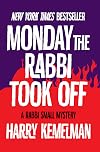
The cover illustration, showing a man in Arab costume trying to elude another man with a knife, has absolutely nothing to do with the story.
The cover illustration, showing a man in Arab costume trying to elude another man with a knife, has absolutely nothing to do with the story.
Rabbi Small finally gets to visit Jerusalem. Bombs are being detonated in the heart of Jerusalem and somehow our Rabbi ends up on the suspicious character list.
This book seemed to putter about, not really adding up to a mystery or involving me much in the affairs of Rabbi Small. I was enjoying it though, simply because it was a terrific glimpse of a time, place and culture. When it finally arrived at the mystery, it was satisfying. I had it figured out, but that did not lessen my enjoyment of the good Rabbi's denouement. Then end of the book made me a bit sad for him, but I suppose it had to be.
This book seemed to putter about, not really adding up to a mystery or involving me much in the affairs of Rabbi Small. I was enjoying it though, simply because it was a terrific glimpse of a time, place and culture. When it finally arrived at the mystery, it was satisfying. I had it figured out, but that did not lessen my enjoyment of the good Rabbi's denouement. Then end of the book made me a bit sad for him, but I suppose it had to be.
I liked reading about 1970's Israel. And I like the characters especially when you get the Rabbi away from his annoying congregation. The murder doesn't happen till half way through the book. This is probably for the best because I figured it all out almost as soon as it happened. The idea for the murder was good but so little time is spent on it that the water isn't muddied with red herrings. I recommend it as "The Smalls go to Israel". But as a puzzle it's an easy connect the dots.
Members
- Recently Added By
Lists

Books Read in 2014
2,343 works; 89 members

Books Read in 2016
4,666 works; 197 members
Author Information

30+ Works 7,610 Members
Harry Kemelman was born in Boston, Massachusetts in 1908. After studying English Literature at Boston University and earning an M.A. from Harvard University in 1931, Kemelman worked as a teacher in several Boston high schools, and later became a private businessman. During this time, he also pursued a career as a freelance writer. Kemelman is best show more known for his mystery-based rabbi books about David Small, a rabbi who solves murder cases. His early stories appeared in Ellery Queen's Mystery Magazine. His first rabbi novel, Friday the Rabbi Slept Late, received the Edgar Allan Poe Award from the Mystery Writers of America in 1964. Some of Kemelman's other novels in the rabbi series include Saturday the Rabbi Went Hungry, Sunday the Rabbi Stayed Home, Monday the Rabbi Took Off, and Conversations with Rabbi Small. He died in 1996, at the age of 88. (Bowker Author Biography) show less
Some Editions
Awards and Honors
Distinctions
Series

Belongs to Publisher Series
Work Relationships
Common Knowledge
- Canonical title
- Monday the Rabbi Took Off
- Original title
- Monday the Rabbi took off
- Original publication date
- 1972
- People/Characters
- Rabbi David Small; Miriam Small; Dan Stedman; Roy Stedman; Chaim Ish-Kosher; Avner Adoumi (show all 8); Rabbi Hugo Deutch; Gittel Schlossberg (Aunt Gittel)
- Important places
- Barnard's Crossing, Massachusetts, USA; Israel; Jerusalem; Massachusetts, USA; Middle East; USA
- Dedication
- To family and friends in Israel
- First words
- From the sofa in the living room where she was immersed in the Sunday paper, Miriam heard the door between the breezeway and the kitchen open and close.
- Last words
- (Click to show. Warning: May contain spoilers.)"For us," he said, "there is always the danger that we won't come back."
- Original language*
- Amerikanisch
*Some information comes from Common Knowledge in other languages. Click "Edit" for more information.
Classifications
Statistics
- Members
- 672
- Popularity
- 42,857
- Reviews
- 13
- Rating
- (3.76)
- Languages
- 8 — Danish, Dutch, English, French, German, Hungarian, Japanese, Portuguese
- Media
- Paper, Audiobook, Ebook
- ISBNs
- 35
- ASINs
- 18