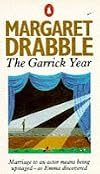
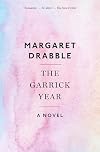
The Garrick Year
by Margaret Drabble
On This Page
Description
The beautiful Emma Evans and her husband, the well-known actor David Evans, seem to have the perfect life until a move from their cosmopolitan life in London exposes the sharp cracks running just below the surface.Tags
Recommendations















Member Reviews
Emma — clever daughter of a Cambridge don, formerly a successful model, now mother of two young children — has got a promising job as a television announcer lined up for herself in London, but she has to renounce it when her actor husband gets the offer of a season in provincial rep in Hereford with the fashionable director Wyndham Farrar.
A wonderfully ironic look at the inequality of the sexes and the dullness of parenthood and provincial England in the early 1960s, where even the inevitable backstage adultery turns into something very like a tedious social obligation. And full of witty portraits of the kind of people who were creating big egos for themselves in the English theatre of those days. But perhaps slightly undermined by show more Emma's rather privileged situation and her snooty contempt for anything outside London. There were a lot of young mothers of her generation for whom the prospect of an au pair to help with the kids and give them time to go out to first-nights sometimes would have seemed like a remote dream... show less
A wonderfully ironic look at the inequality of the sexes and the dullness of parenthood and provincial England in the early 1960s, where even the inevitable backstage adultery turns into something very like a tedious social obligation. And full of witty portraits of the kind of people who were creating big egos for themselves in the English theatre of those days. But perhaps slightly undermined by show more Emma's rather privileged situation and her snooty contempt for anything outside London. There were a lot of young mothers of her generation for whom the prospect of an au pair to help with the kids and give them time to go out to first-nights sometimes would have seemed like a remote dream... show less
Margaret Drabble’s second novel, published in the UK in 1964 when the author was twenty-five, is an account of a troubled period in the marriage of a young couple, David and Emma Evans, parents of toddler Flora and infant Joseph. The family lives in London. But David, a professional actor, must go to where the work is, and when he is invited by a famous producer named Wyndham Farrar to take part in a theatre festival in rural Hereford, he accepts. His insistence that Emma, the children, and their French au pair Pascal, accompany him into the countryside for several months causes some tension because to do this Emma must decline a prestigious newsreader opportunity with a television network, a position just offered to her and that, show more after three years of marriage and a long and exhausting period devoted to meeting the relentless demands of two young children, she had been eager to accept. But this is the 1960s, and Emma dutifully relents in order to support her husband’s ambitions, but not without some bitterness. Emma narrates the story of her Hereford adventures with ironic, clear-eyed and occasionally ruthless honesty—honesty that extends to herself. Emma—intelligent, observant, consummately self-aware—readily admits that she is something of a spoiled brat, accustomed to nice things and the abundant distractions that a cultural hub like London offers. She hates the house in Hereford where the family takes up residence. Easily bored, she finds provincial life tedious and avoids mingling with the town’s inhabitants. She has little patience for people she regards as foolish and, when it suits her, can be pointedly, unapologetically rude without any thought for consequences. But Emma is also beautiful (before marrying David she had spent time modeling) and despite her misanthropic tendencies people are attracted to her. In Hereford, with rehearsal and performance commitments, David is preoccupied and short-tempered. He has little time for her and no patience for the children. Emma’s social circle is limited to Pascal and David’s theatre colleagues, many of whom she finds tiresome. But a notable exception is producer Wyndham Farrar, a man twenty years her senior, with whom, almost without trying, she strikes up a friendship. Flattered by Wyndham’s chivalrous attentions, amused by his world-weary cynicism, and driven by a perverse and vengeful impulse to inflict pain on David, she lets the relationship flourish and evolve into a dalliance. The drama unfolds in a leisurely fashion and throughout the novel Drabble’s prose is poised, elegant and brimming with witty asides and sardonic observations on love and marriage. When the messy denouement arrives, it’s not exactly a surprise, but it still lands with a clatter and causes great damage and emotional fallout. As in her first novel, A Summer Bird-Cage, in her second Margaret Drabble devotes her attention to the two issues that would inform her fiction for years to come: the role of women in society and the tensions between the sexes. The novel addresses profound themes, but for all its seriousness and social consciousness, The Garrick Year is also a delightful entertainment and, without any doubt, the product of a mature and sophisticated talent. show less
I liked books that get me interested on the very first page as this one did. This isn't the sort of book I would typically like, but I was unfamiliar with the author and this novel is a good shorter length for a sample. My penguin edition ran 172 pages.
My preference is for stories with likeable characters. We don't get that here. What we get is excellent writing and very sharp observations of a woman with two young children who is married to an actor. She is our narrator and this begins as a look back to when she was forced to leave London where she was launching a career of her own and taken to the country for a theater job that her husband badly wants for his own career. Our narrator, Emma, establishes herself on the first page of the show more novel as a sharp wit and observer, and we soon (remembering this is from Emma's view) get a pretty unsympathetic opinion about husband David. We see that Emma and David's style of dealing with each other is set from the first time they have a conversation. It is a contest and game for the two of them.
The narrator's voice feels very authentic, it is so well written. My entire time reading this I felt like I was inside of Emma's head looking at herself and the world around her. There are a few parts that felt a little tedious, but I think that would be expected in such a navel-gazing opus like this.
The end is a little unsatisfying, maybe a little weak in the wrap up. The story ran out of steam despite several events in the final pages. I can picture the author saying "Let's get this done."
I was really surprised to see that this was first published in 1964. It has a modern feel, although at first glance the somewhat "obedient wife" bit does feel dated to the early 60's. Or maybe not, because she has little choice it seems when her husband springs the move on her and the situation of moving away for a job for one partner in a relationship happens as much today as 50 years ago.
I'll read more of Drabble when I want a biting look at something! I very much enjoyed reading this one. Recommended. show less
My preference is for stories with likeable characters. We don't get that here. What we get is excellent writing and very sharp observations of a woman with two young children who is married to an actor. She is our narrator and this begins as a look back to when she was forced to leave London where she was launching a career of her own and taken to the country for a theater job that her husband badly wants for his own career. Our narrator, Emma, establishes herself on the first page of the show more novel as a sharp wit and observer, and we soon (remembering this is from Emma's view) get a pretty unsympathetic opinion about husband David. We see that Emma and David's style of dealing with each other is set from the first time they have a conversation. It is a contest and game for the two of them.
The narrator's voice feels very authentic, it is so well written. My entire time reading this I felt like I was inside of Emma's head looking at herself and the world around her. There are a few parts that felt a little tedious, but I think that would be expected in such a navel-gazing opus like this.
The end is a little unsatisfying, maybe a little weak in the wrap up. The story ran out of steam despite several events in the final pages. I can picture the author saying "Let's get this done."
I was really surprised to see that this was first published in 1964. It has a modern feel, although at first glance the somewhat "obedient wife" bit does feel dated to the early 60's. Or maybe not, because she has little choice it seems when her husband springs the move on her and the situation of moving away for a job for one partner in a relationship happens as much today as 50 years ago.
I'll read more of Drabble when I want a biting look at something! I very much enjoyed reading this one. Recommended. show less
Emma Evans is not impressed when her actor husband David announces that he’s accepted the offer to perform in a summer festival season in Hereford. Part of her resistance is based on simple metropolitan disdain for anything outside the M25 (‘the provinces have never appealed to me, except as curiosities’), but part derives from a deeper sense of frustration. Having spent three years being pregnant, giving birth and breastfeeding their two children, Emma is desperate to regain her sense of herself as an independent intellectual. She has been counting on a job as a newsreader, which now she must relinquish in order to follow her arrogant husband halfway across the country, to a place where she expects no stimulation, no decent show more conversation, and the kind of stifling self-important small-town society that she remembers from her girlhood in Cambridge. With a scream trapped in her throat, Emma gathers the children – Flora and baby Joe – the au pair Pascal and a judicious selection of their belongings, and heads west to Hereford, determined to be utterly and entirely bored...
For the full review, please see my blog:
https://theidlewoman.net/2020/03/09/the-garrick-year-margaret-drabble/ show less
For the full review, please see my blog:
https://theidlewoman.net/2020/03/09/the-garrick-year-margaret-drabble/ show less
I picked up copies of Drabble's first two novels, [b:A Summer Birdcage|22403343|A Summer Birdcage|Margaret Drabble|https://i.gr-assets.com/images/S/compressed.photo.goodreads.com/books/1401907435l/22403343._SX50_.jpg|1520585] and this one in a second hand shop earlier this year. Both seem quite slight by the standards of her more recent books, and although both are easy enough to read, neither seems essential to non-completists.
This one tells the story of a strained marriage. The narrator Emma Evans is a young mother of two children with a tentative career in television. Her husband David is an actor. At the start of the book he is offered starring roles in a season of plays in a new theatre in Hereford, and Emma reluctantly agrees to show more accompany him and abandon her job in London.
The rest of the book describes their time in Hereford, in which both succumb to infidelities. For me the biggest problem with the book was that none of the characters are that engaging, perhaps because all the theatrical characters seem a little stereotyped, and Emma is not the most likeable narrator. show less
This one tells the story of a strained marriage. The narrator Emma Evans is a young mother of two children with a tentative career in television. Her husband David is an actor. At the start of the book he is offered starring roles in a season of plays in a new theatre in Hereford, and Emma reluctantly agrees to show more accompany him and abandon her job in London.
The rest of the book describes their time in Hereford, in which both succumb to infidelities. For me the biggest problem with the book was that none of the characters are that engaging, perhaps because all the theatrical characters seem a little stereotyped, and Emma is not the most likeable narrator. show less
Had the name "Margaret Drabble" not been used once in a Monty Python skit I would not have looked twice at any of her novels. To her credit, she is a gifted writer. Her prose is eloquent with being condescending. This particular book is filled with self-involved characters, all of whom are less than likable. My other qualm is that the protagonist's turnaround at the conclusion felt rushed and somewhat unrealistic. Still, the work is unerringly British and penned so flawlessly that it was worth the read.
All I can say about this is YUMMY!
Members
- Recently Added By
Lists

Carole's List
445 works; 13 members

the play's the thing... (novels themed around the theatre + acting)
34 works; 5 members
Author Information

68+ Works 13,785 Members
Margaret Drabble was born on June 5, 1939 in Sheffield, England. She attended The Mount School in York and Newnham College, Cambridge University. After graduation, she joined the Royal Shakespeare Company at Stratford during which time she understudied for Vanessa Redgrave. She is a novelist, critic, and the editor of the fifth edition of The show more Oxford Companion to English Literature. Her works include A Summer Bird Cage; The Millstone, which won the John Llewelyn Rhys Prize in 1966; Jerusalem the Golden, which won James Tait Black Prize in 1967; and The Witch of Exmoor. She also received the E. M. Forster award and was awarded a Society of Authors Travelling Fellowship in the 1960s and the Commander of the Order of the British Empire in 1980. (Bowker Author Biography) show less
Work Relationships
Is abridged in
Common Knowledge
- Original publication date
- 1964
- People/Characters
- Emma Evans; David Evans; Wyndham Farrar; Sophy Brent
- Important places
- Hereford, Herefordshire, England, UK
- Dedication
- For Adam and Angelica
- First words
- While I was watching the advertisements on television last night I saw Sophy Brent.
- Last words
- (Click to show. Warning: May contain spoilers.)Otherwise one might just as well stay at home.
Classifications
Statistics
- Members
- 357
- Popularity
- 87,654
- Reviews
- 7
- Rating
- (3.68)
- Languages
- English, Estonian, Swedish
- Media
- Paper, Audiobook, Ebook
- ISBNs
- 14
- ASINs
- 14