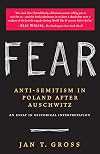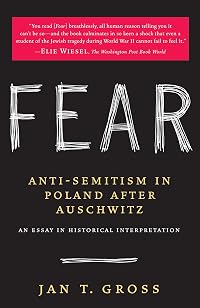
Fear: Anti-Semitism in Poland After Auschwitz
by Jan Gross
On This Page
Description
Poland suffered an exceedingly brutal Nazi occupation during the Second World War. Close to five million Polish citizens lost their lives as a result. More than half the casualties were Polish Jews. Thus, the second largest Jewish community in the world-only American Jewry numbered more than the three and a half million Polish Jews at the time-was wiped out. Over 90 percent of its members were killed in the Holocaust. And yet, despite this unprecedented calamity that affected both Jews and show more non-Jews, Jewish Holocaust survivors returning to their hometowns in Poland after the war experienced widespread hostility, including murder, at the hands of their neighbors. The bloodiest peacetime pogrom in twentieth-century Europe took place in the Polish town of Kielce one year after the war ended, on July 4, 1946. Jan Gross's Fear attempts to answer a perplexing question: How was anti-Semitism possible in Poland after the war? At the center of his investigation is a detailed reconstruction of the Kielce pogrom and the reactions it evoked in various milieus of Polish society. How did the Polish Catholic Church, Communist party workers, and intellectuals respond to the spectacle of Jews being murdered by their fellow citizens in a country that had just been liberated from a five-year Nazi occupation? Gross argues that the anti-Semitism displayed in Poland in the war's aftermath cannot be understood simply as a continuation of prewar attitudes. Rather, it developed in the context of the Holocaust and the Communist takeover: Anti-Semitism eventually became a common currency between the Communist regime and a society in which many had joined in the Nazi campaign of plunder and murder-and for whom the Jewish survivors were a standing reproach. Jews did not bring communism to Poland as some believe; in fact, they were finally driven out of Poland under the Communist regime as a matter of political expediency. In the words of the Nobel Prize-winning poet Czeslaw Milosz, Poland's Communist rulers fulfilled the dream of Polish nationalists by bringing into existence an ethnically pure state. show lessTags
Recommendations










Member Reviews
Poland suffered an exceedingly brutal Nazi occupation during the Second World War. Close to five million Polish citizens lost their lives as a result. More than half the casualties were Polish Jews. Thus, the second largest Jewish community in the world–only American Jewry numbered more than the three and a half million Polish Jews at the time–was wiped out. Over 90 percent of its members were killed in the Holocaust. And yet, despite this unprecedented calamity that affected both Jews and non-Jews, Jewish Holocaust survivors returning to their hometowns in Poland after the war experienced widespread hostility, including murder, at the hands of their neighbors. The bloodiest peacetime pogrom in twentieth-century Europe took place in show more the Polish town of Kielce one year after the war ended, on July 4, 1946.
Jan Gross’s Fear attempts to answer a perplexing question: How was anti-Semitism possible in Poland after the war? At the center of his investigation is a detailed reconstruction of the Kielce pogrom and the reactions it evoked in various milieus of Polish society. How did the Polish Catholic Church, Communist party workers, and intellectuals respond to the spectacle of Jews being murdered by their fellow citizens in a country that had just been liberated from a five-year Nazi occupation?
Gross argues that the anti-Semitism displayed in Poland in the war’s aftermath cannot be understood simply as a continuation of prewar attitudes. Rather, it developed in the context of the Holocaust and the Communist takeover: Anti-Semitism eventually became a common currency between the Communist regime and a society in which many had joined in the Nazi campaign of plunder and murder–and for whom the Jewish survivors were a standing reproach.
Jews did not bring communism to Poland as some believe; in fact, they were finally driven out of Poland under the Communist regime as a matter of political expediency. In the words of the Nobel Prize—winning poet Czeslaw Milosz, Poland’s Communist rulers fulfilled the dream of Polish nationalists by bringing into existence an ethnically pure state.
For more than half a century, what happened to the Jewish Holocaust survivors in Poland has been cloaked in guilt and shame. Writing with passion, brilliance, and fierce clarity, Jan T. Gross at last brings the truth to light. show less
Jan Gross’s Fear attempts to answer a perplexing question: How was anti-Semitism possible in Poland after the war? At the center of his investigation is a detailed reconstruction of the Kielce pogrom and the reactions it evoked in various milieus of Polish society. How did the Polish Catholic Church, Communist party workers, and intellectuals respond to the spectacle of Jews being murdered by their fellow citizens in a country that had just been liberated from a five-year Nazi occupation?
Gross argues that the anti-Semitism displayed in Poland in the war’s aftermath cannot be understood simply as a continuation of prewar attitudes. Rather, it developed in the context of the Holocaust and the Communist takeover: Anti-Semitism eventually became a common currency between the Communist regime and a society in which many had joined in the Nazi campaign of plunder and murder–and for whom the Jewish survivors were a standing reproach.
Jews did not bring communism to Poland as some believe; in fact, they were finally driven out of Poland under the Communist regime as a matter of political expediency. In the words of the Nobel Prize—winning poet Czeslaw Milosz, Poland’s Communist rulers fulfilled the dream of Polish nationalists by bringing into existence an ethnically pure state.
For more than half a century, what happened to the Jewish Holocaust survivors in Poland has been cloaked in guilt and shame. Writing with passion, brilliance, and fierce clarity, Jan T. Gross at last brings the truth to light. show less
I listen a lot about this book, how controversial, how terrible it is...
This book pretend toput polish people in shame, to make them feel bad...
And in some extend he made it... I am half polish and when I just start to read the book I was thinking that I may feel bad about it that maybe, polish people are not that great, and more of the opposite...
But the book was dissapointing inseveral ways, first, the way was written, is very unconfortabble to read that have foodnots, and notes at the end, and the worse, important ones, you have to stop every 5 minutes to go to some notes and turn back... Some are short some are long, but they were far away too much notes...
In the other side the arguments of the author in this case is weak. With show more this I am not pretending to deny what happen at Kielce, not at all, but the author took an attitude to polish people compleatly unvalid. Arguments such as the polish people from that time where normal...
The more that I think it, the more that It lost validity... I want to know what he was thinking when he say that. Who is normal after the II World War?
Arguments at the poles have the antisemitism throught the milk of our mothers?
They are a few more arguments that I don´t agree. With this I don´t pretend to say that it was not a crime that some poles were antisemitics, but the author goes far beyond and instead of that is blind by the fact that since he is sensitive to the story (let´s remember that he is a jew that emigrate from Poland to US)he transform what could be a very good book from a well done research in to a book that is more directed by the heart. Almost a novel... show less
This book pretend toput polish people in shame, to make them feel bad...
And in some extend he made it... I am half polish and when I just start to read the book I was thinking that I may feel bad about it that maybe, polish people are not that great, and more of the opposite...
But the book was dissapointing inseveral ways, first, the way was written, is very unconfortabble to read that have foodnots, and notes at the end, and the worse, important ones, you have to stop every 5 minutes to go to some notes and turn back... Some are short some are long, but they were far away too much notes...
In the other side the arguments of the author in this case is weak. With show more this I am not pretending to deny what happen at Kielce, not at all, but the author took an attitude to polish people compleatly unvalid. Arguments such as the polish people from that time where normal...
The more that I think it, the more that It lost validity... I want to know what he was thinking when he say that. Who is normal after the II World War?
Arguments at the poles have the antisemitism throught the milk of our mothers?
They are a few more arguments that I don´t agree. With this I don´t pretend to say that it was not a crime that some poles were antisemitics, but the author goes far beyond and instead of that is blind by the fact that since he is sensitive to the story (let´s remember that he is a jew that emigrate from Poland to US)he transform what could be a very good book from a well done research in to a book that is more directed by the heart. Almost a novel... show less
Ratings
Members
- Recently Added By
Author Information

22+ Works 1,079 Members
Jan T. Gross is Professor of Politics and European Studies at New York University
Some Editions
Awards and Honors
Series
Belongs to Publisher Series
Common Knowledge
- Canonical title*
- La peur. L'antisémitisme en Pologne après Auschwitz
- Original title
- Fear. Anti-semitism in Poland after Auschwitz, an essay in historical interpretation
- Original publication date
- 2006-06-30 (1e édition originale américaine, Princeton University Press) (1e édition originale américaine, Princeton University Press); 2010-09-08 (1e édition originale française ∙ Histoire ∙ Mémorial de la Shoah ∙ Calmann-Lévy) (1e édition originale française ∙ Histoire ∙ Mémorial de la Shoah ∙ Calmann-Lévy)
- Important places
- Auschwitz concentration camp, Oświęcim, Lesser Poland, Poland; Poland
- Important events
- Holocaust; World War II
- Publisher's editor
- Murphy, Will
- Original language*
- Anglais
*Some information comes from Common Knowledge in other languages. Click "Edit" for more information.
Classifications
- Genres
- History, Nonfiction
- DDC/MDS
- 305.892 — Society, government, & culture Social sciences, sociology & anthropology Social group - Age, Gender, Ethnicity Ethnic and national groups Other ethnic and national groups Semites
- LCC
- DS146 .P6 .G76 — History of Europe, Asia, Africa and Oceania Asia History of Asia Israel (Palestine). The Jews Jews outside of Palestine
- BISAC
Statistics
- Members
- 213
- Popularity
- 153,758
- Reviews
- 2
- Rating
- (3.79)
- Languages
- 7 — Czech, Dutch, English, French, German, Hungarian, Polish
- Media
- Paper, Ebook
- ISBNs
- 11
- ASINs
- 3