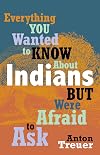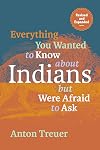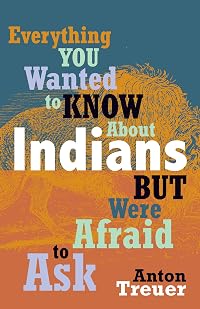
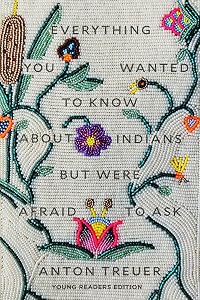
Everything You Wanted to Know About Indians but Were Afraid to Ask
by Anton Treuer
On This Page
Description
History. Multi-Cultural. Geography. Young Adult Nonfiction. HTML:From the acclaimed Ojibwe author and professor Anton Treuer comes an essential book of questions and answers for Native and non-Native young readers alike. Ranging from "Why is there such a fuss about nonnative people wearing Indian costumes for Halloween?" to "Why is it called a 'traditional Indian fry bread taco'?" to "What's it like for natives who don't look native?" to "Why are Indians so often imagined rather than show more understood?", and beyond, Everything You Wanted to Know About Indians But Were Afraid to Ask (Young Readers Edition) does exactly what its title says for young readers, in a style consistently thoughtful, personal, and engaging.Updated and expanded to include:
• Dozens of New Questions and New Sections—including a social activism section that explores the Dakota Access Pipeline, racism, identity, politics, and more!
• Over 50 new Photos
• Adapted text for broad appeal. show less
Tags
Recommendations




Member Reviews
Does what it says on the tin, really, with the book set up with frequently asked questions (asked of Treuer at his speaking engagements, I gather) and his considered answers, grouped into chapters by theme. Very occasionally a little dry, but mostly fascinating, well-written, and wonderfully educational. My only quibble would be that sometimes I knew so little that I didn't even understand the questions, and I think in almost every instance Treuer could have eliminated resulting confusions with one or two sentences of simple explanation before going into his lengthier, detailed answers. Recommended.
This book was written as a resource for both Indians and non-Indians to use as an informational text while being entertained. It is filled with questions regarding Native American people and their lives which stem from stereotyping, lack of knowledge, historical misconceptions, and lack of truthful representation of Native American people. Treuer answers the questions throughout the book using Native humor to explain why while showing respect to fellow Natives and other Native nations. He uses his expertise and experience to aid understanding in an engaging way. I highly recommend this book to young adolescents and adults in every ethnic groups and in all professionals.
Anton Treuer takes on a variety of questions that people outside of the American Indian / Native American community may be wondering but don't want to ask. He breaks it down by topic (terminology, politics, education, etc.) and in question-and-answer format takes on a variety of topics from "What terms are most appropriate in talking about North America's first people?" to "What's the real story about Columbus?" to casinos and language/culture.
As I think almost any book in a Q&A format will be, this is a mixed bag. Some questions and their answers were perfect - I was most interested in the terminology and history sections - some were things I already knew, and others were questions that I never would have thought to ask, or at least show more wouldn't have phrased in the way he does ("Do all Indians have drinking problems?" or "Why do Indians have so many kids?"). He states in the Introduction that, of course, he cannot speak for all Indians, some answers would be heavily influenced by the fact that he is most familiar with Ojibwe culture, and he sometimes will give his opinion. It was obvious when it was opinion, and it's obvious that keeping language and culture alive is really important to him. Which brings me to the next difficulty with the format, and that is the repetitive nature of it. Sometimes to fully answer a question - especially if a reader is picking up and reading only the sections most pressing to him/her - he had to repeat what he'd said in another one, and when he does so it's often verbatim or close to it.
Lastly, though he did a thorough job or including books and other resources to check out for more information and really good end notes, I was completely flummoxed by one issue. On page 138, he quotes the superintendent of a Pennsylvania boarding school for native children, Captain Richard Henry Pratt, as saying: "Our goal is to kill the Indian in order to save the man." Appalled by such a statement, I looked up the end note to find "Captain Richard Henry Pratt, as cited on Wikipedia." As a reference librarian who, admittedly, uses Wikipedia as a starting point, this really bothers me to see as the end note in a published text. I tested to see if I could get a more reputable source, and it's not hard: the Wikipedia entry now (I do want to note that the book was published in 2012 and looking at the Wikipedia entry today, the source is noted as accessed in 2014, so the entry has changed from when he looked) has a link to NPR that has a more thorough quote, with context, that is in fact worded "A great general has said that the only good Indian is a dead one, and that high sanction of his destruction has been an enormous factor in promoting Indian massacres. In a sense, I agree with the sentiment, but only in this: that all the Indian there is in the race should be dead. Kill the Indian in him, and save the man." This is from a speech in 1892, and it bothers me to know that with a little quick research I could find a better source than he did. Granted, it doesn't change the meaning behind it, but to include it in direct quotes and have it slightly off and cited by Wikipedia makes me just a little uneasy about taking his word for other answers, and giving this book a wholehearted recommendation without a caveat. Perhaps Everything You Wanted to Know about Indians But Were Afraid to Ask should be more of a starting point and introduction to the topic, but if you're really interested in more detail follow it up with more research and check his facts. It certainly covers a lot of topics broadly, and leaves you the resources to continue learning. show less
As I think almost any book in a Q&A format will be, this is a mixed bag. Some questions and their answers were perfect - I was most interested in the terminology and history sections - some were things I already knew, and others were questions that I never would have thought to ask, or at least show more wouldn't have phrased in the way he does ("Do all Indians have drinking problems?" or "Why do Indians have so many kids?"). He states in the Introduction that, of course, he cannot speak for all Indians, some answers would be heavily influenced by the fact that he is most familiar with Ojibwe culture, and he sometimes will give his opinion. It was obvious when it was opinion, and it's obvious that keeping language and culture alive is really important to him. Which brings me to the next difficulty with the format, and that is the repetitive nature of it. Sometimes to fully answer a question - especially if a reader is picking up and reading only the sections most pressing to him/her - he had to repeat what he'd said in another one, and when he does so it's often verbatim or close to it.
Lastly, though he did a thorough job or including books and other resources to check out for more information and really good end notes, I was completely flummoxed by one issue. On page 138, he quotes the superintendent of a Pennsylvania boarding school for native children, Captain Richard Henry Pratt, as saying: "Our goal is to kill the Indian in order to save the man." Appalled by such a statement, I looked up the end note to find "Captain Richard Henry Pratt, as cited on Wikipedia." As a reference librarian who, admittedly, uses Wikipedia as a starting point, this really bothers me to see as the end note in a published text. I tested to see if I could get a more reputable source, and it's not hard: the Wikipedia entry now (I do want to note that the book was published in 2012 and looking at the Wikipedia entry today, the source is noted as accessed in 2014, so the entry has changed from when he looked) has a link to NPR that has a more thorough quote, with context, that is in fact worded "A great general has said that the only good Indian is a dead one, and that high sanction of his destruction has been an enormous factor in promoting Indian massacres. In a sense, I agree with the sentiment, but only in this: that all the Indian there is in the race should be dead. Kill the Indian in him, and save the man." This is from a speech in 1892, and it bothers me to know that with a little quick research I could find a better source than he did. Granted, it doesn't change the meaning behind it, but to include it in direct quotes and have it slightly off and cited by Wikipedia makes me just a little uneasy about taking his word for other answers, and giving this book a wholehearted recommendation without a caveat. Perhaps Everything You Wanted to Know about Indians But Were Afraid to Ask should be more of a starting point and introduction to the topic, but if you're really interested in more detail follow it up with more research and check his facts. It certainly covers a lot of topics broadly, and leaves you the resources to continue learning. show less
I saw Dr. Treuer speak in Grand Marais, MN. I wanted to read this book after meeting him.
He is an excellent speaker and writer.
A quote from the book:
"Many tribal languages were never written. Why do they write them now? At one point in time, white people never used cars, so why do they use them now?"
He says we need to confront our collective past, historical trauma, and inequities.
The format of giving answers to commonly stated questions makes the reading clear and meaningful. Very informative.
He is an excellent speaker and writer.
A quote from the book:
"Many tribal languages were never written. Why do they write them now? At one point in time, white people never used cars, so why do they use them now?"
He says we need to confront our collective past, historical trauma, and inequities.
The format of giving answers to commonly stated questions makes the reading clear and meaningful. Very informative.
This book is a primer of sorts, aimed at helping white Americans to "understand, rather than imagine" their native fellow citizens. Presented in a Q & A format, based on the author's public appearances with the same goal, it is easy to take it in small bites for better processing. Although it did not really tell me everything I'd like to know about Native American culture and history (there are at least 50 books in my catalog tagged "Native American" and reading ALL of those would not fulfill that need), it is a good jumping off place for further reading. It covers a lot of ground in a generalized way, from the arrival of Europeans on the North American Continent to the politics of the reservation in the 21st century, and offers a show more suggested reading list for deeper exploration of what it means to be Indian. show less
Presented more or less as an FAQ, Treuer fills this slim volume with the genuinely curious, ignorant but well-meaning, and downright insulting questions he and other American Indians are asked constantly. From the most basic queries about preferred terminology and definitions to political and cultural inquiries requiring more complex responses, Treuer responds with honestly and with feeling. Having read a fair amount on the topic of Native Americans recently, including Treuer's own brother David's Rez Life, much of the content felt already familiar, though no less engaging or important.
Glad I picked this up. It ended up being sort of a collateral read when I was researching book titles to focus on for a class project. I didn’t end up going with this title, but having it at home, and reading There There got me curious.
The author makes it clear from the beginning that he doesn’t speak for all Indians (American Indians). A lot of history he provides encompasses the experiences of more than one nation, and it provides a good intro/overview of important topics. I appreciated what he had to say and how he said it. This book was eye-opening and educational, and it’s given me a lot to think about. I’ve seen complaints in other reviews that it’s repetitive, but I was glad that he re-emphasized things and referred show more back to previous passages. As I get older, I worry about retaining the nonfiction I read, so his style worked well for me.
There’s a long list of recommended reading and viewing in the back of the book for those who want to dig deeper into individual issues. I think this would be great required reading for high schools across the country. show less
The author makes it clear from the beginning that he doesn’t speak for all Indians (American Indians). A lot of history he provides encompasses the experiences of more than one nation, and it provides a good intro/overview of important topics. I appreciated what he had to say and how he said it. This book was eye-opening and educational, and it’s given me a lot to think about. I’ve seen complaints in other reviews that it’s repetitive, but I was glad that he re-emphasized things and referred show more back to previous passages. As I get older, I worry about retaining the nonfiction I read, so his style worked well for me.
There’s a long list of recommended reading and viewing in the back of the book for those who want to dig deeper into individual issues. I think this would be great required reading for high schools across the country. show less
Members
- Recently Added By
Lists

Unshelved Book Clubs
579 works; 5 members

Indigenous America Reader
145 works; 12 members
Author Information

17+ Works 1,420 Members
Anton Treuer, professor of Ojibwe at Bemidji State University, is the author of Everything You Wanted to Know About Indians But Were Afraid to Ask and thirteen other books on Indigenous history and language.
Awards and Honors
Awards
Distinctions
Work Relationships
Common Knowledge
- Canonical title
- Everything You Wanted to Know About Indians but Were Afraid to Ask
Classifications
Statistics
- Members
- 333
- Popularity
- 95,407
- Reviews
- 9
- Rating
- (4.08)
- Languages
- English
- Media
- Paper, Audiobook, Ebook
- ISBNs
- 15
- ASINs
- 2