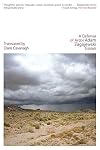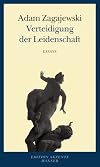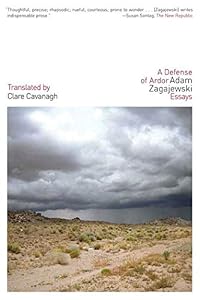
A Defense of Ardor: Essays
by Adam Zagajewski
On This Page
Description
Ardor, inspiration, the soul, the sublime: Such terms have long since fallen from favor among critics and artists alike. In his new collection of essays, Adam Zagajewski continues his efforts to reclaim for art not just the terms but the scanted spiritual dimension of modern human existence that they stake out.Bringing gravity and grace to his meditations on art, society, and history, Zagajewski wears his erudition lightly, with a disarming blend of modesty and humor. His topics range from show more autobiography (his first visit to a post-Soviet Lvov after childhood exile; his illicit readings of Nietzsche in Communist Poland); to considerations of artist friends past and present (Zbigniew Herbert, Czeslaw Milosz); to intellectual and psychological portraits of cities he has known, east and west; to a dazzling thumbnail sketch of postwar Polish poetry.Zagajewski gives an account of the place of art in the modern age that distinguishes his self-proclaimed liberal vision from the "right-wing radicalism" of such modernist precursors as Eliot or Yeats. The same mixture of ardor and compassion that marks Zagajewski's distinctive contribution to modern poetry runs throughout this eloquent, engaging collection. show lessTags
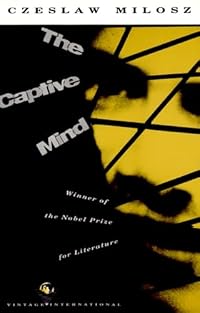
Recommendations

















Member Reviews
My son gave me this collection of essays. I am not a particular student of Polish literature, but I recognized many of the writers mentioned or discussed in this collection. The prose is fluent and impactful, but I don't know how much credit goes to his translator, Clare Cavanagh, and how much to the poet himself. I enjoyed each one, from reminiscences to reviews to autobiographical reflections. On the whole, this is a five star book, but I found myself comparing Zagajewski to Marilynne Robinson--each has the same refreshing sharpness of thought, eloquence, and a perspective framed by place. As an American, I realized as I read through this book, that I prefer Robinson's acerbically American perspective to Zagajewski's reflective but no show more less acerbic European perspective. show less
Written like poems at places. Light and delicate.
Ratings
Members
- Recently Added By
Published Reviews
While Zagajewski differentiates between the irony used by, say, Mann in the struggle to vitiate fascism, and the low irony of advertisements or the glib irony of the university student, he spots a common threat skulking behind each of these forms: paralysis. If you’re scanning for symptoms of this malady, look for the following: an aversion to high style, an avant-garde perpetually in show more revolt, a recoil from generosity and sincerity. show less
added by paradoxosalpha
Author Information

68+ Works 1,181 Members
Some Editions
Classifications
- Genres
- Literature Studies and Criticism, Fiction and Literature, Nonfiction
- DDC/MDS
- 891.8 — Literature & rhetoric Asian Literature East Indo-European and Celtic literatures West and South Slavic languages (Bulgarian, Slovene, Polish, Czech, Slovak, Serbo-Croatian, and Macedonian)
- LCC
- PG7185 .A32 .O2413 — Language and Literature Slavic languages and literatures. Baltic languages. Albanian language Slavic. Baltic. Albanian Slavic Polish
- BISAC
Statistics
- Members
- 95
- Popularity
- 337,655
- Reviews
- 2
- Rating
- (3.73)
- Languages
- English, German, Polish, Spanish
- Media
- Paper, Ebook
- ISBNs
- 8
- ASINs
- 3