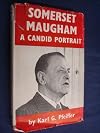
W. Somerset Maugham; A Candid Portrait
by Karl G. Pfeiffer
On This Page
Tags
Member Reviews
The author of this book traded on his acquaintanceship with W. Somerset Maugham to write a work that is dishonest, banal, and malicious. To establish credentials for writing a "candid portrait", Pfeiffer exaggerated his relationship with the famed author to produce a perspective that is not just superficial but distorted and demeaning. Pfeiffer's pretense of fair but critical judgment is belied by his demonstrable dishonesty and factual errors, and barbed attacks that evidence a malevolent intent.
The author's deceptive pose begins with his very first sentence in Chapter 1: "I had known W. Somerset Maugham for eighteen years when, one bright afternoon in 1941..." In fact, as documentary evidence reveals, Pfeiffer had met the author once show more in 1923 (when he was recruited for a game of bridge), and did not meet him again until 1939, a full 16 years later (Morgan p. 460). A book that begins with a blatant lie has nowhere to go but down.
From the beginning of their re-acquaintanceship, Pfeiffer saw Maugham as a means to his own selfish ends. By the author's own account, he took notes on “what he [Maugham] said, wore, ate, and looked like,” frequently slipping out of the room to jot things down when the great man “said something particularly good.” He claims that Maugham gave Pfeiffer his imprimatur to write his biography – yet the small incident that Pfeiffer relates as evidence is highly ambiguous (p. 17). Pfeiffer did see Maugham in the US during World War II, and wrote various magazine articles about him. However, Maugham made clear that he wanted no biography and had no intention of cooperating with one. Nevertheless, Pfeiffer had an academic career to launch, and proceeded against Maugham’s strenuous objections (Morgan p xvi).
The present work is organized chronologically, giving a scattered picture of Somerset Maugham’s life and work. Factual statements are intermixed with gross errors. Pfeiffer claims that while Maugham’s mother apparently remained faithful to his father, that Maugham “seems to have regarded her chastity as quixotic in the extreme” – a libelous affront in view of Maugham’s lifelong veneration of his mother, who died when he was eight. Pfeiffer informs us that during his trip to India that Maugham visited Gandhi – a ridiculous assertion that Maugham himself disputed when this book was printed.
But the biographical portions of this work are a backdrop for Pfeiffer’s judgments on the nature and quality of Maugham’s work at various stages of his career. Here are a few of the barbs with which he peppers his account:
When it came to plays, ”Maugham is a cautious man, and he didn’t write flops until he could afford them.” Maugham is like Walter Fane in “The Painted Veil”: ”Both men have over-perfect manners, which keep others at a distance. Their smiles are forced, a kind of sarcastic smirk, which suggests they think most people are fools.” ”He candidly admits that most people find his personality odious. Nevertheless… without knowing who he was, you might well turn to look at him a second time, just as you would look twice at Satan.” We get amateur psychoanalysis: ”Maugham is a reconstructed personality… The mature Maugham is the youthful Maugham’s ideal, or a reasonably good facsimile, the best he could fashion from the raw materials at hand.” We get amateur literary analysis: “ ‘The Razor’s Edge’ marks his decline as a novelist” and ‘Catalina’ (his last novel) ”is short, charming, and unpretentious.. even though, in order to provide three dollars worth, Maugham dragged it out some seventy pages beyond its logical stopping place”. And then we get character assassination: “Maugham couldn’t write another ‘Of Human Bondage’ because there is no warmth in the man he made himself into” and finally: “When critics of the future make up their minds about him, what will be Maugham’s rating in the world of letters? Will he be a good writer of the second rank, or will he become a footnote in the histories of literature?”
For someone who spent as much time with Maugham as Pfeiffer claims, he has very little to report, and not a single episode that is insightful or interesting. The various anecdotes he relates of their interactions are banal, mundane trivia.
I have given more attention to this book than it has gotten in decades worth of biographies, and far more attention than it deserves. Mine appears to be the only copy at LibraryThing. Let it remain in obscurity.
_____________
Work cited:
Morgan, Ted. Maugham: A Biography. New York: Simon & Schuster, 1980. show less
The author's deceptive pose begins with his very first sentence in Chapter 1: "I had known W. Somerset Maugham for eighteen years when, one bright afternoon in 1941..." In fact, as documentary evidence reveals, Pfeiffer had met the author once show more in 1923 (when he was recruited for a game of bridge), and did not meet him again until 1939, a full 16 years later (Morgan p. 460). A book that begins with a blatant lie has nowhere to go but down.
From the beginning of their re-acquaintanceship, Pfeiffer saw Maugham as a means to his own selfish ends. By the author's own account, he took notes on “what he [Maugham] said, wore, ate, and looked like,” frequently slipping out of the room to jot things down when the great man “said something particularly good.” He claims that Maugham gave Pfeiffer his imprimatur to write his biography – yet the small incident that Pfeiffer relates as evidence is highly ambiguous (p. 17). Pfeiffer did see Maugham in the US during World War II, and wrote various magazine articles about him. However, Maugham made clear that he wanted no biography and had no intention of cooperating with one. Nevertheless, Pfeiffer had an academic career to launch, and proceeded against Maugham’s strenuous objections (Morgan p xvi).
The present work is organized chronologically, giving a scattered picture of Somerset Maugham’s life and work. Factual statements are intermixed with gross errors. Pfeiffer claims that while Maugham’s mother apparently remained faithful to his father, that Maugham “seems to have regarded her chastity as quixotic in the extreme” – a libelous affront in view of Maugham’s lifelong veneration of his mother, who died when he was eight. Pfeiffer informs us that during his trip to India that Maugham visited Gandhi – a ridiculous assertion that Maugham himself disputed when this book was printed.
But the biographical portions of this work are a backdrop for Pfeiffer’s judgments on the nature and quality of Maugham’s work at various stages of his career. Here are a few of the barbs with which he peppers his account:
When it came to plays, ”Maugham is a cautious man, and he didn’t write flops until he could afford them.” Maugham is like Walter Fane in “The Painted Veil”: ”Both men have over-perfect manners, which keep others at a distance. Their smiles are forced, a kind of sarcastic smirk, which suggests they think most people are fools.” ”He candidly admits that most people find his personality odious. Nevertheless… without knowing who he was, you might well turn to look at him a second time, just as you would look twice at Satan.” We get amateur psychoanalysis: ”Maugham is a reconstructed personality… The mature Maugham is the youthful Maugham’s ideal, or a reasonably good facsimile, the best he could fashion from the raw materials at hand.” We get amateur literary analysis: “ ‘The Razor’s Edge’ marks his decline as a novelist” and ‘Catalina’ (his last novel) ”is short, charming, and unpretentious.. even though, in order to provide three dollars worth, Maugham dragged it out some seventy pages beyond its logical stopping place”. And then we get character assassination: “Maugham couldn’t write another ‘Of Human Bondage’ because there is no warmth in the man he made himself into” and finally: “When critics of the future make up their minds about him, what will be Maugham’s rating in the world of letters? Will he be a good writer of the second rank, or will he become a footnote in the histories of literature?”
For someone who spent as much time with Maugham as Pfeiffer claims, he has very little to report, and not a single episode that is insightful or interesting. The various anecdotes he relates of their interactions are banal, mundane trivia.
I have given more attention to this book than it has gotten in decades worth of biographies, and far more attention than it deserves. Mine appears to be the only copy at LibraryThing. Let it remain in obscurity.
_____________
Work cited:
Morgan, Ted. Maugham: A Biography. New York: Simon & Schuster, 1980. show less
Ratings
Members
- Recently Added By
Lists

Works concerning W. Somerset Maugham
62 works; 2 members
Author Information
2 Works 8 Members
Classifications
Statistics
- Members
- 4
- Popularity
- 3,952,806
- Reviews
- 1
- Rating
- (1.00)
- Media
- Paper
- ASINs
- 2