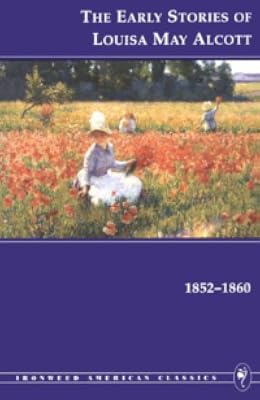
The Early Stories of Louisa May Alcott, 1852–1860
by Louisa May Alcott
On This Page
Description
Presents nineteen early stories by Louisa May Alcott, the nineteenth-century writer famous for "Little Women," including several thrillers that she kept from being republished in her lifetime.Tags
Member Reviews
After reading Harriet Reisen's wonderful biography Louisa May Alcott: The Woman Behind Little Women (which I absolutely loved and which will be one of my favorite books read this year; see my review here), I realized that there was so much of Alcott's work that I never knew about, much less ever read.
For example, I really didn't know the wide range of short stories she wrote - and especially how prolific she was. (She often wrote for 12 or 14 hours a day.) This collection of 19 stories spans only 8 years, which I suppose is reasonable, but some were churned out within weeks of each other (according to the publication dates) and many of them feel more like novellas.
What's such a treat about this is that you definitely see Alcott's show more growth as a writer in these stories. You see similar themes, characters, and plotlines as in Little Women. There's poverty and death, estranged relationships and unrequited love. Monika Ebert of Montclair State University writes an introduction to these stories that is very well done and informative (and more more scholarly than anything I could hope to produce here)
As with any short story collection, there are some wonderful stories in these pages and some that are just okay ("The Rival Painters: A Tale of Rome," "The Masked Marriage," "The Little Seed,") and some that I couldn't quite get through or found downright confusing ("Little Genevieve," "The Monk's Island: A Legend of the Rhine").
Rather than analyze each of them, I thought I would highlight those I especially enjoyed, along with the original publication dates. All of them were originally published in The Saturday Evening Gazette and according to Monika Elbert's introduction, were written when Louisa was in her twenties.
"The Rival Prima Donnas"
November 11, 1854
This is the third story in the collection and I believe might be one of the earliest examples of Louisa May Alcott's thrillers. In my opinion, is when she begins to hit her stride as a short story author. I was reminded of Flannery O'Connor with this one (or, more accurately, Flannery O'Connor's work reminds me of this). Although there is foreboding in this story about the two rival opera divas Beatrice and Theresa, the actual ending (and its aftermath) jolts the reader, taking one by surprise. This is one of my favorites among this collection.
"A New Year's Blessing"
January 5, 1856
I loved this story about the estranged relations of an elderly father and his daughter, and a little girl's attempts at a reconciliation between them before it is too late.
"The Sisters Trial"
January 26, 1856
Like "A New Year's Blessing" this story takes place on a somber New Years Eve. (Christmas and New Years make frequent appearances in Alcott's stories). This is the first story in this collection that is very autobiographical in nature and a prelude to Little Women. Four sisters gather round the fire to announce their decision on their planned vocation (or "trial") for the year ahead. Agnes plans to become an actress (to the dismay of her sisters), Meg an artist, Amy a governess, and Leonore a writer. A year later, they gather again to share the trials and tribulations of the year just past.
"Bertha"
April 19 and 26, 1856
At 35 pages long, this one feels more like a novella than a short story. And what a story it is! "Bertha" is a love story for the ages. I adored this romantic tale about a young girl (that would be Bertha) living with her grandmother. A world-renowed musician, Ernest, happens to be passing by when he hears Bertha singing and asks her grandmother if he can take Bertha to live with him as his student. She agrees (sure, yeah, not a problem ...) and the two hide their real feelings for each other for years, missing chances and opportunities to know true love. Part Gift of the Magi, part Phantom of the Opera, I read "Bertha" with my heart in my throat wanting these two to get together and fearing that the wouldn't. One of my favorites in this collection.
"Agatha's Confession"
March 14, 1857
My favorite of all the 19 stories and definitely one of Louisa May Alcott's "thrillers." There are elements of Poe in this one ... and that's probably enough said about this. It's dark, it's suspenseful, and it is probably one of the best short stories I've ever read.
"Mark Field's Mistake" (March 12, 1859) and "Mark Field's Success" (April 16, 1859) are two connected stories about the relationship between - you guessed it - a guy named Mark Field and a woman named Milly, who cares for a passel of children all who seem to be somewhat infirm or with disabilities. Mark needs to chose between living a life of wealth or one of charity and compassion.
In addition to these stories mentioned above, this collection also includes "Mabel's May Day," "The Lady and the Woman," "Ruth's Secret," "The Cross on the Church Tower," "Marion Earle; or, Only An Actress," and "Love and Self-Love."
This is one of those books that took much longer for me to read than I expected. Partly that was because I usually don't read many classics, so the language slowed me down a bit. (I'm trying to remedy this.) I do think that this collection might be a difficult read for someone who isn't a Louisa May Alcott fan or one who just wants to become more familiar with her work. Still, it is worth reading for the undiscovered gems it offers and for celebrating one of America's most beloved authors. show less
For example, I really didn't know the wide range of short stories she wrote - and especially how prolific she was. (She often wrote for 12 or 14 hours a day.) This collection of 19 stories spans only 8 years, which I suppose is reasonable, but some were churned out within weeks of each other (according to the publication dates) and many of them feel more like novellas.
What's such a treat about this is that you definitely see Alcott's show more growth as a writer in these stories. You see similar themes, characters, and plotlines as in Little Women. There's poverty and death, estranged relationships and unrequited love. Monika Ebert of Montclair State University writes an introduction to these stories that is very well done and informative (and more more scholarly than anything I could hope to produce here)
As with any short story collection, there are some wonderful stories in these pages and some that are just okay ("The Rival Painters: A Tale of Rome," "The Masked Marriage," "The Little Seed,") and some that I couldn't quite get through or found downright confusing ("Little Genevieve," "The Monk's Island: A Legend of the Rhine").
Rather than analyze each of them, I thought I would highlight those I especially enjoyed, along with the original publication dates. All of them were originally published in The Saturday Evening Gazette and according to Monika Elbert's introduction, were written when Louisa was in her twenties.
"The Rival Prima Donnas"
November 11, 1854
This is the third story in the collection and I believe might be one of the earliest examples of Louisa May Alcott's thrillers. In my opinion, is when she begins to hit her stride as a short story author. I was reminded of Flannery O'Connor with this one (or, more accurately, Flannery O'Connor's work reminds me of this). Although there is foreboding in this story about the two rival opera divas Beatrice and Theresa, the actual ending (and its aftermath) jolts the reader, taking one by surprise. This is one of my favorites among this collection.
"A New Year's Blessing"
January 5, 1856
I loved this story about the estranged relations of an elderly father and his daughter, and a little girl's attempts at a reconciliation between them before it is too late.
"The Sisters Trial"
January 26, 1856
Like "A New Year's Blessing" this story takes place on a somber New Years Eve. (Christmas and New Years make frequent appearances in Alcott's stories). This is the first story in this collection that is very autobiographical in nature and a prelude to Little Women. Four sisters gather round the fire to announce their decision on their planned vocation (or "trial") for the year ahead. Agnes plans to become an actress (to the dismay of her sisters), Meg an artist, Amy a governess, and Leonore a writer. A year later, they gather again to share the trials and tribulations of the year just past.
"Bertha"
April 19 and 26, 1856
At 35 pages long, this one feels more like a novella than a short story. And what a story it is! "Bertha" is a love story for the ages. I adored this romantic tale about a young girl (that would be Bertha) living with her grandmother. A world-renowed musician, Ernest, happens to be passing by when he hears Bertha singing and asks her grandmother if he can take Bertha to live with him as his student. She agrees (sure, yeah, not a problem ...) and the two hide their real feelings for each other for years, missing chances and opportunities to know true love. Part Gift of the Magi, part Phantom of the Opera, I read "Bertha" with my heart in my throat wanting these two to get together and fearing that the wouldn't. One of my favorites in this collection.
"Agatha's Confession"
March 14, 1857
My favorite of all the 19 stories and definitely one of Louisa May Alcott's "thrillers." There are elements of Poe in this one ... and that's probably enough said about this. It's dark, it's suspenseful, and it is probably one of the best short stories I've ever read.
"Mark Field's Mistake" (March 12, 1859) and "Mark Field's Success" (April 16, 1859) are two connected stories about the relationship between - you guessed it - a guy named Mark Field and a woman named Milly, who cares for a passel of children all who seem to be somewhat infirm or with disabilities. Mark needs to chose between living a life of wealth or one of charity and compassion.
In addition to these stories mentioned above, this collection also includes "Mabel's May Day," "The Lady and the Woman," "Ruth's Secret," "The Cross on the Church Tower," "Marion Earle; or, Only An Actress," and "Love and Self-Love."
This is one of those books that took much longer for me to read than I expected. Partly that was because I usually don't read many classics, so the language slowed me down a bit. (I'm trying to remedy this.) I do think that this collection might be a difficult read for someone who isn't a Louisa May Alcott fan or one who just wants to become more familiar with her work. Still, it is worth reading for the undiscovered gems it offers and for celebrating one of America's most beloved authors. show less
Ratings
Members
- Recently Added By
Author Information

466+ Works 108,906 Members
Louisa May Alcott was born in Germantown, Pennsylvania, in 1832. Two years later, she moved with her family to Boston and in 1840 to Concord, which was to remain her family home for the rest of her life. Her father, Bronson Alcott, was a transcendentalist and friend of Ralph Waldo Emerson and Henry David Thoreau. Alcott early realized that her show more father could not be counted on as sole support of his family, and so she sacrificed much of her own pleasure to earn money by sewing, teaching, and churning out potboilers. Her reputation was established with Hospital Sketches (1863), which was an account of her work as a volunteer nurse in Washington, D.C. Alcott's first works were written for children, including her best-known Little Women (1868--69) and Little Men: Life at Plumfield with Jo's Boys (1871). Moods (1864), a "passionate conflict," was written for adults. Alcott's writing eventually became the family's main source of income. Throughout her life, Alcott continued to produce highly popular and idealistic literature for children. An Old-Fashioned Girl (1870), Eight Cousins (1875), Rose in Bloom (1876), Under the Lilacs (1878), and Jack and Jill (1881) enjoyed wide popularity. At the same time, her adult fiction, such as the autobiographical novel Work: A Story of Experience (1873) and A Modern Mephistopheles (1877), a story based on the Faust legend, shows her deeper concern with such social issues as education, prison reform, and women's suffrage. She realistically depicts the problems of adolescents and working women, the difficulties of relationships between men and women, and the values of the single woman's life. (Bowker Author Biography) show less
All Editions
Common Knowledge
- Canonical title
- The Early Stories of Louisa May Alcott, 1852–1860
Classifications
- Genres
- Fiction and Literature, General Fiction, Historical Fiction, Romance
- DDC/MDS
- 813.4 — Literature & rhetoric American literature in English American fiction in English Later 19th Century 1861-1900
- LCC
- PS1016 — Language and Literature American literature American literature Individual authors 19th century
Statistics
- Members
- 16
- Popularity
- 1,517,411
- Reviews
- 1
- Rating
- (3.88)
- Languages
- English
- Media
- Paper
- ISBNs
- 1