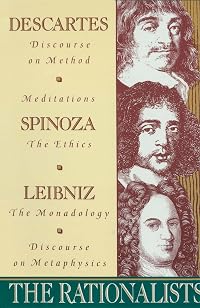
The Rationalists: Descartes: Discourse on Method & Meditations; Spinoza: Ethics; Leibniz: Monadology & Discourse on Metaphysics
by René Descartes, Gottfried Wilhelm Leibnitz, Benedict De Spinoza
On This Page
Description
Founded in the mid-17th century, Rationalism wasnbsp;nbsp;philosophy's first step into the modern era. Thisnbsp;nbsp;volume contains the essential statements ofnbsp;nbsp;Rationalism's three greatest figures: Descartes, whonbsp;nbsp;began it; Spinoza, who epitomized it; and Leibniz,nbsp;nbsp;who gave it its last serious expression.Tags
Recommendations

















Member Reviews
The Rationalists is a collection of philosophical treatises by Rene Descartes, Benedict de Spinoza, and Gottfried Leibniz. You get Descartes’s Discourse on Method and Meditations, Spinoza’s Ethics, and Leibniz’s Monadology and Discourse on Metaphysics. By the middle of the 17th century, philosophy was finding its way out of the tired debates on religion and started to become a bit more scientific. The natural philosophers of the Renaissance started to place more importance on observable phenomena and experimentation rather than dictated dogma. The three philosophers collected here show how the school of rationalism started, matured, and culminated in an entirely different way of thinking.
Descartes’s writing tries to strip away show more all the nonessential from philosophy. If it isn’t absolute and eternal, then it isn’t true knowledge. Using reason alone, one can understand the universe. Even sense experiences aren’t absolute. His famous “cogito ergo sum” is a corollary showing that self-recognition isn’t something that is sensed, but rather reasoned, and being is absolutely true. Spinoza carries the rational baton a little further and tries to combine mathematical axioms and geometrical theorems into both philosophy and psychology. While Spinoza is often times dense and even purposefully obtuse, his propositions on emotions and human thinking are an interesting look at a proto-psychological science. Lastly, Leibniz’s works tries to both fundamentally break down human thought and the physical universe.
These three philosophers, separated from us by hundreds of years, give us an interesting look at humanity entering a new era of thought. They tried to desperately to understand their world and wanted to start from scratch. For those wondering, Descartes is most approachable of the three, and Spinoza’s work can be impenetrable at times, so you have to muscle through it. All in all, these works are intriguing and shed a little light on our philosophical heritage as modern thinkers. A deep and intellectual read. show less
Descartes’s writing tries to strip away show more all the nonessential from philosophy. If it isn’t absolute and eternal, then it isn’t true knowledge. Using reason alone, one can understand the universe. Even sense experiences aren’t absolute. His famous “cogito ergo sum” is a corollary showing that self-recognition isn’t something that is sensed, but rather reasoned, and being is absolutely true. Spinoza carries the rational baton a little further and tries to combine mathematical axioms and geometrical theorems into both philosophy and psychology. While Spinoza is often times dense and even purposefully obtuse, his propositions on emotions and human thinking are an interesting look at a proto-psychological science. Lastly, Leibniz’s works tries to both fundamentally break down human thought and the physical universe.
These three philosophers, separated from us by hundreds of years, give us an interesting look at humanity entering a new era of thought. They tried to desperately to understand their world and wanted to start from scratch. For those wondering, Descartes is most approachable of the three, and Spinoza’s work can be impenetrable at times, so you have to muscle through it. All in all, these works are intriguing and shed a little light on our philosophical heritage as modern thinkers. A deep and intellectual read. show less
Ratings
Members
- Recently Added By
Author Information

365+ Works 19,871 Members
Best known for the quote from his Meditations de prima philosophia, or Meditations on First Philosophy (1641), "I think therefore I am," philosopher and mathematician Rene Descartes also devoted much of his time to the studies of medicine, anatomy and meteorology. Part of his Discourse on the Method for Rightly Conducting One's Reason and show more Searching for the Truth in the Sciences (1637) became the foundation for analytic geometry. Descartes is also credited with designing a machine to grind hyperbolic lenses, as part of his interest in optics. Rene Descartes was born in 1596 in La Haye, France. He began his schooling at a Jesuit college before going to Paris to study mathematics and to Poitiers in 1616 to study law. He served in both the Dutch and Bavarian military and settled in Holland in 1629. In 1649, he moved to Stockholm to be a philosophy tutor to Queen Christina of Sweden. He died there in 1650. Because of his general fame and philosophic study of the existence of God, some devout Catholics, thinking he would be canonized a saint, collected relics from his body as it was being transported to France for burial. (Bowker Author Biography) show less
7 Works 364 Members
18+ Works 734 Members
Work Relationships
Contains
Common Knowledge
- People/Characters
- René Descartes; Gottfried Wilhelm von Leibniz; Baruch Spinoza
Classifications
- Genres
- Philosophy, Nonfiction, General Nonfiction
- DDC/MDS
- 149.7 — Philosophy & psychology Philosophical schools of thought Other philosophical systems and doctrines Agnosticism
- LCC
- B833 — Philosophy, Psychology and Religion Philosophy (General) By period Modern Special topics and schools of philosophy
- BISAC
Statistics
- Members
- 355
- Popularity
- 89,087
- Reviews
- 1
- Rating
- (3.92)
- Languages
- English, Welsh
- Media
- Paper, Ebook
- ISBNs
- 3
- ASINs
- 7