On This Page
Description
Fiction. Science Fiction. From the Nebula Award-winning author comes a newly revised edition of this story in his classic Galactic Center series.Tags
Recommendations
























Member Reviews
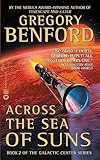
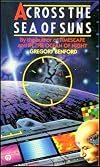
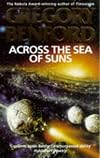
Benford, Gregory. Across the Sea of Suns. 1984. Galactic Center No. 2. Aspect, 2004.
In Across the Sea of Suns, the second novel of the Gregory Benford’s Galactic Center series, we have a two-ring circus, a near-lightspeed interstellar exploration mission and an alien invasion in Earth’s oceans. The space mission provides Benford’s answer to Fermi’s paradox that the universe should be teaming with intelligent life, yet alien civilizations are hard to find. It turns out that the oldest civilizations are machines that stomp on emerging space-faring cultures as soon as they detect radio signals. Meanwhile Earth’s oceans have been seeded with genetically modified creatures designed to destroy the biome. Under pressure human show more governments go to war with one another. The oceanic theater gives Benford the opportunity to tell a very tense castaway survival story. This is hard science fiction that rivals the work of Arthur C. Clarke and arguably has better character development. show less
In Across the Sea of Suns, the second novel of the Gregory Benford’s Galactic Center series, we have a two-ring circus, a near-lightspeed interstellar exploration mission and an alien invasion in Earth’s oceans. The space mission provides Benford’s answer to Fermi’s paradox that the universe should be teaming with intelligent life, yet alien civilizations are hard to find. It turns out that the oldest civilizations are machines that stomp on emerging space-faring cultures as soon as they detect radio signals. Meanwhile Earth’s oceans have been seeded with genetically modified creatures designed to destroy the biome. Under pressure human show more governments go to war with one another. The oceanic theater gives Benford the opportunity to tell a very tense castaway survival story. This is hard science fiction that rivals the work of Arthur C. Clarke and arguably has better character development. show less
First, a bit of backstory. I actually started this series, not knowing it was a series, back in the 80s. I'd picked up this book through a sci-fi book club as a teen. Upon reading it, I realized that it wasn't a standalone but a sequel. However, there was enough backstory that it didn't matter. But then the ending was left wide open, so I knew that it was, in fact, a series. I was not amused and subsequently forgot about the series for decades. A couple of years ago I stumbled across the first book of the series at a library book sale and decided that I would read the series from start to finish. Review of the first book, In the Ocean of Night, can be found here.
Decades have passed since the events that transpired in the first book. The show more alien wreck on the Moon has been reverse engineered to provide humanity with interstellar flight capability (roughly 0.9c). Earlier, a radio signal had been detected from a world (Isis) orbiting Lalande 21185 (Ra). A hollowed out asteroid, dubbed Lancer, has been fitted the new technology from the alien wreck (basically a Bussard Ramjet). Nigel Walmsley, our "hero" from the first book, and his girlfriend, Nikka, have been selected to be on the mission to investigate the source of the radio signal.
Meanwhile on Earth, alien ships have arrived and landed in the oceans, releasing two alien lifeforms, Swarmers and Skimmers. The Swarmers, roughly the size of a great white shark and equipped with sticky proboscises attached to their bellies, are attacking shipping worldwide and, for some reason that I can't fathom, has managed to cripple commerce and stymied the world's navies through headbutts and sticky bio-rope. It's a premise that defies belief. Even if one continues the assumption in the first book that the global economy never recovered from the malaise of the 1970s, nearly a century has passed in the book's timeline (and this book was written during Reagan's first term). For a species to be able to reverse engineer an alien spacecraft and achieve interstellar flight to not be able to figure out a solution to its global energy crisis and provide for national defense against space sharks is just plain nonsense.
Anyway, back to the plot. Warren is a survivor from one of these attacks. After floating on a makeshift raft for weeks, he manages to make a discovery about the Skimmers that offers some clues about the invaders. Warren is a tough guy to like. While I applauded his exceptional resourcefulness (if more people were like him...sorry, going off topic again), he could be a bit of a jerk. It took me a while before I could root for him to succeed.
Back in space, Nigel and Nikka struggle with the most petty onboard ship politics and relationships (I hope this is the last of Benford's books with three-person relationships. It smacks of wish fulfillment.). Much is learned about the aliens on Isis, but mysteries remain. Nigel argues that based on their discoveries here, the Moon, and his encounters with alien craft back home, that there is an malevolent alien intelligence afoot. But since the guy's an arrogant jerk, people don't want to believe him.
Lancer is run as a democratic socialist state with one elected leader, Ted, who calls the shots with input from section chiefs. Ted thinks that Nigel wants to run things and blocks him whenever he can justify it. Benford is clearly no fan of this command structure, writing:
There's even more wrong with this book. For instance, whenever Nigel listens in to the shipwide communications channel, we get all of the voices coming at once without any real designation of who's talking. It's like being at a party and attempting to listen to every conversation at once with everyone talking over one another. While Nigel is supposed to be able to follow it because his mind was "touched by an alien" in the first book, we poor readers are stuck with pages of babble, presented in italics without punctuation or speaker identification. And for a group of people that are supposed to be among the best and brightest, they come across as so much rabble, thumping their chests in proud ignorance.
Benford also gives an inordinate amount of time to on-demand sex changes. I wonder what transgender folks think of his approach. Is he flippant for making it something done on a whim, or is he progressive for this society's attitude that it's not a big deal. Both Nigel and Warren have to deal with others who have gone through the change. In neither case does it advance the plot, but rather it serves to further alienate the men from their fellow humans. And neither transgendered person comes across better for it, merely petty. I think I have my answer.
The original ending to the book was the worst sort of cliffhanger. There was no sense of direction and far too much unresolved. Ten pages were added to the paperback edition (which I somehow seem to have acquired). There was enough there to resolve events that transpired in this book and offer a way forward for the series. It changed the tone of the story. Even Nigel managed to lead by example, rather than just being a curmudgeon.
So what's good here? Well, there are kernels of good plots here with the protagonists attempting to figure out who is responsible for the turmoil they're seeing. The world building is great, both scientifically plausible (ignoring the space sharks) and interesting. And the malevolent alien intelligence that takes shape promises to be a worthy villain for the series. Benford is a physicist, having had his Ph.D fifteen years before writing this book, and continued working in the field up until 2006.
2.5 stars rounded down to 2 because I'm not feeling charitable today. However, I'm going to continue with the series. show less
Decades have passed since the events that transpired in the first book. The show more alien wreck on the Moon has been reverse engineered to provide humanity with interstellar flight capability (roughly 0.9c). Earlier, a radio signal had been detected from a world (Isis) orbiting Lalande 21185 (Ra). A hollowed out asteroid, dubbed Lancer, has been fitted the new technology from the alien wreck (basically a Bussard Ramjet). Nigel Walmsley, our "hero" from the first book, and his girlfriend, Nikka, have been selected to be on the mission to investigate the source of the radio signal.
Meanwhile on Earth, alien ships have arrived and landed in the oceans, releasing two alien lifeforms, Swarmers and Skimmers. The Swarmers, roughly the size of a great white shark and equipped with sticky proboscises attached to their bellies, are attacking shipping worldwide and, for some reason that I can't fathom, has managed to cripple commerce and stymied the world's navies through headbutts and sticky bio-rope. It's a premise that defies belief. Even if one continues the assumption in the first book that the global economy never recovered from the malaise of the 1970s, nearly a century has passed in the book's timeline (and this book was written during Reagan's first term). For a species to be able to reverse engineer an alien spacecraft and achieve interstellar flight to not be able to figure out a solution to its global energy crisis and provide for national defense against space sharks is just plain nonsense.
Anyway, back to the plot. Warren is a survivor from one of these attacks. After floating on a makeshift raft for weeks, he manages to make a discovery about the Skimmers that offers some clues about the invaders. Warren is a tough guy to like. While I applauded his exceptional resourcefulness (if more people were like him...sorry, going off topic again), he could be a bit of a jerk. It took me a while before I could root for him to succeed.
Back in space, Nigel and Nikka struggle with the most petty onboard ship politics and relationships (I hope this is the last of Benford's books with three-person relationships. It smacks of wish fulfillment.). Much is learned about the aliens on Isis, but mysteries remain. Nigel argues that based on their discoveries here, the Moon, and his encounters with alien craft back home, that there is an malevolent alien intelligence afoot. But since the guy's an arrogant jerk, people don't want to believe him.
Lancer is run as a democratic socialist state with one elected leader, Ted, who calls the shots with input from section chiefs. Ted thinks that Nigel wants to run things and blocks him whenever he can justify it. Benford is clearly no fan of this command structure, writing:
It took a week to reach a shipwide consensus, then another to plan the raid.Could you ever imagine that happening on Star Trek?
There's even more wrong with this book. For instance, whenever Nigel listens in to the shipwide communications channel, we get all of the voices coming at once without any real designation of who's talking. It's like being at a party and attempting to listen to every conversation at once with everyone talking over one another. While Nigel is supposed to be able to follow it because his mind was "touched by an alien" in the first book, we poor readers are stuck with pages of babble, presented in italics without punctuation or speaker identification. And for a group of people that are supposed to be among the best and brightest, they come across as so much rabble, thumping their chests in proud ignorance.
Benford also gives an inordinate amount of time to on-demand sex changes. I wonder what transgender folks think of his approach. Is he flippant for making it something done on a whim, or is he progressive for this society's attitude that it's not a big deal. Both Nigel and Warren have to deal with others who have gone through the change. In neither case does it advance the plot, but rather it serves to further alienate the men from their fellow humans. And neither transgendered person comes across better for it, merely petty. I think I have my answer.
The original ending to the book was the worst sort of cliffhanger. There was no sense of direction and far too much unresolved. Ten pages were added to the paperback edition (which I somehow seem to have acquired). There was enough there to resolve events that transpired in this book and offer a way forward for the series. It changed the tone of the story. Even Nigel managed to lead by example, rather than just being a curmudgeon.
So what's good here? Well, there are kernels of good plots here with the protagonists attempting to figure out who is responsible for the turmoil they're seeing. The world building is great, both scientifically plausible (ignoring the space sharks) and interesting. And the malevolent alien intelligence that takes shape promises to be a worthy villain for the series. Benford is a physicist, having had his Ph.D fifteen years before writing this book, and continued working in the field up until 2006.
2.5 stars rounded down to 2 because I'm not feeling charitable today. However, I'm going to continue with the series. show less
‘A través del mar de soles’ (Across the Sea of Suns, 1984), de Gregory Benford, continuación de ‘En el océano de la noche’, ha resultado ser una lectura lenta y aburrida. Sus dos líneas argumentales no han logrado mantener mi atención. Por una parte tenemos a Nigel Walmsley a bordo de la nave Lancer, camino de explorar la procedencia de una extraña radiofrecuencia en un lejano planeta. Por otra parte, en la Tierra, sabremos de dos razas extraterrestres que viven en el mar, los agresivos Pululantes y los supervivientes Espumeantes. Son ideas interesantes, pero Benford las narra con poco pulso y falta de ritmo. Creo que el siguiente título de la serie es bastante mejor, aunque no será una de mis próximas lecturas.
Really good sequel to Benford's 1st book in the series. This was a pretty spectacular book, THOUGH... There was a significant amount of stream of consciousness writing going on in a few places. Like fur in a cat's mouth. Aaaaacccggghh!!!!
I found half of this book to be a splendid read! The sections about life in the Earth's oceans after being invaded by aliens... top notch Science fiction. Unfortunately, I found the other half to be unreadable. I had hopes of getting into this series as I am a fan of hard sf but I really hate the main character and found the writing style awful.
Although "Great Sky River" (the next title in the Galactic Center series), is technically better written, "Across the Sea of Suns" is the book that increased my love of the space opera genre and inspired me to read every other book in this series as soon as they were available to me.
Although Across The Sea Of Suns was first published twenty years ago, it is still good. Twenty years of evolving science, medicine and technology have not turned this book into an annoying or worse yet, humorous, science fiction. This is book two of the six book Galactic Center Series. I have not read the other five books in the series, but I have added them to my list of books I want read.
In 2064 the starship Lancer is launched to investigate near earth stars. A dozen years or so later, the Lancer approaches its first target. The life aboard the starship is described in enough detail to be interesting but is not plot-numbingly exhaustive. The relationships of the characters develop and change as the years pass. The crew faces show more challenges with both success and failure. While the Lancer travels through space, Earth is having its own challenges. Author Benford alternates between following Lancer and Earth. I thoroughly enjoyed the Lancer plot, but I found myself looking ahead to discover how many pages I would read of the Lancer plot before returning to Earth.
A one page star chart at the beginning of the book is helpful in following the Lancer's travels. A timeline at the end of the book is an interesting summary.
Warner Books published a paperback edition in 2004, so it will not be necessary to purchase a used copy of this book. I have not read the first book of the series, In The Ocean Of The Night, (yet), but if available to you, I would read that book before reading this one. show less
In 2064 the starship Lancer is launched to investigate near earth stars. A dozen years or so later, the Lancer approaches its first target. The life aboard the starship is described in enough detail to be interesting but is not plot-numbingly exhaustive. The relationships of the characters develop and change as the years pass. The crew faces show more challenges with both success and failure. While the Lancer travels through space, Earth is having its own challenges. Author Benford alternates between following Lancer and Earth. I thoroughly enjoyed the Lancer plot, but I found myself looking ahead to discover how many pages I would read of the Lancer plot before returning to Earth.
A one page star chart at the beginning of the book is helpful in following the Lancer's travels. A timeline at the end of the book is an interesting summary.
Warner Books published a paperback edition in 2004, so it will not be necessary to purchase a used copy of this book. I have not read the first book of the series, In The Ocean Of The Night, (yet), but if available to you, I would read that book before reading this one. show less
Members
- Recently Added By
Lists

Best Science Fiction Novels
816 works; 430 members
Author Information

239+ Works 22,469 Members
Gregory Benford, was born on January 30, 1941 in Mobile, Alabama. He is a physicist and science fiction writer who earned his Ph.D. from the University of California, San Diego, in 1967. He is a Woodrow Wilson Fellow and a consultant for NASA. Benford's first novel "Deeper than the Darkness" (1970), which was revised as "The Stars in Shroud" show more (1978), gave him notice as a serious Science Fiction writer. His most popular work is "Timescape" (1980), which was the winner of the Nebula and John W. Campbell Memorial Awards; it presented a hard physics approach to limited time travel. "In the Ocean of Night" (1977), "Across the Sea of Suns" (1984), "Great Sky River" (1987), "Tides of Light" (1989) and "Furious Gulf" (1994) were all a part of the Galactic Cluster Series. He has also written the juvenile novel "Jupiter Project" (1975), "Against Infinity" (1983) and the thriller "Artifact" (1985). He has been nominated for 12 Nebula Awards (winning for "Timescape" and for the novelette, "If the Stars are Gods"). Benford, writing alternately with Bruce Sterling, produces science fact articles for the Magazine of Fantasy and Science Fiction. They took over after the death of regular columnist Isaac Asimov. He has also co-edited theme anthologies with Martin H. Greenburg, which include "Hitler Victorious" (1986), "Nuclear War" (1988), "What Might Have Been, Volume 1: Alternate Empires" (1988), "Volume 2: Alternate Heroes" (1989) and "Volume 3: Alternate Wars." (Bowker Author Biography) show less
Some Editions
Awards and Honors
Awards
Series

Belongs to Publisher Series
Heyne Science Fiction & Fantasy (06/4237)
Présence du futur (405-406)
Work Relationships
Common Knowledge
- Canonical title
- Across the Sea of Suns
- Original publication date
- 1984
- People/Characters
- Nigel Walmsley
- Dedication*
- Für David Hartwell
- First words
- Fire boils aft, pushing the ship close to the knife edge of light speed.
- Last words*
- (Click to show. Warning: May contain spoilers.)Und aus irgendeinem Grund lächelte er.
*Some information comes from Common Knowledge in other languages. Click "Edit" for more information.
Classifications
Statistics
- Members
- 963
- Popularity
- 27,308
- Reviews
- 15
- Rating
- (3.52)
- Languages
- 6 — Czech, English, French, German, Italian, Spanish
- Media
- Paper, Ebook
- ISBNs
- 21
- ASINs
- 7