For Love and Glory
by Poul Anderson
On This Page
Description
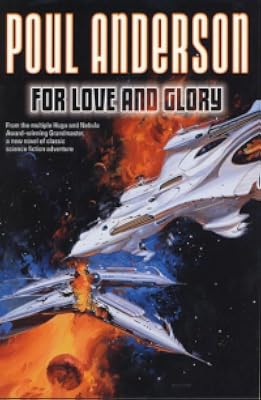
Discovering an ancient artifact from a technologically superior culture, interstellar archaeologist Lissa and her alien academic partner, Karl, encounter dangerous adversaries who also seek the artifact for mercenary purposes.Tags
Recommendations























Member Reviews
Pearl Ruled @ page 60
Nope. Not even a little bit sorry to see you go, book. Poul Anderson standard writing, and that's neither praise nor blame. Plot better than average; but there's no there there. Frankly it's just dull and I am way too old to slog through average to dull prose unless I'm being paid.
No one's paying me. Bye now!
PS The three stars means it's not a bad read just not for me
Nope. Not even a little bit sorry to see you go, book. Poul Anderson standard writing, and that's neither praise nor blame. Plot better than average; but there's no there there. Frankly it's just dull and I am way too old to slog through average to dull prose unless I'm being paid.
No one's paying me. Bye now!
PS The three stars means it's not a bad read just not for me
This book is a fix-up, built around two stories originally written for the Isaac's Universe project, substantially modified and with new materal written to expand it out to novel length. Unfortunately, while each piece of it is a pleasant enough read, the overall effect is choppily episodic, the parts not complete enough to stand as separate stories, and not blended together sufficiently to make a satisfactory novel.
The background is a loose, multi-species civilization occupying mostly the near galactic neighborhood. The various species trade with each other, and have treaties governing how they decide who owns what, and sometimes mount joint scientific expeditions, but mostly don't interact too closely. Like other species, the humans show more aren't all under one government and one culture, and most of the principal human characters are citizens of Asborg, which has the kind of corporate feudalism Anderson has featured in other novels. Earth also has the computer intelligence-based Gaia culture/blended identity that has appeared in other works, but the widespread, ftl-based interstellar culture in this book is incompatible with the stl limitations on travel and colonization featured in some of them. Another of the important human characters is from Earth, but, as one of the first generation for whom serious life extension was available, he's over nine hundred years old and hasn't been back to Earth in several centuries, in part because he chose not to become a member of the shared Gaia mind.
Lissa Windholm is a daughter of one of the noble houses of Asborg, still fairly young (only one rejuvenation), and not yet quite ready to settle down and give up adventuring. While on one of those adventures, as part of a multi-species scientific expedition to a newly-discovered habitable planet, she encounters a pair of freelance explorers. One of them's the Earth-native human mentioned above, Torben Hebo, and the other is Dzesi of the Ulas Trek, one of the vaguely catlike natives of Rikha. Hebo and Dzesi have discovered a Forerunner artifact, and the problem in this episode is making sure the artifact is turned over to proper scientific investigation while not depriving the freelancers of fair compensation for their discovery. Other episodes involve other scientific discoveries related to the Forerunners, and conflict with the lizard-like species known as the Susaians and with another Asborgian house, Seafell, concerning exactly who is going to get to acquire and exploit that knowledge. Hebo and Dzesi wind up playing a major role in Lissa's efforts to ensure that the knowledge is widely shared, rather than becoming the private property of one government.
This is all much more involving to read than it may sound when described like that, but still, this is very minor Anderson. show less
The background is a loose, multi-species civilization occupying mostly the near galactic neighborhood. The various species trade with each other, and have treaties governing how they decide who owns what, and sometimes mount joint scientific expeditions, but mostly don't interact too closely. Like other species, the humans show more aren't all under one government and one culture, and most of the principal human characters are citizens of Asborg, which has the kind of corporate feudalism Anderson has featured in other novels. Earth also has the computer intelligence-based Gaia culture/blended identity that has appeared in other works, but the widespread, ftl-based interstellar culture in this book is incompatible with the stl limitations on travel and colonization featured in some of them. Another of the important human characters is from Earth, but, as one of the first generation for whom serious life extension was available, he's over nine hundred years old and hasn't been back to Earth in several centuries, in part because he chose not to become a member of the shared Gaia mind.
Lissa Windholm is a daughter of one of the noble houses of Asborg, still fairly young (only one rejuvenation), and not yet quite ready to settle down and give up adventuring. While on one of those adventures, as part of a multi-species scientific expedition to a newly-discovered habitable planet, she encounters a pair of freelance explorers. One of them's the Earth-native human mentioned above, Torben Hebo, and the other is Dzesi of the Ulas Trek, one of the vaguely catlike natives of Rikha. Hebo and Dzesi have discovered a Forerunner artifact, and the problem in this episode is making sure the artifact is turned over to proper scientific investigation while not depriving the freelancers of fair compensation for their discovery. Other episodes involve other scientific discoveries related to the Forerunners, and conflict with the lizard-like species known as the Susaians and with another Asborgian house, Seafell, concerning exactly who is going to get to acquire and exploit that knowledge. Hebo and Dzesi wind up playing a major role in Lissa's efforts to ensure that the knowledge is widely shared, rather than becoming the private property of one government.
This is all much more involving to read than it may sound when described like that, but still, this is very minor Anderson. show less
For those who crave one last novel from Anderson, Tor has produced For Love and Glory. This book is a prime example of Anderson's ability to tell a tale with depth and integrity. In the far future, the adventurous have left Earth and the last inhabitants turn increasingly to a machine-maintained mental community. Far-flung human colonies build homogenous and increasingly divergent societies. Lissa Davysdaughter Windholm, from a ruling merchant house on the planet of Asborg, meets "freelancer" Torben Hebo (a man so old he was born on Earth) when they both explore an important artifact left by the mysterious Forerunners.
In another's hands this story might degenerate into the clichéd Beauty and the Beastly Man, but Anderson sends them on show more separate adventures, deftly weaving back and forth. In a time when information is power, Lissa steals a march on the Susaians, a paranoid military race hoarding a secret. Torben takes a necessary, but nostalgic, trip to Earth. Rejuvenation has extended human life indefinitely, but has not provided a system for handling the increasing memories. Torben needs his memories "edited," but what to discard and what to keep? The two eventually meet up again to squabble and foil another plot by the Susaians, but this time at a deadly cost.
For Love and Glory is not among my favorite books from Poul Anderson. Its fragmented nature betrays the inspiration for the novel—two short stories reworked and expanded. But Anderson doesn't take the easy way out, doing the cliched or expected in his story telling. The characters are true to themselves. They don't have any sudden or inexplicable changes in behavior or personality to suit the plot. For Love and Glory is an "average" Anderson novel, but his "average" is better than most people's best.
This an excerpt of a longer review I published at Strange Horizons (http://www.strangehorizons.com/2003/20031201/posthumous.shtml) show less
In another's hands this story might degenerate into the clichéd Beauty and the Beastly Man, but Anderson sends them on show more separate adventures, deftly weaving back and forth. In a time when information is power, Lissa steals a march on the Susaians, a paranoid military race hoarding a secret. Torben takes a necessary, but nostalgic, trip to Earth. Rejuvenation has extended human life indefinitely, but has not provided a system for handling the increasing memories. Torben needs his memories "edited," but what to discard and what to keep? The two eventually meet up again to squabble and foil another plot by the Susaians, but this time at a deadly cost.
For Love and Glory is not among my favorite books from Poul Anderson. Its fragmented nature betrays the inspiration for the novel—two short stories reworked and expanded. But Anderson doesn't take the easy way out, doing the cliched or expected in his story telling. The characters are true to themselves. They don't have any sudden or inexplicable changes in behavior or personality to suit the plot. For Love and Glory is an "average" Anderson novel, but his "average" is better than most people's best.
This an excerpt of a longer review I published at Strange Horizons (http://www.strangehorizons.com/2003/20031201/posthumous.shtml) show less
Judging by the publication data this was published posthumously, it has an incomplete and unedited feel. Most of the story follows Lissa, an idealistic naturalist and Hebo, an aged entrepreneur out to make money wherever he can. They meet, part, meet several years later, part and meet again- all without any real sense of narrative connection. There are some really intriguing ideas here that would individually make a good story but nothing gets developed.
library book read 11/13/2023
library book read 11/13/2023
Anderson's last SF novel (since he died in '01) but, alas, nowhere near his best.
Ratings
Members
- Recently Added By
Author Information

692+ Works 53,368 Members
Poul Anderson, November 25, 1926 - July 31, 2001 Poul Anderson was born on November 25, 1926 in Bristol, Pennsylvania to parents Anton and Astrid. After his father's death, Poul's mother took them first to Denmark and then to Maryland and Minnesota. He earned his degree in Physics from the University of Minnesota, but chose instead to write show more stories for science fiction magazines, such as "Astounding." Anderson is considered a "hard science fiction" writer, meaning that his books have a basis in scientific fact. To attain this high level of scientific realism, Anderson spent many hours researching his topics with scientists and professors. He liked to write about individual liberty and free will, which was a well known theme in many of his books. He also liked to incorporate his love of Norse mythology into his stories, sometimes causing his modern day characters to find themselves in fantastical worlds, such as in "Three Hearts and Three Lions," published in 1961. Anderson has written over a hundred books, his last novel, "Genesis" won the John W. Campbell Award, one of the three major science fiction awards. He is a former president of the Science Fiction and Fantasy Writers of America and won three Nebula awards and nine Hugo Awards. In 1997, Anderson was named a Grandmaster by the Science Fiction and Fantasy Writers of America and was also inducted into the Science Fiction Fantasy Hall of Fame. Poul Anderson died on July 31, 2001 at the age of 74. (Bowker Author Biography) show less
Some Editions
Common Knowledge
- Canonical title
- For Love and Glory
- Original title
- For Love and Glory
- Original publication date
- 2003-03-19
- Dedication
- To Geoff Kidd for help above and beond the call of friendship.
- First words
- At first sight Lissa thought it was an island -- a strange one, yes, but this whole world was strange to her.
- Last words
- (Click to show. Warning: May contain spoilers.)"There will be time afterward," she promised. "Always."
- Blurbers
- Jordan, Robert; Niven, Larry; Haydon, Elizabeth; Anderson, Kevin J.
Classifications
Statistics
- Members
- 267
- Popularity
- 120,732
- Reviews
- 6
- Rating
- (2.71)
- Languages
- English
- Media
- Paper
- ISBNs
- 2
- ASINs
- 3