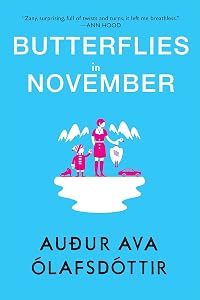
Butterflies in November
by Auður Ava Ólafsdóttir
On This Page
Description
A novel of love, friendship, and self-reinvention: "I can't remember the last time I was so zany, surprising, full of twists and turns" (Ann Hood, author of The Knitting Circle and Something Blue). A translator of Icelandic, the unnamed young woman who narrates Butterflies in November is perhaps more at home in the world of language than the actual world. After a day of being dumped-twice-and accidentally killing a goose, she yearns to escape from the chaos of her life. Instead, her best show more friend's four-year-old deaf-mute son is unexpectedly left in her care. But when the boy chooses the winning numbers for a lottery ticket, the two set off from Reykjavik along Iceland's Ring Road on a journey of discovery. Along the way, they encounter black sand beaches, cucumber farms, lava fields, flocks of sheep, an Estonian choir, a falconer, a hitchhiker, and both of her exes desperate for another chance. What begins as a spontaneous adventure will unexpectedly and profoundly change the way she views her past and charts her future. Longlisted for the Independent Foreign Fiction Prize. show lessTags
Recommendations



















Member Recommendations
Member Reviews
The narrator, who's a freelance translator and proofreader, decides it's time to make a change in her life after her husband walks out on her but then, irritatingly, keeps turning up again. And she has a bit of unfinished business to deal with in the eastern village where her grandmother used to live. However, just when she's announced that she's off to the East, her best friend Auður has to go into hospital, and she finds herself - notwithstanding protestations that she doesn't know the first thing about children and doesn't know sign-language - looking after Auður's four-year-old son, Tumi, who has serious hearing problems. The two of them set off down Highway No.1 in the depths of an unseasonably warm Icelandic November, show more negotiating hazards including floods, landslides, Estonian choirs, roadkill and available single men, and by the time they get to the prefabricated summer cottage that the narrator has won in a charity lottery, the woman and the child have somehow found each other and started working as a team.
It's a quirky book, often very funny indeed, but always rather jumpy and unresolved, full of unnamed characters who seem to overlap a little with each other, switching between present, past and dreams, and just at the point where we might have been expecting a joined-up ending, we get a compilation of recipes for all the food consumed in the course of the book (up to and including "undrinkable coffee"). And a knitting pattern. The "recipes" of course are not just recipes, but give us various hints from which we have to try to work out a resolution to the story ourselves. Or at least we could, if those hints only joined up somehow... show less
It's a quirky book, often very funny indeed, but always rather jumpy and unresolved, full of unnamed characters who seem to overlap a little with each other, switching between present, past and dreams, and just at the point where we might have been expecting a joined-up ending, we get a compilation of recipes for all the food consumed in the course of the book (up to and including "undrinkable coffee"). And a knitting pattern. The "recipes" of course are not just recipes, but give us various hints from which we have to try to work out a resolution to the story ourselves. Or at least we could, if those hints only joined up somehow... show less
Butterflies in November has been on my TBR since it was longlisted for the 2014 Independent Foreign Fiction Prize. It was reviewed, albeit not very enthusiastically by some members of the Shadow Jury chaired by Stu from Winston's Dad, yet other readers such as this one really liked it.
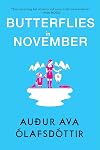
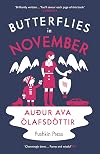
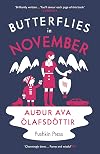
Labelled 'quirky', 'funny and wistful' and 'darkly comic' on the cover (whose artwork makes the book's style even more obvious), Butterflies in November reminds me of Camus' The Outsider. (This might just be because I'm rereading Camus — in French — for book group with my French class. More about that later). Anyway, the nameless central character is similarly disengaged from life, offhand about most of the people she comes across, and observant about show more others without often saying what she thinks.
Her relationships are so pedestrian that it makes no difference to her whether they dump her, or not. Her husband tells her, on the day of his departure, that he is tired of her erratic housekeeping — which made me think, as it would make any modern woman think, why since they are both working, is it her responsibility to have the dinner on the table as a sensible time? On the same day, her lover dumps her (just before she dumps him) because she doesn't think about him obsessively all day long — which makes me think that he needs to get a life (and obviously she thinks so too).
This woman loves her work: she speaks about a dozen languages, and she works as a translator. One of the reasons she doesn't want children is because they inhabit one's consciousness so much that it might only be possible to develop the ability to read two pages of a book in a row before worrying about their welfare intrudes. To her oh-so-needy husband she quotes from a manuscript that she once read:
Either you appreciate the satiric allusion to China's unwanted girls, or you don't. I liked it, and I really enjoyed this book and its bizarre happenings.
To read the rest of my review please visit https://anzlitlovers.com/2019/08/25/butterflies-in-november-by-audur-ava-olafsdo... show less
Labelled 'quirky', 'funny and wistful' and 'darkly comic' on the cover (whose artwork makes the book's style even more obvious), Butterflies in November reminds me of Camus' The Outsider. (This might just be because I'm rereading Camus — in French — for book group with my French class. More about that later). Anyway, the nameless central character is similarly disengaged from life, offhand about most of the people she comes across, and observant about show more others without often saying what she thinks.
Her relationships are so pedestrian that it makes no difference to her whether they dump her, or not. Her husband tells her, on the day of his departure, that he is tired of her erratic housekeeping — which made me think, as it would make any modern woman think, why since they are both working, is it her responsibility to have the dinner on the table as a sensible time? On the same day, her lover dumps her (just before she dumps him) because she doesn't think about him obsessively all day long — which makes me think that he needs to get a life (and obviously she thinks so too).
This woman loves her work: she speaks about a dozen languages, and she works as a translator. One of the reasons she doesn't want children is because they inhabit one's consciousness so much that it might only be possible to develop the ability to read two pages of a book in a row before worrying about their welfare intrudes. To her oh-so-needy husband she quotes from a manuscript that she once read:
"One of the things that characterises a bad relationship is when people start feeling an obligation to have a child together"
I have to confess that's something I read somewhere, because we can't experience everything in the first person. Nevertheless, I throw in an extra bit of my own.
"But maybe we could adopt, in a few years time, a baby girl from China, for example, there are millions of surplus baby girls in China."
"That's exactly it, when you're not talking like a self-help manual, you behave as if you were living in a novel, as if you weren't even speaking for yourself, as if you weren't there." (p.35)
Either you appreciate the satiric allusion to China's unwanted girls, or you don't. I liked it, and I really enjoyed this book and its bizarre happenings.
To read the rest of my review please visit https://anzlitlovers.com/2019/08/25/butterflies-in-november-by-audur-ava-olafsdo... show less
this is thoughtful and contemplative novel; one that dwells in darkness (and lack of sunshine), yet manages to be hopeful at the same time. it was an interesting experience reading this book. when one thinks about road trip novels, a circular road around iceland is probably not the first journey that pops into your mind. and i think that was part of the hook for me into the story. the narrator, desperate for escape, can really only go so far before she ends up back where she began. but isn't it always more about the journey than the destination? and the journey here was so weird. the quirk factor is high with this book. for me, it mostly worked and felt strangely relatable. i enjoyed that iceland featured as a character, and that the show more imperfections of the narrator were made obvious. the ending is not tied up neatly, so if you prefer that in your fiction you may struggle with this book a bit. as well, the end of the story leads into a lengthy inclusion of recipes (and some commentary) which featured in the novel. i didn't love this part and found it a jarring transition. i am also wondering about the translation -- at times things felt very clunky and uneven. for example, the word 'conjugal' cropped up a few times. it's a word that kind of sticks out, especially when repeated. and i can't say it's a word i encounter a lot, day-to-day. in a search on my kobo, it cropped up 6 times: 'conjugal life' (x2); 'conjugal bed' (x3); 'conjugal bliss (x1). this is one of the issues that made me think about the translation - did the author use this word or did the translator select it? perhaps i notice strange things when i read and this is only a 'thing' in my own mind? it is entirely possible. :)
overall, i enjoyed this book - though it's not one i would blanket recommend to everyone. it feels like a story that could translate well to film. (oh - hey, IMDB! the website indicates this is project in development with french actress/producer Judith Godrèche.) show less
overall, i enjoyed this book - though it's not one i would blanket recommend to everyone. it feels like a story that could translate well to film. (oh - hey, IMDB! the website indicates this is project in development with french actress/producer Judith Godrèche.) show less
A short novel about an woman on a trip through Iceland after separation from her husband. Mix into the equation that she is caring for a friend's disabled son, various encounters with domestic and wild animals, her unconventional family, luck with lottery tickets and an appendix of 47 recipes and a knitting pattern, and you get an original and quirky book.
Highly enjoyable road trip through Iceland. Bravo to Pushkin Press for bringing it to an English readership.
Highly enjoyable road trip through Iceland. Bravo to Pushkin Press for bringing it to an English readership.
I’ll admit, part of me was just curious to read something by an Icelandic author (I want to diversify my reading). I have no idea of the grammatical structure of Icelandic, my only guesses stemmed from a few clauses and gender assignments or usages. Anyway: I loved this book! It is a touching, sweet, and funny work that reminded me a little of the “About a Boy” story. The narrator – what is her name? – seems both motherly and not motherly, and these pages are full of real empathy.
There are passages in italics, what are they? Stuff she has translated and remembered? dreams? daydreams? flashbacks? diary entries? her grandmother’s diary? The best answer seems to be “compressed memories.” Our narrator is translator of eleven show more languages, and starts to learn sign language as well. Often looking for the right thesaurus, she has the critical mind of an editor and knows to not always interfere. This translation was well done, and just happens to be the European way of saying things, like the bonnet, boot, or “tyre” of a car. Two words I got to know were “duvet” and “anorak,” which I now realize reflect the country’s climate. The setting is tangible but not overpowering, and I felt there is a sort of timeless quality to the story-telling.
This is a great road trip, on Iceland’s Ring Road, National Highway One. You expect the fortune teller, or “medium,” will have some credibility, such as everything coming in threes. I had lots of laughs, one example a certain image of a sheep that comes across them.
The author has a refined way of telling what’s going on without having to say everything. The chapters are not very long; sometimes the action continues right where it left off, other times it jumps greater distances. Her narrator, imperfect like all of us, receives wanted and unwanted attention, and she muses over why. One of the only characters whose name is used regularly is her musician friend, whose name is the same as the author’s first. There’s Nína Lind, her husband Thorsteinn’s new woman he is having a child with, and of course Tumi, “the boy”, whom she refers to as her “protégé.” His character is just adorable, so loveable through the narrator’s perspective. An unnamed Santa Claus plays an interesting role in the second half of the book. I forgot there are recipes at the end, and so I re-read the last page of the forty-sixth chapter multiple times, it is so beautiful. “Butteflies in November” as a whole is a great read, I highly recommend.
Note: this book was provided through Net Galley, and my review also appears on my blog (http://matt-stats.blogspot.com/). show less
There are passages in italics, what are they? Stuff she has translated and remembered? dreams? daydreams? flashbacks? diary entries? her grandmother’s diary? The best answer seems to be “compressed memories.” Our narrator is translator of eleven show more languages, and starts to learn sign language as well. Often looking for the right thesaurus, she has the critical mind of an editor and knows to not always interfere. This translation was well done, and just happens to be the European way of saying things, like the bonnet, boot, or “tyre” of a car. Two words I got to know were “duvet” and “anorak,” which I now realize reflect the country’s climate. The setting is tangible but not overpowering, and I felt there is a sort of timeless quality to the story-telling.
This is a great road trip, on Iceland’s Ring Road, National Highway One. You expect the fortune teller, or “medium,” will have some credibility, such as everything coming in threes. I had lots of laughs, one example a certain image of a sheep that comes across them.
The author has a refined way of telling what’s going on without having to say everything. The chapters are not very long; sometimes the action continues right where it left off, other times it jumps greater distances. Her narrator, imperfect like all of us, receives wanted and unwanted attention, and she muses over why. One of the only characters whose name is used regularly is her musician friend, whose name is the same as the author’s first. There’s Nína Lind, her husband Thorsteinn’s new woman he is having a child with, and of course Tumi, “the boy”, whom she refers to as her “protégé.” His character is just adorable, so loveable through the narrator’s perspective. An unnamed Santa Claus plays an interesting role in the second half of the book. I forgot there are recipes at the end, and so I re-read the last page of the forty-sixth chapter multiple times, it is so beautiful. “Butteflies in November” as a whole is a great read, I highly recommend.
Note: this book was provided through Net Galley, and my review also appears on my blog (http://matt-stats.blogspot.com/). show less
A slightly quirky novel from Iceland. This is told in the first person by a woman who has just separated from her husband and her lover and agrees to look after her friend's son while the friend is in hospital. A lucky lottery win gives them the chance to take a road trip around half of Iceland in the dark of an Icelandic winter. In a small town on the other side of Iceland it keeps raining and the roads are blocked and it doesn't really become light at all, with just a bit of glimmer at lunch time. The narrator and the four year old boy get along well and both start to relax. Various strange and quirky things happen which are sometimes amusing.
Wat een verrassend leuk boek over een vrouw en een dove kleuter, kind van haar vriendin. Bijna niemand heeft een naam, dat maakt het soms lastig te volgen. Vooral de mannen, ze worden bijna allemaal aangeduid met 'hij'. Ook het jongetje, Tumi, wordt vaak alleen "het kind" genoemd. Het boek gaat over een tocht door IJsland. Het regent constant maar de schoonheid van het land is mooi beschreven. Deed me ook denken aan de film 'Of horses and men'. Het samen leven met de elementen, die wel en niet een belangrijke rol spelen. Ook de klimaatverandering: erg warm in november, apart om dat te lezen nu het hier ook zo warm is in november.
Het boek eindigt met een aantal recepten, die je zeker bij het lezen niet moet overslaan (grappig), en een show more breipatroon. show less
Het boek eindigt met een aantal recepten, die je zeker bij het lezen niet moet overslaan (grappig), en een show more breipatroon. show less
Members
- Recently Added By
Published Reviews
ThingScore 50
It is cheering to see an emerging strain of feminine picaresque in Icelandic fiction in translation (Gðrún Eva Mínervudóttir's The Creator being another example) – a welcome change from the murder mysteries that usually make it across the North Atlantic. There are moving moments of sadness and hilarity, especially during the flashbacks to the narrator's own childhood and adolescence, and show more Ólafsdóttir shows a rare ability to write a serious and convincing small child; the boy's flowering relationship with his clueless foster-carer is beautifully handled. The author's delight in the strangeness of Iceland's weather and landscape will appeal to many readers.
Nevertheless, there are oddities that non-Icelandic readers will find problematic. show less
Nevertheless, there are oddities that non-Icelandic readers will find problematic. show less
added by charl08
Lists

Novels featuring language professionals
98 works; 12 members

Books Read in 2020
4,379 works; 124 members
Author Information

20+ Works 1,807 Members
Some Editions
Awards and Honors
Awards
Common Knowledge
- Canonical title
- Butterflies in November
- Original title
- Rigning í nóvember; Rigning í nóvember
- Original publication date
- 2004
- People/Characters
- Auður; Tumi
- Important places
- Iceland
- Epigraph
- Where are there towns but no houses, roads but no cars, forests but no trees?
Answer: on a map
(Riddle on children's breakfast TV) - Dedication
- Dedicated to Melkorka Sigridur
- First words
- This is how it appears to me now, as I look back, without perhaps fully adhering to the chronology of events.
- Last words*
- (Click to show. Warning: May contain spoilers.)S'il s'agit de jumeaux, il faudra en tricoter deux paires.
- Original language
- Icelandic
*Some information comes from Common Knowledge in other languages. Click "Edit" for more information.
Classifications
- Genres
- General Fiction, Fiction and Literature
- DDC/MDS
- 839.6935 — Literature & rhetoric German & related literatures Other Germanic literatures Old Norse, Old Icelandic, Icelandic, Faroese literatures Modern West Scandinavian; Modern Icelandic Modern Icelandic fiction 21st Century
- LCC
- PT7513 .O43 .R5413 — Language and Literature German, Dutch and Scandinavian literatures Modern Icelandic literature 21st century
- BISAC
Statistics
- Members
- 373
- Popularity
- 84,104
- Reviews
- 18
- Rating
- (3.51)
- Languages
- 9 — Czech, Dutch, English, French, German, Icelandic, Italian, Portuguese, Spanish
- Media
- Paper, Ebook
- ISBNs
- 29
- ASINs
- 6