
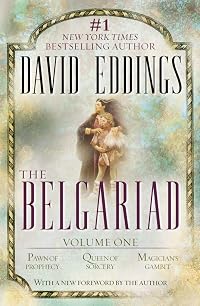
The Belgariad, Volume One: Pawn of Prophecy • Queen of Sorcery • Magician's Gambit:
by David Eddings
The Belgariad (Collections and Selections — Omnibus 1-3), Belgariad Universe (Collections and Selections — Omnibus 03-05)
On This Page
Description
"It all begins with the theft of the Orb that for so long protected the West from an evil god as long as the Orb was at Riva, the prophecy went, its people would be safe from this corrupting power. Garion, a simple farm boy, is familiar with the legend of the Orb, but skeptical in matters of magic. Until, through a twist of fate, he learns not only that the story of the Orb is true, but that he must set out on a quest of unparalleled danger to help recover it. For Garion is a child of show more destiny, and fate itself is leading him far from his home, sweeping him irrevocably toward a distant tower--and a cataclysmic confrontation with a master of the darkest magic"--Back cover. show lessTags
Recommendations

Member Recommendations

Member Reviews
Omnibus edition! I'll be breaking these out as I finish them. The usual disclaimer - I first read these when I was a kid (maybe 13, at the oldest) and am irrationally fond of them. This will be an attempt to look at them with grown-up eyes, but that never actually works.
Pawn of Prophecy:
Two things struck me particularly about this book. First of all is the extremely stylized language - it worked very well on my as a kid, being completely understandable while still feeling Important. As I recall, this tone quickly fades as the series goes on, but it works well for me here. Second, there are some spectacular examples of telling-not-showing, largely in the matter of Garion's identity-crisis subplot. As an adopted kid myself, his clunky and show more heavy-handed struggle to deal with his genetic identity didn't make much sense to me then, and now it just highlights one of the classic bad-eurocentric-fantasy tropes - that race=culture=identity, such that people can identify nationality (even within a group of nations that are explicitly the same ethnicity, or in a nation that is explicitly a melting pot) at a glance. It's lazy writing, and it does bug me a little.
On the narrative side, I noticed something for the first time - reading this book *without* reading the prologue must be a very different experience. Because the prologue not only sets up the cosmology of the world, it also lays out very clearly how all of the nominal mysteries in this first volume are going to end - we know who Aunt Pol is, what Garion's family secret is, and what their mysterious quest must be right up front. But the actual text reveals those things gradually or not at all, in a way that's clearly intended to set up narrative tension. So... this is a self-spoiling book. I wish I could purge it from my head and read it unspoiled, for once, just to see how it went.
Queen of Sorcery
Queen of Sorcery focuses on Garion's development as a moral being, which makes sense, given that he's fifteen, barely hitting puberty, and just now noticing the world around him. I wouldn't say it's deftly handled, exactly - there is very little that is subtle in this series - but the various adventures are entertaining as well as not too obtrusively didactic. The various "hints" leading up to the "big reveal" of Garion's sorcerous power are equally obvious, but the actual climax is exciting enough, and both the justice of the act and its emotional cost are earned, I think.
The book also has a self-spoiling problem, in that the Prologue makes is very clear that Garion and Ce'Nedra are destined to be together, which undercuts any possible tension in their early relationship. I don't love that - they have some genuine problems to work through, and it feels like they're handled much too lightly because Prophecy. I am not generally a fan of relationships that begin with screaming fights and contempt on one or both sides. Ce'Nedra is only lightly characterized here, and I will no doubt gripe about her more later, but this is not an auspicious beginning.
There are some cool bits in this one, but it was never my favorite, and still isn't - too much of it feels like stalling to set up character development, rather than making the development part of the plot. There are also just plain too many characters, I think, and this book is where the author begins to find various excuses to ditch parts of the group for whole chunks of time just so it stays manageable. Lelldorin had some potential as a character and not a cardboard cutout but he goes poof almost as soon as he's introduced, Mandorallen never really becomes more than a caricature, Hettar gets plain forgotten for big chunks of the text, and Barak, Durnik, and Silk trade off the minor character moments but never really grow. Add in Wolf, Pol, Garion, and Ce'Nedra, and we're talking ten members of the ensemble - and every single bit of plot or action is initiated by someone outside the group, not within it. No wonder nationality serves as a stand-in for personality - it almost has to.
(And yes, this world has no black people. None. There are white people, who are good, and there are Asian people, who are evil. Just saying.)
Magician's Gambit:
Magician's Gambit covers not just the development of Garion's powers but the esoteric side of the worldbuilding, which has not been covered in much detail up until now. We meet a couple of gods, the Purpose of the Universe, and a high priest or two. The reason the Asians - excuse me, Angaraks - are evil is explained in detail (woo human sacrifice!) although the blame is very carefully laid on the people in power - lunatic kings and a power-mad priesthood, as well as their megalomaniac god - and we're actually left with at least a little sympathy for the common people. It's better than it could be, I guess.
We spend a bit of time in Ce'Nedra's head before she's conveniently left behind, and, try as I might, I have trouble finding fault with the characterization. She's spoiled, intelligent, and adolescent, and therefore mostly irritating but not unsympathetic. I think that over the course of the series, she doesn't develop as far away from that as she could, but right here I'm pretty much ok with her.
There are some bits that nag at me about this half of the series (Barak and his wife! Taiba! Relationships-as-cosmic-reward!) but they're better saved until later - I can't not know what happens, and be annoyed at the breadcrumbs when they appear, but on the whole this is is inoffensive. (Except, you know, for the race thing.)
And while I am not the same reader I was when I was 11, I still kind of love these books. They are fast-paced, amusing, and give the impression of discussing Serious Things without being at all challenging to a middle-class white American kid. The writing is fine, the dialogue is snappy, and the tropes are well-worn enough to feel totally comfortable. I can't help but be critical, now, but these are totally staying on my shelves. Everyone needs their wubbie. show less
Pawn of Prophecy:
Two things struck me particularly about this book. First of all is the extremely stylized language - it worked very well on my as a kid, being completely understandable while still feeling Important. As I recall, this tone quickly fades as the series goes on, but it works well for me here. Second, there are some spectacular examples of telling-not-showing, largely in the matter of Garion's identity-crisis subplot. As an adopted kid myself, his clunky and show more heavy-handed struggle to deal with his genetic identity didn't make much sense to me then, and now it just highlights one of the classic bad-eurocentric-fantasy tropes - that race=culture=identity, such that people can identify nationality (even within a group of nations that are explicitly the same ethnicity, or in a nation that is explicitly a melting pot) at a glance. It's lazy writing, and it does bug me a little.
On the narrative side, I noticed something for the first time - reading this book *without* reading the prologue must be a very different experience. Because the prologue not only sets up the cosmology of the world, it also lays out very clearly how all of the nominal mysteries in this first volume are going to end - we know who Aunt Pol is, what Garion's family secret is, and what their mysterious quest must be right up front. But the actual text reveals those things gradually or not at all, in a way that's clearly intended to set up narrative tension. So... this is a self-spoiling book. I wish I could purge it from my head and read it unspoiled, for once, just to see how it went.
Queen of Sorcery
Queen of Sorcery focuses on Garion's development as a moral being, which makes sense, given that he's fifteen, barely hitting puberty, and just now noticing the world around him. I wouldn't say it's deftly handled, exactly - there is very little that is subtle in this series - but the various adventures are entertaining as well as not too obtrusively didactic. The various "hints" leading up to the "big reveal" of Garion's sorcerous power are equally obvious, but the actual climax is exciting enough, and both the justice of the act and its emotional cost are earned, I think.
The book also has a self-spoiling problem, in that the Prologue makes is very clear that Garion and Ce'Nedra are destined to be together, which undercuts any possible tension in their early relationship. I don't love that - they have some genuine problems to work through, and it feels like they're handled much too lightly because Prophecy. I am not generally a fan of relationships that begin with screaming fights and contempt on one or both sides. Ce'Nedra is only lightly characterized here, and I will no doubt gripe about her more later, but this is not an auspicious beginning.
There are some cool bits in this one, but it was never my favorite, and still isn't - too much of it feels like stalling to set up character development, rather than making the development part of the plot. There are also just plain too many characters, I think, and this book is where the author begins to find various excuses to ditch parts of the group for whole chunks of time just so it stays manageable. Lelldorin had some potential as a character and not a cardboard cutout but he goes poof almost as soon as he's introduced, Mandorallen never really becomes more than a caricature, Hettar gets plain forgotten for big chunks of the text, and Barak, Durnik, and Silk trade off the minor character moments but never really grow. Add in Wolf, Pol, Garion, and Ce'Nedra, and we're talking ten members of the ensemble - and every single bit of plot or action is initiated by someone outside the group, not within it. No wonder nationality serves as a stand-in for personality - it almost has to.
(And yes, this world has no black people. None. There are white people, who are good, and there are Asian people, who are evil. Just saying.)
Magician's Gambit:
Magician's Gambit covers not just the development of Garion's powers but the esoteric side of the worldbuilding, which has not been covered in much detail up until now. We meet a couple of gods, the Purpose of the Universe, and a high priest or two. The reason the Asians - excuse me, Angaraks - are evil is explained in detail (woo human sacrifice!) although the blame is very carefully laid on the people in power - lunatic kings and a power-mad priesthood, as well as their megalomaniac god - and we're actually left with at least a little sympathy for the common people. It's better than it could be, I guess.
We spend a bit of time in Ce'Nedra's head before she's conveniently left behind, and, try as I might, I have trouble finding fault with the characterization. She's spoiled, intelligent, and adolescent, and therefore mostly irritating but not unsympathetic. I think that over the course of the series, she doesn't develop as far away from that as she could, but right here I'm pretty much ok with her.
There are some bits that nag at me about this half of the series (Barak and his wife! Taiba! Relationships-as-cosmic-reward!) but they're better saved until later - I can't not know what happens, and be annoyed at the breadcrumbs when they appear, but on the whole this is is inoffensive. (Except, you know, for the race thing.)
And while I am not the same reader I was when I was 11, I still kind of love these books. They are fast-paced, amusing, and give the impression of discussing Serious Things without being at all challenging to a middle-class white American kid. The writing is fine, the dialogue is snappy, and the tropes are well-worn enough to feel totally comfortable. I can't help but be critical, now, but these are totally staying on my shelves. Everyone needs their wubbie. show less
Eddings' Belgariad is immediately identifiable as a coming of age tale. Garion, who lives on Faldor's farm with his Aunt Pol, the head cook, is dragged on a mysterious quest with his aunt and an old storyteller who are soon identified as the millennia old sorcerer Belgaroth and his daughter Polgara. Garion is clueless and innocent, but he slowly begins to develop a variety of skills as he works with members of their party. Unfortunately, he may be tied with Harry Potter as the most inept gatherer of information known to man. It becomes clear readers that he is the heir to the Rivan throne, and yet despite picking up every other scrap of available information he remains oblivious to this.
The most difficult part of this series for me was show more Eddings' inability to write women. Polar, a 4,000 year old sorceress and one of the most powerful beings in existence, regularly spends her time chiding the men about drinking beer and ale. C'Nedra, who we know is significant as she is destined to become Garion's wife, is one of the most ridiculous, petty, and flat characters I've come across and the attempts at chemistry between her and Garion appear forced and out of character on both sides.
Eddings' strongest comeback lies with his side characters. Silk (aka Prince Kheldar of Drasnia, Ambar of Kotu, Radek of Boktor) is fun, enjoyable addition to the tale. He is consistently witty, sarcastic, and hilarious to follow. His skills as an assassin, spy, fighter, and merchant lead to his being central to some of the most memorable scenes. Hettar and Mandorallen are similarly enjoyable, and their constant friendly banter, vices, and interests are what convinced me to keep reading. show less
The most difficult part of this series for me was show more Eddings' inability to write women. Polar, a 4,000 year old sorceress and one of the most powerful beings in existence, regularly spends her time chiding the men about drinking beer and ale. C'Nedra, who we know is significant as she is destined to become Garion's wife, is one of the most ridiculous, petty, and flat characters I've come across and the attempts at chemistry between her and Garion appear forced and out of character on both sides.
Eddings' strongest comeback lies with his side characters. Silk (aka Prince Kheldar of Drasnia, Ambar of Kotu, Radek of Boktor) is fun, enjoyable addition to the tale. He is consistently witty, sarcastic, and hilarious to follow. His skills as an assassin, spy, fighter, and merchant lead to his being central to some of the most memorable scenes. Hettar and Mandorallen are similarly enjoyable, and their constant friendly banter, vices, and interests are what convinced me to keep reading. show less
I never knew, that when I started reading The Belgariad, that David Eddings would die. But, ten days after I started reading this volume, covering the first three books of his Belgariad series, Eddings passed away.
It's always weird to start reading a book by a living author, but finish reading a book by a death author. It changes your impression of it. It makes that old reader's interpretation adage even more true: "The Author is Dead."
Before I read this book, my only experience reading Eddings had been reading Belgarath the Sorcerer. This book is best reserved to read after you're read (and enjoyed) the other books in this uber-series. Belgarath is sort of a "behind-the-scenes" book, like if Tolkien would have published "Memoirs of a show more Grey Istari."
The Belgariad is your typical high fantasy novel, even to the point of having tolkienoid analogs (such as an absent-minded professor of a wizard, a boy on a quest, an object of great power, and an incapacitated ancient evil trying to regain enough strength to terrorize the world). It's not as blatant as The Sword of Shannara, but it's still there.
The first three volumes cover Garion, who's a scullion, which isn't a type of onion, and his Aunt Pol. Every once in a while, they're visited by Old Wolf, who is a tale spinner. Pol, as it turns out, is actually Polgara the Sorceress. Old Wolf is Belgarath. Garion is actually the heir to the high throne of Rivan, but he's apparently too dense to realize this, though everyone around him seems to know.
Turns out the Orb of Aldur, a rock with a little soul, was stolen from the unguarded Rivan palace, and it's up to Belgarath and his rag-tag team of Prophecy-fulfilling archetypes (A towering, axe-wielding giant of a man; a small, weasely thief; a chivalrous knight who'd make Don Quixote look like an exceptionally rude gentleman; a conservative blacksmith; a religious zealot who can walk through stone; the imperial princess, who's also half Dryad; a violent horse whisperer; and a woman who's one of the last surviving members of her race. Did I miss any?)
These people journey through a Middle-earth-like setting that's a bit sparse on non-human creatures (but does have some!), but has plenty of warring humans.
One thing that struck me was the apparent and rampant racism of the book. Now, I'm not saying Eddings himself was a racist, nor is his writing demeaning towards non-white people. But rather, it seems that he took a page from Tolkien, who made it clear that if a person was from a particular country, and that country was bad, then that person was bad. Our heroes tromped around, indiscriminately killing all people (humans) described as "Murgos," whenever they had a chance. And one character in particular took special joy in killing them (though, in his defense, Murgos killed his parents, so that makes everything all right, right?).
It was at times unsettling. I kept wondering "Aren't there any good Murgos? Like, one who recycles, or helps old lady Murgos across the street?" Turns out, every single Murgo is a sword-wielding bad guy with poor hygienic qualities. That's not a stereotype at ALL!
Other than the fact that it was tolkienoid and that it was needlessly racists (in my opinion), the story itself was interesting, though frustrating at how dense the protagonist was. The plot, though heavily prophecy-driven (which should be apparent by the first book's title: "Pawn of Prophecy") lacks any sort of character drive, other than to fulfill a prophecy, and in their spare time, discuss it obliquely so Garion doesn't realize he's really the Rivan King. Though, when they did get to their various stops along the way, the plot carried along, and didn't make me wish that the next page would be the last.
It'll definitely stay on my shelf until I need more room for other books.
Recommended for fans of Eddings' other work, or for indiscriminate fans of High Fantasy. show less
It's always weird to start reading a book by a living author, but finish reading a book by a death author. It changes your impression of it. It makes that old reader's interpretation adage even more true: "The Author is Dead."
Before I read this book, my only experience reading Eddings had been reading Belgarath the Sorcerer. This book is best reserved to read after you're read (and enjoyed) the other books in this uber-series. Belgarath is sort of a "behind-the-scenes" book, like if Tolkien would have published "Memoirs of a show more Grey Istari."
The Belgariad is your typical high fantasy novel, even to the point of having tolkienoid analogs (such as an absent-minded professor of a wizard, a boy on a quest, an object of great power, and an incapacitated ancient evil trying to regain enough strength to terrorize the world). It's not as blatant as The Sword of Shannara, but it's still there.
The first three volumes cover Garion, who's a scullion, which isn't a type of onion, and his Aunt Pol. Every once in a while, they're visited by Old Wolf, who is a tale spinner. Pol, as it turns out, is actually Polgara the Sorceress. Old Wolf is Belgarath. Garion is actually the heir to the high throne of Rivan, but he's apparently too dense to realize this, though everyone around him seems to know.
Turns out the Orb of Aldur, a rock with a little soul, was stolen from the unguarded Rivan palace, and it's up to Belgarath and his rag-tag team of Prophecy-fulfilling archetypes (A towering, axe-wielding giant of a man; a small, weasely thief; a chivalrous knight who'd make Don Quixote look like an exceptionally rude gentleman; a conservative blacksmith; a religious zealot who can walk through stone; the imperial princess, who's also half Dryad; a violent horse whisperer; and a woman who's one of the last surviving members of her race. Did I miss any?)
These people journey through a Middle-earth-like setting that's a bit sparse on non-human creatures (but does have some!), but has plenty of warring humans.
One thing that struck me was the apparent and rampant racism of the book. Now, I'm not saying Eddings himself was a racist, nor is his writing demeaning towards non-white people. But rather, it seems that he took a page from Tolkien, who made it clear that if a person was from a particular country, and that country was bad, then that person was bad. Our heroes tromped around, indiscriminately killing all people (humans) described as "Murgos," whenever they had a chance. And one character in particular took special joy in killing them (though, in his defense, Murgos killed his parents, so that makes everything all right, right?).
It was at times unsettling. I kept wondering "Aren't there any good Murgos? Like, one who recycles, or helps old lady Murgos across the street?" Turns out, every single Murgo is a sword-wielding bad guy with poor hygienic qualities. That's not a stereotype at ALL!
Other than the fact that it was tolkienoid and that it was needlessly racists (in my opinion), the story itself was interesting, though frustrating at how dense the protagonist was. The plot, though heavily prophecy-driven (which should be apparent by the first book's title: "Pawn of Prophecy") lacks any sort of character drive, other than to fulfill a prophecy, and in their spare time, discuss it obliquely so Garion doesn't realize he's really the Rivan King. Though, when they did get to their various stops along the way, the plot carried along, and didn't make me wish that the next page would be the last.
It'll definitely stay on my shelf until I need more room for other books.
Recommended for fans of Eddings' other work, or for indiscriminate fans of High Fantasy. show less
David Eddings wrote the five books that comprise The Belgariad while I was still in high school. I remember seeing them on the library shelves, and passing them by for other things. Frequently during those years, I would re-read novels that captivated me. So in 1983-1985, I entirely missed this series. I will blame the font because, in those days, I truly did judge a book by its cover (especially if that book was a fantasy novel, and the cover wasn't designed by Darrell K. Sweet). Now that I'm no longer fifteen years old, I've decided to read some of the titles I remember, but never actually settled on. I found The Belgariad in the "free" bin at my library and decided I needed something light. I hadn't been reading recently. I've been show more bogged down in a few heavy novels (literally. One book weighs several pounds). THis is an omnibus edition, comprised of the first three novels, Pawn of Prophecy, Queen of Sorcery, and Magician's Gambit. The books run smoothly from one to the next without much break in action.
Enough backstory. The Belgariad is quite good. It never won any awards, I believe, but has firmly established itself smack in the middle of 1980s fantasy literature. It's about an orphaned boy called Garion, who finds himself pulled into world-changing politics. Along with his companions, his Aunt Pol, an old storyteller called Mr. Wolf, a huge, bearded warrior (Barak) from the north, and a smooth talking thief who goes by the name of Silk, all the archetypes are there. Hovering over it all is the deformed god Kal Torak, whose evil priests and soldiers control the eastern half of the continent.
The story is good. The characters are solid and interesting. Eddings holds our interest in the plot through the interactions between his characters. Most of the three books' perspective is through Garion's eyes, and he's constantly struggling in that age where a boy isn't quite a man. His Aunt Pol hovers and nags. He is at times belligerent, as a fourteen year old boy would be.
Edding's Universe is complex and had me referring often to the maps, (there were three) and the book's prologue. His Realms are rigidly constructed, with peoples varied in personality, if not lifestyle. Sendari are pragmatic to the point of obnoxiousness; Chereks celebrate in warlike mead-hall fashion. The Nyissans are swamp-dwelling snake worshipers. Each land opens up a glimpse of Edding's Universe, and usually, had me scampering back a hundred pages to remember where I'd heard the name of that Realm before. This wasn't a bad thing, but the book probably would have benefitted from a brief gazeteer.
I read through the six-page prologue of each book. I wish I hadn't. It gave me knowledge of Eddings's cast of characters that, afterward, spoiled aspects of the plot. You knew who the cast was (or could easily guess), and you understood their purpose. Mostly, the story reminds me of a very well-written novelized depiction of a Dungeons and Dragons game, complete with the wizard, the healer, the warrior, the thief, the paladin: even the cave-dwelling gnomes eventually make their way into the story. It doesn't detract from the story; it does enrich the genre.
I liked the novels. The characters were engaging enough to hold my interest, despite being cut from a predictable mold. For those who enjoy an easy, somewhat predictable, read, I'd recommend the Belgariad series. In fact, I passed them on to my fifteen year-old son, who's already started reading Eddings's followup series. I'm not quite sure of their staying power in my memory. I have a feeling it will slip, like many stories, into my subconscious, and in a year I won't have anything but the vaguest recollection of the works. That said, they work. They're certainly not the best in Fantasy literature, but not the worst either. show less
Enough backstory. The Belgariad is quite good. It never won any awards, I believe, but has firmly established itself smack in the middle of 1980s fantasy literature. It's about an orphaned boy called Garion, who finds himself pulled into world-changing politics. Along with his companions, his Aunt Pol, an old storyteller called Mr. Wolf, a huge, bearded warrior (Barak) from the north, and a smooth talking thief who goes by the name of Silk, all the archetypes are there. Hovering over it all is the deformed god Kal Torak, whose evil priests and soldiers control the eastern half of the continent.
The story is good. The characters are solid and interesting. Eddings holds our interest in the plot through the interactions between his characters. Most of the three books' perspective is through Garion's eyes, and he's constantly struggling in that age where a boy isn't quite a man. His Aunt Pol hovers and nags. He is at times belligerent, as a fourteen year old boy would be.
Edding's Universe is complex and had me referring often to the maps, (there were three) and the book's prologue. His Realms are rigidly constructed, with peoples varied in personality, if not lifestyle. Sendari are pragmatic to the point of obnoxiousness; Chereks celebrate in warlike mead-hall fashion. The Nyissans are swamp-dwelling snake worshipers. Each land opens up a glimpse of Edding's Universe, and usually, had me scampering back a hundred pages to remember where I'd heard the name of that Realm before. This wasn't a bad thing, but the book probably would have benefitted from a brief gazeteer.
I read through the six-page prologue of each book. I wish I hadn't. It gave me knowledge of Eddings's cast of characters that, afterward, spoiled aspects of the plot. You knew who the cast was (or could easily guess), and you understood their purpose. Mostly, the story reminds me of a very well-written novelized depiction of a Dungeons and Dragons game, complete with the wizard, the healer, the warrior, the thief, the paladin: even the cave-dwelling gnomes eventually make their way into the story. It doesn't detract from the story; it does enrich the genre.
I liked the novels. The characters were engaging enough to hold my interest, despite being cut from a predictable mold. For those who enjoy an easy, somewhat predictable, read, I'd recommend the Belgariad series. In fact, I passed them on to my fifteen year-old son, who's already started reading Eddings's followup series. I'm not quite sure of their staying power in my memory. I have a feeling it will slip, like many stories, into my subconscious, and in a year I won't have anything but the vaguest recollection of the works. That said, they work. They're certainly not the best in Fantasy literature, but not the worst either. show less
This is epic fantasy at its finest, and exactly why Eddings is a household name (too bad his recent work sucks). All the characters are well developed, the mythology is rich, and the quest a time-tested story arc. If you are a fantasy fan, you have to read this series!
This omnibus edition contained the first three books in the Belgariad series, Pawn of Prophesy, Queen of Sorcery, and The Magician’s Gambit. The story is set in a land created by seven Gods. A legend involving those Gods and a powerful orb that led them to war undergirds the story in the Belgariad. The actual story itself begins thousands of years later after those events, and it focuses on the adventures of a 14-year-old orphan boy named Garion who is suddenly dragged from his farm home in pursuit of a mysterious stolen object that is somehow bound up in Garion's own past and future.
In crafting his world, Eddings does a lot of things right. He has created a fully fledged other world, with many different kingdoms and a long history show more that seems to extend beyond the pages of these books. And by having us travel this world with Garion, we’re able to get acquainted with it a bit at a time.
However, the overarching story is incredibly predictable. Part of this comes from the fact that there is a prophesy involved. What was especially maddening for me was that Garion couldn’t put things together. I also felt that Eddings just doesn’t raise the stakes for his characters enough. There are plenty of moments when the characters are in danger, I never got the sense that the evil characters were more powerful than Garion’s allies. They just weren’t nasty enough—at least not until well into the third book, where things turned suitably dark.
Also, most of the first two books had an episodic structure, as Garion and company traveled from one kingdom to another, usually picking up another ally along the way. Some of these adventures were good fun, and some of the supporting characters are wonderful (the comically boastful and chivalrous knight Mandorallen was a personal favorite), but the action doesn’t really build. If I had been reading this as three separate novels, I would have stopped at the end of Queen of Sorcery out of boredom and annoyance. (I really disliked the female character, Ce’Nedra, who was introduced in that book—and I was incredibly irritated that I knew exactly what her role was the moment she appeared without being told.) However, this being an omnibus, continuing into the next book required less effort than picking up another book would.So I pressed on.
This proved to be a very good thing because the final book in this volume, Magician’s Gambit, was a marked improvement over the other two. The exposition starts to give way to rising action, and the story finally gets exciting. The scary bits are finally scary, and the evil characters are finally evil enough. I found that I was starting to care a bit about what was going to happen, and there are a few aspects of the characters’ futures that do seem open to multiple possibilities. So I do plan to continue the series, but only because of the success of the third book.
See my complete review at Shelf Love. show less
In crafting his world, Eddings does a lot of things right. He has created a fully fledged other world, with many different kingdoms and a long history show more that seems to extend beyond the pages of these books. And by having us travel this world with Garion, we’re able to get acquainted with it a bit at a time.
However, the overarching story is incredibly predictable. Part of this comes from the fact that there is a prophesy involved. What was especially maddening for me was that Garion couldn’t put things together. I also felt that Eddings just doesn’t raise the stakes for his characters enough. There are plenty of moments when the characters are in danger, I never got the sense that the evil characters were more powerful than Garion’s allies. They just weren’t nasty enough—at least not until well into the third book, where things turned suitably dark.
Also, most of the first two books had an episodic structure, as Garion and company traveled from one kingdom to another, usually picking up another ally along the way. Some of these adventures were good fun, and some of the supporting characters are wonderful (the comically boastful and chivalrous knight Mandorallen was a personal favorite), but the action doesn’t really build. If I had been reading this as three separate novels, I would have stopped at the end of Queen of Sorcery out of boredom and annoyance. (I really disliked the female character, Ce’Nedra, who was introduced in that book—and I was incredibly irritated that I knew exactly what her role was the moment she appeared without being told.) However, this being an omnibus, continuing into the next book required less effort than picking up another book would.So I pressed on.
This proved to be a very good thing because the final book in this volume, Magician’s Gambit, was a marked improvement over the other two. The exposition starts to give way to rising action, and the story finally gets exciting. The scary bits are finally scary, and the evil characters are finally evil enough. I found that I was starting to care a bit about what was going to happen, and there are a few aspects of the characters’ futures that do seem open to multiple possibilities. So I do plan to continue the series, but only because of the success of the third book.
See my complete review at Shelf Love. show less
One of my most favourite series! I've reread this series 3 times, and am thinking about reading it yet again. So many interesting characters and an engaging plot. I love the weasely and witty Silk, and the Gruff but gentle Barak! As well as the serious and kind Hettar. A truly amazing adventure that I always look forward to.
Members
- Recently Added By
Lists

Best Fantasy Novels
821 works; 361 members

Favorite Series
238 works; 94 members

Gateway Book: Fantasy
19 works; 34 members

Elevenses
316 works; 88 members

Books Read in 2009
464 works; 11 members
Author Information

117 Works 123,301 Members
David Eddings was born on July 7, 1931 in Spokane, Washington. He received a B.A. in English from Reed College in Portland in 1954 and a M.A. in Middle English from the University of Washington in 1961. After serving in the U.S. Army for two years, he worked as a grocery clerk, as a sales clerk for the Boeing Company, and as an English teacher in show more a business college and a teachers' college. During his lifetime, he wrote more than 25 books, many of them with his wife Leigh Eddings. His first novel, High Hunt, was published in 1973. His other works include the Belgariad series, the Mallorean series, the Elenium series, and the Dreamers series. He died on June 2, 2009 at the age of 77. (Bowker Author Biography) show less
Some Editions
Series


Work Relationships
Is contained in
Contains
Common Knowledge
- Canonical title
- The Belgariad, Volume One: Pawn of Prophecy • Queen of Sorcery • Magician's Gambit:
- Original publication date
- Pawn of Prophecy (1982) (1982); Queen of Sorcery (1982) (1982); Magician's Gambit (1983) (1983)
- People/Characters
- Aldur; Asharak the Murgo (Chamdar the Grolim); Barak (the Dreadful Bear, Earl of Trellheim); Beldin; Belgarath (the Eternal Man, Mister Wolf, Old Wolf); Belkira (show all 44); Beltira; Bethra; Ce'Nedra (Imperial Princess of Tolnedra, jewel of the House of Borune, the Queen of the World); Ctuchik; Doroon; Durnik (the Man with Two Lives, the One with Two Lives); Eriond (Errand); Faldor; Garion (Belgarion, the Child of Light); Gorim; Grinneg; Hettar (the Horse Lord); Issa (the Snake God); Issus; Korodullin (King of Arendia); Lelldorin of Wildantor (the Archer, the Bowman); Mandorallen (Baron of Vo Mandor, the Knight Protector); Mara; Mayaserana (Queen of Arendia); Nerina (Baroness of Vo Ebor); the Orb of Aldur (Cthrag Yaska); Polgara (Aunt Pol, the Duchess of Erat); Emperor Ran Borune XXIII; Relg (the Blind Man); Rundorig; Sadi (the Man Who Is No Man); Eternal Salmissra (Queen of Nyissa); Silk (Ambar of Kotu, the Guide, the Nimble Thief, Prince Kheldar, Radek of Boktor); Taiba (the Mother of the Race That Died); Taur Urgas (King of the Murgos); UL; Xantha (Queen of the Dryads); Xera; Yarblek; Zedar (Belzedar); Zubrette; Anhelda; Eilbrig
- Important places
- Sendaria; Cherek; Vo Wacune, Arendia; Asturia, Arendia; the Great Arendish Fair, Arendia; Vo Mimbre, Arendia (show all 22); the forest of Vordue, Tolnedra; Tol Honeth, Tolnedra; Wood of the Dryads; Nyissa; Maragor; Ulgoland; Vale of Aldur; Algaria; Rak Cthol, Cthol Murgos; Sendar, Sendaria; Upper Gralt; Faldor's farm, Sendaria; Cthol Murgos; Isle of the Winds; Sea of the Winds; Arendia
- Dedication
- For Theone,
who told me stories by could not stay for mine--
and for Arthur,
who showed me the way to become a man--and who shows me still. - First words
- As we previously mentioned in The Rivan Codex, The Belgariad grew out of a map (or a doodle, to be more precise) I'd been working on for a piece of literary tripe that even bored me, and I found myself sketc... (show all)hing out a map of a place that existed only in my fevered imagination as a form of relaxation.
- Last words
- (Click to show. Warning: May contain spoilers.)He turned and led them back into the dark cave with the earthquake rumbling beneath their feet.
- Disambiguation notice
- This is an omnibus work consisting the first 3 volumes of the Belgariad by David Eddings:
- Pawn of Prophecy
- Queen of Sorcery
- Magician's Gambit
Do not combine it ... (show all)with any of the individual volumes.
Classifications
Statistics
- Members
- 2,637
- Popularity
- 7,101
- Reviews
- 24
- Rating
- (4.13)
- Languages
- English, French
- Media
- Paper
- ISBNs
- 6
- ASINs
- 12