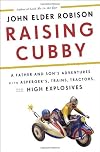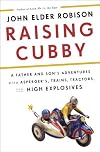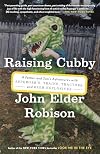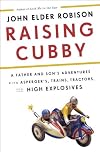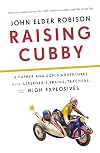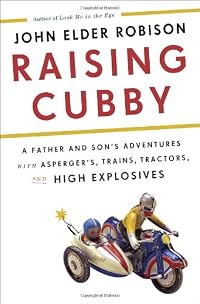
Raising Cubby: A Father and Son's Adventures with Asperger's, Trains, Tractors, and High Explosives
by John Elder Robison
On This Page
Description
"The slyly funny, sweetly moving memoir of an unconventional dad's relationship with his equally offbeat son--complete with fast cars, tall tales, homemade explosives, and a whole lot of fun and trouble Misfit, truant, delinquent. John Robison was never a model child, and he wasn't a model dad either. Diagnosed with Asperger's syndrome at the age of forty, he approached fatherhood as a series of logic puzzles and practical jokes. When his son, Cubby, asked, "Where did I come from?" John said show more he'd bought him at the Kid Store and that the salesman had cheated him by promising Cubby would "do all chores." He read electrical engineering manuals to Cubby at bedtime. He told Cubby that wizards turned children into stone when they misbehaved. Still, John got the basics right. He made sure Cubby never drank diesel fuel at the automobile repair shop he owns. And he gave him a life of adventure: By the time Cubby was ten, he'd steered a Coast Guard cutter, driven a freight locomotive, and run an antique Rolls Royce into a fence. The one thing John couldn't figure out was what to do when school authorities decided that Cubby was dumb and stubborn--the very same thing he had been told as a child. Did Cubby have Asperger's too? The answer was unclear. One thing was clear, though: By the time he turned seventeen, Cubby had become a brilliant chemist--smart enough to make military-grade explosives and bring state and federal agents calling. Afterward, with Cubby facing up to sixty years in prison, both father and son were forced to take stock of their lives, finally coming to terms with being "on the spectrum" as both a challenge and a unique gift. By turns tender, suspenseful, and hilarious, this is more than just the story of raising Cubby. It's the story of a father and son who grow up together"-- "The comic memoir of an Aspergian father raising his Aspergian son, by the bestselling author of Look Me in the Eye"-- show lessTags
Recommendations





Member Reviews
If men are from Mars, and women from Venus, then John Elder Robison is from a whole different universe from me. That's not to say I didn't like the book, because I did, or that I didn't think he loved his son and tried his best to be a good father, because he did. Some brains are wired differently, and that difference makes it hard for those individuals to fit into the world where most of us reside. So when you get an intelligent, articulate, and observant man, who has a differently wired brain, telling the story of raising a differently wired son, someone (such as myself) with mundane wiring in my brain, can only marvel at the alternate viewpoint.
The main thing that jumped out at me, aside from how much Robison loved his boy, is the show more vast imagination of the man. The stories he told his son were marvelous: getting Cubby from a store that sold kids, rather than that vastly unbelievable "mommy and daddy made you" or "the stork brought you"; how Santa got started, what that stone figure of a child holding a lantern at the end of someone's driveway really was. The activities he and his son did together were wonderful, too, and the solution to getting past security guards who wouldn't let him take his son to explore stockyards, energy plants, etc that they wanted to see, was brilliant. It was such a different world view than my own, and so fascinating.
Robison was diagnosed at age 40 with Asperger's; his son was diagnosed shortly after that. The boy's mother also turns out to be on the autistic spectrum, as do several other people who appear in the book. (And while not on the autistic scale, Robison's younger brother has written about his own life in the memoir Running With Scissors. Finding a way to work in the mainstream world is a struggle and a challenge for such folks. I know people in my own life who also fall in this spectrum, some who have managed more successfully than others, but I do know the hard work it takes. This book not only recounts the story of getting Cubby from babyhood to young adult (with a few minor blow-ups, pun intended, along the way), but it serves to help raise the awareness of those of us with the standard brain wiring of the gifts and challenges "different" folks bring to our world.
Tags: biography-autobiography-or-memoir, blogging-for-books, made-me-laugh-out-loud-for-real, made-me-look-something-up, read, taught-me-something, wow
Thank you to Blogging for Books and to the publishers for sending me a copy of this book. show less
The main thing that jumped out at me, aside from how much Robison loved his boy, is the show more vast imagination of the man. The stories he told his son were marvelous: getting Cubby from a store that sold kids, rather than that vastly unbelievable "mommy and daddy made you" or "the stork brought you"; how Santa got started, what that stone figure of a child holding a lantern at the end of someone's driveway really was. The activities he and his son did together were wonderful, too, and the solution to getting past security guards who wouldn't let him take his son to explore stockyards, energy plants, etc that they wanted to see, was brilliant. It was such a different world view than my own, and so fascinating.
Robison was diagnosed at age 40 with Asperger's; his son was diagnosed shortly after that. The boy's mother also turns out to be on the autistic spectrum, as do several other people who appear in the book. (And while not on the autistic scale, Robison's younger brother has written about his own life in the memoir Running With Scissors. Finding a way to work in the mainstream world is a struggle and a challenge for such folks. I know people in my own life who also fall in this spectrum, some who have managed more successfully than others, but I do know the hard work it takes. This book not only recounts the story of getting Cubby from babyhood to young adult (with a few minor blow-ups, pun intended, along the way), but it serves to help raise the awareness of those of us with the standard brain wiring of the gifts and challenges "different" folks bring to our world.
Tags: biography-autobiography-or-memoir, blogging-for-books, made-me-laugh-out-loud-for-real, made-me-look-something-up, read, taught-me-something, wow
Thank you to Blogging for Books and to the publishers for sending me a copy of this book. show less
The majority of the book contains stories of the author and his family before his son's Asperger's diagnosis. It could definitely give some insight into what it's like to be a parent of a kid with undiagnosed Asperger's. The book did not delve too much into the author's experience of getting the diagnosis for his son. I found it fascinating to read how one person on the spectrum parents another person on the spectrum. My take on the book can not help but be influenced by my experiences with the Aspie(s) in my own life!
One aspect of Mr. Robison's writing that kept jumping out at me was his tendency to "de-humanize" the human. I don't mean this is a mean way - it's just that when he refers to people, his son in particular, he almost show more always uses non-human terms or metaphors. I particularly noticed this in the first half of the book. I started writing down the occurrences. Here are a few:
paws = hands
two wheel drive versus four wheel drive - child walking versus crawling
hatch = be born
full-grown = adult
activate walk mode = stand the kid up
reset him = calm kid down after tantrum
refuel = feed kid
"when he produces grandchildren"
kid ownership = parenting
nesting materials = baby supplies
regularly fed and watered = kid had regular meals
If I could ask Mr. Robison why he does this, I would! Was it a conscious choice, or is it just his natural tendency? Is is just a somewhat humorous way to talk about his kid? Does it have anything to do with Aspies finding people difficult to "read?" Perhaps it sprung from needing to simplify the whole thing down to animal terms? Just speculating here - that one aspect of the book gave me lots to think about! show less
One aspect of Mr. Robison's writing that kept jumping out at me was his tendency to "de-humanize" the human. I don't mean this is a mean way - it's just that when he refers to people, his son in particular, he almost show more always uses non-human terms or metaphors. I particularly noticed this in the first half of the book. I started writing down the occurrences. Here are a few:
paws = hands
two wheel drive versus four wheel drive - child walking versus crawling
hatch = be born
full-grown = adult
activate walk mode = stand the kid up
reset him = calm kid down after tantrum
refuel = feed kid
"when he produces grandchildren"
kid ownership = parenting
nesting materials = baby supplies
regularly fed and watered = kid had regular meals
If I could ask Mr. Robison why he does this, I would! Was it a conscious choice, or is it just his natural tendency? Is is just a somewhat humorous way to talk about his kid? Does it have anything to do with Aspies finding people difficult to "read?" Perhaps it sprung from needing to simplify the whole thing down to animal terms? Just speculating here - that one aspect of the book gave me lots to think about! show less
Raising Cubby was different than any other book that I have read regarding a father and son relationship. The writing of the book itself was a little stranger than most and I think that is due to the fact that John Robison has aspergers and as he said in the book he communicates differently than most people, so it was probably written exactly as he thinks and speaks. Nothing wrong with it at all it was a good insight into the mind of someone with aspergers. This book is incredibly interesting on how John leads his life and thinks. He is very literal about everything such as when Cubby (Jake) was little he liked to be tossed up in the air but he became to heavy John decided to spin him by his arms in circles (like most kids have) Cubby's show more mother started screaming his arms are going to come out of the sockets John actually believed it. There are a lot of laugh out loud moments. They went to many interesting places like nuclear power plants, navy ships, rail yards and dams. Cubby loved these things. He was interested in so many things beyond his years. Some things were slightly disturbing. Like John explaining that stone statues of people or anything really are real but turned to stone by witches. Cubby was a smart child but because of his limitations he got himself into some big trouble with the Feds. You got to read the book to find out the rest! It is worth the read!
"I received this book from Blogging for Books for this review." show less
"I received this book from Blogging for Books for this review." show less
A wonderful read an incredibly devoted father to his Aspergian son. As the reader you live through the trials and tribulations of his son growing up with Aspergers and succeeds in the end. What is stranger than fiction is that both the father and Mother are Aspergians but they didn't know it in the early years just as they didn't know that their son was for some time.
John Robison is still one of the better writers out there when it comes to writing about Asperger's. I have read several books in pursuit of finding out more about Asperger's (of which I probably have, which hasn't been diagnosised). His books are some of the better ones of what it's like.
Ratings
Members
- Recently Added By
Author Information

10 Works 3,794 Members
John Elder Robison was born in Athens, Georgia in the summer of 1957. His father was a professor of Philosophy in Amherst, Massachusetts. His brother is Augusten Burroughs, author of Running with Scissors. Growing up John did not know he had Aspergers. He did know that he had a rare insight into electronics. With that knowledge, he joined a band, show more and ended up designing special effects guitars for KISS by the late 1970s. Afterward, he was an engineer with a major toy and game company. He moved up the corporate ladder for many years, and then became unable to function in the high social climate of the corporate wold. He began fixing Mercedes and Land Rover cars in his driveway and opened his own car repair specialty shop---J E Robison Service. Eventually he was diagnosed by a therapist as having Aspergers. "Look Me in the Eye" is his honest and touching memoir. (Bowker Author Biography) show less
Classifications
- Genres
- Nonfiction, Biography & Memoir, General Nonfiction
- DDC/MDS
- 616.85 — Applied Science & Technology Medicine & health Diseases, Allergies, Skin Conditions Nervous Disorders: Autism, Anorexia, OCD Miscellaneous
- LCC
- RC553 .A88 .R6355 — Medicine Internal medicine Internal medicine Neurosciences. Biological psychiatry. Neuropsychiatry Psychiatry Psychopathology
- BISAC
Statistics
- Members
- 143
- Popularity
- 226,589
- Reviews
- 5
- Rating
- (3.35)
- Languages
- English
- Media
- Paper, Audiobook, Ebook
- ISBNs
- 13
- ASINs
- 2