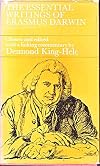
The essential writings of Erasmus Darwin;
by Erasmus Darwin, Erasmus Darwin
On This Page
Tags
Member Reviews
Erasmus Darwin (1731- 1802) was one of the most accomplished men of his age. In addition to being a notable physician, he also was a key thinker of the Enlightenment, as well as a scientist, inventor, and poet. In his poetry he set out ideas about evolution that foreshadowed those of his famous grandson, Charles, published a half century later.
Desmond King-Hele is the most prominent and prolific scholar of Erasmus Darwin's life and work, having (nearly single-handedly) resurrected interest in him. Having published the definitive biography of Erasmus Darwin (in addition to three earlier, more concise biographies of the great man), he also has published an analysis of his poetry prior to this work. Erasmus Darwin's poetry is of show more particular interest, because most of his scientific ideas were presented in this unusual form. Their form of presentation helps explain why his ideas were overlooked by subsequent scientists.
King-Hele's veneration of Erasmus Darwin ("ED" below) is evident from his Introduction to this book: Darwin belongs with Leonardo da Vinci and Goethe, in the small band of great all-rounders, who excelled in both practical and theoretical work, in both literature and science. No one since Darwin's day has equaled him in the scope and variety of his accomplishments, and in our fragmented culture, few can appreciate the full range of his accomplishments. The author quotes the poet Coleridge as asserting of ED that he had a greater range of knowledge than any other man in Europe.
The Essential Writings of Erasmus Darwin will be invaluable to anyone interested in Darwin's life and work. It offers a broad compilation of excerpts of ED's writings (especially his poetry), interspersed with commentary and explanations by King-Hele. Following a brief (12 page) account of ED's life, the author offers the following: excerpts from Darwin's letters; eye-witness descriptions by his contemporaries; excerpts from his "Plan for the Conduct of Female Education" (a work ahead of its time); his medical writings; his extended ideas about evolution and the history of life (as presented in "Zoonomia" and "The Temple of Nature"); botanical writings (from "Phytologia," "The Botanic Garden," and "The Economy of Vegetation" and "Loves of the Plants"); and the "ascent of man" (in "The Temple of Nature"). Also included are Darwin's scientific papers (two of which are reprinted in toto, and excerpts of poems that show the influence of ED's work on Keats, Shelley, Wordsworth, and Coleridge. A concluding summary ends with an alphabetized list of 75 subjects on which King-Hele believes that ED was a pioneer, including "female emancipation," "abolition of slavery," "photosynthesis," "hereditary diseases," "microscopy," "windmills," "origin of life," "mental illness," and "evolutionary theory."
ED's poetry is not easy to read or understand by the modern reader. The meter is in a dated style, and the language and literary allusions are often obscure. King-Hele offers carefully selected excerpts, often of but a few lines or stanzas, interspersed with his commentary. For someone who is not a scholar of 18th century poetry, this may be the most fruitful way to comprehend ED's poetic works, as King-Hele's prose explains their content and context, and draws parallels to other works and ideas.
As I have found in other works by King-Hele, his perspective on ED tends to be somewhat Whiggish; a more dispassionate assessment would not award as much credit to ED as does the author. Likewise, I was not convinced by some of the examples he offers of places where prominent poets seem to have "borrowed" from Darwin's poetry. Nevertheless, King-Hele makes a powerful case for the stunning breadth and depth of Erasmus Darwin's interests, ideas, and accomplishments. This book offers a good way to become familiar with his actual writings, with the guidance of a scholar who has spent his life on the works and contributions of one of the 18th century's most remarkable intellects. show less
Desmond King-Hele is the most prominent and prolific scholar of Erasmus Darwin's life and work, having (nearly single-handedly) resurrected interest in him. Having published the definitive biography of Erasmus Darwin (in addition to three earlier, more concise biographies of the great man), he also has published an analysis of his poetry prior to this work. Erasmus Darwin's poetry is of show more particular interest, because most of his scientific ideas were presented in this unusual form. Their form of presentation helps explain why his ideas were overlooked by subsequent scientists.
King-Hele's veneration of Erasmus Darwin ("ED" below) is evident from his Introduction to this book: Darwin belongs with Leonardo da Vinci and Goethe, in the small band of great all-rounders, who excelled in both practical and theoretical work, in both literature and science. No one since Darwin's day has equaled him in the scope and variety of his accomplishments, and in our fragmented culture, few can appreciate the full range of his accomplishments. The author quotes the poet Coleridge as asserting of ED that he had a greater range of knowledge than any other man in Europe.
The Essential Writings of Erasmus Darwin will be invaluable to anyone interested in Darwin's life and work. It offers a broad compilation of excerpts of ED's writings (especially his poetry), interspersed with commentary and explanations by King-Hele. Following a brief (12 page) account of ED's life, the author offers the following: excerpts from Darwin's letters; eye-witness descriptions by his contemporaries; excerpts from his "Plan for the Conduct of Female Education" (a work ahead of its time); his medical writings; his extended ideas about evolution and the history of life (as presented in "Zoonomia" and "The Temple of Nature"); botanical writings (from "Phytologia," "The Botanic Garden," and "The Economy of Vegetation" and "Loves of the Plants"); and the "ascent of man" (in "The Temple of Nature"). Also included are Darwin's scientific papers (two of which are reprinted in toto, and excerpts of poems that show the influence of ED's work on Keats, Shelley, Wordsworth, and Coleridge. A concluding summary ends with an alphabetized list of 75 subjects on which King-Hele believes that ED was a pioneer, including "female emancipation," "abolition of slavery," "photosynthesis," "hereditary diseases," "microscopy," "windmills," "origin of life," "mental illness," and "evolutionary theory."
ED's poetry is not easy to read or understand by the modern reader. The meter is in a dated style, and the language and literary allusions are often obscure. King-Hele offers carefully selected excerpts, often of but a few lines or stanzas, interspersed with his commentary. For someone who is not a scholar of 18th century poetry, this may be the most fruitful way to comprehend ED's poetic works, as King-Hele's prose explains their content and context, and draws parallels to other works and ideas.
As I have found in other works by King-Hele, his perspective on ED tends to be somewhat Whiggish; a more dispassionate assessment would not award as much credit to ED as does the author. Likewise, I was not convinced by some of the examples he offers of places where prominent poets seem to have "borrowed" from Darwin's poetry. Nevertheless, King-Hele makes a powerful case for the stunning breadth and depth of Erasmus Darwin's interests, ideas, and accomplishments. This book offers a good way to become familiar with his actual writings, with the guidance of a scholar who has spent his life on the works and contributions of one of the 18th century's most remarkable intellects. show less
Members
- Recently Added By
Author Information

44 Works 203 Members
1 Work 13 Members
Some Editions
Classifications
Statistics
- Members
- 11
- Popularity
- 1,775,186
- Reviews
- 1
- Rating
- (4.00)
- Languages
- English
- Media
- Paper
- ISBNs
- 1
- ASINs
- 1