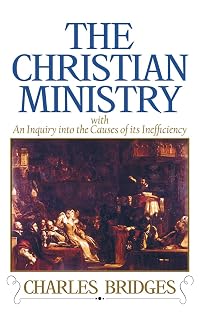
The Christian Ministry: With An Inquiry Into The Causes Of Its Inefficiency With Especial Reference To The Ministry Of The Establishment
by Charles Bridges
On This Page
Description
Wouldn't you like it if you were the reason someone is saved from the depths of hell? More importantly, how would God feel about you if you were the reason one of the lost souls, was guided to faith? In his best literary work, Charles Bridges lays down the foundation of Christian ministry. He displays how to preach for specific kinds of people, how to win their hearts over and inspire their souls to Christian faith.Tags
Recommendations



























Member Reviews
Ill not lay hands on any man to enter the ministry without also giving him a copy of this book, and then making sure that he reads it slowly, prayerfully and even annually. Every page and sentence is filled with significance and meaning. Scripture drips from almost every sentence. Its one of those books that if you were to underline the good parts, youd need to underline it all. Without the godly wisdom contained in Charles Bridges work, I quite possibly would have left the ministry by now. His book is a wonderful counter to all of the unbiblical success models on the shelves of so many Christian bookstores. If love the Church and the pastoral work and desires to see it conformed more closely to the Word of God then this is a necessary show more addition to your library! show less
Charles Bridges' work entitled “The Christian Ministry with An Inquiry into the Causes of its Insufficiency” is exactly what it claims to be. From exalted description of the majesty of the church in its divine origin, to detailed exposition of various different types of people that make up our churches with corresponding instructions on how to practically minister to each one, this is a complete work indeed. Yet do not think that in being so broad in topics it is shallow in its treatment of each—nay, Bridges' work is dug just as deep as it is wide. One cannot help but feel as though Bridges is speaking directly to him, jumping out of the pages, having himself first spent much time meditating upon these things and feeling them show more excruciatingly necessary in his own life. He has read much on the subject, evidenced by a majority of the pages having at least one-fourth of it consisting in footnotes, quotations, and further explanation.
This book originated in a letter written by Bridges “to a beloved friend upon the interesting subject of Ministerial inefficiency.” This is the main burden which motivated the writing of this work, and it is evidenced throughout. The work has two main concerns: 1) negatively, to point out error / malpractice causing inefficiency, both in our practice and in our person; 2) positively, to present the proper view of and proper method of carrying out the ministry so as to have a proper effect. These two concerns are separated into five main parts: “General view of the Christian Ministry”, “General causes in the want of success in the Christian Ministry”, “Causes of Ministerial inefficiency connected with our personal character”, “The public work of the Christian Ministry”, “The Pastoral Work of the Christian Ministry.”
One often feels that inquiring as to the causes of inefficiency in one's ministry is something that should never be done. There is often a sense of piety that seems to be connected to entrusting the results of one's ministry completely to the Lord, with no view whatsoever to fruit borne. This is partially true. Yet, this book argues, it is a legitimate pursuit to make such an inquiry, and one ought not be charged with blasphemy or unbelief for so doing. There is indeed a balance that is to be kept here and Bridges does so masterfully. Quoting another man, he writes, “If you have preached a considerable time in a place, and done little or no good, there must in all probability be some fault, not only in your hearers, but in you, or your sermons. . . . Inquire then where the fault may be.” (245-6) His words sting with accuracy, yet are soft and gracious.
Such poignancy is consistent throughout, drawing the reader to see his responsibility and helplessness, yet not ever failing to mention simultaneously the sufficiency that we have in God. He writes earlier on, “Conscious helplessness sinks under the depressing weight of responsibility. Faith links our weakness in immediate connexion with the promises of Almighty aid.” (17)
In this fashion, he first demonstrates the final guarantee we have of success, reminding us that “wherever the Gospel was sent, and so long as it was continued, the work of success invariably proceeded.” (72) The sovereignty of God ensures the minister that all whom the Father has chosen shall come. (John 6:37) The church being the program of God upon the earth has the guarantee of final success. However, one must not presume upon such success. It is to be won through means. “God is pleased to make himself known by the use of means. And when the means are used in subordination to his grace, he will honour the means.” (34) And so it is not a vain exercise to inquire as to the sources of inefficiency in a given ministry.
“The Christian Ministry” is likely to be more appreciated by someone in the work of the ministry, as he will thus be familiar “experimentally” with the pain of ineffective ministry, and will be greatly enriched by the wise counsel, godly insight, and refreshing balance offered here.
[http://matthauck.typepad.com/blog/2008/12/bridges-the-christian-ministry.html] show less
This book originated in a letter written by Bridges “to a beloved friend upon the interesting subject of Ministerial inefficiency.” This is the main burden which motivated the writing of this work, and it is evidenced throughout. The work has two main concerns: 1) negatively, to point out error / malpractice causing inefficiency, both in our practice and in our person; 2) positively, to present the proper view of and proper method of carrying out the ministry so as to have a proper effect. These two concerns are separated into five main parts: “General view of the Christian Ministry”, “General causes in the want of success in the Christian Ministry”, “Causes of Ministerial inefficiency connected with our personal character”, “The public work of the Christian Ministry”, “The Pastoral Work of the Christian Ministry.”
One often feels that inquiring as to the causes of inefficiency in one's ministry is something that should never be done. There is often a sense of piety that seems to be connected to entrusting the results of one's ministry completely to the Lord, with no view whatsoever to fruit borne. This is partially true. Yet, this book argues, it is a legitimate pursuit to make such an inquiry, and one ought not be charged with blasphemy or unbelief for so doing. There is indeed a balance that is to be kept here and Bridges does so masterfully. Quoting another man, he writes, “If you have preached a considerable time in a place, and done little or no good, there must in all probability be some fault, not only in your hearers, but in you, or your sermons. . . . Inquire then where the fault may be.” (245-6) His words sting with accuracy, yet are soft and gracious.
Such poignancy is consistent throughout, drawing the reader to see his responsibility and helplessness, yet not ever failing to mention simultaneously the sufficiency that we have in God. He writes earlier on, “Conscious helplessness sinks under the depressing weight of responsibility. Faith links our weakness in immediate connexion with the promises of Almighty aid.” (17)
In this fashion, he first demonstrates the final guarantee we have of success, reminding us that “wherever the Gospel was sent, and so long as it was continued, the work of success invariably proceeded.” (72) The sovereignty of God ensures the minister that all whom the Father has chosen shall come. (John 6:37) The church being the program of God upon the earth has the guarantee of final success. However, one must not presume upon such success. It is to be won through means. “God is pleased to make himself known by the use of means. And when the means are used in subordination to his grace, he will honour the means.” (34) And so it is not a vain exercise to inquire as to the sources of inefficiency in a given ministry.
“The Christian Ministry” is likely to be more appreciated by someone in the work of the ministry, as he will thus be familiar “experimentally” with the pain of ineffective ministry, and will be greatly enriched by the wise counsel, godly insight, and refreshing balance offered here.
[http://matthauck.typepad.com/blog/2008/12/bridges-the-christian-ministry.html] show less
Charles Bridges, writes a book that flows directly from the heart of a shepherd fully engaged and devoted to ministry. His work, though written over one hundred years ago is extremely relevant to those who aspire to serve the Lord’s church. Its timeliness is grounded in his commitment to the scriptures. Bridges breathes scripture in his language. Every page, paragraph and sentence either directly quotes from the Bible or borrows Biblical language and terminology.
Bridges writes as an encourager to brothers who have encountered difficulties in ministry, “Thus discouragements properly sustained and carefully improved, become our most fruitful sources of eventual encouragement; while love to our work bears us on above all our show more difficulties” (17). This is the best manner of encouragement, rooted in the sovereignty of God that sustains a minister, not in spite of trouble but through it and even because of it. Bridges continual admonishments throughout his work serve as an encouraging balm to the embattled pastor.
His work is not only spiritually refreshing but practically helpful as well. He divides his subject into five parts of Christian ministry. First he considers ministry in its general view, which speaks of the origins, dignity, use, necessity and qualifications of ministry. This section also devotes a large and portion of its emphasis to the importance of the pastors studies and preparation. His second section considers the “want of success” in ministry. Unlike a modern book of marketing mistakes and misnomers, this section focuses on the divine need for blessing of ministry, the sinfulness of the pastor as a natural obstacle to success, and the work and war of the Devil as the final resistance in the causes for the lack of success in ministry. The third part of the work takes up the subject of ministerial inefficiency as connected with the minister’s personal character. This section is convicting and hard hitting, Bridges goes after pride, worldliness, the fear of man, family neglect and more topics that every pastor must battle against. Bridges assessment of the fear of man, is most insightful, He speaks of the cowardice and timidity that arises from esteeming men rather than teaching the full counsel of Scripture. He writes, “Thus, as the heart is more in the world, it is less in our work; our duties are consequently performed with reluctance, and unproductive in their results. (126) In the forth part Bridges considers the public work of the ministry, and it is in this section that he becomes most practical and hands on. The forth part is a crash course on preaching. He gives a scriptural survey of true biblical, gospel-centered, expository, doctrinal, practical bold and wise preaching. In this section on preaching is tucked in a rich chapter on pastoral prayer both devotional and public prayer being considered. Bridges concludes his work with a staccato analysis of how to minister to diverse individuals with assorted problems.
Some may find Bridges verbiage and cadence cumbersome and dated. This is a valid criticism; there are sections of his work that are very difficult for the modern reader to digest. For example early in his section on the necessity of the ministry he writes, “Because the nature of things consisting, as this doth, in action, is known by the object whereabout they are conversant, and by the end or scope whereunto they are referred; we must know that the object of this function is both God and men: God, in that he is publicly worshipped of his church; and men, in that they are capable of happiness by means, which Christian discipline appointeth.” Yikes. This is obviously difficult and cumbersome for us, but the struggle is worth the fruit, he explains what this means in more simple terms following, “So that the sum of our whole labor in this kind is to honor God, and to save men.” The diamonds are worth the labor.
Some would criticize his sacral commitment to the Church of England, but his understanding of ministry is far from sacramental and obviously warmhearted and evangelical. He even seeks to not alienate his readers of differing theological persuasion as he carefully considers his Calvinistic sources and gently explains his views in a wise and balanced fashion. This conciliatory nature in and of itself is very helpful advice for a young minister.
Another less helpful aspect of Bridges work is the large quantity of references that he turns his readers to that are long out of print and outdated. He also provides the reader with copious footnotes, sometimes taking up half a page with helpful quotes and at other times taking up half a page with unhelpful quotes in the original Latin.
Archaic language and outdated references should not long deter a reader hungry for transcendent truth. Bridges is a helpful and wise shepherd, a discerning teacher and a devoted and authentic believer. show less
Bridges writes as an encourager to brothers who have encountered difficulties in ministry, “Thus discouragements properly sustained and carefully improved, become our most fruitful sources of eventual encouragement; while love to our work bears us on above all our show more difficulties” (17). This is the best manner of encouragement, rooted in the sovereignty of God that sustains a minister, not in spite of trouble but through it and even because of it. Bridges continual admonishments throughout his work serve as an encouraging balm to the embattled pastor.
His work is not only spiritually refreshing but practically helpful as well. He divides his subject into five parts of Christian ministry. First he considers ministry in its general view, which speaks of the origins, dignity, use, necessity and qualifications of ministry. This section also devotes a large and portion of its emphasis to the importance of the pastors studies and preparation. His second section considers the “want of success” in ministry. Unlike a modern book of marketing mistakes and misnomers, this section focuses on the divine need for blessing of ministry, the sinfulness of the pastor as a natural obstacle to success, and the work and war of the Devil as the final resistance in the causes for the lack of success in ministry. The third part of the work takes up the subject of ministerial inefficiency as connected with the minister’s personal character. This section is convicting and hard hitting, Bridges goes after pride, worldliness, the fear of man, family neglect and more topics that every pastor must battle against. Bridges assessment of the fear of man, is most insightful, He speaks of the cowardice and timidity that arises from esteeming men rather than teaching the full counsel of Scripture. He writes, “Thus, as the heart is more in the world, it is less in our work; our duties are consequently performed with reluctance, and unproductive in their results. (126) In the forth part Bridges considers the public work of the ministry, and it is in this section that he becomes most practical and hands on. The forth part is a crash course on preaching. He gives a scriptural survey of true biblical, gospel-centered, expository, doctrinal, practical bold and wise preaching. In this section on preaching is tucked in a rich chapter on pastoral prayer both devotional and public prayer being considered. Bridges concludes his work with a staccato analysis of how to minister to diverse individuals with assorted problems.
Some may find Bridges verbiage and cadence cumbersome and dated. This is a valid criticism; there are sections of his work that are very difficult for the modern reader to digest. For example early in his section on the necessity of the ministry he writes, “Because the nature of things consisting, as this doth, in action, is known by the object whereabout they are conversant, and by the end or scope whereunto they are referred; we must know that the object of this function is both God and men: God, in that he is publicly worshipped of his church; and men, in that they are capable of happiness by means, which Christian discipline appointeth.” Yikes. This is obviously difficult and cumbersome for us, but the struggle is worth the fruit, he explains what this means in more simple terms following, “So that the sum of our whole labor in this kind is to honor God, and to save men.” The diamonds are worth the labor.
Some would criticize his sacral commitment to the Church of England, but his understanding of ministry is far from sacramental and obviously warmhearted and evangelical. He even seeks to not alienate his readers of differing theological persuasion as he carefully considers his Calvinistic sources and gently explains his views in a wise and balanced fashion. This conciliatory nature in and of itself is very helpful advice for a young minister.
Another less helpful aspect of Bridges work is the large quantity of references that he turns his readers to that are long out of print and outdated. He also provides the reader with copious footnotes, sometimes taking up half a page with helpful quotes and at other times taking up half a page with unhelpful quotes in the original Latin.
Archaic language and outdated references should not long deter a reader hungry for transcendent truth. Bridges is a helpful and wise shepherd, a discerning teacher and a devoted and authentic believer. show less
Dommage que ce livre ne soit qu'un recueil de pensées ou de phrases extraites de l'ouvrage de 700 pages de l'auteur. Il perd sa lisibilité et son liant. Bien sûr on trouve quelques pépites, mais c'est dommage que l'ouvrage français ait pris le même titre que l'original. On a l'impression d'avoir l'original, mais sans tout son contenu.
Bridges subtitled this book; "CHRISTIAN MINISTRY, An inquiry into the Causes of its inefficiency"
This ought to be read by all the office bearers of the Church. It calls for careful, sober thought bin ministry to do serious personal understanding of the qualifications and preparation for ministry. General reasons of lack of success, Lack of divine callWithholding of the Holy Spirit, hardness of the natural mans heart, the power and and activity of Satan.
Self examination of personal character and habits, preaching and pastoral work.
This ought to be read by all the office bearers of the Church. It calls for careful, sober thought bin ministry to do serious personal understanding of the qualifications and preparation for ministry. General reasons of lack of success, Lack of divine callWithholding of the Holy Spirit, hardness of the natural mans heart, the power and and activity of Satan.
Self examination of personal character and habits, preaching and pastoral work.
Charles Bridges was a 19th century Anglican minister. I read his The Christian Ministry in my twenties and have not really re-read it since. It is an interesting and helpful book, however. It can be found easily enough online or in print. One anomaly is that this Banner version (the one most of us are familiar with) lacks the final sections of the whole work for some reason.
Some quotations
This sacred office is administered by agents, Divinely-called through the medium of lawful authority, and entrusted with the most responsible and enriching blessing; rendering the highest possible service to their fellow men, because that most nearly connected with the glory of the Saviour.
As to spiritual qualifications, we would be careful neither to show more lower, exceed, or deviate from, the Scriptural standard.
It is not easy to overcome our natural love of ease, our indisposition to self-denying devotedness, and our false tenderness in flinching from the declaration of unpalatable truths.
When we see the most "able Minister of the New Testament" that the Church has ever known, deeply penetrated, and indeed well-nigh overwhelmed, with the sense of the "necessity laid upon him" — we may well be ashamed, that with qualifications far inferior, our sense of obligation should be less accurate and constraining.”
Except we realise a high estimation of the Church, the constraining influence of the Saviour's love, and the upholding prop of Almighty grace, what is there to preserve us from sinking in despondency?
Covetousness is far more specious than worldly conformity. It has much to plead under the cover of necessity, justice, prudence, and economy.
In the Church he " transforms himself into an angel of light" — exhibiting either the attractive idol of self-righteousness — or that most inveterate form of antichrist — the dependence on the profession of a pure doctrine.
What a large share of humility, what unceasing supply of Divine grace, is needed to resist a temptation, that falls in so powerfully with the selfish principle of the natural heart!
No one attains remarkable eminence or success, without a resolute and habitual self-denial in subordinating every secondary point to the primary object.
The kindness of the world is far more formidable than its enmity. Many, who were prepared to stem the torrent of its opposition, have yielded with compromising indulgence to its paralysing kindness.
The contempt also of the Sabbath — the predominant character of pleasure, dissipation, and the general inattention or opposition to religion in the heads of the parish — too often present a hostile front to our course of effort and instruction
Thus our whole course is a struggle against the mighty current of sin — flowing out of that restless bias of the natural heart, which upon the highest authority is declared to be "enmity against God."
The Church is the mirror, that reflects the whole effulgence of the Divine character. It is the grand scene, in which the perfections of Jehovah are displayed to the universe.
If a young man has capacity; culture and application may make him a scholar, a philosopher, or an orator; but a true Minister must have certain principles, motives, feelings, and aims, which no industry or endeavours of men can either acquire or communicate. They must be given from above, or they cannot be received.
Thus discouragements, properly sustained and carefully improved, become our most fruitful sources of eventual encouragement while love to our work bears us on above all our difficulties.
The revelations made to the Church — the successive grand events in her history — and, above all the manifestation of "the glory of God in the Person of Jesus Christ" — furnish even to the heavenly intelligences fresh subjects of adoring contemplation.
the Divine call to this sacred office will be evidenced by a supply of competent qualifications for its discharge.
In considering "the Apostle and High Priest of our profession, Christ Jesus," we witness a most harmonious combination of seemingly opposite characteristics. The Ministry of our Lord was distinguished by the dignity of God, and the sympathy of a man and a brother — by the authority of the commissioned delegate of his Father, and yet by the humility of a servant, who " came not to be ministered unto, but to minister. show less
Some quotations
This sacred office is administered by agents, Divinely-called through the medium of lawful authority, and entrusted with the most responsible and enriching blessing; rendering the highest possible service to their fellow men, because that most nearly connected with the glory of the Saviour.
As to spiritual qualifications, we would be careful neither to show more lower, exceed, or deviate from, the Scriptural standard.
It is not easy to overcome our natural love of ease, our indisposition to self-denying devotedness, and our false tenderness in flinching from the declaration of unpalatable truths.
When we see the most "able Minister of the New Testament" that the Church has ever known, deeply penetrated, and indeed well-nigh overwhelmed, with the sense of the "necessity laid upon him" — we may well be ashamed, that with qualifications far inferior, our sense of obligation should be less accurate and constraining.”
Except we realise a high estimation of the Church, the constraining influence of the Saviour's love, and the upholding prop of Almighty grace, what is there to preserve us from sinking in despondency?
Covetousness is far more specious than worldly conformity. It has much to plead under the cover of necessity, justice, prudence, and economy.
In the Church he " transforms himself into an angel of light" — exhibiting either the attractive idol of self-righteousness — or that most inveterate form of antichrist — the dependence on the profession of a pure doctrine.
What a large share of humility, what unceasing supply of Divine grace, is needed to resist a temptation, that falls in so powerfully with the selfish principle of the natural heart!
No one attains remarkable eminence or success, without a resolute and habitual self-denial in subordinating every secondary point to the primary object.
The kindness of the world is far more formidable than its enmity. Many, who were prepared to stem the torrent of its opposition, have yielded with compromising indulgence to its paralysing kindness.
The contempt also of the Sabbath — the predominant character of pleasure, dissipation, and the general inattention or opposition to religion in the heads of the parish — too often present a hostile front to our course of effort and instruction
Thus our whole course is a struggle against the mighty current of sin — flowing out of that restless bias of the natural heart, which upon the highest authority is declared to be "enmity against God."
The Church is the mirror, that reflects the whole effulgence of the Divine character. It is the grand scene, in which the perfections of Jehovah are displayed to the universe.
If a young man has capacity; culture and application may make him a scholar, a philosopher, or an orator; but a true Minister must have certain principles, motives, feelings, and aims, which no industry or endeavours of men can either acquire or communicate. They must be given from above, or they cannot be received.
Thus discouragements, properly sustained and carefully improved, become our most fruitful sources of eventual encouragement while love to our work bears us on above all our difficulties.
The revelations made to the Church — the successive grand events in her history — and, above all the manifestation of "the glory of God in the Person of Jesus Christ" — furnish even to the heavenly intelligences fresh subjects of adoring contemplation.
the Divine call to this sacred office will be evidenced by a supply of competent qualifications for its discharge.
In considering "the Apostle and High Priest of our profession, Christ Jesus," we witness a most harmonious combination of seemingly opposite characteristics. The Ministry of our Lord was distinguished by the dignity of God, and the sympathy of a man and a brother — by the authority of the commissioned delegate of his Father, and yet by the humility of a servant, who " came not to be ministered unto, but to minister. show less
A great primer for all Bible college men preparing for the ministry. Required reading for 1st year ministerial students at North Love Baptist Bible College.
Members
- Recently Added By
Lists

Recommendations by Tim Keller
50 works; 2 members
Author Information

30 Works 3,108 Members
A country clergyman who became a scholar, Charles Bridges (1794-1869) was well known as a prominent leader of the Evangelical Party in the Church of England. He is best remembered for his Old Testament commentaries and The Christian Ministry, his 1829 treatise on pastoral ministry that remains influential today
Common Knowledge
- Canonical title
- The Christian Ministry: With An Inquiry Into The Causes Of Its Inefficiency With Especial Reference To The Ministry Of The Establishment
Classifications
Statistics
- Members
- 1,373
- Popularity
- 17,398
- Reviews
- 10
- Rating
- (4.30)
- Languages
- English, French, Korean, Spanish
- Media
- Paper, Ebook
- ISBNs
- 24
- ASINs
- 18