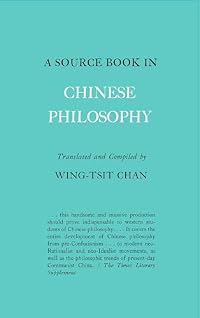
A Source Book in Chinese Philosophy
by Wing-tsit Chan (Editor)
On This Page
Description
A Source Book in Chinese Philosophy is a milestone along the complex and difficult road to significant understanding by Westerners of the Asian peoples and a monumental contribution to the cause of philosophy. It is the first anthology of Chinese philosophy to cover its entire historical development. It provides substantial selections from all the great thinkers and schools in every period--ancient, medieval, modern, and contemporary--and includes in their entirety some of the most important show more classical texts. It deals with the fundamental and technical as well as the more general aspects of Chinese thought. With its new translation of source materials (some translated for the first time), its explanatory aids where necessary, its thoroughgoing scholarly documentation, this volume will be an indispensable guide for scholars, for college students, for serious readers interested in knowing the real China. show lessTags
Recommendations








Member Reviews
A very comprehensive look at Chinese philosophy, marred by distracting in-text comments which would have been much better as footnotes. Possibly the most intriguing chapter is the last one, which looks at Chinese philosophy under Commmunism.
Translated and compiled by Wing-tsit Chan, a Harvard PhD. Extracts from Confucius, Mencius, Hsun Tzu,
With an Appendix on "translation" of certain words. For example CHI means subtle force, CH'I means a definite object, and CH'I means material force, including both matter and energy or ether.
Also, a Bibliography, Glossary of Chinese Characters, and a detailed Index.
Confucius (born 551 bc) rarely mentions "spiritual" life, but turns humanism into a driving force. Wishing to be prominent, he helped others to prominence.
Mencius, like Confucius, lived in a period of political struggle, moral choas, and intellectual conflicts -- 317 bc. Still, thought human nature was "good". Contemporary of Plato.
With an Appendix on "translation" of certain words. For example CHI means subtle force, CH'I means a definite object, and CH'I means material force, including both matter and energy or ether.
Also, a Bibliography, Glossary of Chinese Characters, and a detailed Index.
Confucius (born 551 bc) rarely mentions "spiritual" life, but turns humanism into a driving force. Wishing to be prominent, he helped others to prominence.
Mencius, like Confucius, lived in a period of political struggle, moral choas, and intellectual conflicts -- 317 bc. Still, thought human nature was "good". Contemporary of Plato.
First received as a text book for a class on Eastern Philosophies at Oklahoma State in 1990, this volume has been an invaluable reference over the years. Admirably encapsulates some fairly impenetrable subject matter.
A great book if you're overwhelmed by the sheer amount and scope of chinese philosophy and you just want to know where to start. It provides a nice spine for further studies.
A good collection of the work of China's major thinkers.
Members
- Recently Added By
Lists

Literary Works Read in College
316 works; 15 members
Author Information
Common Knowledge
- Original publication date
- 1969
- People/Characters
- Confucius; Lao Tzu; Mencius; Hsun Tzu; Chuang Tzu; Mo Tzu (show all 31); Tung Chung-shu; Yang Hsiung; Wang Ch'ung; Huai-nan Tzu; Seng-chao; Chi-tsang; Fa-tsang; Han Yu; Li Ao; Chou Tun-i; Shao Yung; Chang Tsai; Ch'eng Hao; Ch'eng I; Lu Hsiang-shan; Chu Hsi; Wang Yang-ming; Wang Fu-chih; Yen Yuan; Tai Chen; K'ang Yu-wei; T'an Ssu-t'ung; Chang Tung-sun; Fang Yu-lan; Hsiung Shih-li
- Important places
- China
- Dedication
- To Gregg M. Sinclair
- First words
- If one word could characterize the entire history of Chinese philosophy, that word would be humanism--not the humanism that denies or slights a Supreme Power, but one that professes the unity of man and Heaven.
Classifications
- Genres
- Philosophy, Nonfiction, Religion & Spirituality, General Nonfiction, History
- DDC/MDS
- 181.11082 — Philosophy and Psychology Ancient, medieval & eastern philosophy Eastern philosophy Far East and South Asia China & Korea
- LCC
- B125 .C45 — Philosophy, Psychology and Religion Philosophy (General) By period Ancient
- BISAC
Statistics
- Members
- 663
- Popularity
- 43,235
- Reviews
- 7
- Rating
- (4.02)
- Languages
- English, German
- Media
- Paper, Ebook
- ISBNs
- 6
- ASINs
- 4