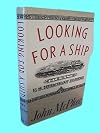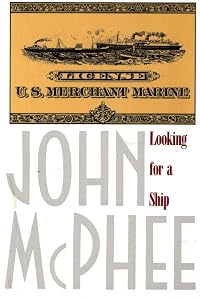
Looking for a Ship
by John McPhee
On This Page
Description
This is an extraordinary tale of life on the high seas aboard one of the last American merchant ships, the S.S. Stella Lykes, on a forty-two-day journey from Charleston down the Pacific coast of South America. As the crew of the Stella Lykes makes their ocean voyage, they tell stories of other runs and other ships, tales of disaster, stupidity, greed, generosity, and courage.Tags
Recommendations















Member Reviews
John McPhee, because he appears to be interested in many things, is capable of interesting the reader in many things. He immerses himself in a subject (fish, oranges, trucking, the New Jersey Pine Barrens), extracts its lifeblood, and puts in on the page. This time his subject is ships, specifically ships of the U.S. Merchant Marine. More specifically the Stella Lykes. He rides the ship on a South American run and describes the crew, the cargo, the ports and the business of running a ship.
He also observes and describes nature: “We saw whales on the way south, and were led by porpoises. Albatrosses flew beside us, motionless to the point of impudence, their eyes on our necks, their great wings fixed, their iron momentum matching the show more ship’s.”
He gets on the Stella Lykes by accompanying an officer, Andy Chase. The intricacies of getting a ship are just as compelling as shipboard operations. The entire book is fascinating. show less
He also observes and describes nature: “We saw whales on the way south, and were led by porpoises. Albatrosses flew beside us, motionless to the point of impudence, their eyes on our necks, their great wings fixed, their iron momentum matching the show more ship’s.”
He gets on the Stella Lykes by accompanying an officer, Andy Chase. The intricacies of getting a ship are just as compelling as shipboard operations. The entire book is fascinating. show less
McPhee's first person account of a 42 day trip to South American he took with the Merchant Marines a quarter century ago is entertaining and informative. One of my friends from high school became a merchant mariner and now I have some idea of the kind of career and life he's led. McPhee discusses how older union cards trump younger ones, the decline of the American Merchant Marine, the mechanics of ships, navigation, different ports of call, piracy, and the men who choose this life. McPhee, observes everything, including the minutia of the ships' cargo. He recounts his and others' adventure. His writing is crafty and precise, if a little impersonal. It dwells on exteriors and surfaces, those of people and boats, not inner or emotional show more lives. There are characters, but it is not a character driven narrative. Stylistically, it took getting used to but over time I warmed up to it. show less
Pirates, storms, shipwrecks, oh my! The first two chapters detail just how hard it is to get a berthing on an American Merchant ship. The author and second mate Andy Chase who the author stays with as they await a ship. They wind up on the S.S. Stella Lykes and meet Captain Washburn. A lot of stories about the Merchant Marine are told, most exciting is the chapter on storms and the effects on ships. After the author gives numerous examples of the devastating effects on shipping and crews, the TV Weatherman states the "Storm has passed, and is safely at sea", not so safe for the sailors.
The last chapter is kinda poetic, as the ship lies dead in the water, much like the American Merchant Marine industry. Seems like there is more future in coal mining then shipping.
show less
The last chapter is kinda poetic, as the ship lies dead in the water, much like the American Merchant Marine industry. Seems like there is more future in
This is McPhee's report of his voyage on a freighter, the Stella Lykes. Another thing I really want to do before I croak. He travels for 42 days, through the Panama Canal and down the coast of South America delivering containers. The are attacked by pirates, navigate around storms, and discuss the decline of the American Merchant Marine. My father actually took a trip on one of the Lykes container ship and was stuck for several weeks on the west side of the Panama Canal during our invasion of Panama. Highly recommended for nautical buffs.
An interesting read. I've often looked out at cargo ships passing through the bay of my home town and wondered what happens onboard. McPhee provides an insight into the decreasing size of the US Merchant Marine and paints it as a dying industry.
Unfortunately, the book meanders along without ever really reaching any high point or having something grander to say than describing the minutiae of every day. I think there were plenty of missed opporunties with this one. I haven't read any other of McPhee's works though, so this could be stylistic.
Unfortunately, the book meanders along without ever really reaching any high point or having something grander to say than describing the minutiae of every day. I think there were plenty of missed opporunties with this one. I haven't read any other of McPhee's works though, so this could be stylistic.
The book starts out very interesting. The author catches a ride on a container ship. He give the reader a look at the present state of the Merchant Marine. Following the ship from port to port in South America, where the crew deals with boaders stealing out of the containers. The book though ends in frustration. The ship has a major engine meltdown, but then it ends. You have no idea what happened to the crew or the ship. It is almost like part of the book is missing.
My very favorite John McPhee book.
Members
- Recently Added By
Author Information

59+ Works 21,095 Members
McPhee was born in Princeton, New Jersey, and educated at Princeton University and Cambridge University. His writing career began at Time magazine and led to his long association with the New Yorker, where he has been a staff writer since 1965. That same year he published his first book, A Sense of Where You Are, with FSG, and soon followed with show more The Headmaster (1966), Oranges (1967), The Pine Barrens (1968), A Roomful of Hovings and Other Profiles (collection, 1969), The Crofter and the Laird (1969), Levels of the Game (1970), Encounters with the Archdruid (1972), The Deltoid Pumpkin Seed (1973), The Curve of Binding Energy (1974), Pieces of the Frame (collection, 1975), and The Survival of the Bark Canoe (1975). Both Encounters with the Archdruid and The Curve of Binding Energy were nominated for National Book Awards in the category of science Since 1977, the year in which McPhee received the Award in Literature from the American Academy of Arts and Letters and The John McPhee Reader and the bestselling Coming into the Country appeared in print, Farrar, Straus and Giroux has published Giving Good Weight (collection, 1979), Basin and Range (1981), In Suspect Terrain (1983), La Place de la Concorde Suisse (1984), Table of Contents (collection, 1985), Rising from the Plains (1986), Heirs of General Practice (in a paperback edition, 1986), The Control of Nature (1989), Looking for a Ship (1990), Assembling California (1993), The Ransom of Russian Art (1994), The Second John McPhee Reader (1996), and Irons in the Fire (1997). Annals of the Former World was published in 1998 and was awarded the Pulitzer Prize in 1999. McPhee has taught at Princeton as Ferris Professor since 1975. (Bowker Author Biography) show less
Awards and Honors
Awards
Distinctions
Work Relationships
Common Knowledge
- People/Characters
- George Anderson Chase; John McPhee; Gene Whalen; Nathaniel Bowditch; Pete Pizzarelli; Kenneth Ronald Crook (show all 25); Chester Dauksevich; John Abbate; Vernon McLaughlin; Calvin King; William "Peewee" Kennedy; Pinckney B. "Zeke" Esekiel; Trevor "Kiwi" Proctor; Paul McHenry Washburn; Luke Midgett; Jerome Pope; William Raymond Charteris "Sparks" Beach; David Carter; Phillip Begin; Graham Ramsay; Karl Knudsen; Carlos Rolando Lopez; Milian Engh; Gretchen Engh; John Shephard
- Important places
- Charleston, South Carolina, USA; New York, New York, USA; Jersey City, New Jersey, USA; Savannah, Georgia, USA; Guayaquil, Ecuador; Valparaiso, Chile (show all 10); Panama Canal, Panama; Cartagena, Colombia; Callao, Peru; Buenaventura, Colombia
- Dedication
- For Yolanda.
- First words
- Andy was worried about the Ben Sawyer Bridge
- Last words
- (Click to show. Warning: May contain spoilers.)With our lemons and lollipops and terry-cloth towels, our three thousand cases of wine, with our ninety drums of passion-fruit juice, our onions, umbrellas, bone glue, and balsa wood, our kiln-dried radiata pine, with our glass Nativity scenes and our peach chips, we are dead in the water.
- Original language
- English
Classifications
- Genres
- Nonfiction, General Nonfiction, Travel
- DDC/MDS
- 910.45 — History & geography Geography & travel modified standard subdivisions of Geography and travel Pirates & Shipwrecks Ocean voyages, pirates
- LCC
- G540 .M365 — Geography, Anthropology and Recreation Geography (General) Seafaring life, ocean travel, etc.
- BISAC
Statistics
- Members
- 755
- Popularity
- 37,436
- Reviews
- 7
- Rating
- (4.07)
- Languages
- English, French, German
- Media
- Paper, Audiobook, Ebook
- ISBNs
- 15
- ASINs
- 7