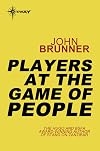
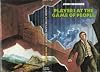
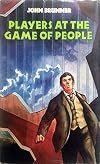
Players at the Game of People
by John Brunner
On This Page
Description
War hero, jet-setter, gourmet - Godwin Harpinshield was all of those and more; his life was a game played among the Beautiful People whose fame, wealth and power set them above the law, and beyond the laws of nature. Because of a simple bargain that all the Beautiful People made, Godwin's every desire was his for the asking. Seduced by luxury, Godwin never doubted his fortune, never wondered about his mysterious patrons. Then the game turned ugly. Suddenly, the ante was raised and the game show more was real. The stakes were his future, his sanity and, possibly, his very soul. All Godwin Harpinshield had to discover was: What were the rules of the game? And who - or what - were the other players? show lessTags
Recommendations















Member Reviews
Good christ, that's bleak. Seems deliberately obfuscating. Brunner's descriptions and despair are top notch, but the whole premise, that it could not be interrogated sincerely, feels kind of like an intentionally evasive writing exercise. Oversold as hell by the copy. Still, has a kernel of greatness.
review of
John Brunner's Players at the Game of People
by tENTATIVELY, a cONVENIENCE - October 14, 2013
Yet another Brunner. The most recent one I've read yet. 1980 publishing date. At 1st I thought of just listing all the permutations that the alien animal name goes thru. Tempting, but not enuf.
"Beside the couch, looking as though a four-foot fir cone had been carved out of anthracite, then flattened like a cowering hedgehog, lay Adirondinatarigo." - p 54
""Oh, that's Canaptarosigapatruleeva,"" - p 55
"All the while Potanandrusabalinicta lay immobile except for an occasional ripple of its carapace." - p 55
"Apticaranogapetulami stirred and readjusted the pattern of its scales by a few millimeters here and there." - p 57 show more
"Apitaculabricomulapariti folded its scales and resumed a condition of inertness." - p 58
"Lurabanguliticapulanduri remained as motionless as though it were carved in ebony." - p 59
"But Abutaralingotogulisica lay as unresponsive as a bone." - p 60
"Had Hermann known in advance about Arikapanotulandaba's amazing powers?" - p 97
Brunner being a writerly bloke, he doesn't always directly describe, he writes around, he tantalizes w/o immediately, if ever, spelling it out. "Hugo & Diana": "By this time she was fondling Gorse's clitoris and his prick was standing at attention." (p 63) ""No, no!" exclaimed Hugo & Diana in dismay. "Not at all like this! This is mine!["]" (p 64) ""Well, we don't," Hugo & Diana said, turning her back and pushing off into the empyrean and beginning to caress his clitoris with sighs and moans of pleasure." (p 64) Amorphous. Hermaphrodite? Conjoined twins? ""Hermaphrodite, of course. Maybe one of these days you'll meet the surgeon who performed the transplants. Brilliant man."" (p 67)
This cast of phantasmagorical characters have extraordinary lives imparted to them by unseen puppet masters, they're owned like pets. In exchange for performing tricks they get spectacular treats.
[reviewer's insertion: As I'm writing this, I'm listening to the Piano Music in America Vol. II: 1900-1945 VOXBOX, Roger Fields, pianist - Shields is phenomenal, it's Wallingford Riegger's wonderful "Six Movements from "New and Old"" (1944) right now - liner notes by none other than Lejaren Hiller, one of my favorite composers, whose Piano Sonatas 4 & 5 I've been listening to repeatedly lately]
Godwin's treat is a George Medal given him for heroism performed by him whilst apparently time-traveling or some such. But is it 'real'?:
""September the twentieth," Bill said at last, tapping the paper with a blunt forefinger.
""Yes!"
""1940?"
""Yes, of course—during the Blitz!"
""I don't believe it," Bill said with finality, surrendering the paper again.
""Nobody's asking you to!" Godwin snapped, returning it to his pocket. But a sour taste was gathering in his mouth, and he forced himself to add the crucial question: "Why?"
""Weren't no George Medals then, nor George Cross neither. Didn't get introduced until September the twenty-third."" - pp 85-86
'Commonplace' details accumulate & set the atmosphere w/o ever being put into a defined context:
"A moment later Godwin was back in the dingy street under a dismal sky. People seemed to be looking at him more than even they had at Bill in his out-of-date finery. Their faces were cold and pinched with hunger. Some of the children playing in the gutter wore only ragged vests or outgrown dresses and were mechanically masturbating as they gazed at him with dull eyes." - p 86
"Masturbating"? What time is this?!
"But when he arrived at Harry's basement flat, in a narrow street of sleazy gray-brick houses beset—like the whole of London—with abandoned cars, there was no reply to his ring . . . this being one of the few doors which did not automatically open even to his touch.
"The most likely explanation was that Harry had been called, and for that there was no help. There was never any help.
"Perhaps it didn't matter. Harry's forgeries were—naturally—the finest in the world, and Godwin had not actually been warned that he shouldn't use a passport too often; it just seemed like a reasonable precaution, because there were so many countries where the police were forever demanding "Vos papiers!" and "Ihr Ausweis!"—or whatever—and the presence fo a visitor unrecorded at any port or airport might entrain problems . . ." - p 87
"As he trudged toward the nearest street where a cruising taxi could logically be intersecting with him" - p 87
"Abandoned cars"? Forged passports? Taxis everywhere? What time is this? Is it London at the time of the bk's writing w/ some new explanations for the despair? For the deterioration? No, not exactly, but I reckon that's in there somewhere. Instead, Godwin is "enjoying his isolation and his suspension in time as well as space", he's beyond jet-setting, a pampered pet, utterly privileged & totally owned. &, yet, there's still no explanation for the background degradation:
"Oxford Street having been for a long while closed to all traffic but buses and taxis, and in any case being beset by homeless hawkers, peddlers, and prostitutes, Godwin detoured via Wigmore Street and made his eventual way to Holburn and the slums of the City, where squatters swarmed like ants in the abandoned office blocks—some bombed, some burned for the insurance, some simply left to rot when the owning company collapsed. Hordes of ragged and filthy children rushed out to celebrate this rare event, the passage of a car, and when he halted more from force of habit than necessity at a blind junction, they converged on him screaming for money and displaying stump wrists and carefully cultivated sores.
"He scared them off with a roar of his engine and thereafter crossed intersections without slowing, blasting his horn.
"Thinking of Sittingbourne, he turned south to A2. In greenwich an armed fascist patrol had set up a roadblock guarded by stern-faced boys with stolen army guns wearing Union Jack armbands on their black leather motorcycle jackets. Luckily a trio of policemen had paused to pass the time of day with them and someone had cracked a good joke which made them all chuckle. Barely glancing at him except to ensure he was white, they waved him by." - p 95
Another of Godwin's 'treats' seems to be traveling in time to an earlier more aristocratic time.. &.. yet.. it goes awry & he's held captive under brutal conditions.. to be eventually taken before the despot.. where he hears music.. "It was by William Walton. / It was Belshazzar's Feast." (p 102) Twentieth century music in a pre-20th c context. As w/ the George Medal it does not compute. [Coincidentally, I'd just been listening to Walton's "Facade" shortly before I read this passage.] This apparent delusion, this apparent hallucination, this 'treat' transforms from one ill-inspired illusion to another: "Shaw! Androcles who took the thorn out of the lion's pad! The whole setup was so illy". (p 105)
&, yes, Brunner does recycle his material a fair amt: "And there, dead ahead of him, was a nearly naked girl tied to the face of a smooth gray rock." "As it began to crisp around the edges in the blasting-hot breath of a creature waddling toward her on scaly legs with claw-tipped toes like an overgrown cockerel's" (p 108) is reminiscent of his Father of Lies; "Two or three had, on cheekbones or wrists, the long-lasting subcutaneous hemorrhages indicative of scurvy" (p 118) is reminiscent of Bedlam Planet.
All in all, I enjoyed reading this, as I enjoy reading all Brunner.. but I read it as a way of distracting myself from more important things to be read.. & I've reviewed it here as a way of avoiding writing more important things to be written - wch is not to say that Brunner's not a great writer, he is, but this was too much entertainment & too little intellectual rigor for me personally. show less
John Brunner's Players at the Game of People
by tENTATIVELY, a cONVENIENCE - October 14, 2013
Yet another Brunner. The most recent one I've read yet. 1980 publishing date. At 1st I thought of just listing all the permutations that the alien animal name goes thru. Tempting, but not enuf.
"Beside the couch, looking as though a four-foot fir cone had been carved out of anthracite, then flattened like a cowering hedgehog, lay Adirondinatarigo." - p 54
""Oh, that's Canaptarosigapatruleeva,"" - p 55
"All the while Potanandrusabalinicta lay immobile except for an occasional ripple of its carapace." - p 55
"Apticaranogapetulami stirred and readjusted the pattern of its scales by a few millimeters here and there." - p 57 show more
"Apitaculabricomulapariti folded its scales and resumed a condition of inertness." - p 58
"Lurabanguliticapulanduri remained as motionless as though it were carved in ebony." - p 59
"But Abutaralingotogulisica lay as unresponsive as a bone." - p 60
"Had Hermann known in advance about Arikapanotulandaba's amazing powers?" - p 97
Brunner being a writerly bloke, he doesn't always directly describe, he writes around, he tantalizes w/o immediately, if ever, spelling it out. "Hugo & Diana": "By this time she was fondling Gorse's clitoris and his prick was standing at attention." (p 63) ""No, no!" exclaimed Hugo & Diana in dismay. "Not at all like this! This is mine!["]" (p 64) ""Well, we don't," Hugo & Diana said, turning her back and pushing off into the empyrean and beginning to caress his clitoris with sighs and moans of pleasure." (p 64) Amorphous. Hermaphrodite? Conjoined twins? ""Hermaphrodite, of course. Maybe one of these days you'll meet the surgeon who performed the transplants. Brilliant man."" (p 67)
This cast of phantasmagorical characters have extraordinary lives imparted to them by unseen puppet masters, they're owned like pets. In exchange for performing tricks they get spectacular treats.
[reviewer's insertion: As I'm writing this, I'm listening to the Piano Music in America Vol. II: 1900-1945 VOXBOX, Roger Fields, pianist - Shields is phenomenal, it's Wallingford Riegger's wonderful "Six Movements from "New and Old"" (1944) right now - liner notes by none other than Lejaren Hiller, one of my favorite composers, whose Piano Sonatas 4 & 5 I've been listening to repeatedly lately]
Godwin's treat is a George Medal given him for heroism performed by him whilst apparently time-traveling or some such. But is it 'real'?:
""September the twentieth," Bill said at last, tapping the paper with a blunt forefinger.
""Yes!"
""1940?"
""Yes, of course—during the Blitz!"
""I don't believe it," Bill said with finality, surrendering the paper again.
""Nobody's asking you to!" Godwin snapped, returning it to his pocket. But a sour taste was gathering in his mouth, and he forced himself to add the crucial question: "Why?"
""Weren't no George Medals then, nor George Cross neither. Didn't get introduced until September the twenty-third."" - pp 85-86
'Commonplace' details accumulate & set the atmosphere w/o ever being put into a defined context:
"A moment later Godwin was back in the dingy street under a dismal sky. People seemed to be looking at him more than even they had at Bill in his out-of-date finery. Their faces were cold and pinched with hunger. Some of the children playing in the gutter wore only ragged vests or outgrown dresses and were mechanically masturbating as they gazed at him with dull eyes." - p 86
"Masturbating"? What time is this?!
"But when he arrived at Harry's basement flat, in a narrow street of sleazy gray-brick houses beset—like the whole of London—with abandoned cars, there was no reply to his ring . . . this being one of the few doors which did not automatically open even to his touch.
"The most likely explanation was that Harry had been called, and for that there was no help. There was never any help.
"Perhaps it didn't matter. Harry's forgeries were—naturally—the finest in the world, and Godwin had not actually been warned that he shouldn't use a passport too often; it just seemed like a reasonable precaution, because there were so many countries where the police were forever demanding "Vos papiers!" and "Ihr Ausweis!"—or whatever—and the presence fo a visitor unrecorded at any port or airport might entrain problems . . ." - p 87
"As he trudged toward the nearest street where a cruising taxi could logically be intersecting with him" - p 87
"Abandoned cars"? Forged passports? Taxis everywhere? What time is this? Is it London at the time of the bk's writing w/ some new explanations for the despair? For the deterioration? No, not exactly, but I reckon that's in there somewhere. Instead, Godwin is "enjoying his isolation and his suspension in time as well as space", he's beyond jet-setting, a pampered pet, utterly privileged & totally owned. &, yet, there's still no explanation for the background degradation:
"Oxford Street having been for a long while closed to all traffic but buses and taxis, and in any case being beset by homeless hawkers, peddlers, and prostitutes, Godwin detoured via Wigmore Street and made his eventual way to Holburn and the slums of the City, where squatters swarmed like ants in the abandoned office blocks—some bombed, some burned for the insurance, some simply left to rot when the owning company collapsed. Hordes of ragged and filthy children rushed out to celebrate this rare event, the passage of a car, and when he halted more from force of habit than necessity at a blind junction, they converged on him screaming for money and displaying stump wrists and carefully cultivated sores.
"He scared them off with a roar of his engine and thereafter crossed intersections without slowing, blasting his horn.
"Thinking of Sittingbourne, he turned south to A2. In greenwich an armed fascist patrol had set up a roadblock guarded by stern-faced boys with stolen army guns wearing Union Jack armbands on their black leather motorcycle jackets. Luckily a trio of policemen had paused to pass the time of day with them and someone had cracked a good joke which made them all chuckle. Barely glancing at him except to ensure he was white, they waved him by." - p 95
Another of Godwin's 'treats' seems to be traveling in time to an earlier more aristocratic time.. &.. yet.. it goes awry & he's held captive under brutal conditions.. to be eventually taken before the despot.. where he hears music.. "It was by William Walton. / It was Belshazzar's Feast." (p 102) Twentieth century music in a pre-20th c context. As w/ the George Medal it does not compute. [Coincidentally, I'd just been listening to Walton's "Facade" shortly before I read this passage.] This apparent delusion, this apparent hallucination, this 'treat' transforms from one ill-inspired illusion to another: "Shaw! Androcles who took the thorn out of the lion's pad! The whole setup was so illy". (p 105)
&, yes, Brunner does recycle his material a fair amt: "And there, dead ahead of him, was a nearly naked girl tied to the face of a smooth gray rock." "As it began to crisp around the edges in the blasting-hot breath of a creature waddling toward her on scaly legs with claw-tipped toes like an overgrown cockerel's" (p 108) is reminiscent of his Father of Lies; "Two or three had, on cheekbones or wrists, the long-lasting subcutaneous hemorrhages indicative of scurvy" (p 118) is reminiscent of Bedlam Planet.
All in all, I enjoyed reading this, as I enjoy reading all Brunner.. but I read it as a way of distracting myself from more important things to be read.. & I've reviewed it here as a way of avoiding writing more important things to be written - wch is not to say that Brunner's not a great writer, he is, but this was too much entertainment & too little intellectual rigor for me personally. show less
Not one of John Brunner's best, this fiction felt undeveloped. Godwin Harpinshield is a slut with a fancy car, who rents a shoddy room in a boardinghouse in a crappy, crime-ridden part of London. Life has no meaning for him; he gets to live a life free from work, and with a flick of a switch, he can turn his shoddy room into a swinging bachelor's pad, located in any paradise on Earth he chooses. The only thing he does in exchange is to submit to a sleepiness every so often, during which time his body gets used. This is the undeveloped part; it's never developed or explained what happens to his body during this time. All he knows is that when he comes to himself again, he is sick, grey, wrinkled, starving, hungover, and used up. He must show more go for a rejuvenation treatment. But things stop being so pleasant, and now he starts asking questions: who is he owned by? show less
Players at the Game of People is a somewhat strange story about the life of Godwin who seems to live apart from ordinary people along with a fees odd acquaintances also mostly living apart from London's other inhabitants. As we follow Godwin we begin to see why he lives as he does with almost magical technology others don't have and there is a sense that it will all turn out badly in the end. Some interesting ideas but not exactly enjoyable to read.
This work of Brunner didn't appeal to me as strongly as some of his other works -- but it spiraled down into a fascinating and eerie conclusion that almost redeemed some of the preceding chaos.
Ciudad de Vados es la cuidad perfecta. Pero sus modernas y brillantes calzadas se están tiñendo de rojo con la sangre derramada por hombres brutalmente asesinados.
El origen del conflicto es una lucha por el poder en la que el ministro de Información manipula y controla las piezas de su batalla personal contra el presidente Vados. Boyd Hakluyt, asesor de tráfico contratado por el presidente, llega a la ciudad justo a tiempo de presenciar otro asesinato, y poco a poco se da cuenta de que su presencia allí no tiene mucho que ver con el control de tráfico: es otro peón de un juego de ajedrez mortal que se juega con la propia cuidad como tablero...
El origen del conflicto es una lucha por el poder en la que el ministro de Información manipula y controla las piezas de su batalla personal contra el presidente Vados. Boyd Hakluyt, asesor de tráfico contratado por el presidente, llega a la ciudad justo a tiempo de presenciar otro asesinato, y poco a poco se da cuenta de que su presencia allí no tiene mucho que ver con el control de tráfico: es otro peón de un juego de ajedrez mortal que se juega con la propia cuidad como tablero...
Jul 6, 2022Spanish
Es el primer libro que leo del autor, así que no puedo comparar con el resto de su obra.
Es una novela extraña. Un tal Godwin (que luego nos enteraremos que no es su verdadero nombre) vive una vida peculiar perteneciendo a una rara sociedad secreta que vive ajeno a la vida cotidiana. Sólo se relacionan abiertamente entre ellos y tienen la particularidad que cada cierto tiempo reciben "la llamada" de los amos. No sabemos quienes son esos amos, aunque se va intuyendo. Deben cumplir ciertas misiones que se les encomiendan, y a cambio, reciben todo tipo de favores. Para Godwin, este tipo de vida es idílica ya que le sacó de una mala situación. Pero algo va a trastocar su día a día cuando conoce a cierta persona que le va a hacer show more cuestionarse su extraña forma de vivir.
Me ha resultado entretenida la lectura. Más que nada, porque quería saber más sobre el protagonista y su trasfondo, a parte de saber quienes eran los amos y aquella chiquilla que salvó del desastre cuya imagen le perseguirá toda su vida. show less
Es una novela extraña. Un tal Godwin (que luego nos enteraremos que no es su verdadero nombre) vive una vida peculiar perteneciendo a una rara sociedad secreta que vive ajeno a la vida cotidiana. Sólo se relacionan abiertamente entre ellos y tienen la particularidad que cada cierto tiempo reciben "la llamada" de los amos. No sabemos quienes son esos amos, aunque se va intuyendo. Deben cumplir ciertas misiones que se les encomiendan, y a cambio, reciben todo tipo de favores. Para Godwin, este tipo de vida es idílica ya que le sacó de una mala situación. Pero algo va a trastocar su día a día cuando conoce a cierta persona que le va a hacer show more cuestionarse su extraña forma de vivir.
Me ha resultado entretenida la lectura. Más que nada, porque quería saber más sobre el protagonista y su trasfondo, a parte de saber quienes eran los amos y aquella chiquilla que salvó del desastre cuya imagen le perseguirá toda su vida. show less
Oct 3, 2024Spanish
Members
- Recently Added By
Author Information

290+ Works 24,612 Members
Legendary science fiction author John Brunner was the winner of the Hugo award and two-time winner of the British Science Fiction Award. He was perhaps the first science fiction author to predict the Internet and coined the term "worm" to descibe computer viruses. Mr. Brunner died in 1995
Some Editions
Series
Belongs to Publisher Series
Heyne Science Fiction & Fantasy (06/4056)
Science Fiction Book Club (2210)
Common Knowledge
- Canonical title
- Players at the Game of People
- Original title
- Players at the Game of People
- Original publication date
- 1980-01-01
- People/Characters
- Godwin Harpinshield; Gorse; Barbara
- Important places
- London, England, UK
- First words
- The air was literally filthy.
- Last words
- (Click to show. Warning: May contain spoilers.)And did not know whether to pity or envy her, with life before her.
- Original language*
- Englisch
*Some information comes from Common Knowledge in other languages. Click "Edit" for more information.
Classifications
Statistics
- Members
- 365
- Popularity
- 86,868
- Reviews
- 7
- Rating
- (3.23)
- Languages
- English, French, German, Spanish
- Media
- Paper, Ebook
- ISBNs
- 8
- ASINs
- 11