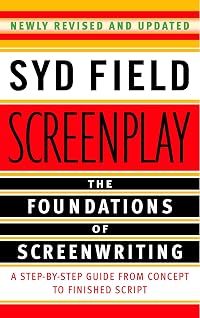
Screenplay: The Foundations of Screenwriting - A Step-by-Step Guide from Concept to Finished Script
by Syd Field
On This Page
Description
Hollywood's script guru teaches you how to write a screenplay in the 'bible of screenwriting', The New York Times Syd Field's definitive guide, "Screenplay: The Foundations of Screenwriting" is now celebrating over forty years of screenwriting success! Field's books on the essential structure of emotionally satisfying screenplays have ignited lucrative careers in film and television since 1979. In this revised edition of his premiere guide, the underpinnings of successful onscreen narratives show more are revealed in clear and encouraging language that will remain wise and practical as long as audiences watch stories unfold visually-from hand-held devices to IMAX to virtual reality, and whatever comes next! As the first person to articulate common structural elements unique to successful movies, celebrated producer, lecturer, teacher, and bestselling author Syd Field has gifted us a classic text. From concept to character, from opening scene to finished script, here are fundamental guidelines to help all screenwriters-novices and Oscar-winners-hone their craft and sell their work. In "Screenplay: The Foundations of Screenwriting", Syd Field can help you discover - Why the first ten pages of every script are crucial to keeping professional readers' interest - How to visually grab these influential readers from page one, word one - Why structure and character are the basic components of all narrative screenplays - How to adapt a novel, a play, or an article into a saleable script - Tips on protecting your work-three ways to establish legal ownership of screenplays - Vital insights on writing authentic dialogue, crafting memorable characters, building strong yet flexible storylines (form, not formula), overcoming writer's block, and much more - Syd Field is revered as the original master of screenplay story structure, and this guide continues to be the industry's gold standard for learning the foundations of screenwriting. show lessTags
Recommendations

Member Recommendations
Member Reviews
Every character has a dramatic need, something that drives them forward into action. As someone raised in the Hollwood foothills, I've long wondered how you can make a multi-million dollar movie and forget to have a story (Rise of Skywalker cough cough). Screenplays are the least expensive part of a film, probably below the craft services table, so why are they so frequently incoherent and mediocre?
Well, I'm still not sure, and having read Syd Field's classic guide, Hollywood has even less of an excuse. A screenplay is an odd beast of a genre, a written description of moving images. They're short, 120 pages with a lot of white space, which puts then in the novella range, and have a distinct format of scene descriptions, character show more dialog, and action. Field mentions that successful screenplays 'look right', with a nice balance, but his concern is with form and structure.
Field prototype, his favorite movie, is Chinatown. And while he's no fan of formulaic movies, for him a movie needs form. Much like a coat has two sleeves, a collar, and a front a back, a screenplay has certain requirements. A screenplay is built of scenes arranged into sequences. There's a main character, who is thrust into conflict at Plot Point I, and then resolves the conflict at Plot Point II. The best parts of the book concern the writing and research process, working up a full biography of your characters, figuring out the context and content of the incidents that illuminate who they are (and incidentally make up the pages of your screenplay), and then the harsh work of removing all the cruft to leave a tight, lean story that grabs the reader from page one. The technique of using 52 3x5 notecards for scenes, and then laying them out, has some inspired parallels with some futurist work I've done.
Field's tone is a friendly elder letting you in on the secrets of the guild. He wants you to succeed, and he has few illusions about your low odds in Hollywood. But with this book, you're at least forewarned. It's a lot better and more professional than The Writer's Journey, which I read ages ago.
Here's looking at you, kid. show less
Well, I'm still not sure, and having read Syd Field's classic guide, Hollywood has even less of an excuse. A screenplay is an odd beast of a genre, a written description of moving images. They're short, 120 pages with a lot of white space, which puts then in the novella range, and have a distinct format of scene descriptions, character show more dialog, and action. Field mentions that successful screenplays 'look right', with a nice balance, but his concern is with form and structure.
Field prototype, his favorite movie, is Chinatown. And while he's no fan of formulaic movies, for him a movie needs form. Much like a coat has two sleeves, a collar, and a front a back, a screenplay has certain requirements. A screenplay is built of scenes arranged into sequences. There's a main character, who is thrust into conflict at Plot Point I, and then resolves the conflict at Plot Point II. The best parts of the book concern the writing and research process, working up a full biography of your characters, figuring out the context and content of the incidents that illuminate who they are (and incidentally make up the pages of your screenplay), and then the harsh work of removing all the cruft to leave a tight, lean story that grabs the reader from page one. The technique of using 52 3x5 notecards for scenes, and then laying them out, has some inspired parallels with some futurist work I've done.
Field's tone is a friendly elder letting you in on the secrets of the guild. He wants you to succeed, and he has few illusions about your low odds in Hollywood. But with this book, you're at least forewarned. It's a lot better and more professional than The Writer's Journey, which I read ages ago.
Here's looking at you, kid. show less
Unless you're already a naturally-gifted screenwriter you can't do much better than start with Syd Field's book Screenplay. And would go further and say that even if you're already talented, being familiar with Syd Field's contribution is still fundamental to understanding the art and form of the craft.
Screenplay will take the aspiring writer from conception to final draft, and wherever possible an explanation of "why this works" is given. The criticism that his approach is inorganic and formulaic is valid, but why not use it as another tool in the toolbox as opposed to an all-or-nothing way of writing movies?
Screenplay will take the aspiring writer from conception to final draft, and wherever possible an explanation of "why this works" is given. The criticism that his approach is inorganic and formulaic is valid, but why not use it as another tool in the toolbox as opposed to an all-or-nothing way of writing movies?
The all-hailed last word in screenwriting books. Syd Field wrote this book as a model for building screenplays that follow a very specific narrative structure. You could call it a formula, but it is more based on how you pace and build the story structure than a set of cookie-cutter blueprints. Field uses the (awesome) movie Chinatown as the "ideal" example, and then uses a mockup story that is quite different as an in-process example. It also gives movie examples for variations.
Obviously, there have been excellent screenplays that don't follow this model. But this is definitely a good place to start.
Obviously, there have been excellent screenplays that don't follow this model. But this is definitely a good place to start.
Very well done, but even knowing what you need to do doesn't help if you can't make yourself do it! This is one of the better books on the subject I have read, however.
Very helpful book about the three-act structure model. Field’s focus is on screenplays, but his paradigm applies just as well to novels. He includes lots of detailed examples thoughout, using well-known movies, to illustrate the points he is making. I borrowed this from the library but may end up buying myself a copy for future reference—especially since I am looking forward to thinking about how three-act structure might apply my own novel-in-progress and maybe help me get a better handle on the shape of the overall story.
The book was a good source of material. It had a lot of good information for those starting out with screenwriting. Though the book was a little hard to read at times mostly because of the blocks of text to read. It took me two weeks to read. The book had a lot of examples from current and past films. I don't think a student would read this on their own, but there is a lot of good tid bits of information that I pulled from it to teach students on the basics of storytelling inside the film universe.
I've attended his class and he's good, but not on the same level as McKee. It's a classic book on screenplays, but there are now better books.
Members
- Recently Added By
Lists

The Great Courses: How to View and Appreciate Great Movies
30 works; 1 member

The Great Courses: How to Write Best-Selling Fiction
36 works; 2 members
Author Information

17 Works 2,807 Members
Sydney Alvin Field was born in Hollywood, California on December 19, 1935. He acted while majoring in literature at the University of California, Berkeley. Then, at the suggestion of one of his instructors, the filmmaker Jean Renoir, he entered film school at the University of California, Los Angeles. His uncle, Sol Halprin, the Academy show more Award-winning head of the camera department at 20th Century Fox, helped him find a job at the television company Wolper Productions. He started in the shipping department but eventually helped produce the company's documentary series Biography, hosted by Mike Wallace. He left to pursue his dream of writing screenplays. He wrote scripts for several television shows including The Man from U.N.C.L.E. and Batman, but never had a major hit. While writing reviews of screenplays and reading thousands of poorly conceived works submitted to another production company he worked for, he decided aspiring writers needed help and wrote his first book, Screenplay: The Foundations of Screenwriting. His wrote several other books including Going to the Movies: A Personal Journey through Four Decades of Modern Film. He also taught at several universities, served as a consultant to Hollywood studios, and advised scientists on how to write screenplays to stir interest in science as a career. He was elected to the Screenwriting Hall of Fame of the American Screenwriting Association. He died from hemolytic anemia on November 17, 2013 at the age of 77. (Bowker Author Biography) show less
Common Knowledge
- Canonical title
- Screenplay: The Foundations of Screenwriting - A Step-by-Step Guide from Concept to Finished Script
- Original title
- Screenplay
- Alternate titles
- A step-by-step guide from concept to finished script
- Original publication date
- 1979
- Canonical DDC/MDS
- 808.2'3
- Canonical LCC
- PN1996.F43
Classifications
Statistics
- Members
- 1,630
- Popularity
- 13,781
- Reviews
- 11
- Rating
- (3.56)
- Languages
- 8 — Chinese, English, German, Hungarian, Malay, Portuguese, Spanish, Turkish
- Media
- Paper, Audiobook, Ebook
- ISBNs
- 22
- ASINs
- 11