
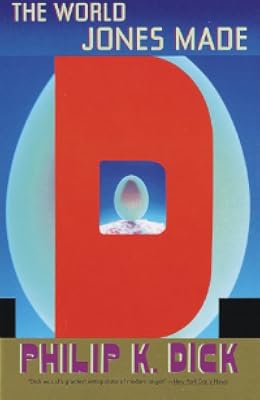
The World Jones Made
by Philip K. Dick
On This Page
Description
Precognition; a world ruled by Relativism; giant alien jellyfish. The World Jones Made is a classic Philip K. Dick mash-up, taking deep philosophical musings and infusing them with wild action. Floyd Jones has always been able to see exactly one year into his future, a gift and curse that began one year before he was even born. As a fortune-teller at a post-apocalyptic carnival, Jones is a powerful force, and may just be able to force society away from its paralyzing Relativism. If, that is, show more he can avoid the radioactively unstable government hitman on his tail. show lessTags
Recommendations














Member Reviews
A post-apocalyptic novel exploring determinism and political fanaticism. Floyd Jones, a mutant with one-year precognition, becomes a demagogue, breaking a society based on Relativism before his inability to alter the future leads to his downfall.
Jones rises from a carnival fortune-teller to dominate the government, causing chaos in a previously stable world. However, his foresight is fatalistic. He cannot change what he sees, making him a tragic messiah.
Jones rises from a carnival fortune-teller to dominate the government, causing chaos in a previously stable world. However, his foresight is fatalistic. He cannot change what he sees, making him a tragic messiah.
Originally published in 1956 when the author was a mere twenty-eight years old, The World Jones Made contains a bushel basket full of Philip K. Dick's signature sf wackiness. The novel also features an eerie foreshadowing of Pastor Jim Jones and the 1978 mass suicide and mass murder in Jonestown, Guyana. Holy hair-raising! PKD's Floyd Jones - even the same last name. Uncanny and creepy in the extreme.
We're in a future time in the aftermath of a vast nuclear worldwide war. Jones is a major thread but there is much, much more - no fewer than five intertwining storylines propel this tale. In no particular order, here's a modest sampling of what a reader will encounter:
Doug Cussick: Member of the Fedgov’s police force. In many ways, the show more hero of the novel, an ordinary kind of guy who values tolerance and a respect for others as well as wanting a world where future generations can grow and flourish. However, Cussick is in a tight spot – following the nuclear war caused in large measure by Mohammedans and Christian fanatics, Fedgov, the ruling power, has taken on the character of totalitarianism with its many forced labor camps, prisons and detention centers. The foundation of their ideology is what is termed “relativism,” where an individual should not voice an opinion that can’t be supported by concrete facts. According to Fedgov, citizens are best remaining silent. Sound inviting? As for me, not only would I not want to live under such suffocating conditions, I wouldn't even want to visit.
Keepers of the Status Quo: Security Director Pearson heads up the secret police and the weapons police. Also part of the Fedgov police force is a friend of Cussick - Max Kaminski, a surly, heavyset man whose lethargy and moroseness typify the mindset of the established order. Kaminski is disgusted with the direction society has taken and at one point lets Cussick know, “Fedgov is still in business. Trying out a few last tricks before it goes down in ruin.”
Jones, One: Cussick meets Floyd Jones for the first time at a carnival where Jones doesn’t tell personal fortunes but answers questions about the future of mankind. Jones can do this since he is a precog, that is, someone who knows the future; for Jones, he can see one year into the future. Such unique knowledge gives him real power. Jones can be killed but he can’t be taken by surprise. Pregcogs - a major ongoing PKD theme, men or women who are not shackled with one big drawback of “normal” human experience– not knowing the future. Just imagine what it would be like to have such ability. Oh, how your life would charge. If nothing else, you could go to Las Vegas and play roulette.
Jones, Two: "End the tyrannical reign of alien relativism. Free men’s minds!" One of the slogans shouted by fanatical followers of the swelling movement lead by Floyd Jones. Jones urges the world to follow him in “The Crusade” – a futurist philosophy that will not be bound by the inertia of the Fedgov or relativism, an exciting movement and philosophy that seeks to explore worlds beyond our own, to send settlers out to colonize the stars. Oh, yes, in the new world order Jones proposes, since he can see into the future, he himself will hold sole authority and power as absolute ruler.
Nina Cussick: Pretty, independent minded Danish lady, wife of Doug and mother of their baby boy, Jack. Nina is bored with the lackluster, dull, dreary world of Fedgov; she years for excitement and change, thus she turns to the Jones movement. The inclusion of Nina in The World Jones Made adds real zest to the story.
Sex, Drugs and Rock ‘n Roll: We witness one captivating scene at an underground club where crowds of young people dance to frantic rhythms, Nina is served capsules of heroin and Cossick smokes marijuana, all the while watching hermaphrodites go through their act – a man and a woman having sex, then changing into two lesbians and then a final change: the man becoming the woman and the woman becoming the man. Even in the suppression of a totalitarian society, young people will discover outlets for their creative energy and imagination.
Custom-made Mutants: There are eight miniature, mutant humans living in a “refuge" outside San Francisco. All of these mutants are inquisitive as to why they are provided with such a lavish, specialized habitat. Is their mutation a consequence of the nuclear war? There’s a Doctor Rafferty who oversees their living arrangements. The more pages we turn, the more these mutants are central to story. To say anything more would be to say too much.
War Mutants: A novel written in those paranoid 1950s I remember so well, the decade of fallout shelters and duck and cover drills. Nuclear attack could happen any day resulting in extreme genetic mutation. PKD picks up on this with Cussick seeing mutant freaks in a carnival freak show; “There were many-headed babies, a common sport. He passed by the usual display of parasites living on sibling hosts. Feathered, scaled, tailed, winged humanoid freaks squeaked and fluttered on all sides: infinite oddities from ravaged genes. People with internal organs situated outside the dermal walls; eyeless, faceless, even headless freaks; freaks with enlarged and elongated and multi-jointed limbs; sad-looking creatures peeping out from within other creatures.”
Drifters: Huge migrating protozoa, many feet in length, float down to earth from another solar system. Fedgov passes laws to protect these organisms; Jones and his followers burn them with gasoline. What course of action is best for us humans? One of the more quizzical parts of the tale.
Venus: The planet in our solar system holding a key to the solution of survival. How? You will have to read for yourself. Highly recommended for both readers new to Philip K. Dick or those fans who want to visit the author’s earlier work.
"My friends," Jones shouted, "the entrenched plutocracy has tried to silence me. But they have grown soft; like great parasites they sit behind their desks running the world. They have gown fat on us; they have feasted well. But it is going to end. I can see it."
Shouted approval.
"We must strike out!" Jones raved on. "Beyond the world, beyond the dead systems. It is our destiny. The race cannot be denied its future. Nothing will stop us. We cannot be defeated."
American Science Fiction author Philip K. Dick, 1928-1982 show less
Books where a character can see the future reliably are weird, and this one is no different. The problem is always that an unchangeable future locks in every character, even the one who knows what's coming. So I always question it when things always work out for the precog. They can't use their knowledge of the future to their advantage, they just have to try and look surprised when it happens. Having said that, this is reliably weird PKD, with mutants and paranoia and heroin pills and giant space amoebas.
Philip K. Dick is a great storyteller of ideas, and this one has a bunch.
- Nuclear apocalypse
- Clairvoyance
- Authoritarian revolution
- Alien invasion
- Interplanetary colonization
- Genetic manipulation
Did I miss anything?
The plot places us in a post-apocalyptic world governed by “Fedgov,” enforcing an ideology of Relativism. We follow a security officer, Cussick, from his early days on the job, where he meets a man named Jones, a carnival fortune teller. Jones is not an orindary clairvoyant — he lives simultaneously in the present with memories running a year into the future.
In the ragged, barely stable political world that Dick creates, Jones parlays his talent/affliction into an authoritarian coup. overthrowing Fedgov, or at show more least throwing political control into chaos.
Jones, by virtue of his clairvoyance, is a formidable figure. He can’t be assassinated, because he knows, in detail, what is destined to happen to him in the next year’s future. He can outmaneuvre political opponents, gain the upper hand in any conversation or relationship, because he knows the script, at least through the next year’s act.
Cussick himself is locked in a battle with Jones, one he seemingly cannot possibly win. Jones knows the next moves in the game.
A subplot gives us what amounts to an alien invasion. Large single-celled organisms floating and landing on Earth’s surface, only to dry in the atmosphere’s heat and sunlight. Known as “drifters,” they seem harmless, but also inexplicable. How could single-celled organisms travel interstellar, or at least interplanetary, distances? Why would they simply fall and die?
Another subplot involves a Fedgov project, engineered human mutations. The war has generated a mess of mutations, most of them unfavorable for their unfortunate carriers, although Jones himself may be just such a mutant.
In the shadow of those mutations, Fedgov has produced a small group of engineered mutants. The mutants are small in stature and depend on an artificial environment to survive, in an atmosphere favorable only to them. They cannot survive outside their “refuge.”
If you think about Jones’ unique ability, you realize that, at some point, his memory of the future will run up against the limits of his life. He will either know what lies beyond his own death, or the horizon of his memories will begin to shrink.
That’s going to force a crisis, and a climax to the story.
It’s also going to coincide with the culmination of subplots, including those involving the drifters and the engineered mutants.
There’s a lot going on here. Dick is like a conductor of ideas, orchestrating them into a single storyline that makes you think about everything from political chaos to the ins and outs of determinism and knowledge of the future, to alien life, to . . . . All good. show less
- Nuclear apocalypse
- Clairvoyance
- Authoritarian revolution
- Alien invasion
- Interplanetary colonization
- Genetic manipulation
Did I miss anything?
The plot places us in a post-apocalyptic world governed by “Fedgov,” enforcing an ideology of Relativism. We follow a security officer, Cussick, from his early days on the job, where he meets a man named Jones, a carnival fortune teller. Jones is not an orindary clairvoyant — he lives simultaneously in the present with memories running a year into the future.
In the ragged, barely stable political world that Dick creates, Jones parlays his talent/affliction into an authoritarian coup. overthrowing Fedgov, or at show more least throwing political control into chaos.
Jones, by virtue of his clairvoyance, is a formidable figure. He can’t be assassinated, because he knows, in detail, what is destined to happen to him in the next year’s future. He can outmaneuvre political opponents, gain the upper hand in any conversation or relationship, because he knows the script, at least through the next year’s act.
Cussick himself is locked in a battle with Jones, one he seemingly cannot possibly win. Jones knows the next moves in the game.
A subplot gives us what amounts to an alien invasion. Large single-celled organisms floating and landing on Earth’s surface, only to dry in the atmosphere’s heat and sunlight. Known as “drifters,” they seem harmless, but also inexplicable. How could single-celled organisms travel interstellar, or at least interplanetary, distances? Why would they simply fall and die?
Another subplot involves a Fedgov project, engineered human mutations. The war has generated a mess of mutations, most of them unfavorable for their unfortunate carriers, although Jones himself may be just such a mutant.
In the shadow of those mutations, Fedgov has produced a small group of engineered mutants. The mutants are small in stature and depend on an artificial environment to survive, in an atmosphere favorable only to them. They cannot survive outside their “refuge.”
If you think about Jones’ unique ability, you realize that, at some point, his memory of the future will run up against the limits of his life. He will either know what lies beyond his own death, or the horizon of his memories will begin to shrink.
That’s going to force a crisis, and a climax to the story.
It’s also going to coincide with the culmination of subplots, including those involving the drifters and the engineered mutants.
There’s a lot going on here. Dick is like a conductor of ideas, orchestrating them into a single storyline that makes you think about everything from political chaos to the ins and outs of determinism and knowledge of the future, to alien life, to . . . . All good. show less
This isn't eggsactly (prior readers will get my pun) a classic PKD novel, but it has some rather interesting ideas scattered within it. Or upon it.
It's almost hermaphroditic in its construction. lol
OKAY, fine, I'll stop being weird.
This world that Jones made is brought about by a one-year foreknowledge of his own life. It's always one year ahead in time, too, so when the alien invasion comes, Jones gathers a ton of followers who believe in him and his vision of how to save the world.
Jones is not the protagonist. :)
There's a ton of interesting reveals and twists in the novel that would ruin prospective readers' enjoyment. Probably. So I'll skip them, but maybe just one. The aliens are RATHER interesting and I loved the whole concept. show more To think of humanity as a virus is pretty spot on, and using a biological process to fix it is also pretty brilliant. This came out in 1956. It's pretty cool to see various themes stolen by later novels and movies. *coughmatrixcough* Or some great David Brin stories. Or perhaps some of you might point to your own great examples. :)
The legend of Jones will not live forever, unlike the prediction in the novel, but I still think that PKD will. :) show less
It's almost hermaphroditic in its construction. lol
OKAY, fine, I'll stop being weird.
This world that Jones made is brought about by a one-year foreknowledge of his own life. It's always one year ahead in time, too, so when the alien invasion comes, Jones gathers a ton of followers who believe in him and his vision of how to save the world.
Jones is not the protagonist. :)
There's a ton of interesting reveals and twists in the novel that would ruin prospective readers' enjoyment. Probably. So I'll skip them, but maybe just one. The aliens are RATHER interesting and I loved the whole concept. show more To think of humanity as a virus is pretty spot on, and using a biological process to fix it is also pretty brilliant. This came out in 1956. It's pretty cool to see various themes stolen by later novels and movies. *coughmatrixcough* Or some great David Brin stories. Or perhaps some of you might point to your own great examples. :)
The legend of Jones will not live forever, unlike the prediction in the novel, but I still think that PKD will. :) show less
I've reread this book after (I guess) 20-and-more years. I didn't remember the plot - just some part of it - and I've found this novel astonishing, huge, fresh and foolish. I can't stand Venus colony that way - but everything else is as odd as breathtaking.
La catastrófica guerra nuclear entre EEUU, Rusia y China finalizó, y el liderazgo para la reconstrucción recae en el Gobierno Federal Mundial (Fedgov en el inglés), cuyo principio medular es el permitir que cualquier ciudadano crea en lo que mejor le parezca, siempre y cuando no intente convencer a otro de sus creencias. Una filosofía respetable, aún más si consideramos que la guerra se debió a la incapacidad de entendimiento entre comunistas y libremercadistas, malos contra malos, pero un pensamiento que de manera reptante esconde una nueva forma de dictadura y control de masas. Quienes no cumplan con esta normativa esencial no serán condenados a muerte, sino que serán castigados con la pena máxima: trabajo forzado en campos show more de concentración (claro, todo lo que sea trabajo, sin duda, es un castigo del averno). Brevemente agregar que el cumplimiento de la ley es supervisado y ejecutado por la Policía Federal. Además, siguiendo en el contexto, en este futuro no es inusual encontrar toda clase de mutantes, hijos naturales de la exposición nuclear residual de la guerra. Y de pronto hace su aparición Floyd Jones, un hombre arrogante, impaciente, egocéntrico y ambicioso, un ser dotado con la extraordinaria habilidad de ver todo lo que acontecerá en el transcurso de un año. Su visión no es para nada optimista: una terrible amenaza está en ciernes: una invasión alienígena a gran escala: la llegada de los derivantes (drifters, en el inglés). Sus seguidores no demoran en crecer en número e influencia y los hechos son exactamente a cómo Floyd anticipó. El Fedgov deberá golpear la mesa para evitar que este debilitado mundo colapse y sean en vano sus esfuerzos de reconstrucción.
Así parte la historia, no voy a dar más detalles del argumento posterior (lo dejo para mis apuntes o se conversan por interno) pero el giro es demencial y fascinante (en particular la verdadera naturaleza de los drifters y el destino de Jones). Hay que tener paciencia durante las primeras páginas, posicionarse en este mundo y de ahí en adelante disfrutar.
No fue un cinco porque algunas ideas maestrales no fueron del todo bien desarrolladas, incluso parecía que en el contexto global de la novela podrían ser omitidas y no tendrían mayor implicancia en la historia. Una de ellas es la tesis que plantea PKD respecto a los viajes espaciales. Hasta ahora tenía dos ideas en mi mente (no soy físico ni científico, por lo que mis argumentos no van más allá del sentido común, o al menos lo que me parece que es el sentido común). La primera es el viaje al estilo Star Trek, esto es alcanzar una tecnología lo suficientemente avanzada que permita recorrer vastas distancias a velocidades mayores a la de la luz (es decir, bendita sea la tecnología warp), y una vez en el lugar de destino comenzar el proceso de colonización. La segunda, y al parecer la más razonable y consensuada en el campo científico, es la de crear la tecnología que permita recrear la atmósfera terrestre en plataformas de navegación gigantescas, una especie de arca de Noé intergaláctica, un viaje lento y que cruce generación tras otra. La principal diferencia entre ambas sería entonces la velocidad de navegación, y lo común sería el contar con la tecnología para replicar la atmósfera terrestre en los nuevos mundos. A esto último PKD le da un giro y propone crear artificialmente en la tierra a seres humanos modificados genéticamente capaces de resistir un nuevo ambiente de destino, que en el caso de la novela será en Venus, reduciendo con ello el costo de las instalaciones de colonización y el tiempo de adaptación de la raza humana. Y así en lo sucesivo, continuar con la expansión del hombre en el universo. Por cierto que juega con los límites de la ética: nadie quiere que su hijo, ni tampoco el de otro, creo, sea sometido a un experimento que podría significar la temida muerte. Pero no deja de ser interesante, aunque poco viable.
Otra crítica sería para un excelente personaje como fueron los hermafroditas, que tan solo con el pensamiento podían cambiar su cuerpo de género, femenino a masculino y viceversa, pero la escena es hoy trivial (oscura, meramente sexual y en un bar de mala muerte) y me huele también la homofobia imperante de la época (como pasa con muchos trabajos del siglo XX hacia atrás, que apesta a misoginia, homofobia y racismo). Por último, la relación entre Nina y Dough, otros de los personajes principales, me parece que raya con la esquizofrenia e incluso no me resultan convincentes: sus roles son casi instrumentales al devenir de la historia.
Pero fuera de las críticas, es una obra muy entretenida, es una recomendación de cuatro puntos con fuerza (diría incluso 4,5), y me confirmó como un fan de PKD. show less
Así parte la historia, no voy a dar más detalles del argumento posterior (lo dejo para mis apuntes o se conversan por interno) pero el giro es demencial y fascinante (en particular la verdadera naturaleza de los drifters y el destino de Jones). Hay que tener paciencia durante las primeras páginas, posicionarse en este mundo y de ahí en adelante disfrutar.
No fue un cinco porque algunas ideas maestrales no fueron del todo bien desarrolladas, incluso parecía que en el contexto global de la novela podrían ser omitidas y no tendrían mayor implicancia en la historia. Una de ellas es la tesis que plantea PKD respecto a los viajes espaciales. Hasta ahora tenía dos ideas en mi mente (no soy físico ni científico, por lo que mis argumentos no van más allá del sentido común, o al menos lo que me parece que es el sentido común). La primera es el viaje al estilo Star Trek, esto es alcanzar una tecnología lo suficientemente avanzada que permita recorrer vastas distancias a velocidades mayores a la de la luz (es decir, bendita sea la tecnología warp), y una vez en el lugar de destino comenzar el proceso de colonización. La segunda, y al parecer la más razonable y consensuada en el campo científico, es la de crear la tecnología que permita recrear la atmósfera terrestre en plataformas de navegación gigantescas, una especie de arca de Noé intergaláctica, un viaje lento y que cruce generación tras otra. La principal diferencia entre ambas sería entonces la velocidad de navegación, y lo común sería el contar con la tecnología para replicar la atmósfera terrestre en los nuevos mundos. A esto último PKD le da un giro y propone crear artificialmente en la tierra a seres humanos modificados genéticamente capaces de resistir un nuevo ambiente de destino, que en el caso de la novela será en Venus, reduciendo con ello el costo de las instalaciones de colonización y el tiempo de adaptación de la raza humana. Y así en lo sucesivo, continuar con la expansión del hombre en el universo. Por cierto que juega con los límites de la ética: nadie quiere que su hijo, ni tampoco el de otro, creo, sea sometido a un experimento que podría significar la temida muerte. Pero no deja de ser interesante, aunque poco viable.
Otra crítica sería para un excelente personaje como fueron los hermafroditas, que tan solo con el pensamiento podían cambiar su cuerpo de género, femenino a masculino y viceversa, pero la escena es hoy trivial (oscura, meramente sexual y en un bar de mala muerte) y me huele también la homofobia imperante de la época (como pasa con muchos trabajos del siglo XX hacia atrás, que apesta a misoginia, homofobia y racismo). Por último, la relación entre Nina y Dough, otros de los personajes principales, me parece que raya con la esquizofrenia e incluso no me resultan convincentes: sus roles son casi instrumentales al devenir de la historia.
Pero fuera de las críticas, es una obra muy entretenida, es una recomendación de cuatro puntos con fuerza (diría incluso 4,5), y me confirmó como un fan de PKD. show less
Members
- Recently Added By
Lists

Books Read in 2020
4,379 works; 124 members
Author Information

669+ Works 146,579 Members
Phillip Kindred Dick was an American science fiction writer best known for his psychological portrayals of characters trapped in illusory environments. Born in Chicago, Illinois, on December 16, 1928, Dick worked in radio and studied briefly at the University of California at Berkeley before embarking on his writing career. His first novel, Solar show more Lottery, was published in 1955. In 1963, Dick won the Hugo Award for his novel, The Man in the High Castle. He also wrote a series of futuristic tales about artificial creatures on the loose; notable of these was Do Androids Dream of Electric Sheep?, which was later adapted into film as Blade Runner. Dick also published several collections of short stories. He died of a stroke in Santa Ana, California, in 1982. (Bowker Author Biography) show less
Some Editions
Series
Belongs to Publisher Series
Work Relationships
Common Knowledge
- Canonical title
- The World Jones Made
- Original title
- The World Jones Made
- Original publication date
- 1956
- People/Characters
- Floyd Jones; Doug Cussick; Nina Cussick; Max Kaminski; Dieter; Dr. Rafferty (show all 19); Pearson; Tyler Fleming; Frank; Louis; Irma; Hyndshaw; Pratt; Major McHaffie; Dr. Manion; Vivian; Garry; Trillby; Syd
- Important places
- San Francisco, California, USA; Frankfurt am Main, Hesse, Germany; Venus
- Dedication
- To Eph Konigsburg
who talked fast
and talked very well - First words
- The temperature of the Refuge varied from 99 degrees Fahrenheit to 101 degrees Fahrenheit.
- Last words
- (Click to show. Warning: May contain spoilers.)"I want him to know what he's going to be up against," Cussick explained. "So he'll be prepared, when the three of us go back."
- Original language
- English
- Canonical DDC/MDS
- 813.08762
- Disambiguation notice
- This entry represents those works that contain only The World Jones Made. Please do not combine with Ace Double Novel D-150, or any other work containing more than one title.
Classifications
- Genres
- Science Fiction, Fiction and Literature
- DDC/MDS
- 813.08762 — Literature & rhetoric American literature in English American fiction in English By type Genre fiction Adventure fiction Speculative fiction Science fiction
- LCC
- PS3554 .I3 .W67 — Language and Literature American literature American literature Individual authors 1961-
- BISAC
Statistics
- Members
- 1,252
- Popularity
- 19,565
- Reviews
- 24
- Rating
- (3.51)
- Languages
- 12 — Czech, Dutch, English, Finnish, French, German, Greek, Hungarian, Italian, Japanese, Polish, Spanish
- Media
- Paper, Audiobook, Ebook
- ISBNs
- 38
- ASINs
- 22