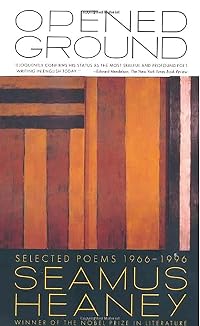
Opened Ground: Poems 1966–1996
by Seamus Heaney
On This Page
Description
This volume is a much-needed new selection of Seamus Heaney's work, taking account of recent volumes and of the author's work as a translator, and offering a more generous choice from previous volumes. Opened Ground: Poems 1966-1996 comes as close to being a 'Collected Poems' as its author cares to make it. It replaces his New Selected Poems 1966-1987, giving a fuller selection from each of the volumes represented there and adding large parts of those that have appeared since, together with show more examples of his work as a translator from the Greek, Latin, Italian and other languages. The book concludes with 'Crediting Poetry', the speech with which Seamus Heaney accepted the 1995 Nobel Prize in Literature, awarded to him, in the words of the Swedish Academy of Letters, for his 'works of lyrical beauty and ethical depth'. show lessTags
Recommendations









Member Recommendations
Member Reviews
Berry season is here! I could smell their summery juice on the air currents during a recent hike, and although I haven't been out to pick my own yet, the markets are suddenly glutted with delicious, ripe berries of all stripes: rasp, blue, black, marion, straw, logan - they're all there, waiting for me to cave to temptation. All throughout berry season, as I stuff scrumptious fruit into my mouth in an effort to consume the totally unrealistic number of berries I always end up purchasing, and as I mourn over the molded cartons that I wake up to the next day, a certain couplet runs ceaselessly through my head. "It wasn't fair," it starts: the last two lines of Seamus Heaney's gorgeous "Blackberry-picking." Since the verses were already show more rattling around in my brain, I found it a good excuse to reinstate my poetry-memorization project for July.
Late August, given heavy rain and sun,
For a full week, the blackberries would ripen.
At first, just one, a glossy purple clot
Among others, red, green, hard as a knot.
You ate that first one and its flesh was sweet
Like thickened wine: summer's blood was in it
Leaving stains upon the tongue and lust for
Picking. Then red ones inked up and that hunger
Sent us out with milk cans, pea tins, jam-pots
Where briars scratched and wet grass bleached our boots.
Round hayfields, cornfields and potato-drills
We trekked and picked until the cans were full,
Until the tinkling bottom had been covered
With green ones, and on top big dark blobs burned
Like a plate of eyes. Our hands were peppered
With thorn-pricks, our palms sticky as Bluebeard's.
We hoarded the fresh berries in the byre.
But when the bath was filled we found a fur,
A rat-grey fungus, glutting our cache.
The juice was stinking too. Once off the bush
The fruit fermented, the sweet flesh would turn sour.
I always felt like crying. It wasn't fair
That all the lovely canfuls smelt of rot.
Each year I hoped they'd keep, knew they would not.
As sublime as individual lines are throughout the poem - "a glossy purple clot," "We hoarded fresh berries in the byre," "You ate that first one and its flesh was sweet / Like thickened wine" - it's that final couplet that really makes the poem shine for me. It speaks so eloquently to a universal tendency on all our parts, knowing one thing and stubbornly hoping another. Even though I still engage in this kind of "magical thinking," I associate its hopefulness particularly with that time just before adolescence when we begin to suspect certain truths about the adult world, but still retain a some of childhood's fuzziness around cause and effect, reality and hope. That one line takes the poem's nostalgia for childhood summers and transforms it into something deeper, leaving the childhood self intact, and simultaneously glancing toward the growing-up process. There is a feeling of existing between two states, or in both states simultaneously. "Each year I hoped they'd keep, knew they would not." It's masterfully done.
I also love what "Blackberry Picking" has to say about the futility of hoarding riches away from their source: "Once off the bush / The fruit fermented, the sweet flesh would turn sour." This must also be a universally devastating and intriguing experience, judging from all the fairy-, folk- and popular tales featuring elusive riches, vanishing piles of gold, Holy Grails that slip through our fingers, the bullion at the end of the rainbow, bewitched banquets, and so on. It's difficult to look at bounty and understand that it can't effectively be gathered to one's bosom and kept there without losing its shine and beauty. And it's equally crushing to accept that the glut of treasure in good times can't eliminate the lean times of scarcity, even if they can temper them. I love the way Heaney's poem moves from expectation, through lust and exuberance, to heartbreak, and on to a simultaneous melancholia, distance and hope.
And of course, the real high-point is the scrumptiously tactile and specific language. In a poem about berries, it's particularly fitting that one feel as if one's hands and tongue get stained purple just from reading it. "Blackberry-picking" delivers this feeling so viscerally for me that it's never far from my mind when a berry is near. show less
Late August, given heavy rain and sun,
For a full week, the blackberries would ripen.
At first, just one, a glossy purple clot
Among others, red, green, hard as a knot.
You ate that first one and its flesh was sweet
Like thickened wine: summer's blood was in it
Leaving stains upon the tongue and lust for
Picking. Then red ones inked up and that hunger
Sent us out with milk cans, pea tins, jam-pots
Where briars scratched and wet grass bleached our boots.
Round hayfields, cornfields and potato-drills
We trekked and picked until the cans were full,
Until the tinkling bottom had been covered
With green ones, and on top big dark blobs burned
Like a plate of eyes. Our hands were peppered
With thorn-pricks, our palms sticky as Bluebeard's.
We hoarded the fresh berries in the byre.
But when the bath was filled we found a fur,
A rat-grey fungus, glutting our cache.
The juice was stinking too. Once off the bush
The fruit fermented, the sweet flesh would turn sour.
I always felt like crying. It wasn't fair
That all the lovely canfuls smelt of rot.
Each year I hoped they'd keep, knew they would not.
As sublime as individual lines are throughout the poem - "a glossy purple clot," "We hoarded fresh berries in the byre," "You ate that first one and its flesh was sweet / Like thickened wine" - it's that final couplet that really makes the poem shine for me. It speaks so eloquently to a universal tendency on all our parts, knowing one thing and stubbornly hoping another. Even though I still engage in this kind of "magical thinking," I associate its hopefulness particularly with that time just before adolescence when we begin to suspect certain truths about the adult world, but still retain a some of childhood's fuzziness around cause and effect, reality and hope. That one line takes the poem's nostalgia for childhood summers and transforms it into something deeper, leaving the childhood self intact, and simultaneously glancing toward the growing-up process. There is a feeling of existing between two states, or in both states simultaneously. "Each year I hoped they'd keep, knew they would not." It's masterfully done.
I also love what "Blackberry Picking" has to say about the futility of hoarding riches away from their source: "Once off the bush / The fruit fermented, the sweet flesh would turn sour." This must also be a universally devastating and intriguing experience, judging from all the fairy-, folk- and popular tales featuring elusive riches, vanishing piles of gold, Holy Grails that slip through our fingers, the bullion at the end of the rainbow, bewitched banquets, and so on. It's difficult to look at bounty and understand that it can't effectively be gathered to one's bosom and kept there without losing its shine and beauty. And it's equally crushing to accept that the glut of treasure in good times can't eliminate the lean times of scarcity, even if they can temper them. I love the way Heaney's poem moves from expectation, through lust and exuberance, to heartbreak, and on to a simultaneous melancholia, distance and hope.
And of course, the real high-point is the scrumptiously tactile and specific language. In a poem about berries, it's particularly fitting that one feel as if one's hands and tongue get stained purple just from reading it. "Blackberry-picking" delivers this feeling so viscerally for me that it's never far from my mind when a berry is near. show less
A pesares da mala tradución, e unha escolma moi desigual, este volumen bilingüe non deixa de mostrarnos unha parte da obra dun poeta grandioso. O Nobel irlandés demostra esa máxima de Vázquez Montalbán de que incluso a política, as ideas, a ideoloxía e a crítica histórica poden ser materia poética.
Seamus Heaney is certainly a great Irish poet and a great naturalist poet. I think he goes even beyond just those limits. His poetry, in my mind, embodies everything that makes the English language and English poetry so wonderful and unique. I really hope that when 20th century poetry is taught in 21st century schools that no curriculum skips past Heaney.
I read Heaney for the first time more than 12 years ago now (thanks Mr. Masterman!) Death of a Naturalist was probably the second poem I can really remember thinking hard about. I wouldn't say I'm a poetry guy, but Heaney's command of sound and imagery gets me. Take Blackberry Picking, or The Gravel Walks; he can pull out feeling from the simplest of scenes. I'll add some thoughts here as I am reminded of particular pieces.
Digging
Mid-Term Break
Requiem for the Croppies
A Call
Digging
Mid-Term Break
Requiem for the Croppies
A Call
I picked this book to comply with the Literary Awards Mini Challenge from the 2013 Reading Challenge group to read a book by an author who has received the Nobel Prize in Literature. I went through the list and ended up with Seamus Heaney. He wrote in English and I haven't read a lot of poetry.
I didn't realize till after that I had already read a book by him:
[b:Beowulf: A New Verse Translation|52357|Beowulf A New Verse Translation|Unknown|http://d.gr-assets.com/books/1327878125s/52357.jpg|189503]
which I read in high school and the only thing I remember about it is that Beowulf refused to die in the end. I think I'll try give it another chance at some point.
Anyway, this book brings together many of the author's famous poems over the show more years. I unfortunately had numerous books out from the library so I read this faster than I initially planned to and was not able to take my time going through all the poems. Also, as I have mentioned in other reviews, English class was not my forte.
I liked many of his poems, particularly the translations of Greek poems since I love Greek mythology. I did also laugh that there were passages from the Aeneid translated since I have also translated parts when I took Latin in high school. Seamus Heaney did a better job than me not surprisingly. show less
I didn't realize till after that I had already read a book by him:
[b:Beowulf: A New Verse Translation|52357|Beowulf A New Verse Translation|Unknown|http://d.gr-assets.com/books/1327878125s/52357.jpg|189503]
which I read in high school and the only thing I remember about it is that Beowulf refused to die in the end. I think I'll try give it another chance at some point.
Anyway, this book brings together many of the author's famous poems over the show more years. I unfortunately had numerous books out from the library so I read this faster than I initially planned to and was not able to take my time going through all the poems. Also, as I have mentioned in other reviews, English class was not my forte.
I liked many of his poems, particularly the translations of Greek poems since I love Greek mythology. I did also laugh that there were passages from the Aeneid translated since I have also translated parts when I took Latin in high school. Seamus Heaney did a better job than me not surprisingly. show less
Seamus Heaney is a master at his craft. His poems are evocative and ensnaring. They deal with the culture of Ireland in actions and landmarks. His works are emotional and stirring.
His poetry is at once mysteriously haunting one minute and in the next a revelation.
Members
- Recently Added By
Lists

Irish writers
87 works; 17 members

Poetry Corner
187 works; 15 members

20th Century Literature
1,161 works; 55 members

Nobel Price Winners
222 works; 19 members

Top-Rated Books on LibraryThing
272 works; 118 members

Poetry volumes by single author
122 works; 8 members
Author Information

210+ Works 15,861 Members
Seamus Heaney was born in Mossbawn, Ireland on April 13, 1939. He received a degree in English from Queen's College in Belfast in 1961. After earning his teacher's certificate in English from St. Joseph's College in Belfast the following year, he took a position at the school as an English teacher. During his time as a teacher at St. Joseph's, he show more wrote and published work in the university magazine under the pen name Incertus. In 1966, he became an English literature lecturer at Queen's College in Belfast. His first volume of poems, Death of a Naturalist, went on to receive the E.C. Gregory Award, the Cholmondeley Award, the Somerset Maugham Award, and the Geoffrey Faber Memorial Prize. After the death of his parents, Heaney published the poetry volumes The Haw Lantern, which includes a sonnet sequence memorializing his mother, and Seeing Things, a collection containing numerous poems for his father. His other works included Field Work, Opened Ground: Poems 1966-1996, and Human Chain. Heaney was a professor at Harvard from 1981 to 1997 and its Poet in Residence from 1988 to 2006. From 1989 to 1994 he was also the Professor of Poetry at Oxford and in 1996 was made a Commandeur de l'Ordre des Arts et Lettres. Other awards that he received include the Geoffrey Faber Memorial Prize (1968), the E. M. Forster Award (1975), the PEN Translation Prize (1985), the Golden Wreath of Poetry (2001), T. S. Eliot Prize (2006) and two Whitbread Prizes (1996 and 1999). In 2012, he was awarded the Lifetime Recognition Award from the Griffin Trust For Excellence In Poetry. His literary papers are held by the National Library of Ireland. He died following a short illness on August 30, 2013 at the age of 74. Heaney's last words were in a text to his wife Marie, "Noli timere", which means "Do not be afraid." (Bowker Author Biography) Seamus Heaney lives in Dublin and teaches at Harvard University. He was awarded the Nobel Prize in literature in 1995. (Publisher Provided) Seamus Heaney was born in 1939 in Northern Ireland. He was awarded the Nobel Prize in Literature in 1995. A resident of Dublin, he has taught poetry at Oxford University and Harvard University. (Publisher Provided) show less
Awards and Honors
Distinctions
Work Relationships
Contains
Has as a student's study guide
Common Knowledge
- Canonical title
- Opened Ground: Poems 1966–1996
- Original title
- Opened Ground: Poems 1966–1996
- Alternate titles
- Opened Ground: Selected Poems 1966–1996
- Original publication date
- 1998
- Dedication
- for Marie
- Blurbers
- Hofmann, Michael; Kermode, Frank; McKendrick, Jamie; Miller, Karl
Classifications
Statistics
- Members
- 1,651
- Popularity
- 13,666
- Reviews
- 9
- Rating
- (4.30)
- Languages
- Dutch, English, Spanish
- Media
- Paper, Ebook
- ISBNs
- 11
- ASINs
- 7