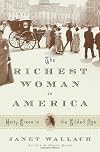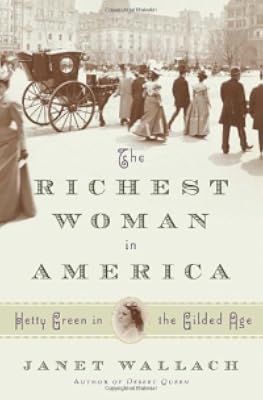
The Richest Woman in America: Hetty Green in the Gilded Age
by Janet Wallach
On This Page
Description
A captivating biography of America's first female tycoon, Hetty Green, the iconoclast who forged one of the greatest fortunes of her time.No woman in the Gilded Age made as much money as Hetty Green. At the time of her death in 1916, she was worth at least 100 million dollars, equal to more than 2 billion dollars today. A strong believer in women being financially independent, she offered valuable lessons for the present times.
Abandoned at birth by her neurotic mother, show more scorned by her misogynist father, Hetty set out as a child to prove her value. Following the simple rules of her wealthy Quaker father, she successfully invested her money and along the way proved to herself that she was wealthy and therefore worthy.
Never losing faith in America's potential, she ignored the herd mentality and took advantage of financial panics and crises. When everyone else was selling, she bought railroads, real estate, and government bonds. And when everyone was buying and borrowing, she put her money into cash and earned safe returns on her dollars. Men mocked her and women scoffed at her frugal ways, but she turned her back and piled up her earnings, amassing a fortune that supported businesses, churches, municipalities, and even the city of New York itself.
She relished a challenge. When her aunt died and did not leave Hetty the fortune she expected, she plunged into a groundbreaking lawsuit that still resonates in law schools and courts. When her husband defied her and sank her money on his own risky interests, she threw him out and, marching down to Wall Street, quickly made up the loss. Her independence, outspokenness, and disdain for the upper crust earned her a reputation for harshness that endured for decades. Newspapers kept her in the headlines, linking her name with witches and miscreants. Yet those who knew her admired her warmth, her wisdom, and her wit.
Set during a period of financial crisis strikingly similar to our current one, acclaimed author Janet Wallach's engrossing exploration of a fascinating life revives a rarely-mentioned queen of American finance. show less
Tags
Recommendations

Member Reviews
At a young age, she learned the business at her grandfather’s knee, continued her financial education while working with her father and was soon poised to take over the family business. Contemplating the woman hailed as one of the richest in America, you would be forgiven if you thought our topic was Fidelity Investment’s Abigail Johnson, highly ranked on the Forbes 400 list. That the subject of noted biographer Janet Wallach’s recent effort died almost 100 years ago makes for fascinating reading. Indeed, Hetty Green’s life, as well as the financial times in which she lived, often seems eerily prescient.
Green (1834-1916) came from a stern New Bedford Quaker whaling family. Her quirky childhood, sent shuttling between relatives show more by her mother’s invalidism, gave her little tether or interest in girlish pursuits. Instead, she received her greatest validation through reading the financial pages to her grandfather and father, accompanying them to visit their holdings and writing business letters on their behalf from a young age. Hetty quickly took to heart the family’s ethos of simplicity and avoidance of waste in personal habit and the preservation and growth of capital. Upon her father’s death, she was disappointed to learn that she only inherited outright a small proportion of his estate, the rest being held in trust for her. Famously litigious, she embarked on a lifetime of law suits aimed at contesting the will and testing the control of the trustees. She quickly multiplied the monies over which she had direct control. When her husband lost some of ‘her’ money through imprudent investing, she swiftly moved to wrest away control of her financial matters. During her lifetime, she engaged in what we would presently describe as ‘contrarian’ investing, buying Civil War bonds and railroad stock at their nadir. By the time of her death, her estate was valued in the billions in today’s dollars.
Janet Wallach acknowledges the difficulties a lack of diaries and other first person accounts by Hetty and her inner coterie entailed. She does rely upon a wealth of secondary sources, newspaper and magazine accounts, the accuracy of which cannot always be vouchsafed. It is unclear the extent of any newly discovered material. (I have not read Charles Slack’s 2004 Hetty Green biography and cannot say how they would compare.) It appears Wallach was quite careful to avoid reporting mere rumor and myth, like the many tales of Green’s purported stinginess (e.g., only washing the hems of her clothing to save on soap.) Nevertheless, Wallach’s winsome writing brings Hetty to life with all of her fine aspects and failings apparent. The press dubbed her the “Witch of Wall Street” widely publicizing her pettiness, vindictiveness, and penurious eccentricities. As a mother and wife, she was the antithesis of Mrs. Astor and the other ‘Real Housewives’ of the Gilded Age. Shunning extravagant fashion and interior design, she disappointed the yellow journalists and their hungering readers. Less well known were acts of honor and integrity. Hetty repeatedly came to the rescue of New York City, making enormous loans at rates favorable to the metropolis. She was happiest living among the ‘lower’ classes and often offered sound investing advice.
Wallach’s book is at its best in reflecting the financial world of the late 1800’s in the mirror present day. The panic of 1857 is blamed, in part on the lightening speed in which information was transmitted by the latest invention – the telegraph – bringing to mind current day indictments of the internet and robo-investing. She describes multiple banking crises arising out of lack of regulation and oversight, over-leveraged investors, over-heated economies and the failure of the market to police itself. Hetty’s own adages are equally forward thinking: “It is the duty of every woman to learn to take care of her own business affairs.” “Railroads and real estate are the things I like. Government bonds are good, though they do not pay very high interest. Still, for a woman safe and low is better than risky and high.” “I am always buying when everyone wants to sell and selling when everyone wants to buy.” The ceaselessly cyclical nature of the financial markets ensures Janet Wallach’s subject will remain fresh and timeless. show less
Green (1834-1916) came from a stern New Bedford Quaker whaling family. Her quirky childhood, sent shuttling between relatives show more by her mother’s invalidism, gave her little tether or interest in girlish pursuits. Instead, she received her greatest validation through reading the financial pages to her grandfather and father, accompanying them to visit their holdings and writing business letters on their behalf from a young age. Hetty quickly took to heart the family’s ethos of simplicity and avoidance of waste in personal habit and the preservation and growth of capital. Upon her father’s death, she was disappointed to learn that she only inherited outright a small proportion of his estate, the rest being held in trust for her. Famously litigious, she embarked on a lifetime of law suits aimed at contesting the will and testing the control of the trustees. She quickly multiplied the monies over which she had direct control. When her husband lost some of ‘her’ money through imprudent investing, she swiftly moved to wrest away control of her financial matters. During her lifetime, she engaged in what we would presently describe as ‘contrarian’ investing, buying Civil War bonds and railroad stock at their nadir. By the time of her death, her estate was valued in the billions in today’s dollars.
Janet Wallach acknowledges the difficulties a lack of diaries and other first person accounts by Hetty and her inner coterie entailed. She does rely upon a wealth of secondary sources, newspaper and magazine accounts, the accuracy of which cannot always be vouchsafed. It is unclear the extent of any newly discovered material. (I have not read Charles Slack’s 2004 Hetty Green biography and cannot say how they would compare.) It appears Wallach was quite careful to avoid reporting mere rumor and myth, like the many tales of Green’s purported stinginess (e.g., only washing the hems of her clothing to save on soap.) Nevertheless, Wallach’s winsome writing brings Hetty to life with all of her fine aspects and failings apparent. The press dubbed her the “Witch of Wall Street” widely publicizing her pettiness, vindictiveness, and penurious eccentricities. As a mother and wife, she was the antithesis of Mrs. Astor and the other ‘Real Housewives’ of the Gilded Age. Shunning extravagant fashion and interior design, she disappointed the yellow journalists and their hungering readers. Less well known were acts of honor and integrity. Hetty repeatedly came to the rescue of New York City, making enormous loans at rates favorable to the metropolis. She was happiest living among the ‘lower’ classes and often offered sound investing advice.
Wallach’s book is at its best in reflecting the financial world of the late 1800’s in the mirror present day. The panic of 1857 is blamed, in part on the lightening speed in which information was transmitted by the latest invention – the telegraph – bringing to mind current day indictments of the internet and robo-investing. She describes multiple banking crises arising out of lack of regulation and oversight, over-leveraged investors, over-heated economies and the failure of the market to police itself. Hetty’s own adages are equally forward thinking: “It is the duty of every woman to learn to take care of her own business affairs.” “Railroads and real estate are the things I like. Government bonds are good, though they do not pay very high interest. Still, for a woman safe and low is better than risky and high.” “I am always buying when everyone wants to sell and selling when everyone wants to buy.” The ceaselessly cyclical nature of the financial markets ensures Janet Wallach’s subject will remain fresh and timeless. show less
 This review was written for LibraryThing Early Reviewers.
From the little bit of information I knew about Green, called the Witch of Wall Street, I was very suprised by how much I liked her. Intelligent, driven, single-minded, unconventional. All adjectives I like in women can be applied to Green. Flying under the radar initially, she was able to amass such a fortune that she loaned money to the City of New York when they were in trouble. She may not have been the best parent and wife, but I didn't care. Her genius was making and saving money and being willing to go to court every time she felt cheated. She was able to ride out the Depression of 1897 when bigger names lost money and property.
An absolutely wonderful biography, easy to read and although containing alot of information on show more finances it is easily understood. It is incredible that sthe author was able to make Green a real person when there was a paucity of primary sources. My only complaint is that this proof version has no photos, which I can't wait to see. A winner. show less
An absolutely wonderful biography, easy to read and although containing alot of information on show more finances it is easily understood. It is incredible that sthe author was able to make Green a real person when there was a paucity of primary sources. My only complaint is that this proof version has no photos, which I can't wait to see. A winner. show less
This review was written for LibraryThing Early Reviewers.Hetty Green lived from the mid 1800s until the early 1900s. She inherited a large fortune and made it into a massive fortune with her own intellect and financial savvy. As a woman in this era, that was quite a feat. Hetty Green was an admirable, intelligent, informed woman, though not necessarily a very likable one. She inherited a lot of money which she used to make herself incredibly rich but some of her financial practices grated on me. She also gave a very small percentage to charity, thinking that people generally spend too much and save too little. However, she did bail out the city of New York and many business by lending money at low (for the times) rates, so I won't say that she didn't do any good with her money. Also, her show more children who had no children of their own, gave most of their inheritance away to charities upon their deaths. Hetty Green lived a very thrifty life considering the millions she had. She generally wore old clothes, lived in rented apartments, and owned little. She was married, but controlled her finances on her own as stipulated in her father's will.
This is an interesting look at a financial time period in our country that has many parallels to today's financial crisis. In the late 1800s and early 1900s there was serious over-leveraging going on, the real estate market was in a big bubble, and the stock market was over-valued. There were several relatively minor crashes that most likely led to the Great Depression (this book doesn't go that far).
I found the writing well done and interesting and Hetty Green to be a worthwhile person to know about. All in all a recommended book. show less
This is an interesting look at a financial time period in our country that has many parallels to today's financial crisis. In the late 1800s and early 1900s there was serious over-leveraging going on, the real estate market was in a big bubble, and the stock market was over-valued. There were several relatively minor crashes that most likely led to the Great Depression (this book doesn't go that far).
I found the writing well done and interesting and Hetty Green to be a worthwhile person to know about. All in all a recommended book. show less
This review was written for LibraryThing Early Reviewers.biography - b. 1834 in New Bedford, Massachusetts, Hetty would grow up to own properties in New York, Chicago, plus major shares in railroads in several other states.
interesting to learn about such an eminent, famous woman that has never been mentioned in my history books, and also interesting to learn that in many ways she was exactly the sort of woman that certain politicians would not feel threatened by (she didn't support the cause of women's suffrage, perhaps because she had enough influence already, and did support certain causes in moderation-- the creation of jobs, etc. without mistreating workers the way other moguls migt).
However, there were a few statements that would have benefited from some context or background:
Th. show more Jefferson wishing that the practice of slavery would die out (mentioned on p. 45) -- Jefferson's involvement with the practice has been fairly well documented and is "complicated" to say the least, so I think a footnote on the topic at the very least would be worthwhile here. Even if he was unable to free all the enslaved people connected to his estate in his will because they would still be seized by debtors to settle outstanding debts after his death, there were plenty of questionable decisions he made apart from that (and apart from what became of his children with Sally Hemings--some of whom he did free, though not all?), including some very detailed records of the severe beatings received by the enslaved on his estate, presumably on his orders.
"With 60 percent of the electoral college but less than 40 percent of the popular vote, in November 1860 Abraham Lincoln won the election for President of the United States." (p.50) -- this is not inaccurate (see https://www.presidency.ucsb.edu/statistics/elections/1860) but again I feel some context would be valuable here. He had the highest share of the popular vote that year (closer to 39.9%), easily eclipsing Democrat Stephen Douglas' 29.5% and Southern Democrat John Breckenridge's 18.1% (as well as John Bell's 12.6%). This is one of those odd factoids apparently (mis)quoted often and as such requires a more exacting look.
The pirates faced by Edward Green in the south China seas were described as "the ugliest ruffians they had ever encountered" (pp 62-63) which, hyperbole or no, would be more meaningful if the text provided the exact quote (as in Edward's letters or other primary source). It's hard to know what the author meant -- are they missing teeth from scurvy, bearing lots of scars from sea battles, or are they maybe just swarthy/brown/darker-skinned? This is perhaps a relatively minor detail compared to the others but it did make me wonder. As before, I checked the end notes for some source info but came up empty.
Tldr: it was overall fairly interesting (and not by any means an easy task to write such a book when so many of the newspaper articles about her were inaccurate), but would definitely benefit from much more thorough source notes. show less
interesting to learn about such an eminent, famous woman that has never been mentioned in my history books, and also interesting to learn that in many ways she was exactly the sort of woman that certain politicians would not feel threatened by (she didn't support the cause of women's suffrage, perhaps because she had enough influence already, and did support certain causes in moderation-- the creation of jobs, etc. without mistreating workers the way other moguls migt).
However, there were a few statements that would have benefited from some context or background:
Th. show more Jefferson wishing that the practice of slavery would die out (mentioned on p. 45) -- Jefferson's involvement with the practice has been fairly well documented and is "complicated" to say the least, so I think a footnote on the topic at the very least would be worthwhile here. Even if he was unable to free all the enslaved people connected to his estate in his will because they would still be seized by debtors to settle outstanding debts after his death, there were plenty of questionable decisions he made apart from that (and apart from what became of his children with Sally Hemings--some of whom he did free, though not all?), including some very detailed records of the severe beatings received by the enslaved on his estate, presumably on his orders.
"With 60 percent of the electoral college but less than 40 percent of the popular vote, in November 1860 Abraham Lincoln won the election for President of the United States." (p.50) -- this is not inaccurate (see https://www.presidency.ucsb.edu/statistics/elections/1860) but again I feel some context would be valuable here. He had the highest share of the popular vote that year (closer to 39.9%), easily eclipsing Democrat Stephen Douglas' 29.5% and Southern Democrat John Breckenridge's 18.1% (as well as John Bell's 12.6%). This is one of those odd factoids apparently (mis)quoted often and as such requires a more exacting look.
The pirates faced by Edward Green in the south China seas were described as "the ugliest ruffians they had ever encountered" (pp 62-63) which, hyperbole or no, would be more meaningful if the text provided the exact quote (as in Edward's letters or other primary source). It's hard to know what the author meant -- are they missing teeth from scurvy, bearing lots of scars from sea battles, or are they maybe just swarthy/brown/darker-skinned? This is perhaps a relatively minor detail compared to the others but it did make me wonder. As before, I checked the end notes for some source info but came up empty.
Tldr: it was overall fairly interesting (and not by any means an easy task to write such a book when so many of the newspaper articles about her were inaccurate), but would definitely benefit from much more thorough source notes. show less
The author states right up front that she had limited sources available to tell the story of Hetty Green. The subject didn’t keep a journal or diary, nor did she maintain voluminous correspondence. The main information for Hetty’s life consists of newspaper accounts and interviews (not always reliable), lawsuits (many, many of them) and genealogical sources. Yet, Ms Wallach is able to paint a vivid portrait of Hetty and her times by illuminating what it was like to grow up female in those years and the many obstacles she had to overcome.
Born in 1834 in Massachusetts, Hetty Howland Robinson learned the business of business from her Quaker father. And, despite the handicap of her gender, she became the richest woman in America – show more dying in 1916, the Warren Buffet of her age. The story the author tells is a fascinating one.
Hetty was smart and a hard worker. She loved the game of investing (mostly in real estate and railroads) and was fearless – able to “buy low and sell high” – and a contrarian of epic proportions. She bailed out cities, New York more than once. She didn’t need designer clothing or mansions. For the most part she lived in boarding houses.
My only complaint about The Richest Woman in America is that the author underestimates her readers. Rather than let us draw our own parallels between the economic times during Hetty’s life and today, she has to hammer it home for us. The intrusion of today into a story about yesterday was annoying and un-necessary.
One of the most fascinating things I learned was the economic symbolism in L. Frank Baum’s The Wonderful Wizard of Oz – published during Hetty’s heyday. It’s a topic I want to learn more about.
Review based on published-provided bound galley. show less
Born in 1834 in Massachusetts, Hetty Howland Robinson learned the business of business from her Quaker father. And, despite the handicap of her gender, she became the richest woman in America – show more dying in 1916, the Warren Buffet of her age. The story the author tells is a fascinating one.
Hetty was smart and a hard worker. She loved the game of investing (mostly in real estate and railroads) and was fearless – able to “buy low and sell high” – and a contrarian of epic proportions. She bailed out cities, New York more than once. She didn’t need designer clothing or mansions. For the most part she lived in boarding houses.
My only complaint about The Richest Woman in America is that the author underestimates her readers. Rather than let us draw our own parallels between the economic times during Hetty’s life and today, she has to hammer it home for us. The intrusion of today into a story about yesterday was annoying and un-necessary.
One of the most fascinating things I learned was the economic symbolism in L. Frank Baum’s The Wonderful Wizard of Oz – published during Hetty’s heyday. It’s a topic I want to learn more about.
Review based on published-provided bound galley. show less
This review was written for LibraryThing Early Reviewers.Before picking up this book, I had never heard of Hetty Green, who inherited and invested her way to an estate that at the time of her death in 1916, was worth over $2 billion in today's money. She did this at a time when women were not supposed to be involved in business and certainly not in Wall Street. Green's favored strategy was buy low, sell high, and she also made her money go farther by living a plain and frugal life at a time when people with comparable wealth were living extravagantly.
Throughout the book, Wallach uses an odd mix of formal and conversational language, as if she couldn't decide whether her audience should be academic or popular. She goes into great detail on trivial aspects of Green's life, while glossing over show more major events. In areas where there is little information on Green's life, Wallach brings in anecdotes of the period, but does not connect these anecdotes to Green in a clear or meaningful way. Her writing style is extremely passive. There are a few typographical errors, but since I received a bound galley rather than a final copy of the book, I hope these have been corrected in the final version. A major flaw is that black people are nearly always referred to as "colored" or "Negro," even in passages written by Wallach that are not quotes from the period. Even though these were common and accepted terms in the nineteenth century, they should not be used for what appears to be no good reason in a modern work. show less
Throughout the book, Wallach uses an odd mix of formal and conversational language, as if she couldn't decide whether her audience should be academic or popular. She goes into great detail on trivial aspects of Green's life, while glossing over show more major events. In areas where there is little information on Green's life, Wallach brings in anecdotes of the period, but does not connect these anecdotes to Green in a clear or meaningful way. Her writing style is extremely passive. There are a few typographical errors, but since I received a bound galley rather than a final copy of the book, I hope these have been corrected in the final version. A major flaw is that black people are nearly always referred to as "colored" or "Negro," even in passages written by Wallach that are not quotes from the period. Even though these were common and accepted terms in the nineteenth century, they should not be used for what appears to be no good reason in a modern work. show less
This review was written for LibraryThing Early Reviewers.This is a terrific read and I am embarrassed to say I had not even heard of Hetty Green until I read this book. This is more evidence of how many women worthy of note have been overlooked in U.S. history. Another example is the great biography of Frances Perkins, a member of FDR's cabinet and a true pioneer in the welfare of the nation. I encourage readers to pick up this book and spread the word...
This review was written for LibraryThing Early Reviewers.Members
- Recently Added By
Lists

Non-fiction
55 works; 1 member

Books Read in 2016
4,666 works; 199 members

Penguin Random House
458 works; 4 members
Author Information

10 Works 1,838 Members
Common Knowledge
- Canonical title
- The Richest Woman in America: Hetty Green in the Gilded Age
- Original publication date
- 2012
- People/Characters
- Hetty Green
- Important places
- New York, New York, USA
- Important events
- Gilded Age
- Epigraph
- My Symphony
(A favorite poem of Hetty Howland Robinson Green)
To live content with small means;
To seek elegance rather than luxury,
And refinement rather than fashion;
To be worthy, not respectable, and we... (show all)althy, not rich;
To study hard, think quietly,
Talk gently,
Act frankly;
To listen to stars and birds, to babes and sages, with open heart;
To bear all cheerfully,
Do all bravely,
Await occasions,
Hurry never.
In a word, to let the spiritual, unbidden and unconscious, grow up through the common.
This is to be my symphony.
--William Henry Channing - Dedication
- To Bob
- First words
- Author's Note: Hetty Green left no diaries, jounals, or correspondence, no personal jottings to serve as a key to her enigmatic ways.
Prologue: A pack of reporters swarmed around the woman who emerged from the heavy doors of the courthouse.
Chapter 1: The rancid smell of whale oil pervaded the air and perfumed the purses of New Bedford, Massachusetts,in 1841. - Last words
- (Click to show. Warning: May contain spoilers.)Making her way in a hostile male world, she was never hesitant to look a man in the eye, never reluctant to say what she thought, never afraid to act as she saw fit.
Classifications
Statistics
- Members
- 200
- Popularity
- 163,688
- Reviews
- 17
- Rating
- (3.30)
- Languages
- English
- Media
- Paper, Audiobook, Ebook
- ISBNs
- 5
- ASINs
- 2