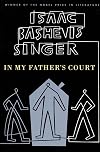
In My Father's Court
by Isaac Bashevis Singer
On This Page
Description
'A world that no longer exists reaches us through one of the greatest literary artists of our time' Saturday ReviewIn this autobiographical work, specifically mentioned in Issac Bashevis Singer's Nobel Prize citation, Singer remembers his childhood in Warsaw, and especially the bet din, or Jewish Court, in his father's home on working-class Krochmalna Street. Advice seekers and petitioners making wills or seeking marriage settlements daily visit the rabbi in his study. In a world on the show more brink of modernity, Singer's gentle, learned father and his mother, equally pious but eminently practical, maintain a stubbornly traditional existence. In My Father's Court is a tribute to their efforts, and a fine evocation of life in early-twentieth century Warsaw. show lessTags
Recommendations























Member Recommendations
Member Reviews
In My Father’s Court is Isaac Bashevis Singer's memoir about his childhood in Poland in the years leading up to, and during, World War One. Singer’s father was a Hasidic rabbi and the court of the title was the Beth Din, the traditional court in the Singers' home to which community members came to have their divorces, lawsuits and other disputes arbitrated and their questions about Jewish holy books and law answered and illuminated. As Singer wrote in his Author’s Note to his book, “The Beth Din could exist only among a people with a deep faith and humility, and it reached its apex among the Jews when there were completely bereft of worldly power and influence.”
The book is presented as a series of short vignettes, each from show more five to seven pages in length, told more or less in chronological order, with Singer’s narrative evolving as the small boy begins to grow and to question his surroundings. In the early remembrances, the perspective is kept very tightly on his father’s fierce devotion to God and to Jewish biblical and rabbinical law, custom and mysticism. The tales told are about the people who arrive in the Singers' home, what their problems are, and how his father deals with them. There is a somewhat otherworldly glow about it all, the result, I thought, of Singer’s representing the viewpoint of a small and overawed boy as well as the effect of the author’s journey back through decades of his life.
Soon enough, however, the outside world begins gradually to intrude. The family moves from a small town to the crowded streets of a Jewish Warsaw slum. Next come rumors and then the realities of World War One, with its uncertainties and sharp deprivations. Singer’s older brother becomes more worldly, and young Isaac begins asking questions himself and longing for information about the outside world. Zionism and socialism begin to be discussed among the young, further eroding the hold of the old ways over the community as a whole.
Also, about halfway through, Singer begins dropping in reminders of what we all know will be the ultimate fate of this community. The chapter “Reb Asher the Dairyman” ends thusly:
“After we had left Warsaw (during the First World War), we continued to hear news of him from time to time. One son died, a daughter fell in love with a young man of low origins and Asher was deeply grieved. I do not know whether he lived to see the Nazi occupation of Warsaw. He probably died before that. But such Jews as he were dragged off to Treblinka. May these memoirs serve as a monument to him and his like, who lived in sanctity and died as martyrs.”
The reader is brought up sharply by this passage, because it is the first time Singer raises his focused view from the era he's describing to the greater disasters awaiting. After that, though, perhaps every third tale ends with a notation about the fate of one or more figures in the coming whirlwind.
The stories are all told with affection, humor, with a delightful touch for detail and phrasing. Throughout, we experience Singer’s deep love and respect for the faith of his father and grandfathers, of their longing for the coming of the Messiah, and of their certainty that this miracle will only occur if Jews hold firmly to the path laid out for them by their God. Petty disputes are interlaced with genuine compassion. As Singer’s father often says of the poorest wretch who comes to his chamber, “Who knows? She may be a hidden saint, one of heaven’s elect.” show less
The book is presented as a series of short vignettes, each from show more five to seven pages in length, told more or less in chronological order, with Singer’s narrative evolving as the small boy begins to grow and to question his surroundings. In the early remembrances, the perspective is kept very tightly on his father’s fierce devotion to God and to Jewish biblical and rabbinical law, custom and mysticism. The tales told are about the people who arrive in the Singers' home, what their problems are, and how his father deals with them. There is a somewhat otherworldly glow about it all, the result, I thought, of Singer’s representing the viewpoint of a small and overawed boy as well as the effect of the author’s journey back through decades of his life.
Soon enough, however, the outside world begins gradually to intrude. The family moves from a small town to the crowded streets of a Jewish Warsaw slum. Next come rumors and then the realities of World War One, with its uncertainties and sharp deprivations. Singer’s older brother becomes more worldly, and young Isaac begins asking questions himself and longing for information about the outside world. Zionism and socialism begin to be discussed among the young, further eroding the hold of the old ways over the community as a whole.
Also, about halfway through, Singer begins dropping in reminders of what we all know will be the ultimate fate of this community. The chapter “Reb Asher the Dairyman” ends thusly:
“After we had left Warsaw (during the First World War), we continued to hear news of him from time to time. One son died, a daughter fell in love with a young man of low origins and Asher was deeply grieved. I do not know whether he lived to see the Nazi occupation of Warsaw. He probably died before that. But such Jews as he were dragged off to Treblinka. May these memoirs serve as a monument to him and his like, who lived in sanctity and died as martyrs.”
The reader is brought up sharply by this passage, because it is the first time Singer raises his focused view from the era he's describing to the greater disasters awaiting. After that, though, perhaps every third tale ends with a notation about the fate of one or more figures in the coming whirlwind.
The stories are all told with affection, humor, with a delightful touch for detail and phrasing. Throughout, we experience Singer’s deep love and respect for the faith of his father and grandfathers, of their longing for the coming of the Messiah, and of their certainty that this miracle will only occur if Jews hold firmly to the path laid out for them by their God. Petty disputes are interlaced with genuine compassion. As Singer’s father often says of the poorest wretch who comes to his chamber, “Who knows? She may be a hidden saint, one of heaven’s elect.” show less
This was my first Singer work, and it floored me. WOW! His memoir describing his family's life in Warsaw before WWI is such a beautiful blend of humor and tragedy that I wasn't sure whether to laugh or cry. Absolutely stunning book.
In his "Author's Note" Singer explains his thoughts behind In My Father's Court. He wanted readers to know he thought of it as memoir; "belles-lettres about a life that no longer exists" (p xi). I would say In My Father's Court is a sentimental collection of essays about memory. It is the first of his many autobiographical writings. Looking back at one's childhood is sometimes painful, sometimes awe inspiring, but always full of nostalgia. Singer is sweet remembering his family's history.
Singer has collected his childhood memories in this charming collection. He grew up in an ultra-orthodox home in pre-WWII Warsaw, one of the youngest children of two highly intelligent, devout people. It's a very intimate account, and also quite moving. The upcoming Holocaust is a constant shadow over the characters, but it doesn't interfere with the joy that comes across in many episodes. (As a random aside, Singer also wrote the story that became the movie "Yentl", and won the Nobel Prize in 1978.)
Singer, Isaac Bashevis, 1904-1991.
[2021-11-19]
Mayn Tatn Bes-din-shtub
Members
- Recently Added By
Lists

Jewish Books
367 works; 24 members

Harold Bloom - The Western Canon: D. The Chaotic Age
833 works; 24 members

Books Read in 2016
4,666 works; 199 members

Llibres que he llegit el 2019
42 works; 1 member
Author Information

380+ Works 23,905 Members
Isaac Bashevis Singer (1904-91) was the author of many novels, stories, children's books, and memoirs. He received the Nobel Prize in Literature in 1978. (Publisher Provided) Isaac Bashevis Singer was born in Radzymin, Poland on July 14, 1904. He received a traditional Jewish education, including training at the rabbinical seminary in Warsaw. He show more began writing in Hebrew while he worked for 10 years as a proofreader and translator in Warsaw. In 1935, he immigrated to New York, where he became a journalist for the Daily Forward, America's largest Yiddish newspaper. Most of his stories were originally published in this newspaper in serial form. His first novel, The Family Moskat, was published in 1950. His other works include The Magician of Lublin, The Spinoza of Market Street, The Slave, and A Friend of Kafka. A Day of Pleasure: Stories of a Boy Growing Up in Warsaw won the National Book Award for children's literature. He received numerous awards during his lifetime including the Nobel Prize for Literature in 1978 and the Gold Medal for Fiction in 1989. He died after suffering a series of strokes on July 24, 1991. (Bowker Author Biography) show less
Some Editions
Awards and Honors
Awards
Distinctions
Notable Lists
Series
Belongs to Publisher Series
Common Knowledge
- Canonical title*
- Папин домашний суд
- Original title
- בית הדין של אבא; Mayn tatn’s bes-din shtub
- Original publication date
- 1956; 1966 (English) (English)
- Dedication
- This book is dedicated to the sacred memory of Cecil Hemley, who helped me wholeheartedly as a friend, a publisher, an editor, a translator. His wife Elaine Gottlieb translated a part of this work, and it was all done with Ci... (show all)ceil's advice. His love for literature was as great as this taste.
- First words
- There are in this world some very strange individuals whose thoughts are even stranger than they are.
- Last words
- (Click to show. Warning: May contain spoilers.)Many novels and a lot of poetry had filled my mind by then; I was prepared for the turmoil that writers call "love" . . .
- Original language
- Yiddish
*Some information comes from Common Knowledge in other languages. Click "Edit" for more information.
Classifications
- Genre
- Biography & Memoir
- DDC/MDS
- 892.49303 — Literature & rhetoric Asian Literature Afro-Asiatic literatures Jewish, Israeli, and Hebrew
- LCC
- PJ5054 .S572 .Z513 — Language and Literature Oriental languages and literatures Oriental philology and literature Hebrew Literature Individual authors and works
- BISAC
Statistics
- Members
- 835
- Popularity
- 32,798
- Reviews
- 12
- Rating
- (4.10)
- Languages
- 15 — Catalan, Dutch, English, Finnish, French, German, Hebrew, Hungarian, Italian, Japanese, Portuguese, Russian, Spanish, Swedish, Yiddish
- Media
- Paper, Audiobook, Ebook
- ISBNs
- 38
- ASINs
- 23