On This Page
Description
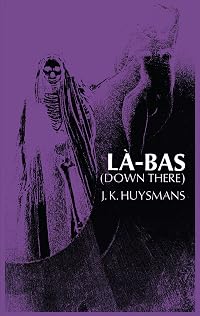
Published in 1891, "La-bas" is Huysmans' best-selling novel; its success was due, in part, to its sensational contents (descriptions of Satanism in late 1880 France.) It is in this novel that Huysmans' character, Durtal, is introduced for the first time. This character is thought to be a semi-autobiographical depiction of the author and is used in his next three books which chart Durtal's (and Huysmans') search for religious truths and his ultimate conversion to Roman Catholicism. The show more journey begins with the viewing of an extremely realistic painting: "In Germany, before a Crucifixion by Matthus Grnewald, he had found what he was seeking." show lessTags
Recommendations




































Member Recommendations
Member Reviews
While I’m told Huysmans’ À rebours (Against Nature) is considered a jewel of Decadent literature, it’s not clear if this novel is a work of Decadent fiction.
If I’m understanding its definition, Decadent literature, in its English and French varieties, portrays the present as decaying and advocates for enjoying the long fall of civilization with sex and drugs and outré experiences.
This novel votes yes on the decaying society part and no on the pursuit of strange aesthetic pleasures. Rather, it postulates that decay brings mysticism to the fore, and here that mysticism takes on two strains: Catholicism and Satanism.
"It is just at the moment when positivism is at its zenith that mysticism rises again and the follies of the show more occult begin."
After À rebours was published, that Huysmans was going to have to eventually chose between “the muzzle of a pistol and the foot of the Cross”. Huysmans would eventually choose the latter, ending up as a Benedictine monk. This considered one of the great novels of “literary Satanism”, but Catholics of a conservative bent (it was one who recommended this book to me) also admire the Durtal trilogy.
Durtal’s progression from Decadent to monk is paralleled by three Huysmann novels featuring the writer Durtal, generally considered to be Huysman’s alter ego. Là-Bas is the first of that trilogy.
Durtal’s newest project is a biography of the infamous Gilles de Rais, French noblemen, defender and champion of Joan of Arc, Marshal of France – and raper, torturer, and killer of hundreds of children. The puzzle Durtal seeks to answer is why Rais, “a brave captain and a good Christian, all of a sudden became a sacrilegious sadist and a coward”. The novel will present the story of Rais throughout and conclude with Durtal’s ideas on the Marshal’s motivations.
Durtal’s friend, Dr. Des Hermies, is a man of amazing learning and equally broad cynicism. He doesn’t have a lot of faith in modern medicine or “alienists”. It’s not his peers he likes to hang out with but “astrologers, cabbalists, demonologists, alchemists, theologians, or inventors”.
Durtal is similar.
“I learned long ago that there are no people interesting to know except saints, scoundrels, and cranks. They are the only persons whose conversation amounts to anything. Persons of good sense are necessarily dull, because they revolve over and over again the tedious topics of everyday life. They are the crowd, more or less intelligent, but they are the crowd, and they give me a pain.
”
As for their conversations, well, both men believe “Conversations which do not treat of religion or art are so base and vain”.
And there is a lot of talk about art and religion in this book including the art of bellringing and the symbols of church bells (material supplied by Hermies’ friend Carhaix, a devout Catholic and poor bellringer who also just happens to be an expert in heraldry), demon possessions, “alienist” explanations of said possessions, medicine, Paracelsus, a Third Kingdom of God proposed by a Catholic mystic, miraculous healing, and poisons. I have no idea how many things presented are real and how many are Huysmans’ inventions.
And there is a show less
If I’m understanding its definition, Decadent literature, in its English and French varieties, portrays the present as decaying and advocates for enjoying the long fall of civilization with sex and drugs and outré experiences.
This novel votes yes on the decaying society part and no on the pursuit of strange aesthetic pleasures. Rather, it postulates that decay brings mysticism to the fore, and here that mysticism takes on two strains: Catholicism and Satanism.
"It is just at the moment when positivism is at its zenith that mysticism rises again and the follies of the show more occult begin."
After À rebours was published, that Huysmans was going to have to eventually chose between “the muzzle of a pistol and the foot of the Cross”. Huysmans would eventually choose the latter, ending up as a Benedictine monk. This considered one of the great novels of “literary Satanism”, but Catholics of a conservative bent (it was one who recommended this book to me) also admire the Durtal trilogy.
Durtal’s progression from Decadent to monk is paralleled by three Huysmann novels featuring the writer Durtal, generally considered to be Huysman’s alter ego. Là-Bas is the first of that trilogy.
Durtal’s newest project is a biography of the infamous Gilles de Rais, French noblemen, defender and champion of Joan of Arc, Marshal of France – and raper, torturer, and killer of hundreds of children. The puzzle Durtal seeks to answer is why Rais, “a brave captain and a good Christian, all of a sudden became a sacrilegious sadist and a coward”. The novel will present the story of Rais throughout and conclude with Durtal’s ideas on the Marshal’s motivations.
Durtal’s friend, Dr. Des Hermies, is a man of amazing learning and equally broad cynicism. He doesn’t have a lot of faith in modern medicine or “alienists”. It’s not his peers he likes to hang out with but “astrologers, cabbalists, demonologists, alchemists, theologians, or inventors”.
Durtal is similar.
“I learned long ago that there are no people interesting to know except saints, scoundrels, and cranks. They are the only persons whose conversation amounts to anything. Persons of good sense are necessarily dull, because they revolve over and over again the tedious topics of everyday life. They are the crowd, more or less intelligent, but they are the crowd, and they give me a pain.
”
As for their conversations, well, both men believe “Conversations which do not treat of religion or art are so base and vain”.
And there is a lot of talk about art and religion in this book including the art of bellringing and the symbols of church bells (material supplied by Hermies’ friend Carhaix, a devout Catholic and poor bellringer who also just happens to be an expert in heraldry), demon possessions, “alienist” explanations of said possessions, medicine, Paracelsus, a Third Kingdom of God proposed by a Catholic mystic, miraculous healing, and poisons. I have no idea how many things presented are real and how many are Huysmans’ inventions.
And there is a show less
A learned paranoid Catholic and Satanic adventure novel with a longing for the good old days - as in, the dark ages. It is apparent to me that Huysmans decided to end this just as it was nearing its climax. The night I finished the book, I dreamt of a small black volume that contained the missing ending, written, but also suppressed, by Huysmans. If you should happen to run across it, please let me know.
The best one can do is point to Dostoevsky . . . as providing the closest approximation to such an ideal. Yet even that amenable Russian is more an evangelical socialist than an enraptured realist. In France, now that the purely physical recipe has fallen into such discredit, two clans have emerged: the liberals, who, by emasculating it of anything contentious, whether social or linguistic, have made Naturalism a subject fit for drawing room chitter-chatter; and, even more extreme, the decadents who reject plot, description, even character, and rave on unintelligibly in a telegraphic gibberish intended to represent the language of the soul.
The Damned is a curious novel. It is not necessarily one of extremes, but, rather of alarm. There show more is a concern for traditions gone awry and hopes for salvation. Both are obscured by the mechanized din of existence. This strikes me as rather Marxist, but then who am I?
I braced myself for the horrific but felt more disturbed by hope professed. Huysmans reminds me of the Serbian director Dušan Makavejev displaying a poetics of detail, a departure away from explication in the form of procedure. A spectre is haunting Paris, democratic sheep are rejecting the Republic and the church has abandoned heraldry. Huysmans instead allows the reader to ponder the preperation of a soup and the nature of a liqueur, all the while the dining table discussions argue the timetable of Christ's thousand year reign. The term surreal is bandied about too often today. The contrasts between this and the descriptions of Gilles de Rais' atrocities provides a calm, one I fashion to be of despair. I found the idea that Rais repented and was, however obliquely, regarded as martyr to be an all-too-human eventuality. show less
The Damned is a curious novel. It is not necessarily one of extremes, but, rather of alarm. There show more is a concern for traditions gone awry and hopes for salvation. Both are obscured by the mechanized din of existence. This strikes me as rather Marxist, but then who am I?
I braced myself for the horrific but felt more disturbed by hope professed. Huysmans reminds me of the Serbian director Dušan Makavejev displaying a poetics of detail, a departure away from explication in the form of procedure. A spectre is haunting Paris, democratic sheep are rejecting the Republic and the church has abandoned heraldry. Huysmans instead allows the reader to ponder the preperation of a soup and the nature of a liqueur, all the while the dining table discussions argue the timetable of Christ's thousand year reign. The term surreal is bandied about too often today. The contrasts between this and the descriptions of Gilles de Rais' atrocities provides a calm, one I fashion to be of despair. I found the idea that Rais repented and was, however obliquely, regarded as martyr to be an all-too-human eventuality. show less
Barbey d'Aurevilly compared Joris-Karl Huysmans to Baudelaire, recalling: "After Les Fleurs du mal I told Baudelaire it only remains for you to choose between the muzzle of the pistol and the foot of the Cross. But will the author of À rebours make the same choice?" His prediction eventually proved true when Huysmans converted to Catholicism in the 1890s. Là-Bas was published in 1891. Perhaps this novels serves as the author's statement on just how far he wanted to separate himself from Émile Zola and naturalism. Indeed, Là-Bas has a particular Catholic flavor, but remains within the tradition of Decadent literature. Here are several Decadent themes one will find within its pages:
Hatred of positivism, materialism and show more commercialism
The first chapter of Là-Bas begins with a serious rip into Émile Zola, naturalism and the 'the Americanization of culture'. Those French Decadents like Huysmans could see cable cars, telegraph wires, mass production, gadgets of every stripe taking over cities, reducing culture to reading newspapers, a round of vulgar, utilitarian tastes, shallow optimism and a complete lack of spirituality. On several occasions throughout the novel, Huysmans-like main character, Durtal, bemoans the mechanized, routinized, money-grubbing modern world.
Rise above the grimy ruck
After ascending a church tower to listen to the bells and meet Carhaix, the bell ringer, Durtal reflects, “What inconceivable happiness it would be to escape from the age, and, while the waves of human folly were breaking against the foot of the tower, to sit up here, out of it all, and pore over antique tomes by the shaded light of a lamp.” By his desire to transcend to a higher, more rarified, refined aesthetic plane, Durtal expresses perfectly the Decadent affinity with German philosopher Arthur Schopenhauer.
Explore extreme sensations and intense enjoyments
Durtal is both repelled and fascinated by Satanism, sadism and the Black Mass. The interplay of mysticism and the diabolical arts is at the core of Là-Bas. A hefty portion of the novel follows Durtal’s current writing project – the life of Gilles de Rais, nobleman, captain, supported Joan of Arc, who in middle age, as if someone flipped a modern-day electrical switch, transformed into a sadistic demon and coward. And, to add a fascinating twist, Durtal reports how Gilles de Rais was a connoisseur and collector of fine art and arcane books, luxurious fabric and rare gems, aromatic wines and spiced foods, that he was “the Des Esseintes of the fifteenth century!” (Des Esseintes being the main character in À rebours, cult favorite for aesthetes both then and now).
Rich language
Ah, the lavish, lush, luxuriant vocabulary of those French Decadents, writers like Villiers de l'Isle-Adam and Jean Lorrain. As one would suspect, Là-Bas maintains the gold standard – from the first pages: patois, ferruginous, tetanic, lenitive, perfervid, vituperate, fluvial, tumefied, gimsy, exsurrected, pusillanimous, ecstasized.
La femme
“She was so mysterious, so enticing,” Durtal resumed to himself. “Her eyes, remote, deep as space, and reflecting cemeteries and festivals at the same time. And she has shown herself up for all she is, within an hour. . . . All the nastiness of women unite in her to exasperate me.” No surprise, being a novel of decadence, at the heart of the heart of Là-Bas is one Hyacinthe Chantelouve.
The horrible and disturbing
Là-Bas is soaking in the horrible and the disturbing. One quote from Mms. Chantelouve will suffice to whet a reader’s appetite: “I know that my ideas are not the ideas of the world I live in, and they appear not to be yours. . . . but I have an iron will and bend the people who love me.” Spirit possession, anyone? On a personal note, I myself was not raised Catholic nor do I have any connection with the Catholic church or Catholic religon, but, having said that, reading this novel was one powerful, gripping experience. show less
“Really, when I think it over, literature has only one excuse for existing; it saves the person who makes it from the disgustingness of life.”
― Joris-Karl Huysmans, Là-Bas
Barbey d'Aurevilly compared Joris-Karl Huysmans to Baudelaire, recalling: "After Les Fleurs du mal I told Baudelaire it only remains for you to choose between the muzzle of the pistol and the foot of the Cross. But will the author of À rebours make the same choice?"
His prediction eventually proved true when Huysmans converted to Catholicism in the 1890s. Là-Bas was published in 1891. Perhaps this novels serves as the author's statement on just how far he wanted to separate himself from Émile Zola and naturalism. Indeed, Là-Bas has a particular Catholic show more flavor, but remains within the tradition of Decadent literature. Here are several Decadent themes one will find within its pages:
Hatred of positivism, materialism and commercialism
The first chapter of Là-Bas begins with a serious rip into Émile Zola, naturalism and the "the Americanization of culture." Those French Decadents like Huysmans could see cable cars, telegraph wires, mass production, gadgets of every stripe taking over cities, reducing culture to reading newspapers, a round of vulgar, utilitarian tastes, shallow optimism and a complete lack of spirituality. On several occasions throughout the novel, Huysmans-like main character, Durtal, bemoans the mechanized, routinized, money-grubbing modern world.
Rise above the grimy ruck
After ascending a church tower to listen to the bells and meet Carhaix, the bell ringer, Durtal reflects, “What inconceivable happiness it would be to escape from the age, and, while the waves of human folly were breaking against the foot of the tower, to sit up here, out of it all, and pore over antique tomes by the shaded light of a lamp.” By his desire to transcend to a higher, more rarified, refined aesthetic plane, Durtal expresses perfectly the Decadent affinity with German philosopher Arthur Schopenhauer.
Explore extreme sensations and intense enjoyments
Durtal is both repelled and fascinated by Satanism, sadism and the Black Mass. The interplay of mysticism and the diabolical arts is at the core of Là-Bas. A hefty portion of the novel follows Durtal’s current writing project – the life of Gilles de Rais, nobleman, captain, supported Joan of Arc, who in middle age, as if someone flipped a modern-day electrical switch, transformed into a sadistic demon and coward. And, to add a fascinating twist, Durtal reports how Gilles de Rais was a connoisseur and collector of fine art and arcane books, luxurious fabric and rare gems, aromatic wines and spiced foods, that he was “the Des Esseintes of the fifteenth century!” (Des Esseintes being the main character in À rebours, cult favorite for aesthetes both then and now).
Rich language
Ah, the lavish, lush, luxuriant vocabulary of those French Decadents, writers like Villiers de l'Isle-Adam and Jean Lorrain. As one would suspect, Là-Bas maintains the gold standard – from the first pages: patois, ferruginous, tetanic, lenitive, perfervid, vituperate, fluvial, tumefied, gimsy, exsurrected, pusillanimous, ecstasized.
La femme
“She was so mysterious, so enticing,” Durtal resumed to himself. “Her eyes, remote, deep as space, and reflecting cemeteries and festivals at the same time. And she has shown herself up for all she is, within an hour. All the nastiness of women unite in her to exasperate me.” No surprise, being a novel of decadence, at the heart of the heart of Là-Bas is one Hyacinthe Chantelouve.
The horrible and disturbing
Là-Bas is soaking in the horrible and the disturbing. One quote from Mms. Chantelouve will suffice to whet a reader’s appetite: “I know that my ideas are not the ideas of the world I live in, and they appear not to be yours, but I have an iron will and bend the people who love me.” Spirit possession, anyone? On a personal note, I myself was not raised Catholic nor do I have any connection with the Catholic church or Catholic religion, but, having said that, reading this novel was one powerful, gripping experience. show less
Straight off, I should mention that the prose reminds me of Oscar Wilde - featuring a lot of intellectual conversations between the main characters that deal with themes of materialism and scientism, occultism and Satanism, history and religion.
The main character is disappointed with the modern world and is engaged in writing a biography medieval character called Gilles de Rais (known as Bluebeard), who is an infamous murderer and child molester. He mentions to his friends that he is interested in finding living people like the aforementioned Satanist to help him understand what's going on in the period so that he could write the biography more effectively. Fortunately for him, his friends let him know that there are in fact people like show more this in the modern age. He just needs to learn how to find them. He naturally goes and takes diligence with a married woman and ends up finding his way into a saint in society. This whole thing culminates in the description of the Black mass, which is a largely fictional ceremony celebrated by Satanic groups.
The moral of the story, from my point of view, is how a century of materialism, scientism, and atheism has turned away society from mysticism, religion, and theology in general. All these immaterial notions and focusing purely on rationalism and science has ended up losing the valuable things in life but has retained plenty of the perversions so the author is coming back into the Christian fold with his assessment of the late 19th century.
I would recommend this book if you are interested in the occult or Satanism, as well as late 19th-century literature. show less
The main character is disappointed with the modern world and is engaged in writing a biography medieval character called Gilles de Rais (known as Bluebeard), who is an infamous murderer and child molester. He mentions to his friends that he is interested in finding living people like the aforementioned Satanist to help him understand what's going on in the period so that he could write the biography more effectively. Fortunately for him, his friends let him know that there are in fact people like show more this in the modern age. He just needs to learn how to find them. He naturally goes and takes diligence with a married woman and ends up finding his way into a saint in society. This whole thing culminates in the description of the Black mass, which is a largely fictional ceremony celebrated by Satanic groups.
The moral of the story, from my point of view, is how a century of materialism, scientism, and atheism has turned away society from mysticism, religion, and theology in general. All these immaterial notions and focusing purely on rationalism and science has ended up losing the valuable things in life but has retained plenty of the perversions so the author is coming back into the Christian fold with his assessment of the late 19th century.
I would recommend this book if you are interested in the occult or Satanism, as well as late 19th-century literature. show less
La Bas (Down There or The Damned). J.K. Huysman. 1891. This is a book I wish I hadn’t read. It is the first title in a series, and I saw a reference to the second title, En Route, on a Catholic site about conversion. I was intrigued because it was set in France. As I downloaded En Route, I saw that is was a trilogy so I downloaded all three volumes since they were free because they were so old. Durtal, the narrator is tired of life in fin de siècle Paris. He is a writer and longs for what he considers a better age, the Middle Ages (a French Miniver Cheevy?), so he decides to write a book on Giles De Rais known to us as Bluebeard (Barbebleu). Giles de Rais was a compatriot of Joan of Arc. He accompanies her on all her battles and was show more named a Marshal of France because of his bravery. He returned home and later descended into utter depravity. The records are unclear as to how many children he abused and later killed. He also became involved in Satanism. The more Durtal read about Satanism the more interested he became. Through a friend Durtal met a woman who took him to a black mass. He was so disgusted and sickened that he never saw the woman again and completely lost his interest in Satanism. Huysman reminds me of Umberto Eco. His erudition is astonishing. His description of Grunewald, “Crucifixion” makes you feel as if you are looking at the horror with him: “…this coarse, tear-compelling Calvary was at the opposite pole from those debonair Golgothas adopted by the Church ever since the Renaissance….the Christ of the apostolic church, the vulgar Christ, ugly with the assumption of the whole burden of our sins and clothed, through humility, in the most abject of forms…He had willed to suffer the Passion with all the suffering permitted to the human senses.” There are numerous references and comments on the church and suggestions that he will eventually convert. “Durtal was attracted to the Church by its intimate and ecstatic art, the splendor of its legends, and the radiant naivete of the histories of its saints show less
Members
- Recently Added By
Lists

Weird and Weirder Fiction
270 works; 35 members

Best Books Involving Satan
63 works; 24 members

Lovecraft's 'Supernatural Horror in Literature' Reading List
216 works; 8 members
Jones & Newman: Best Horror Books Further Recommended Reading
577 works; 4 members

Our Favorite Banned Books
138 works; 122 members
Author Information

120+ Works 7,513 Members
Some Editions
Awards and Honors
Series

Belongs to Publisher Series
Work Relationships
Common Knowledge
- Canonical title*
- Tief unten
- Original title
- Là-bas
- Alternate titles
- Down There; Là-bas (Lower Depths) (Lower Depths)
- Original publication date
- 1891
- First words
- "You believe pretty thoroughly in these things, or you wouldn’t abandon the eternal triangle and the other stock subjects of the modern novelists to write the story of Gilles de Rais," and after a silence Des Hermies added,... (show all) "I do not object to the latrine; hospital; and workshop vocabulary of naturalism.
- Quotations
- Ah! devant ce Calvaire barbouillé de sang et brouillé de larmes, l'on était loin de ces débonnaires Golgotha que, depuis la Renaissance, l'Eglise adopte! Ce Christ au tétanos n'était pas le Christ des riches, l'Adonis d... (show all)e Galilée, le bellâtre bien portant, le joli garçon aux mèches rousses, à la barbe divisée, aux traits chevalins et fades, que depuis quatre cents ans les fidèles adorent. Celui-là, c'était le Christ de saint Justin, de saint Basile, de saint Cyrille, de Tertullien, le Christ des premiers siècles de l'Eglise, le Christ vulgaire, laid, parce qu'il assuma toute la somme des péchés et qu'il revêtit, par humilité, les formes les plus abjectes.
- Last words
- (Click to show. Warning: May contain spoilers.)"They will stuff their guts and crowd out their souls through their alimentary canals."
- Original language*
- Französisch
*Some information comes from Common Knowledge in other languages. Click "Edit" for more information.
Classifications
Statistics
- Members
- 1,578
- Popularity
- 14,521
- Reviews
- 33
- Rating
- (3.81)
- Languages
- 14 — Catalan, Czech, Dutch, English, Finnish, French, German, Greek, Italian, Japanese, Polish, Portuguese, Spanish, Swedish
- Media
- Paper, Audiobook, Ebook
- ISBNs
- 80
- UPCs
- 1
- ASINs
- 32