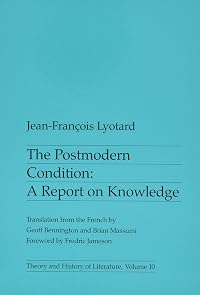
The Postmodern Condition: A Report on Knowledge
by Jean-Francois Lyotard
On This Page
Description
Many definitions of postmodernism focus on its nature as the aftermath of the modern industrial age when technology developed dynamically. In The Postmodern Condition Jean-Francois Lyotard extends that analysis to postmodernism by looking at the status uf science, technology, and the arts, the significance of technocracy, and the way the flow of information and knowledge are controlled in the Western world. Lyotard emphasized language; the world of postmodern knowledge can be represented as show more a game of language where speaking is participation in the game whose goal is the creation of new and ever-changing social linkages. show lessTags
Recommendations




Member Reviews
Well before Big Data there were ominous whispers. That is how I recall this book's bark at my door: fear tinged with the excitement of change Sometime between the collapse of the Wall and the Towers, I was forever fearful of a mis-step. The world was tumultuous and I lacked all grace. I was late to the Theory party. I was blind drunk on my Nietzsche, sort of mumbled through the grotesque parts of Foucault (though it was his biographies that have resonated) with Derrida and the Rhizome Twins (D and G) just too cool for school. Out of that rave this text resonated. It simply asked, theoretically what can we adhere towards, lacking a legitimate metanarrative, we are orphans, without a heritage or metaphysical hope. Of course it was show more stagecraft, we -- readers of Lyotard -- weren't being hunted in streets nor blasted by unmanned weapon platforms. The Postmodern Condition is a placeholder. It works best temporarily. Planned ignoring is suitable strategy after the fact. show less
A short, oddly readable work in which Lyotard argues that the twentieth century has seen an upswing in cynicism that rejects societal ideologies or metanarratives. Postmodernism is a rejection of the notion of universal truths, as there is no "view from nowhere" and every speaker has a bias imprinted upon his or her speech and viewpoints. With this realization comes the breakdown of the "grand narrative" of Western thought.
Oddly, writing this in the 1970s, Lyotard champions the computer as an answer against the potential for nihilism that arises out of postmodernism. It allows for knowledge that is both accessible and decentralized, to allow for local dialogues and a broader range of ideas without imposing the same universal Truth upon show more discussions by affirming only a single, indisputable Knowledge. It's too bad he died in 1998, before the real Internet boom. Maybe he'd have recanted his position after witnessing the localized internet metanarratives like LOLcats and FML :-p show less
Oddly, writing this in the 1970s, Lyotard champions the computer as an answer against the potential for nihilism that arises out of postmodernism. It allows for knowledge that is both accessible and decentralized, to allow for local dialogues and a broader range of ideas without imposing the same universal Truth upon show more discussions by affirming only a single, indisputable Knowledge. It's too bad he died in 1998, before the real Internet boom. Maybe he'd have recanted his position after witnessing the localized internet metanarratives like LOLcats and FML :-p show less
Believe Anything by artist Barbara Kruger
Language games along with technology coloring knowledge and coding messages, anyone? Welcome to The Postmodern Condition by French philosopher Jean-François Lyotard (1924-1998). In the spirit of freshness and as a way of providing what I hope is a unique angle on the philosopher’s abstract theory, below are quotes from the text along with my observations incorporating what I judge to be a near-perfect literary example of Lyotard’s presentation of postmodernism in action: Donald Barthelme’s short story “Game.”
One meaning of postmodern for Lyotard: “The emphasis can also be placed on the increase of being and the jubilation which results from the invention of new rules of the game, be show more it pictorial, artistic or any other.” ---------- The first thing our narrator tells us is how the other man in an underground bunker with him has a set of jacks and rubber ball and refuses to allow him, the narrator, to join in the game. As if a multicolored thread stretched from one end of their bunker to another, the theme of games and game playing runs through the entire story. In the postmodern, all phases of life are touched by gaming.
“The grammar and vocabulary of literary language are no longer accepted as given; rather, they appear as academic forms, as rituals originating in piety (as Nietzsche said) which prevent the unpresentable from being put forward.” ---------- Reading Barthelme we have the distinct impression the author has set aside traditional literary forms and formulas – when Shotwell plays jacks, the narrator begins writing on the walls, writing a series of descriptions of forms occurring within nature, such as a shell, a leaf, a stone and an animal. Writing on the walls - how outrageous and childlike! Writing itself as a light touch undercutting pretentiousness and any claim to literary seriousness. Is our narrator creating in a similar spirit to Barbara Kruger, the artist in the above photo?
“The postmodern would be that which puts forward the unpresentable in presentation itself. ---------- For Jean-François Lyotard, knowledge is power and this very fact is key to what I take him to mean by “the unpresentable.” Our narrator relates a power game he and Shotwell play with pistols, for example, he gives the impression he is watching Shotwell’s .45 but this is simply a ruse, a maneuver since he is actually watching Shotwell’s hand when it dangles within reach of his hidden Beretta. Indirection and maneuvering as a method of undercutting established norms and conventional modes of power.
“The postmodern would be that which denies itself the solace of good forms.” ----------- At one point in the story, the author writes: “When it became clear that an error had been made, that we were not to be relieved, the norms were relaxed. Definitions of normality were redrawn in the agreement of January 1, called by us, "The Agreement.”" One way of reading Barthelme’s short tale is as an exercise in seeing clearly how “an error had been made” in the setting down and establishing fixed rules when it comes to literature and the arts.
“The postmodern would be that which the consensus of taste which would make it possible to share collectively the nostalgia for the unattainable.” ---------- For me, “consensus of taste” brings to mind how in our multimedia world we are all very much influenced by technology. Millions of people across the globe watch the same image from the same broadcast. In the story, a constant presence in their bunker – the console. And that’s ‘console’ as in an unending stream of visual images and audio transmission.
“The postmodern would be that which searches for new presentations, not in order to enjoy them but in order to impart a stronger sense of the unpresentable.” ---------- Key concept here is ‘experiment’ – the arts, writing and the creative process itself as an exercise in experimentation. At one point our narrator reflects how the entire episode of remaining underground with Shotwell all these many days might be nothing other than an experiment. Very fitting for Barthelme’s experimental fiction.
“A postmodern artist or writer is in the position of a philosopher; the text he writes, the work he produces are not in principle governed by preestablished rules, and they cannot be judged according to a determining judgement, by applying familiar categories to the text or to the work.” ---------- A subject the narrator writes about on one of the walls is, of all things, a baseball bat. And his description runs 4500 words! Words, words, words – in our information age, is there anything anywhere not drowning in an entire ocean of words?
“The artist and the writer are working without rules in order to formulate the rules of what will have been done.” ---------- Felling creative? Like author Donald Barthelme and his narrator in this story as fragment (or, perhaps, fragment as story) feel free to make up the rules as you go along,
Jean-François Lyotard show less
Believe Anything by artist Barbara Kruger
Language games along with technology coloring knowledge and coding messages, anyone? Welcome to The Postmodern Condition by French philosopher Jean-François Lyotard (1924-1998). In the spirit of freshness and as a way of providing what I hope is a unique angle on the philosopher’s abstract theory, below are quotes from the text along with my observations incorporating what I judge to be a near-perfect literary example of Lyotard’s presentation of postmodernism in action: Donald Barthelme’s short story “Game.”
One meaning of postmodern for Lyotard: “The emphasis can also be placed on the increase of being and the jubilation which results from the invention of new rules of the game, be show more it pictorial, artistic or any other.” ---------- The first thing our narrator tells us is how the other man in an underground bunker with him has a set of jacks and rubber ball and refuses to allow him, the narrator, to join in the game. As if a multicolored thread stretched from one end of their bunker to another, the theme of games and game playing runs through the entire story. In the postmodern, all phases of life are touched by gaming.
“The grammar and vocabulary of literary language are no longer accepted as given; rather, they appear as academic forms, as rituals originating in piety (as Nietzsche said) which prevent the unpresentable from being put forward.” ---------- Reading Barthelme we have the distinct impression the author has set aside traditional literary forms and formulas – when Shotwell plays jacks, the narrator begins writing on the walls, writing a series of descriptions of forms occurring within nature, such as a shell, a leaf, a stone and an animal. Writing on the walls - how outrageous and childlike! Writing itself as a light touch undercutting pretentiousness and any claim to literary seriousness. Is our narrator creating in a similar spirit to Barbara Kruger, the artist in the above photo?
“The postmodern would be that which puts forward the unpresentable in presentation itself. ---------- For Jean-François Lyotard, knowledge is power and this very fact is key to what I take him to mean by “the unpresentable.” Our narrator relates a power game he and Shotwell play with pistols, for example, he gives the impression he is watching Shotwell’s .45 but this is simply a ruse, a maneuver since he is actually watching Shotwell’s hand when it dangles within reach of his hidden Beretta. Indirection and maneuvering as a method of undercutting established norms and conventional modes of power.
“The postmodern would be that which denies itself the solace of good forms.” ----------- At one point in the story, the author writes: “When it became clear that an error had been made, that we were not to be relieved, the norms were relaxed. Definitions of normality were redrawn in the agreement of January 1, called by us, "The Agreement.”" One way of reading Barthelme’s short tale is as an exercise in seeing clearly how “an error had been made” in the setting down and establishing fixed rules when it comes to literature and the arts.
“The postmodern would be that which the consensus of taste which would make it possible to share collectively the nostalgia for the unattainable.” ---------- For me, “consensus of taste” brings to mind how in our multimedia world we are all very much influenced by technology. Millions of people across the globe watch the same image from the same broadcast. In the story, a constant presence in their bunker – the console. And that’s ‘console’ as in an unending stream of visual images and audio transmission.
“The postmodern would be that which searches for new presentations, not in order to enjoy them but in order to impart a stronger sense of the unpresentable.” ---------- Key concept here is ‘experiment’ – the arts, writing and the creative process itself as an exercise in experimentation. At one point our narrator reflects how the entire episode of remaining underground with Shotwell all these many days might be nothing other than an experiment. Very fitting for Barthelme’s experimental fiction.
“A postmodern artist or writer is in the position of a philosopher; the text he writes, the work he produces are not in principle governed by preestablished rules, and they cannot be judged according to a determining judgement, by applying familiar categories to the text or to the work.” ---------- A subject the narrator writes about on one of the walls is, of all things, a baseball bat. And his description runs 4500 words! Words, words, words – in our information age, is there anything anywhere not drowning in an entire ocean of words?
“The artist and the writer are working without rules in order to formulate the rules of what will have been done.” ---------- Felling creative? Like author Donald Barthelme and his narrator in this story as fragment (or, perhaps, fragment as story) feel free to make up the rules as you go along,
Jean-François Lyotard show less
Many definitions of postmodernism focus on its nature as the aftermath of the modern industrial age when technology developed. This book extends that analysis to postmodernism by looking at the status of science, technology, and the arts, the significance of technocracy, and the way the flow of information is controlled in the Western world.
An important work, and not a bad read either.
pretty easy to understand, just not very good.
Members
- Recently Added By
Lists

Filosofía - Clásicos
217 works; 1 member

Shaykh Hamza's Book Recommendations
439 works; 3 members
Author Information

103+ Works 4,013 Members
The late Jean-Francois Lyotard was Emeritus Professor of Philosophy at the University of Paris-VIII and Professor of Humanities at Emory University
Some Editions
Series
Belongs to Publisher Series
Common Knowledge
- Canonical title
- The Postmodern Condition: A Report on Knowledge
- Original title
- La condition postmoderne: rapport sur le savoir
- Original publication date
- 1979
- Publisher's editor*
- Tulkojumu sērija
- Original language*
- Francés
- Canonical LCC
- BD162.L913
*Some information comes from Common Knowledge in other languages. Click "Edit" for more information.
Classifications
- Genres
- Philosophy, Nonfiction, Literature Studies and Criticism, General Nonfiction
- DDC/MDS
- 001 — Computer science, information & general works Computer science, knowledge & systems Knowledge and learning in general
- LCC
- BD162 .L913 — Philosophy, Psychology and Religion Speculative philosophy Speculative philosophy Epistemology. Theory of knowledge
- BISAC
Statistics
- Members
- 1,823
- Popularity
- 12,001
- Reviews
- 13
- Rating
- (3.70)
- Languages
- 15 — Catalan, Danish, Dutch, English, Finnish, French, German, Greek, Italian, Latvian, Polish, Spanish, Swedish, Turkish, Portuguese (Portugal)
- Media
- Paper
- ISBNs
- 36
- ASINs
- 9