On This Page
Description
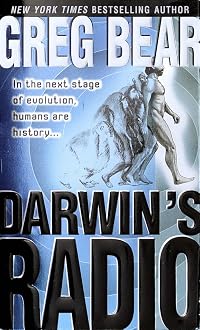
A retrovirus is discovered which provokes miscarriages in women, followed by a second pregnancy without sexual intercourse. As scientists race to unlock its mysteries, fears grow it may herald the end of the human race as we know it.Tags
Recommendations








Member Reviews
Darwin's Radio is the novel most firmly-based on modern science that I've ever read which puts forth a theory on how evolution to man may have occurred. Greg Bear's acknowledgements in the back credit conversations with numerous scientists. I was in molecular biology in grad school, and I was amazed at the advanced level of knowledge shown in this book. How can an author gain such an informed knowledge of such a difficult subject without becoming a molecular biologist himself? But Greg Bear did it, to write this book.
The theory Greg Bear puts forth is not supported as "the truth" by the scientists he talked to, he says; but it is a fascinating supposition, and the scientific details are valid and the theory consistent with knowledge at show more the time of publication.
Besides having my mind opened to a remarkable interpretation of biological science to explain how evolution may occur in leaps and bounds rather than in one tiny incremental change in some one individual at a time, I was amazed at the skill with which the author wove the science into the text so as to allow the characters who live the story to live and breath as very real and sympathetic people. There is no subverting of characterization in the interest of scientific or technological exposition, which is something that commonly turns me off in science fiction. A good book has to be about people under stress with serious problems to solve, and Darwin's Radio is certainly this! I found most of the characters to be written with great imagination and understanding of human nature.
This SF novel is unique in my reading experience in its treatment of current progress in biotechnology as the means to understand the evolution of mankind rather than a poorly understood excuse for all sorts of imagined future physical enhancements. If the book has a drawback - which I have to admit it does - it is that the science is so truly a part of the book that people without any college courses in biology or genetics would probably find it difficult. My brother, an engineer but without the biology background, did. The author added a glossary to the back of the book, but it's probably not enough to make it easy to read. But there's nothing wrong in learning some actual facts while you lose yourself in this fascinating book!
The novel was awarded the Nebula Award for Best Novel after it came out. I found it mind-blowing, and in my opinion this book should be recognized as one of the best ten works of science fiction of all time. show less
The theory Greg Bear puts forth is not supported as "the truth" by the scientists he talked to, he says; but it is a fascinating supposition, and the scientific details are valid and the theory consistent with knowledge at show more the time of publication.
Besides having my mind opened to a remarkable interpretation of biological science to explain how evolution may occur in leaps and bounds rather than in one tiny incremental change in some one individual at a time, I was amazed at the skill with which the author wove the science into the text so as to allow the characters who live the story to live and breath as very real and sympathetic people. There is no subverting of characterization in the interest of scientific or technological exposition, which is something that commonly turns me off in science fiction. A good book has to be about people under stress with serious problems to solve, and Darwin's Radio is certainly this! I found most of the characters to be written with great imagination and understanding of human nature.
This SF novel is unique in my reading experience in its treatment of current progress in biotechnology as the means to understand the evolution of mankind rather than a poorly understood excuse for all sorts of imagined future physical enhancements. If the book has a drawback - which I have to admit it does - it is that the science is so truly a part of the book that people without any college courses in biology or genetics would probably find it difficult. My brother, an engineer but without the biology background, did. The author added a glossary to the back of the book, but it's probably not enough to make it easy to read. But there's nothing wrong in learning some actual facts while you lose yourself in this fascinating book!
The novel was awarded the Nebula Award for Best Novel after it came out. I found it mind-blowing, and in my opinion this book should be recognized as one of the best ten works of science fiction of all time. show less
'Darwin's Radio' is a highly accomplished work of popular fiction, as much a scientifically-orientated political thriller as a conventional science fiction novel. It was published in 1999 as the first volume of a two-volume series when much of the gene science in it was still new and unclear.
The basic premise is the triggering of our own genome's inherent endogenous retroviruses in our 'junk' DNA (or so it is claimed) to effect a somewhat traumatic 'upgrade' of our species which (it is suggested) has happened before - in the transition from the Neanderthal species to Sapiens.
It picks up on theories of punctuated equilibrium, then-recent discoveries about the human genome and a claimed relationship between social stress and speciation. show more Whether Bear's scientific speculation is plausible over two decades later (I suspect it is not) is not really the point.
The point is that Bear gives us a 'what if?' that makes us think about possible human reactions to any sudden species transformation within our own kind triggered by whatever means but especially by something that manifests itself as a public health crisis for which we are not ready. Familiar?
The fact that speciation is caused here through a retrovirus and that the scientific community is not given the time to come to a fully evidence-based view of its societal implications as it spreads rapidly through the population has immediate resonance today.
The film 'Outbreak' came out in 1995 (based on a novel published in 1994) and we had a recapitulation of the theme of mass viral infection in 'Contagion' in 2011 so none of what happened in the last two years should be too much of a surprise.
What Bear does is shift sudden highly transmissable viral infection from being just a disease to becoming something far more transformative. In this case, it directly affects gender relations since males pass it on to females who suffer the most traumatic effects.
Two separate narratives, reaction to a public health crisis and in due course to speciation and 'difference', become overlaid. We see (if not exactly aligned) some of the real world experiences of the last two years played out in imaginative fiction over two decades ago.
Bear is not just good on the science (he is generally good at explaining it without slowing down the narrative although X-Ray on Kindle helps) but on the politics of academic infighting, disease control and ultimately of public order. It is a fine political thriller in that context.
There are no bad guys here but there are good guys unclear about what they are dealing with doing what may be bad things in good faith simply to control the situation. This too is familiar today with governments feeling forced to take drastic actions and sections of the public resisting.
There are, of course, implausible elisions of narrative to get us from A to B (which is how thrillers have to work) but not many - the whole works well within its popular fiction framework. Details of the scientific and politico-administrative narratives should not be discussed here to avoid spoilers
My reaction to the book was that much of what was to happen in society because of COVID-19 may not have been predictable in the detail but was at least partly predictable in general. Our unpreparedness has less excuse if even popular fiction writers can see the trajectories.
The story shifts over time from the public sphere and debate as dominant narrative to the state of affairs for a new family with a new-speciated child. The personal is central to Bear's tale centring on a particular female scientist and her emotional and sexual life.
She has as foil male bureaucrats on one side and a rather hapless male anthropologist on the other who is father of the child. One flaw is that the narrative is rather summarily and unsatisfactorily resolved but it is just the first volume of two so some slack must be cut here.
Bear seems highly sensitive to the woman's perspective in a story built around pregnancy, miscarriages and abortion. He has strong women playing their roles throughout. I cannot judge if he got it right here (I am a man) but it looks impressive from the outside.
He is also good on complexity. I do not just mean the complexities involved in virology, genomics and so forth but also those of politics and society. Although there are some standard thriller tropes, the individuals also stand out as real people attempting to deal with something utterly new.
The one false note is the insertion of a 'dreaming' narrative, not because the indigenous voice (from which it derives) does not have a right to be heard (it does) but because one of the 'scientific' characters appears to dream himself into the Neanderthal past and have it taken seriously.
This adds a note of magical thinking to the science. It suggests some sort of imaginative vitalism in play and even, hidden somewhere back there, a guiding hand so that evolution gets captured for the quasi-Gaia camp far far too easily, unravelling the plausibility elsewhere.
The book is a solid crowd-pleasing entertainment even if it perhaps just misses the chance to dig deeper not into the science (which is well done) but into the societal effects of the transformation ... although perhaps this comes in the second part about which I shall assume nothing here. show less
The basic premise is the triggering of our own genome's inherent endogenous retroviruses in our 'junk' DNA (or so it is claimed) to effect a somewhat traumatic 'upgrade' of our species which (it is suggested) has happened before - in the transition from the Neanderthal species to Sapiens.
It picks up on theories of punctuated equilibrium, then-recent discoveries about the human genome and a claimed relationship between social stress and speciation. show more Whether Bear's scientific speculation is plausible over two decades later (I suspect it is not) is not really the point.
The point is that Bear gives us a 'what if?' that makes us think about possible human reactions to any sudden species transformation within our own kind triggered by whatever means but especially by something that manifests itself as a public health crisis for which we are not ready. Familiar?
The fact that speciation is caused here through a retrovirus and that the scientific community is not given the time to come to a fully evidence-based view of its societal implications as it spreads rapidly through the population has immediate resonance today.
The film 'Outbreak' came out in 1995 (based on a novel published in 1994) and we had a recapitulation of the theme of mass viral infection in 'Contagion' in 2011 so none of what happened in the last two years should be too much of a surprise.
What Bear does is shift sudden highly transmissable viral infection from being just a disease to becoming something far more transformative. In this case, it directly affects gender relations since males pass it on to females who suffer the most traumatic effects.
Two separate narratives, reaction to a public health crisis and in due course to speciation and 'difference', become overlaid. We see (if not exactly aligned) some of the real world experiences of the last two years played out in imaginative fiction over two decades ago.
Bear is not just good on the science (he is generally good at explaining it without slowing down the narrative although X-Ray on Kindle helps) but on the politics of academic infighting, disease control and ultimately of public order. It is a fine political thriller in that context.
There are no bad guys here but there are good guys unclear about what they are dealing with doing what may be bad things in good faith simply to control the situation. This too is familiar today with governments feeling forced to take drastic actions and sections of the public resisting.
There are, of course, implausible elisions of narrative to get us from A to B (which is how thrillers have to work) but not many - the whole works well within its popular fiction framework. Details of the scientific and politico-administrative narratives should not be discussed here to avoid spoilers
My reaction to the book was that much of what was to happen in society because of COVID-19 may not have been predictable in the detail but was at least partly predictable in general. Our unpreparedness has less excuse if even popular fiction writers can see the trajectories.
The story shifts over time from the public sphere and debate as dominant narrative to the state of affairs for a new family with a new-speciated child. The personal is central to Bear's tale centring on a particular female scientist and her emotional and sexual life.
She has as foil male bureaucrats on one side and a rather hapless male anthropologist on the other who is father of the child. One flaw is that the narrative is rather summarily and unsatisfactorily resolved but it is just the first volume of two so some slack must be cut here.
Bear seems highly sensitive to the woman's perspective in a story built around pregnancy, miscarriages and abortion. He has strong women playing their roles throughout. I cannot judge if he got it right here (I am a man) but it looks impressive from the outside.
He is also good on complexity. I do not just mean the complexities involved in virology, genomics and so forth but also those of politics and society. Although there are some standard thriller tropes, the individuals also stand out as real people attempting to deal with something utterly new.
The one false note is the insertion of a 'dreaming' narrative, not because the indigenous voice (from which it derives) does not have a right to be heard (it does) but because one of the 'scientific' characters appears to dream himself into the Neanderthal past and have it taken seriously.
This adds a note of magical thinking to the science. It suggests some sort of imaginative vitalism in play and even, hidden somewhere back there, a guiding hand so that evolution gets captured for the quasi-Gaia camp far far too easily, unravelling the plausibility elsewhere.
The book is a solid crowd-pleasing entertainment even if it perhaps just misses the chance to dig deeper not into the science (which is well done) but into the societal effects of the transformation ... although perhaps this comes in the second part about which I shall assume nothing here. show less
The first time I read this I felt horrified and dazed for weeks. I still consider this a masterpiece of horror/sci-fi. The characters are somewhat memorable, but more memorable is their pain; indeed, the pain of the whole world was felt in the back of my mouth, preparing it rise up from my stomach, up the pipe, out the maw, to hang onto my lip and smack me thrice on my face, wink, and then jump off to slither under the door-jam and horrify someone else.
Don't get me wrong, this is a pure sci-fi novel, but no sci-fi affects me as much as the types that are just as facile in other genres. This one does and gleefully so. I may not know that much about biology, or enough to tear Bear apart, but I followed his arguments and treatment and was show more amazed at the way he pulled a rabbit out of the junk DNA.
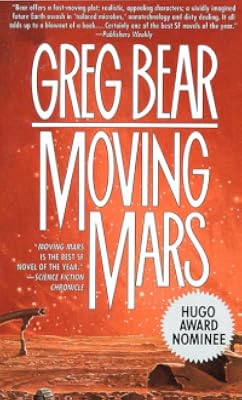
I've been a fan of Greg Bear's work for many years, and I thought I had really loved works like Eon and Legacy, and then I was amazed by Queen of Angels and then I was jumping up and down with Moving Mars. His short story collection of Tangents still makes me sit in awe. Still, all of these books paled in comparison with Darwin's Radio.
I have to say one thing: I cried uncontrollable tears at no less than three times during this novel. I cannot give higher praise. show less
Don't get me wrong, this is a pure sci-fi novel, but no sci-fi affects me as much as the types that are just as facile in other genres. This one does and gleefully so. I may not know that much about biology, or enough to tear Bear apart, but I followed his arguments and treatment and was show more amazed at the way he pulled a rabbit out of the junk DNA.
I've been a fan of Greg Bear's work for many years, and I thought I had really loved works like Eon and Legacy, and then I was amazed by Queen of Angels and then I was jumping up and down with Moving Mars. His short story collection of Tangents still makes me sit in awe. Still, all of these books paled in comparison with Darwin's Radio.
I have to say one thing: I cried uncontrollable tears at no less than three times during this novel. I cannot give higher praise. show less
Fascinerend en goed uitgewerkt: hoe de mensheid geconfronteerd wordt met een evolutionaire sprong binnen de eigen soort en daarop reageert alsof het een pandemie is. Straf hoe Greg Bear de twee kanten van dat verhaal schetst en zowel de politieke, de maatschappelijke en de persoonlijke gevolgen ervan gedegen de revue laat passeren. Geloofwaardige en sterke personages in een heftige en originele context. Puik!
A fast-paced, page-turning sci-fi/medical thriller, with an acknowledged nod to Robin Cook's "Outbreak." However, the interesting (although improbable) scientific ideas in the book lift it above the run-of the-mill bestseller.
An unusual discovery is made - two Neandertal mummies, with a seemingly normal, Homo Sapiens infant. Is the child theirs?
Meanwhile, a new transmissible retrovirus is discovered - although it might seem to be nothing more than a cold, one of its side effects in pregnant women seems to be miscarriage. Mitch - an anthropological archaeologist with a dubious reputation, and Kaye, a rising star in the field of genetics, are brought together by an unexpected correlation between the ancient discovery and the modern virus. show more What seems to be a disease may not be that at all - but a major jump in the evolution of the species show less
An unusual discovery is made - two Neandertal mummies, with a seemingly normal, Homo Sapiens infant. Is the child theirs?
Meanwhile, a new transmissible retrovirus is discovered - although it might seem to be nothing more than a cold, one of its side effects in pregnant women seems to be miscarriage. Mitch - an anthropological archaeologist with a dubious reputation, and Kaye, a rising star in the field of genetics, are brought together by an unexpected correlation between the ancient discovery and the modern virus. show more What seems to be a disease may not be that at all - but a major jump in the evolution of the species show less
Maybe it's just because I'm an evolutionary biologist, but this book stretched my suspension of disbelief to the breaking point. When something unbelievable happens in a science-fiction book, the author can take one of two approaches: either quickly handwave it with technobabble and move on to focus on the consequences of the event, or foreground the explanation based on reasonable extrapolations of current science. The author tried to do the latter, but his "explanation" made all the sense of a handwave.I also found the author's attitudes toward women, particularly the bodily autonomy of women, to be troubling. What happens to the women in this story is a violation of their bodily autonomy: they become pregnant against their wishes. show more Being disgusted and horrified by this pregnancy is a perfectly normal and understandable reaction. However, by the end of the book, the women who are frightened and repulsed by their unwanted pregnancies and the offspring created of same are vilified, while those who embrace pregnancy and motherhood are celebrated. Not to mention that the children produced by these pregnancies, who are supposed to be yay and wonderful and the next step in human evolution, are just plain creepy. show less
Very absorbing, quick read. The characters are convincing, and the main characters are likeable, so you care about what happens to them. Bear does a good job of making some rather abstract science seem very real, and of showing the implications throughout society of such genetic changes.
Members
- Recently Added By
Lists

The Guardian's 1000 Novels Everyone Must Read
1,005 works; 551 members

Best Science Fiction Novels
816 works; 430 members

Unbound Worlds 100 Best SF Books
100 works; 8 members

Nebula Award
111 works; 14 members

Speculative Fiction to Read
706 works; 32 members

Unread books
1,063 works; 87 members

Transhumanism
2 works; 2 members
Author Information

141+ Works 47,236 Members
Greg Bear was born in San Diego, California, on August 20, 1951. He received a Bachelor of Arts degree from San Diego State University in 1973. At age 14, he began submitting pieces to magazines and at 15 he sold his first story to Robert Lowndes' Famous Science Fiction. It would be five years before he sold another piece, but by 23 he was selling show more stories regularly. He has written more than 30 science fiction and fantasy books and has won numerous awards for his work. In 1984, Hardfought and Blood Music won the Nebula Awards for best novella and novelette; Blood Music went on to win the Hugo Award. The novel version of that story, also called Blood Music, won the Prix Apollo in France. In 1987, Tangents won the Hugo and Nebula awards for best short story. He also won a Nebula in 1994 for Moving Mars and in 2001 for Darwin's Radio. Both Dinosaur Summer and Darwin's Radio have been awarded the Endeavour for best novel published by a Northwest science fiction author. He is also an illustrator and his work has appeared in Galaxy, Fantasy and Science Fiction, and Vertex, and in both hardcover and paperback books. He was a founding member of ASFA, the Association of Science Fiction Artists. His works include City at the End of Time, Hull Zero Three, The Mongoliad, Mariposa, Halo: Cryptum, Halo: Primordium and Halo: Silentium. (Bowker Author Biography) show less
Some Editions
Awards and Honors
Awards
Series

Work Relationships
Is contained in
Common Knowledge
- Canonical title*
- La Radio de Darwin
- Original title
- Darwin's Radio
- Original publication date
- 1999-09
- People/Characters
- Mitch Rafelson; Kaye Lang; Christopher Dicken; Mark Augustine; Marge Cross
- Important places
- USA; Tbilisi, Georgia; Alps; Innsbruck, Tyrol, Austria; Seattle, Washington, USA
- Dedication
- For My Mother, Wilma Merriman Bear 1915-1997
- First words
- The flat afternoon sky spread over the black and gray mountains like a stage backdrop, the color of a dog's pale crazy eye.
- Last words
- (Click to show. Warning: May contain spoilers.)"Did we make it again, Mitch?" Stella asked.
- Blurbers
- McCaffrey, Anne
- Original language*
- Inglés
*Some information comes from Common Knowledge in other languages. Click "Edit" for more information.
Classifications
Statistics
- Members
- 3,785
- Popularity
- 4,219
- Reviews
- 89
- Rating
- (3.52)
- Languages
- 10 — Bulgarian, Czech, English, Finnish, French, German, Italian, Polish, Romanian, Spanish
- Media
- Paper, Audiobook, Ebook
- ISBNs
- 35
- ASINs
- 16