On This Page
Description
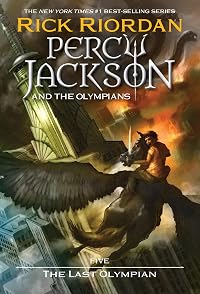
The long-awaited prophecy surrounding Percy Jackson's sixteenth birthday unfolds as he leads an army of young demigods to stop Kronos in his advance on New York City, while the Olympians struggle to contain the rampaging monster, Typhon.Tags
Recommendations





Member Recommendations

Member Reviews
Summary: Demigod Percy Jackson has known about the prophecy - that a child of one of the "big three" Greek gods will make a choice on his sixteenth birthday that will either doom or save Mount Olympus - since he was twelve. Now Percy's a week away from turning sixteen, and the forces of the Titan Kronos are arrayed against the Olympians, and closing in. The demigod campers of Camp Half-Blood have been preparing for this battle all year, but how can a small group of half-mortals hope to stand against the combined forces of the Lord of Time and his allies and monster servants?
Review: I've complained in the past about the previous books in this series being too episodic, so you might think that I'd be thrilled that The Last Olympian is show more much more tightly focused, involving only the battle between the Camp-Half-Blood-ers and the forces of Lord Kronos. And in some ways, I am. But I also felt a little cheated; the book (as is usual) skips over almost a year since the ending of the previous one, but in this case, there was a lot of stuff - preparations and skirmishes, etc. - that happened during that year that would have been interesting to see. Percy also makes a lot of side comments that reference the intervening time without much explanation or elaboration. I can understand why Riordan chose to structure the series as he did, but I do think there's a way to tell a complete and fast-moving story without slam-cutting readers right to the big blowout at the end.
But as for the big blowout itself, it was pretty great. The books in this series have matured as Percy does, and this is not a battle without some serious, permanent, and not-kiddie-stuff consequences. Riordan doesn't linger on the deaths, but he makes sure we feel them, and this book made me sniffly more than once -- pretty good for a series that started out as silly mid-grade fantasy adventure. Of course, the silliness is not gone completely; there are touches of humor throughout (both subtle and more overtly silly), even at some of the darkest moments. And plot-wise, Riordan manages to wrap up all of the threads of his story in a way that was satisfying, yet that I didn't see coming - an impressive feat in a genre that is typically plagued by predictability. All in all, I had a blast with this series, and am looking forward to starting the follow-up books. 4 out of 5 stars.
Recommendation: Don't start at the end, but this series as a whole is great, definitely recommended for fans of mythology, and anyone who is looking for a light, fun, funny read that isn't overly juvenile or completely brainless fluff. show less
Review: I've complained in the past about the previous books in this series being too episodic, so you might think that I'd be thrilled that The Last Olympian is show more much more tightly focused, involving only the battle between the Camp-Half-Blood-ers and the forces of Lord Kronos. And in some ways, I am. But I also felt a little cheated; the book (as is usual) skips over almost a year since the ending of the previous one, but in this case, there was a lot of stuff - preparations and skirmishes, etc. - that happened during that year that would have been interesting to see. Percy also makes a lot of side comments that reference the intervening time without much explanation or elaboration. I can understand why Riordan chose to structure the series as he did, but I do think there's a way to tell a complete and fast-moving story without slam-cutting readers right to the big blowout at the end.
But as for the big blowout itself, it was pretty great. The books in this series have matured as Percy does, and this is not a battle without some serious, permanent, and not-kiddie-stuff consequences. Riordan doesn't linger on the deaths, but he makes sure we feel them, and this book made me sniffly more than once -- pretty good for a series that started out as silly mid-grade fantasy adventure. Of course, the silliness is not gone completely; there are touches of humor throughout (both subtle and more overtly silly), even at some of the darkest moments. And plot-wise, Riordan manages to wrap up all of the threads of his story in a way that was satisfying, yet that I didn't see coming - an impressive feat in a genre that is typically plagued by predictability. All in all, I had a blast with this series, and am looking forward to starting the follow-up books. 4 out of 5 stars.
Recommendation: Don't start at the end, but this series as a whole is great, definitely recommended for fans of mythology, and anyone who is looking for a light, fun, funny read that isn't overly juvenile or completely brainless fluff. show less
Rick Riordan has really outdone himself with this final book in the Percy Jackson series. The war with Kronos has been raging on for a year now, with no signs of stopping. Meanwhile, Percy's birthday, the fateful day of the Great Prophecy, is approaching in less than a week.
This is a very intense, high tension book as the story takes place over several days as Percy and his friends, along with Camp Half-Blood, the Olympians, and their allies fight it out with Kronos's army in New York City. The action is non-stop as it looks like there is no end to the advance of Kronos's legion of evil, with battles upon battles and crises upon crises. While the narrative still contains Riordan's trademark humour, the chipper mood of the series has show more been mostly left behind in favour of something much more serious. And I think this is what makes this last book of the series better than the previous ones. Riordan doesn't shy away from writing about some truly heartbreaking developments in the story, and our heroes face some really difficult and emotional situations. You realize that Percy and his friends have really grown up over the course of the series, even if the tone of Riordan's first person narration hasn't seemed to have changed much since the first book. The way Riordan also dealt with all of the parent-child relationships, involving both human parents and divine parents, was masterfully done. I really enjoyed the scenes between Percy and his Olympian father as well as his relationship with Paul, his mother's new husband.
I enjoyed seeing the full cast of the series's characters being used in this book as many of the characters who've made brief appearances previously all show up and some even take on significant roles. Some antagonistic or less-friendly relationships between characters are resolved as well. I pretty much expected that all the characters would come together in this last stand for Olympus, but it didn't make the book any less enjoyable for its predictability.
The ending was a little weak-- I didn't quite understand why certain characters made certain decisions and I personally wouldn't have minded a darker conclusion-- but overall it was fitting for a children's series. This was a really fun and compulsive read-- I had so much trouble putting the book down. But all the action aside, it was really the surprising amount of emotional depth that made the book so strong. The situations the characters found themselves in pushed them to grow, and I thought Riordan had a good handle on how teenagers think and feel. I thought the writing was stronger too, compared to previous books. I felt like Riordan put a lot of care into crafting this book-- not a single word felt extraneous. show less
This is a very intense, high tension book as the story takes place over several days as Percy and his friends, along with Camp Half-Blood, the Olympians, and their allies fight it out with Kronos's army in New York City. The action is non-stop as it looks like there is no end to the advance of Kronos's legion of evil, with battles upon battles and crises upon crises. While the narrative still contains Riordan's trademark humour, the chipper mood of the series has show more been mostly left behind in favour of something much more serious. And I think this is what makes this last book of the series better than the previous ones. Riordan doesn't shy away from writing about some truly heartbreaking developments in the story, and our heroes face some really difficult and emotional situations. You realize that Percy and his friends have really grown up over the course of the series, even if the tone of Riordan's first person narration hasn't seemed to have changed much since the first book. The way Riordan also dealt with all of the parent-child relationships, involving both human parents and divine parents, was masterfully done. I really enjoyed the scenes between Percy and his Olympian father as well as his relationship with Paul, his mother's new husband.
I enjoyed seeing the full cast of the series's characters being used in this book as many of the characters who've made brief appearances previously all show up and some even take on significant roles. Some antagonistic or less-friendly relationships between characters are resolved as well. I pretty much expected that all the characters would come together in this last stand for Olympus, but it didn't make the book any less enjoyable for its predictability.
The ending was a little weak-- I didn't quite understand why certain characters made certain decisions and I personally wouldn't have minded a darker conclusion-- but overall it was fitting for a children's series. This was a really fun and compulsive read-- I had so much trouble putting the book down. But all the action aside, it was really the surprising amount of emotional depth that made the book so strong. The situations the characters found themselves in pushed them to grow, and I thought Riordan had a good handle on how teenagers think and feel. I thought the writing was stronger too, compared to previous books. I felt like Riordan put a lot of care into crafting this book-- not a single word felt extraneous. show less
As one might expect, all of the hanging plot threads, character issues, and conflicts left over from the previous books featuring Percy Jackson all culminate in The Last Olympian the final volume of the Percy Jackson & the Olympians series. While many series experience something of a let down in their final act, as the author struggles to bring his carefully laid plots to a satisfying conclusion, happily The Last Olympian avoids this problem and finishes off this excellent young adult series with a strong story and in a manner that is both unpredictable and yet fully in character for all the participants.
Following the attack on Camp Half-Blood in The Battle of the Labyrinth, Kronos had retired to rally his forces, but also set various show more plans in motion. After an awkward interlude with plot complication Rachel Dare, the book opens with Percy, along with the demigod Beckendorf (a child of Hephaestus), heading off to try to destroy Kronos' cruise ship of the damned and weaken the forces of the Titans. Although the series has had its share of lethal consequences before - Bianca di Angelo's death, Daedalus' death, and so on - the book signals that things will be getting rough for the final act when Beckendorf meets his end a scant handful of pages into the story.
And the action only accelerates from there. With most of the Olympian gods away to fight the released monster Typhon, and Poseidon defending his undersea kingdom from the forces of the titan Oceanus, Percy and the other inhabitants of Camp Half-Blood are called upon to defend Mount Olympus itself (actually, Manhattan) from Kornos' main forces, including a variety of monsters, disaffected demigods, and several titans (including Prometheus). The demigods are aided by various allied creatures, such as the Party Ponies, the Hunters of Artemis, and various nature spirits, but they are wildly outnumbered. Their position is made even more untenable with the revelation that there is a spy among the supposedly loyal demigods of Camp Half-Blood, and the fact that the entire Ares contingent refuses to fight as a result of feeling snubbed.
Which brings up one of the interesting questions that is more or less unanswered in the book, namely why would anyone remain loyal to the Olympian gods? Riordan presents them in a modern context, with their attributes given a contemporary twist, but keeps them by and large true to their mythologicaly established personalities. And to the modern eye, the mythological personalities of the Olympian gods are fairly distasteful. They are petty, childish, mostly uncaring of the harm they might cause, and generally indifferent to anything that is not of immediate interest. In this context, and with the additional character background provided in this volume, not only does Luke's turn against the Olympian gods become understandable, one begins to wonder why those who are loyal have remained so. In short, the disaffected demigods and minor gods seem to have a much better basis for choosing Kronos' side than the demigods have for choosing to side with Zeus. Interestingly, Prometheus also turns against the gods in this go round (having supported the Olympian gods in the first Titanomachy), which for those who understand the myth centered on him, seems unsurprising, and is yet another example of the arbitrary and cruel nature of the Olympian gods. But the interesting element here is that the character of Prometheus, who the myths say brought man learning and knowledge, is much more in line with what one would describe as Western civilization than the traditional Olympian gods. Given that Mount Olympus is supposed to be located in the "Heart of the West, and the power of the Olympian gods is supposed to underpin Western civilization, this is an interesting (and probably unintentional) contradiction.
Philosophical contradictions aside, the meat of the book is in the fight for control of Manhattan. And the action in the fight comes fast and furious. Just about every character that has entered the story before gets a chance to shine in the fight, even a couple characters that in previous books died get a nod here, notably Daedalus whose creations Annabeth is able to turn to the side of the demigods in a sequence that adds some much needed levity to the otherwise fairly dark story. As noted elsewhere, the demigods in the Percy Jackson series display a level of power that seems more in line with comic book superheroes than the demigods of Greek legend, a fact which comes in to play in the battle. Ramping up the powers of the demigods is probably the only thing that makes the battle even plausible, as one would expect that Jason, Achilles, and Theseus, a heroic as they are in their myths, would have a hard time standing against one or two monsters, let alone the hundreds that swarm Manhattan's defenders in this story. After many twists and turns, eventually everything leads up to a big showdown with Kronos, and the prophecy that had been hanging over most of the series must finally be fulfilled, and it is, although not in the way that one might expect. In the end, it falls to Percy to convince his father to choose the strategic option though it costs him a tactical defeat. Percy must also rectify the troubles caused by the Olympians own personalities by compelling the Olympians to behave in a more civilized manner than they have in the past. One might question whether a sixteen year old boy, even one who has experienced the incredible highs and lows that Percy Jackson has, could have anything to say that divine beings would need to hear. But since Riordan has kept the capricious and almost cruel nature of the Olympian gods intact as part of his fantasy milieu, the lecture Percy delivers at the close of the second Titanomachy seems to fit the story perfectly and caps off the story with a strong finish.
Overall, this is a strong finish to a very good young adult fantasy series. Despite the generally upbeat ending, Riordan weaves in a fair amount of sadness, as many of the heroic characters who have populated this fantasy world fall in the fight to save Olympus from destruction, and others find themselves at the end of their road having won, but having to face their own disappointments. The very final pages resolve the romantic conundrum of the series, but also serve as a potential springboard for a follow-up series, as the newly installed Oracle announces a new prohpecy. But with only that hanging thread left, the story othewise runs to a very satisfying conclusion and serves as an excellent final act to a fun and engaging series of books.
This review has also been posted to my blog Dreaming About Other Worlds. show less
Following the attack on Camp Half-Blood in The Battle of the Labyrinth, Kronos had retired to rally his forces, but also set various show more plans in motion. After an awkward interlude with plot complication Rachel Dare, the book opens with Percy, along with the demigod Beckendorf (a child of Hephaestus), heading off to try to destroy Kronos' cruise ship of the damned and weaken the forces of the Titans. Although the series has had its share of lethal consequences before - Bianca di Angelo's death, Daedalus' death, and so on - the book signals that things will be getting rough for the final act when Beckendorf meets his end a scant handful of pages into the story.
And the action only accelerates from there. With most of the Olympian gods away to fight the released monster Typhon, and Poseidon defending his undersea kingdom from the forces of the titan Oceanus, Percy and the other inhabitants of Camp Half-Blood are called upon to defend Mount Olympus itself (actually, Manhattan) from Kornos' main forces, including a variety of monsters, disaffected demigods, and several titans (including Prometheus). The demigods are aided by various allied creatures, such as the Party Ponies, the Hunters of Artemis, and various nature spirits, but they are wildly outnumbered. Their position is made even more untenable with the revelation that there is a spy among the supposedly loyal demigods of Camp Half-Blood, and the fact that the entire Ares contingent refuses to fight as a result of feeling snubbed.
Which brings up one of the interesting questions that is more or less unanswered in the book, namely why would anyone remain loyal to the Olympian gods? Riordan presents them in a modern context, with their attributes given a contemporary twist, but keeps them by and large true to their mythologicaly established personalities. And to the modern eye, the mythological personalities of the Olympian gods are fairly distasteful. They are petty, childish, mostly uncaring of the harm they might cause, and generally indifferent to anything that is not of immediate interest. In this context, and with the additional character background provided in this volume, not only does Luke's turn against the Olympian gods become understandable, one begins to wonder why those who are loyal have remained so. In short, the disaffected demigods and minor gods seem to have a much better basis for choosing Kronos' side than the demigods have for choosing to side with Zeus. Interestingly, Prometheus also turns against the gods in this go round (having supported the Olympian gods in the first Titanomachy), which for those who understand the myth centered on him, seems unsurprising, and is yet another example of the arbitrary and cruel nature of the Olympian gods. But the interesting element here is that the character of Prometheus, who the myths say brought man learning and knowledge, is much more in line with what one would describe as Western civilization than the traditional Olympian gods. Given that Mount Olympus is supposed to be located in the "Heart of the West, and the power of the Olympian gods is supposed to underpin Western civilization, this is an interesting (and probably unintentional) contradiction.
Philosophical contradictions aside, the meat of the book is in the fight for control of Manhattan. And the action in the fight comes fast and furious. Just about every character that has entered the story before gets a chance to shine in the fight, even a couple characters that in previous books died get a nod here, notably Daedalus whose creations Annabeth is able to turn to the side of the demigods in a sequence that adds some much needed levity to the otherwise fairly dark story. As noted elsewhere, the demigods in the Percy Jackson series display a level of power that seems more in line with comic book superheroes than the demigods of Greek legend, a fact which comes in to play in the battle. Ramping up the powers of the demigods is probably the only thing that makes the battle even plausible, as one would expect that Jason, Achilles, and Theseus, a heroic as they are in their myths, would have a hard time standing against one or two monsters, let alone the hundreds that swarm Manhattan's defenders in this story. After many twists and turns, eventually everything leads up to a big showdown with Kronos, and the prophecy that had been hanging over most of the series must finally be fulfilled, and it is, although not in the way that one might expect. In the end, it falls to Percy to convince his father to choose the strategic option though it costs him a tactical defeat. Percy must also rectify the troubles caused by the Olympians own personalities by compelling the Olympians to behave in a more civilized manner than they have in the past. One might question whether a sixteen year old boy, even one who has experienced the incredible highs and lows that Percy Jackson has, could have anything to say that divine beings would need to hear. But since Riordan has kept the capricious and almost cruel nature of the Olympian gods intact as part of his fantasy milieu, the lecture Percy delivers at the close of the second Titanomachy seems to fit the story perfectly and caps off the story with a strong finish.
Overall, this is a strong finish to a very good young adult fantasy series. Despite the generally upbeat ending, Riordan weaves in a fair amount of sadness, as many of the heroic characters who have populated this fantasy world fall in the fight to save Olympus from destruction, and others find themselves at the end of their road having won, but having to face their own disappointments. The very final pages resolve the romantic conundrum of the series, but also serve as a potential springboard for a follow-up series, as the newly installed Oracle announces a new prohpecy. But with only that hanging thread left, the story othewise runs to a very satisfying conclusion and serves as an excellent final act to a fun and engaging series of books.
This review has also been posted to my blog Dreaming About Other Worlds. show less
The final novel in the Percy Jackson and the Olympians series by Rick Riordan, THE LAST OLYMPIAN, is everything a final novel should be. There is no build-up because Mr. Riordan took care of that in the first four books. Neither does he make readers wait for the promised battle. He doesn't add any last-minute characters. Instead, we have nonstop action and the unveiling of long-held secrets.
Even better, Percy finally shows some of the maturity I would expect to see from a teenager who was forced to grow up at a young age. He is clever with his battle tactics, compassionate where necessary but brutal when needed. After feeling like Percy sounded too young and naive in books three and four given his experiences, it is a treat to get a show more glimpse of what Percy would be like as an adult.
I'll also say that even though I wasn't a huge Percy and Annabeth fan, the ending of THE LAST OLYMPIAN was adorable. Mr. Riordan handled the awkwardness and Percy's nervousness with delicacy and just a slight touch of humor. I imagine there was more than one child who used those scenes as motivation for their own awkward romantic encounters.
There is no doubt that THE LAST OLYMPIAN is the best book in the series. It contains within its pages everything I was hoping to see in previous books culminating in the battle for Olympus. I thought the battle scenes to be well-written, detailed without being graphic, and touching on fallen comrades and foes with the appropriate level of gravitas. While Mr. Riordan sets up the next series with a well-timed prophecy, I consider my time with Percy Jackson and friends at an end, with a final book that provides enough closure to satisfy me. show less
Even better, Percy finally shows some of the maturity I would expect to see from a teenager who was forced to grow up at a young age. He is clever with his battle tactics, compassionate where necessary but brutal when needed. After feeling like Percy sounded too young and naive in books three and four given his experiences, it is a treat to get a show more glimpse of what Percy would be like as an adult.
I'll also say that even though I wasn't a huge Percy and Annabeth fan, the ending of THE LAST OLYMPIAN was adorable. Mr. Riordan handled the awkwardness and Percy's nervousness with delicacy and just a slight touch of humor. I imagine there was more than one child who used those scenes as motivation for their own awkward romantic encounters.
There is no doubt that THE LAST OLYMPIAN is the best book in the series. It contains within its pages everything I was hoping to see in previous books culminating in the battle for Olympus. I thought the battle scenes to be well-written, detailed without being graphic, and touching on fallen comrades and foes with the appropriate level of gravitas. While Mr. Riordan sets up the next series with a well-timed prophecy, I consider my time with Percy Jackson and friends at an end, with a final book that provides enough closure to satisfy me. show less
The last installment to the terrific, humorous, fast-paced and generally just awesome Percy Jackson series. Great books always end so fast! *Sniff. Sniff.*
By far, this is my favorite among all the 5 books. I really loved the interaction between May Castellan, Nico and Percy - you'll keep pitying her. The small gradual revelation of Luke's past was also wonderfully written. We could finally see the root of Luke's hatred towards the gods, and he was like the typical villan with a dark past who could have once been saved. Well he was 'saved' in the end. Sacrificing himself and being the real hero in the end to destroy Kronos was a rather unexpected twist in what we had expected.
This book - or in fact, the entire series - are the only ones show more that would make me reread and reread them over and over. I've read this about 5 or 6 times maybe. (:
The Last Olympian was also as humorous as the previous books; it's small jokes and Percy's -slightly weird - thoughts making us all laugh out loud. Finally, the surviving hero decides to give up immortality in return of a small request that greatly benefitted the rest of the demigods, and to be with his friends and soon-to-be girlfriend.
Then at the end of the book, when we all think it's over, the world's safe, another twist occurs - Rachel becomes the new Oracle and the demigods were given a new prophecy that basically tells us fans that there would be another series. (:
And I love Rick Riordan for that. :D show less
By far, this is my favorite among all the 5 books. I really loved the interaction between May Castellan, Nico and Percy - you'll keep pitying her. The small gradual revelation of Luke's past was also wonderfully written. We could finally see the root of Luke's hatred towards the gods, and he was like the typical villan with a dark past who could have once been saved. Well he was 'saved' in the end. Sacrificing himself and being the real hero in the end to destroy Kronos was a rather unexpected twist in what we had expected.
This book - or in fact, the entire series - are the only ones show more that would make me reread and reread them over and over. I've read this about 5 or 6 times maybe. (:
The Last Olympian was also as humorous as the previous books; it's small jokes and Percy's -slightly weird - thoughts making us all laugh out loud. Finally, the surviving hero decides to give up immortality in return of a small request that greatly benefitted the rest of the demigods, and to be with his friends and soon-to-be girlfriend.
Then at the end of the book, when we all think it's over, the world's safe, another twist occurs - Rachel becomes the new Oracle and the demigods were given a new prophecy that basically tells us fans that there would be another series. (:
And I love Rick Riordan for that. :D show less
Okay, funny thing: when I re-read "Percy Jackson and the Battle of the Labyrinth" a few days ago, I was practically certain it was my favorite of the entire series. However, after re-reading the final entry in this series, I'm not so sure anymore. Yeah, I can't believe I'm saying this, but the highest-rated Percy Jackson actually surprised me. Why is that, you ask? Well, it's because I didn't like this book as much as I do now when I read it the first two times. I thought it was pretty good, but I didn't like it as much as books 3 or 4. [return][return]So, what changed? Well, my absolute favorite thing about this book is how grounded and emotional it is. While I love this series for how fun and light-hearted it is, a lot of the times I show more felt like it was a bit too fun. It felt like a lot of Marvel movies that were great to watch but didn't have that emotional core that could make a truly a great movie. Thankfully, the final entry does a fantastic job giving the series a much-need emotional pay off. Even though this book is almost 400 pages long, more than half of it is dedicated to the final battle in Manhattan. However, that's not just because the battle is long and difficult, but it's also due to the fact that a LOT of time is spent in dreams, visions, conversations, and thoughts, all of which pack a lot of emotional punch. The themes of love, sacrifice, and hope are extremely prevalent here. I was surprised by how much this book touched me. I thought I would get really bored having to read almost 200 pages to get through the final battle, but it actually gave me a lot to think about and left me craving more. Bravo.[return][return]The battle itself is great as well. One thing I didn't like about the final Harry Potter book was that the final battle felt like it happened a little too quickly, at least when compared to the size of the whole series. This battle, however, takes its sweet ass time. There are multiple assaults by Kronos and his army, and there are multiple breaks and retreats. Just when you think the battle may be won due to the arrival of some last-minute saviors (The Party Ponies, Ares's cabin, The House of Hades), the fight continues and gets even more intense. It felt like a true war. I loved it.[return][return]Even the last 40 pages of the book after the battle ended were great. Rick Riordan tied off all loose ends. No stones were left unturned. Every character in the franchise got a satisfying send-off. It was extremely gratifying. I say this because I dislike how abruptly things end in "Harry Potter and the Deathly Hallows". That book feels like it needs another 20 or 30 pages to do the same thing this book does.[return][return]I don't really have much to say about Luke's arc in this book because everyone knows how great it is and how it gives this series such an emotional conclusion. I'll only add that I love how much time is dedicated to learning about Luke's past and his family. It makes his final sacrifice to defeat Kronos feel so much more climactic and epic. The final stand-off in the palace of the gods is a truly a remarkable ending to an incredible battle. [return][return]I don't really have much that I dislike about this book. My problems here are pretty much the same as my problems with the previous entries [silliness that went a bit too far (Kronos disappearing under a big blue butt. Really?), and love triangles that make want to rip my hairs out]. Yeah, I love this book, and I will say that, right now, it is tied with "Percy Jackson and the Battle of the Labyrinth" as my favorite book in the series, thought that may change in the future. show less
Okay, funny thing: when I re-read "Percy Jackson and the Battle of the Labyrinth" a few days ago, I was practically certain it was my favorite of the entire series. However, after re-reading the final entry in this series, I'm not so sure anymore. Yeah, I can't believe I'm saying this, but the highest-rated Percy Jackson actually surprised me. Why is that, you ask? Well, it's because I didn't like this book as much as I do now when I read it the first two times. I thought it was pretty good, but I didn't like it as much as books 3 or 4.
So, what changed? Well, my absolute favorite thing about this book is how grounded and emotional it is. While I love this series for how fun and light-hearted it is, a lot of the times I felt like it was show more a bit too fun. It felt like a lot of Marvel movies that were great to watch but didn't have that emotional core that could make a truly a great movie. Thankfully, the final entry does a fantastic job giving the series a much-need emotional pay off. Even though this book is almost 400 pages long, more than half of it is dedicated to the final battle in Manhattan. However, that's not just because the battle is long and difficult, but it's also due to the fact that a LOT of time is spent in dreams, visions, conversations, and thoughts, all of which pack a lot of emotional punch. The themes of love, sacrifice, and hope are extremely prevalent here. I was surprised by how much this book touched me. I thought I would get really bored having to read almost 200 pages to get through the final battle, but it actually gave me a lot to think about and left me craving more. Bravo.
The battle itself is great as well. One thing I didn't like about the final Harry Potter book was that the final battle felt like it happened a little too quickly, at least when compared to the size of the whole series. This battle, however, takes its sweet ass time. There are multiple assaults by Kronos and his army, and there are multiple breaks and retreats. Just when you think the battle may be won due to the arrival of some last-minute saviors (The Party Ponies, Ares's cabin, The House of Hades), the fight continues and gets even more intense. It felt like a true war. I loved it.
Even the last 40 pages of the book after the battle ended were great. Rick Riordan tied off all loose ends. No stones were left unturned. Every character in the franchise got a satisfying send-off. It was extremely gratifying. I say this because I dislike how abruptly things end in "Harry Potter and the Deathly Hallows". That book feels like it needs another 20 or 30 pages to do the same thing this book does.
I don't really have much to say about Luke's arc in this book because everyone knows how great it is and how it gives this series such an emotional conclusion. I'll only add that I love how much time is dedicated to learning about Luke's past and his family. It makes his final sacrifice to defeat Kronos feel so much more climactic and epic. The final stand-off in the palace of the gods is a truly a remarkable ending to an incredible battle.
I don't really have much that I dislike about this book. My problems here are pretty much the same as my problems with the previous entries [silliness that went a bit too far (Kronos disappearing under a big blue butt. Really?), and love triangles that make want to rip my hairs out]. Yeah, I love this book, and I will say that, right now, it is tied with "Percy Jackson and the Battle of the Labyrinth" as my favorite book in the series, thought that may change in the future. show less
So, what changed? Well, my absolute favorite thing about this book is how grounded and emotional it is. While I love this series for how fun and light-hearted it is, a lot of the times I felt like it was show more a bit too fun. It felt like a lot of Marvel movies that were great to watch but didn't have that emotional core that could make a truly a great movie. Thankfully, the final entry does a fantastic job giving the series a much-need emotional pay off. Even though this book is almost 400 pages long, more than half of it is dedicated to the final battle in Manhattan. However, that's not just because the battle is long and difficult, but it's also due to the fact that a LOT of time is spent in dreams, visions, conversations, and thoughts, all of which pack a lot of emotional punch. The themes of love, sacrifice, and hope are extremely prevalent here. I was surprised by how much this book touched me. I thought I would get really bored having to read almost 200 pages to get through the final battle, but it actually gave me a lot to think about and left me craving more. Bravo.
The battle itself is great as well. One thing I didn't like about the final Harry Potter book was that the final battle felt like it happened a little too quickly, at least when compared to the size of the whole series. This battle, however, takes its sweet ass time. There are multiple assaults by Kronos and his army, and there are multiple breaks and retreats. Just when you think the battle may be won due to the arrival of some last-minute saviors (The Party Ponies, Ares's cabin, The House of Hades), the fight continues and gets even more intense. It felt like a true war. I loved it.
Even the last 40 pages of the book after the battle ended were great. Rick Riordan tied off all loose ends. No stones were left unturned. Every character in the franchise got a satisfying send-off. It was extremely gratifying. I say this because I dislike how abruptly things end in "Harry Potter and the Deathly Hallows". That book feels like it needs another 20 or 30 pages to do the same thing this book does.
I don't really have much to say about Luke's arc in this book because everyone knows how great it is and how it gives this series such an emotional conclusion. I'll only add that I love how much time is dedicated to learning about Luke's past and his family. It makes his final sacrifice to defeat Kronos feel so much more climactic and epic. The final stand-off in the palace of the gods is a truly a remarkable ending to an incredible battle.
I don't really have much that I dislike about this book. My problems here are pretty much the same as my problems with the previous entries [silliness that went a bit too far (Kronos disappearing under a big blue butt. Really?), and love triangles that make want to rip my hairs out]. Yeah, I love this book, and I will say that, right now, it is tied with "Percy Jackson and the Battle of the Labyrinth" as my favorite book in the series, thought that may change in the future. show less
Members
- Recently Added By
Published Reviews
ThingScore 75
The action, never leisurely in any of the five books in the series, runs at a frantic pace here — monsters pop out with a rapidity that becomes almost predictable, except that they are so enjoyably hair-raising, and that Riordan has such clever ways of dispatching them.
added by Shortride
Lists

NPRs Ultimate Backseat Bookshelf: 100 Must-Reads for kids 9-14
222 works; 30 members

Wish List
3 works; 1 member

Best Friendship Stories
205 works; 16 members

Most popular YA Fiction in Charles City
25 works; 1 member

Best books I read in 2013
152 works; 3 members

Books Read in 2023
5,547 works; 145 members

Elaina's
183 works; 1 member

Favorite Books of All Time Ranked
8 works; 1 member

Read in 2023
44 works; 1 member

Overdue Podcast
806 works; 9 members

4th Grade Books
312 works; 5 members
Favorite Books of All Time Ranked
8 works; 1 member

SYES Library Wishlist
1,080 works; 4 members

Books Read in 2018
4,360 works; 110 members

Books Read in 2012
816 works; 34 members

Books on my Kindle
162 works; 3 members

Puffin Books 70th anniversary handbook recommendations
537 works; 10 members

Kindle Action/Adventure - Junior and Teenage Re-Read
247 works; 1 member
Talk Discussions
Past Discussions
The Last Olympian - spoilers! in Hogwarts Express (January 2010)
Author Information

253+ Works 337,271 Members
Rick Riordan was born on June 5, 1964, in San Antonio, Texas. After graduating from the University of Texas at Austin with a double major in English and history, he taught in public and private middle schools for many years. He writes several children's series including Percy Jackson and the Olympians, The Kane Chronicles, and The Heroes of show more Olympus, Magnus Chase and the Gods of Asgard, and The Trials of Apollo. He also writes the Tres Navarre mystery series for adults. He has won Edgar, Anthony, and Shamus Awards for his mystery novels. . (Bowker Author Biography) show less
Some Editions
Awards and Honors
Awards
Series

Work Relationships
Common Knowledge
- Canonical title
- The Last Olympian
- Original title
- The Last Olympian
- Alternate titles
- Percy Jackson and the Olympians
- Original publication date
- 2009-12-06
- People/Characters
- Percy Jackson; Annabeth Chase; Rachel Elizabeth Dare; Grover Underwood; Nico di Angelo; Clarisse La Rue (show all 96); Chris Rodriguez; Luke Castellan; Ethan Nakamura; Thalia Grace; Tyson; Poseidon; Hades; Persephone; Demeter; Zeus; Ares; Hestia; Chiron; Dionysus; Kronos; Prometheus; Hera; Artemis; Athena; Blackjack (Pegasus); Charles Beckendorf; Krios; Oceanus; Typhon; Mrs. O'Leary; Leneus; Sally Jackson; Paul 'Blowfish' Blofis; Morpheus; Alecto; Furies; Achilles; Minotaur; Silena Beauregard; Maria di Angelo; Bianca di Angelo; May Castellan; The Oracle; The Fates; Rainbow (hippocampus); Apollo; Atlas; Delphin; Amphitrite; Triton; Briares; Connor Stoll; Travis Stoll; Peleus; Pollux; Katie Gardner; Jake Mason; Juniper; Gleeson Hedge; Cerberus; Mrs. Dodds; Argus; Bessie (Ophiotaurus); George; Martha; Aeolus; Kayla Knowles; Austin Lake; Pompona; Will Solace; Elpis (Hope); Morrain; Queen Sess; Hyperion; Clazmonian Sow; Larry; Owen; Guido; Lydian drakon; Michael Yew; Iris; W. Dare (Rachel's father); Malcolm Pace; Tisiphone (a Fury); Megaera (A Fury); Porkpie (pegasus); Mrs. Dare; Hermes; East; Hudson; Aphrodite; Clotho; Lachesis; Atropos; Hephaestus
- Important places
- New York, New York, USA; Mount Olympus; Princess Andromeda; Mount Tamalpais, California, USA; Mount Othrys; Poseidon's Palace (show all 13); The Underworld; Westport, Connecticut, USA; Camp Half-Blood; Manhattan, New York, New York, USA; Empire State Building, New York, New York, USA; Central Park, New York, New York, USA; Plaza Hotel, New York, New York, USA
- Important events
- Second Titan War; Battle of Manhattan
- Dedication
- To Mrs. Pabst, my eighth grade English teacher, who started me on my journey as a writer.
- First words
- The end of the world started when a pegasus landed on the hood of my car.
- Quotations
- "The world will fall, the gods will die, and I will never achieve a perfect score on this stupid machine." (Dionysus)
- Last words
- (Click to show. Warning: May contain spoilers.)For once, I didn't look back.
- Original language
- English
- Canonical DDC/MDS
- 813.6
- Canonical LCC
- PZ7.R4829
- Disambiguation notice*
- Das LT ist die fünfte (und letzte) Band in Rick Riordan Serie, Percy Jackson and the Olympians. Bitte nicht in Kombination mit einem anderen einzelnen Titel oder Sammlung von Titeln aus der Reihe. Danke.
*Some information comes from Common Knowledge in other languages. Click "Edit" for more information.
Classifications
Statistics
- Members
- 24,905
- Popularity
- 191
- Reviews
- 414
- Rating
- (4.36)
- Languages
- 20 — Catalan, Chinese, Danish, Dutch, English, Estonian, Finnish, French, German, Hungarian, Indonesian, Italian, Japanese, Korean, Polish, Portuguese, Russian, Spanish, Swedish, Turkish
- Media
- Paper, Audiobook, Ebook
- ISBNs
- 119
- ASINs
- 60